Can You Access Super at 55? A Practical Australian Guide

Most Australians aged 55 cannot simply withdraw their superannuation on demand. Whether you can access super at 55 depends on two things: your preservation age and whether you have met a recognized condition of release under Australian super law.
Here is the short version. If you were born before July 1, 1960, your preservation age is 55, and you may be able to access your super if you have permanently retired. If you were born after that date, your preservation age is higher, up to 60 for anyone born on or after July 1, 1964. Early access outside these rules is tightly restricted.
Quick actions to take right now:
- Check your preservation age using the ATO’s conditions of release table
- Contact your super fund to confirm what conditions apply to your account
- Model the impact on your Age Pension eligibility before making any withdrawal decision
- Consult ASIC’s MoneySmart and Services Australia for rules on means testing
Key Takeaways
Accessing super at 55 is possible for some Australians, but it depends entirely on your preservation age, your condition of release, and the long-term trade-offs you model before acting.
| Point | Details |
|---|---|
| Preservation age varies by birth date | Only those born before July 1, 1960 have a preservation age of 55; most others must wait until 60. |
| Condition of release is required | Reaching preservation age alone is not enough — permanent retirement or another recognized ground must also be met. |
| Early access is tightly restricted | Outside preservation-age rules, only specific grounds (hardship, compassionate, medical) allow access, each with strict evidence requirements. |
| Tax and pension impacts are real | Withdrawals before 60 may attract tax; early drawdowns can also affect Age Pension means-test outcomes at 67. |
| Aerowealth models the full picture | Aerowealth’s bridge-year and TRIS scenario tools let you compare “access now” vs. “wait” across retirement income and Age Pension projections. |
Table of Contents
- What preservation age actually means for you
- Legitimate routes to access super early
- How a transition-to-retirement income stream works
- Tax and Age Pension trade-offs of withdrawing early
- Checklist before you decide to access your super
- Why you should model before you act
- How to request access from your super fund
- The case for modelling before you commit
- Model your access-at-55 decision with Aerowealth
- Sources
- FAQ
What preservation age actually means for you
Your preservation age is the minimum age at which you can normally access your preserved super benefits. It is set by your date of birth, and it is not the same as the Age Pension age (currently 67 for most Australians).
Preservation age by date of birth (ATO):
- Born before July 1, 1960: preservation age is 55
- Born July 1, 1960 – June 30, 1961: preservation age is 56
- Born July 1, 1961 – June 30, 1962: preservation age is 57
- Born July 1, 1962 – June 30, 1963: preservation age is 58
- Born July 1, 1963 – June 30, 1964: preservation age is 59
- Born on or after July 1, 1964: preservation age is 60
Reaching your preservation age alone does not unlock your super. You also need to satisfy a condition of release, such as permanently retiring from the workforce. Turning 65 is a separate milestone: at that point you can access super regardless of employment status, and payments are generally tax-free.
The tax treatment also shifts at 60. Withdrawals before 60 may attract tax on the taxable component of your balance, while withdrawals at 60 or older are generally tax-free from a taxed fund. Confirm your personal preservation age on your fund statement or through the ATO’s online tools, then verify with your fund before acting.
Legitimate routes to access super early
Outside the standard preservation-age-plus-retirement pathway, early access to super is available only in specific, tightly defined circumstances. Each route has its own eligibility test, administrator, and evidence requirements.
Severe financial hardship. Your fund administers this pathway, not the ATO. You generally need to have been receiving an eligible government income support payment continuously for 26 weeks and be unable to meet reasonable and immediate family living expenses. Under some hardship rules, you may access up to $10,000 once every 12 months. Documentation and processing times vary by fund.
Compassionate grounds. The ATO decides these applications. Eligible reasons include paying for medical treatment you cannot otherwise afford, preventing foreclosure on your home, or covering palliative care costs. You apply through the ATO’s online services, and the ATO notifies your fund if approved.
Permanent incapacity. If you are permanently unable to work in any occupation for which you are reasonably qualified, your fund can release your benefits. Medical evidence from at least two doctors is typically required.
Terminal medical condition. Two medical practitioners (one a specialist) must certify that you are likely to die within 24 months. Your fund or the ATO will specify the exact evidence needed.
Temporary resident departing Australia. If you held a temporary visa and have permanently left Australia, you can claim your super through the ATO’s Departing Australia Superannuation Payment process.
First Home Super Saver Scheme. If you made voluntary contributions specifically under the FHSS scheme, you may be able to withdraw them (up to the scheme’s limits) toward a first home purchase. The ATO administers this.
Small-balance and lost super rules. Accounts below certain thresholds may be released under specific conditions. Check with your fund or the ATO’s online super search tool.
Pro Tip: Documentation requirements differ significantly between funds. Before you start any application, call your fund directly and ask for their specific forms and evidence checklist. Starting without the right paperwork is the most common reason applications stall.
How a transition-to-retirement income stream works
A Transition to Retirement Income Stream (TRIS) is the most practical option for people who have reached their preservation age but are not yet ready to fully retire. Once you hit your preservation age, you can start a TRIS and draw an income from your super while continuing to work.
What a TRIS allows:
- Draw between 4% and 10% of your TRIS account balance each financial year as income
- Reduce your working hours without a proportional drop in take-home pay
- Salary sacrifice more of your income into super while the TRIS replaces part of your salary
What a TRIS does not allow:
- Lump-sum withdrawals (income stream payments only)
- Exceeding the 10% annual drawdown cap
- Tax-free earnings on the TRIS balance until you move to full retirement phase
Example scenario. Say you are 58, have reached your preservation age, and earn $80,000 a year. You drop to four days a week (roughly $64,000 salary) and start a TRIS drawing $16,000 annually to make up the difference. Your lifestyle stays roughly the same.
A TRIS converts to full retirement phase once you turn 65 or notify your fund that you have permanently retired. At that point, earnings become tax-free. For detailed TRIS modelling, the transition-to-retirement calculator on Aerowealth’s blog walks through the numbers for different work-reduction scenarios.
Tax and Age Pension trade-offs of withdrawing early
Early withdrawal has real costs that are easy to underestimate. The most significant ones are tax treatment, Age Pension means testing, and the compounding loss of investment earnings.

After 60, most withdrawals from taxed funds are tax-free. Withdrawing at 55 rather than waiting five years can mean a meaningful tax bill on a large lump sum.
Age Pension means testing. Super balances count toward both the assets test and the income test once you reach Age Pension age. Withdrawing super early and converting it to cash or spending it can reduce your assessable assets, which might temporarily increase your pension entitlement. But spending down your super too fast creates a different risk: running out of money in your 80s when the Age Pension alone may not cover your costs. Integrated modelling of super, savings, property, and pension eligibility is the only reliable way to see this trade-off clearly.
Insurance inside super. Many super funds provide death, total and permanent disability (TPD), and income protection cover automatically. Moving your balance to a retirement-phase account or withdrawing a large lump sum can reduce or cancel that cover. Check your fund’s product disclosure statement before acting.
Pro Tip: Run the numbers at two ages, not one. Compare your projected retirement income if you access super at 55 versus waiting until 60 or 65. The difference in total lifetime income is often larger than people expect, especially when Age Pension eligibility shifts.
Checklist before you decide to access your super
Work through these questions before contacting your fund:
- Preservation age confirmed? Check the ATO table against your date of birth.
- Condition of release identified? Permanent retirement, TRIS, or an early-access ground?
- Age Pension impact modelled? Have you projected combined assets and income at Age Pension age?
- Insurance reviewed? Will withdrawing or switching accounts reduce your TPD or death cover?
- Tax calculated? Is your withdrawal before or after age 60, and what is the taxable component?
- Alternative funding considered? Could savings, an offset account, or reduced hours cover the gap instead?
- Trust deed restrictions checked? Your fund’s trust deed may impose conditions beyond the ATO’s minimum rules.
Red flags to watch for: any adviser or service pressuring you to withdraw quickly, promises that early access is “easy” or “guaranteed,” or requests for upfront fees to process your application. Legitimate applications go through your fund or the ATO directly.
Questions to ask your fund: “Will my insurance cover change if I move to a retirement-phase account?” and “Does your trust deed impose any additional conditions on releasing my benefits?”
Why you should model before you act
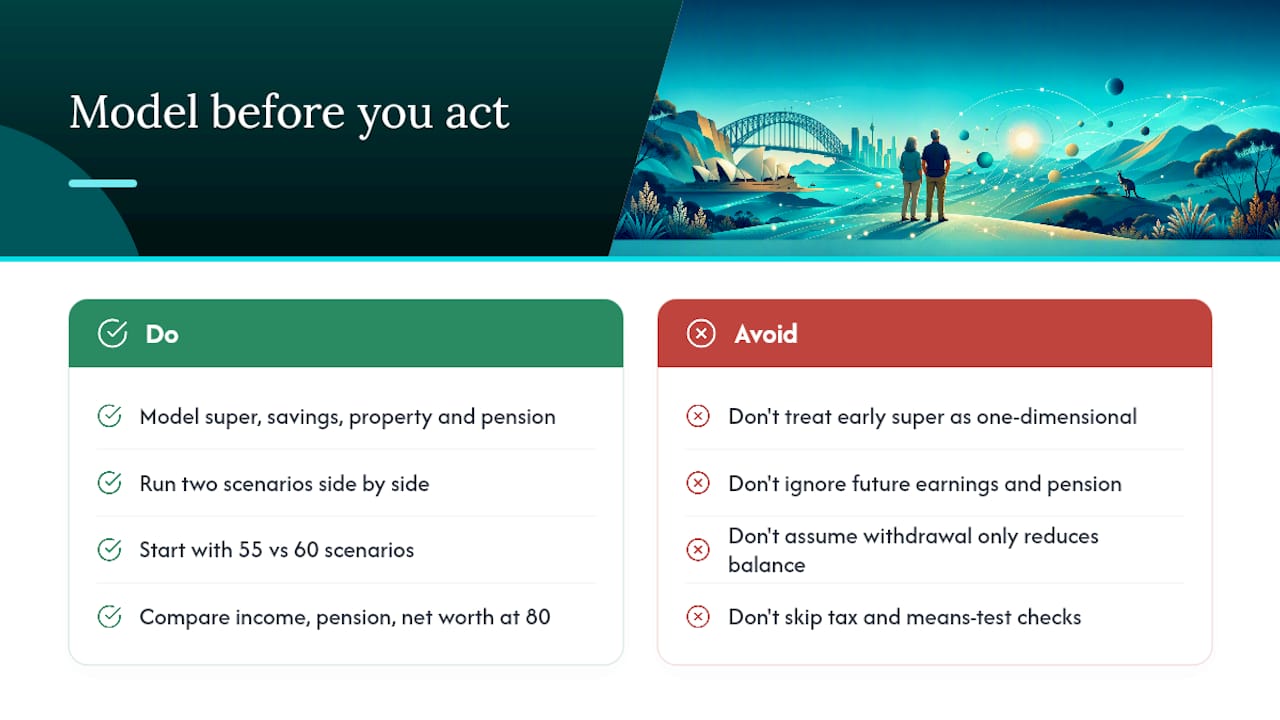
The single most common mistake people make with early super access is treating it as a one-dimensional decision. Withdrawing $50,000 at 55 does not just reduce your balance by $50,000. It removes the future earnings on that amount, potentially shifts your Age Pension entitlement, and may trigger a tax bill. Those three effects compound over 20 or 30 years.
MoneySmart recommends treating super, personal savings, property, and Age Pension projections as an integrated strategy rather than separate buckets. That is exactly what scenario modelling tools are built for.
Running two scenarios side by side, one where you access super at 55 and one where you wait, is the fastest way to see whether the short-term cash benefit outweighs the long-term income loss. Most people are surprised by how much the gap widens over time.
Aerowealth’s platform lets you model bridge-year scenarios (the years between early retirement and when super becomes fully accessible), simulate a TRIS alongside salary changes, project Age Pension means-test outcomes, and stress-test assumptions like investment returns and inflation. The Australian retirement calculator on Aerowealth’s site shows how these projections look in practice.
Pro Tip: Start with two scenarios: “withdraw at 55” and “wait until 60.” Compare projected retirement income, Age Pension entitlement, and total net worth at age 80. That single comparison often clarifies the decision faster than any amount of general reading.
How to request access from your super fund
-
Identify your condition of release. Confirm which ground applies to you (preservation age plus retirement, TRIS, hardship, compassionate, or medical). This determines whether your fund or the ATO handles the application.
-
Gather your evidence. For hardship: proof of 26 weeks of continuous eligible income support payments (Centrelink letters work). For compassionate grounds: quotes, invoices, or medical letters as specified by the ATO. For medical grounds: certificates from two doctors, one a specialist for terminal cases.
-
Contact your fund or the ATO. Hardship and retirement-phase requests go to your fund. Compassionate grounds and FHSS applications go through the ATO’s online services portal (myGov). Medical-grounds applications may go to either, depending on the ground.
-
Submit forms and keep copies. Most funds have downloadable forms on their website. Submit everything in one package to avoid delays. Keep certified copies of all documents you send.
-
Track and escalate if needed. Processing times vary. Hardship applications can take several weeks depending on the fund. If you have not heard back within the fund’s stated timeframe, escalate to the Australian Financial Complaints Authority (AFCA) if the fund is unresponsive.
Pro Tip: Call your fund before submitting anything. A five-minute conversation can confirm exactly which form applies to your situation and whether any additional trust deed requirements exist. It saves weeks of back-and-forth.
The case for modelling before you commit
Accessing super early is one of the few financial decisions that cannot easily be undone. Once you withdraw, those funds lose their concessional tax environment permanently. The compounding effect of that loss over 20 or 30 years is substantial, and it often does not show up in a simple back-of-envelope calculation.
The advisers who see the most regret are not those who helped clients wait. They are the ones who helped clients withdraw at 55 without a full picture of what their Age Pension entitlement would look like at 67, or what their balance would have grown to at 65 had they left it untouched. Small adjustments now, like reducing hours through a TRIS rather than withdrawing a lump sum, can preserve significantly more long-term income.
Before you speak to your fund, build at least two scenarios. Bring those projections to your adviser. The conversation will be sharper, faster, and far more useful than starting from scratch.
Model your access-at-55 decision with Aerowealth
Knowing the rules is step one. Seeing the numbers is what actually moves the decision.

Aerowealth is built specifically for Australians who want to stress-test retirement decisions before committing. For the access-at-55 question, that means running a bridge-year scenario against a wait-until-60 scenario side by side, with Age Pension means-test projections and TRIS income modelling included in the same plan. No spreadsheet juggling, no guesswork about which variable to change first.
Key features for this decision:
- Bridge-year modelling: project income and assets during the gap between early retirement and full super access
- TRIS simulation: model reduced hours alongside a TRIS drawdown and see the long-term balance impact
- Pension means-test projections: see how withdrawals shift your Age Pension entitlement over time
- Side-by-side scenario comparison: compare “access now” vs. “wait” on retirement income, net worth, and Age Pension outcomes
Start with the free plan or view Aerowealth’s pricing to see which tier fits your planning needs.
Sources
Official sources to verify rules and follow up on your specific situation:
- Moneysmart
- Who can access their superannuation early? - Services Australia
- Conditions of release | Australian Taxation Office
This article provides general information only and is not a substitute for professional financial or legal advice. Confirm current rules with the ATO, Services Australia, or a registered financial adviser before making any superannuation decision.
FAQ
Can you access super at 55 in Australia?
Only if your preservation age is 55 (you were born before July 1, 1960) and you have met a condition of release, such as permanently retiring. Most Australians born after that date have a higher preservation age, up to 60.
What is a transition-to-retirement income stream?
How does early super withdrawal affect the Age Pension?
Super balances count toward the Age Pension assets and income tests once you reach Age Pension age (currently 67). Withdrawing early and spending the funds can reduce your assessable assets, but depleting your super too fast risks running short of income in later retirement when the pension alone may not be sufficient.
What evidence do I need for a hardship super withdrawal?
You generally need proof of continuous eligible income support payments for 26 weeks, along with documentation showing you cannot meet reasonable living expenses. Your super fund administers the application and sets its own evidence requirements, so contact your fund directly for their specific checklist.
How much super do I need to retire at 60?
The amount depends on your expected lifestyle, other income sources, and Age Pension eligibility. As a general planning benchmark, model your projected annual expenses against your super balance, expected investment returns, and Age Pension entitlement using a tool like Aerowealth to see whether your balance is sufficient for your target retirement age.