Age Pension Income Test Explained for Retirees in 2026

The Age Pension income test assesses most cash and deemed income you receive each fortnight, and if that total exceeds the free area for your situation, your pension payment reduces by a set amount for every dollar over the threshold. According to Services Australia, Centrelink calculates both the income test and the assets test, and then pays whichever result produces the lower pension. So, even if your income looks modest, a large asset base can still cut your payment.
The main income categories that typically count toward the test are:
- Employment income (wages, salary, contractor payments)
- Income streams, including account-based pensions and annuities
- Investment earnings assessed through deeming (bank accounts, term deposits, shares)
- Rental income (net of allowable expenses)
- Overseas income in any form
Check Services Australia directly for live thresholds and the effective dates of any recent changes before making financial decisions.
Key Takeaways
The Age Pension income test applies deeming to financial assets, adds ordinary income, and reduces your pension by 50 cents per dollar above the free area for singles and 25 cents per dollar for each member of a couple.
| Point | Details |
|---|---|
| Income and assets tests both apply | Centrelink runs both tests every fortnight and pays the lower result. |
| Deeming converts assets to income | Financial assets are deemed at 1.25% (below $64,200 for singles) and 3.25% above that threshold. |
| Free area and taper rate | Singles have a $212 per fortnight free area; income above it reduces pension by 50 cents per dollar. |
| Report changes within 14 days | Employment, new income streams, asset sales, and lump sums must all be reported promptly to avoid overpayments. |
| Model before July 1 each year | Free areas are indexed on July 1; deeming rates can change on dates like March 20. Simulate both current and post-indexation figures. |
Table of Contents
- How does the age pension income test actually work?
- What types of income count toward the pension test?
- How does deeming work, and what are the current rates?
- How do free areas, taper rates, and cut-off points reduce your pension?
- Who is on transitional rates, and how do they differ?
- How do the income test and assets test interact?
- Worked examples: calculating your assessed income and pension reduction
- How to model your income test outcomes before you claim
- What you must report to Centrelink and when
- Why modeling early matters more than most people realize
- Try Aerowealth to model your pension scenarios
- Sources
- FAQ
How does the age pension income test actually work?
The income test measures what Services Australia calls ordinary income, which covers most money you receive or are taken to receive each fortnight. That includes wages, business income, rental income, and payments from income streams. On top of ordinary income, Centrelink applies deeming to your financial assets, converting their total value into a notional income figure regardless of what those assets actually earn.
The assessment window is fortnightly. Every two weeks, Centrelink calculates your total assessed income (ordinary income plus deemed income from financial assets) and compares it against the free area for your situation. If you go over, your pension reduces. If your income drops, your pension can rise again at the next assessment.
The test exists because the Age Pension is a means-tested payment under the Social Security Act. The DSS Social Security Guide sets out the legal framework, and Services Australia administers it. Both the income test and the assets test run simultaneously; you receive the lower of the two results.
Pro Tip: If you are approaching pension age and your financial situation is changing, report income changes to Centrelink promptly. Delays can create overpayments that must be repaid.
What types of income count toward the pension test?
MoneySmart summarizes the main categories well: employment income, income streams, annuities, investments, and overseas earnings all count. The full list is broader than most people expect.
Income that is assessed:
- Employment and self-employment income: wages, salary, contractor fees, director fees, and most salary-packaged benefits
- Superannuation income streams: regular payments from a super fund in pension phase
- Account-based pensions: since January 1, 2015, these are assessed under deeming rather than their actual drawdown amount (more on that below)
- Annuities: both lifetime and term annuities, assessed under specific rules depending on their structure
- Bank interest and term deposit returns: assessed through deeming, not actual interest
- Dividends and managed fund distributions: also captured under deeming for the underlying financial assets
- Rental income: net rental income after allowable deductions such as rates, insurance, and maintenance
- Business income: net profit from any business activity
- Overseas income: pensions, wages, or investment returns from another country, converted to Australian dollars at the date of receipt
Special cases worth knowing:
- Capital gains from selling an asset are generally not assessed as income under the income test. The sale proceeds may, however, increase your assessable assets.
- Rollovers between super funds are not income.
- Inherited money is not income at the point of receipt, but once it sits in a bank account or investment, deeming applies to it.
- One-off lump sums can be treated as either income or assets depending on their nature. A compensation payment, for example, may be assessed differently from an inheritance.
Pro Tip: Overseas income must be reported in Australian dollars. Use the exchange rate on the date you received the payment, not the current rate. The Australian Taxation Office publishes historical rates that Centrelink accepts.
The account-based pension rule deserves emphasis. Before 2015, Centrelink assessed only the actual drawdown from an account-based pension. Now, Services Australia applies deeming to the full account balance, which can produce a higher or lower assessed income than the actual withdrawal depending on the deeming rates and the balance size.
How does deeming work, and what are the current rates?
Deeming assumes your financial assets earn a fixed rate of return, regardless of what they actually earn. Centrelink applies this assumed return to calculate your income from financial assets, then adds it to your other ordinary income for the test.
The DSS Social Security Guide explains that deeming was introduced to prevent people from deliberately reducing their income by holding low-yielding assets. It applies to bank accounts, term deposits, shares, managed funds, account-based pensions, and most other financial investments.
Current deeming rates (effective from March 20, 2026)
The Australian Government Actuary’s March 2026 recommendation proposed the following rates:
| Financial assets | Deeming rate |
|---|---|
| First $64,200 (single) / first $106,800 (couple combined) | 1.25% per year |
| Amount above threshold | 3.25% per year |
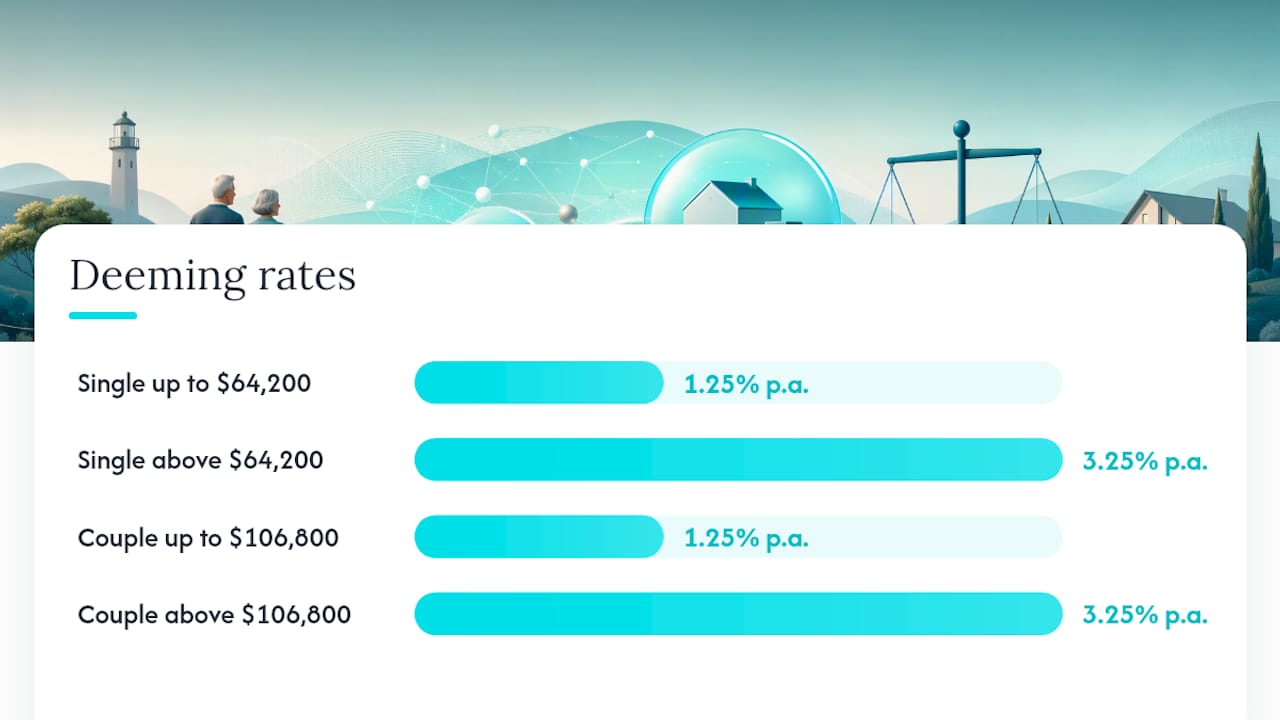
These rates apply to the total value of your financial assets, split at the threshold. The lower rate applies to the first portion; the higher rate applies to everything above.
How deeming is calculated: a simple example
Say you are single with $120,000 in financial assets (a mix of bank savings and an account-based pension).
- First $64,200 is deemed at 1.25% per year = $802.50 per year = $30.87 per fortnight
- Remaining $55,800 is deemed at 3.25% per year = $1,813.50 per year = $69.75 per fortnight
- Total deemed income = $100.62 per fortnight
That $100.62 is added to any other ordinary income you have (wages, rental income, etc.) to get your total assessed income for the fortnight.
One practical upside of deeming: if your portfolio actually earns more than the deeming rate, the excess is invisible to Centrelink. Growth-focused investments that outperform the deeming threshold do not increase your assessed income, which can make them more attractive from a pension-eligibility perspective.
Deeming exemptions exist but are rare. The Minister for Social Services can grant them in limited circumstances, such as a fundamentally failed investment or a fully preserved super fund that is genuinely inaccessible. Critically, an exemption removes the income assessment but does not remove the asset from the assets test.
How do free areas, taper rates, and cut-off points reduce your pension?
Once your total assessed income is calculated, Centrelink compares it to the income free area for your situation. Income below the free area has no effect on your pension. Income above it triggers a reduction.
Free areas and taper rates (current figures):
- Single pensioner: free area of $212 per fortnight; pension reduces by 50 cents for every dollar of income above that
- Couple (combined): combined free area applies; each partner’s pension reduces by 25 cents per dollar of combined income above the threshold (effectively 50 cents per dollar combined, split equally)
The single income free area is a set amount per fortnight. Every dollar above that cuts the pension by 50 cents, so a single pensioner with $412 in fortnightly income faces a $100 reduction in their pension payment. (Services Australia)
The pension reaches zero at the cut-off point. For a single pensioner on the full rate, the cut-off is a specified amount per fortnight that changes with indexation; confirm the current figure on Services Australia’s website. Couples have a higher combined cut-off.
Factors that shift cut-off points:
- Rent Assistance: if you receive Rent Assistance, your total pension entitlement is higher, so the income level at which it reaches zero is also higher
- Work Bonus: eligible pensioners can earn up to $300 per fortnight from employment without it counting toward the income test (up to a $7,800 annual accrual limit), which effectively raises the cut-off for workers
- Couple separated due to ill health: each partner is assessed at the single rate rather than the couple rate, which gives each a higher free area
For a quick sense of where you sit, the Services Australia income test page publishes current free areas and cut-off tables. Rates are indexed on July 1 each year, so the numbers shift annually.
Who is on transitional rates, and how do they differ?
Transitional rates apply to a shrinking group of pensioners who were receiving a pension before September 20, 2009, and whose payment has been continuously maintained since then. These pensioners are assessed under older rules that use a different taper structure.
Key differences for transitional-rate pensioners:
- The taper rate is 40 cents per dollar of income over the free area (compared to 50 cents for standard-rate pensioners)
- The free area amounts differ from the current standard free areas
- Centrelink automatically applies whichever rate (transitional or standard) produces the higher payment
If you have been on a part pension continuously since before September 2009 and your payment has never been cancelled, you may still be on the transitional rate. Most new claimants and anyone whose pension was cancelled and restarted after that date will be on the standard rate.
Other special cases:
- Dependent children: having a dependent child in your care increases the income free area, which means more income before your pension starts to reduce
- Couples separated due to ill health: each partner is assessed individually at the single rate, giving both a higher free area and a higher cut-off point than the standard couple assessment
How do the income test and assets test interact?
Both tests run every fortnight. Centrelink calculates what your pension would be under the income test, then calculates what it would be under the assets test, and pays the lower of the two results. You cannot choose which test applies.
Three scenarios that illustrate how this plays out:
- High financial assets, low ordinary income: A retiree with $800,000 in an account-based pension but no employment income might have modest ordinary income. Deeming, however, converts those assets into a significant assessed income figure, and the assets test may also reduce the pension substantially. Both tests bite.
- Low assets, high ongoing income: A pensioner with minimal savings but a defined-benefit super pension paying $1,800 per fortnight will be cut off by the income test long before the assets test becomes relevant.
- Mixed case: A couple with $400,000 in financial assets and $600 per fortnight in combined employment income may find the income test is the binding constraint in some months and the assets test in others, depending on how their balances move.
Deeming exemptions affect only the income test. If an exemption is granted on a failed investment, that asset’s deemed income drops to zero, but the asset’s value still counts in the assets test. This distinction matters when planning around distressed investments.
Worked examples: calculating your assessed income and pension reduction
These examples use the deeming rates recommended by the Australian Government Actuary for March 2026 and the income free area and taper rules published by Services Australia. Confirm current figures on official pages before applying them to your own situation.
Example 1: single pensioner
Profile: Single, age 68. Financial assets: $50,000 in a savings account and $90,000 in an account-based pension. No employment income.
- Total financial assets: $140,000
- First $64,200 deemed at 1.25% per year = $802.50 per year = $30.87 per fortnight
- Remaining $75,800 deemed at 3.25% per year = $2,463.50 per year = $94.75 per fortnight
- Total deemed income: $30.87 + $94.75 = $125.62 per fortnight
- Income above free area: $125.62 minus $212 = $0 (income is below the free area)
- Pension reduction: nil. Full pension applies under the income test.
In this case the assets test may still reduce the pension, but the income test alone does not.
Example 2: pensioner couple
Profile: Couple, both age 67. Combined financial assets: $280,000. One partner earns $400 per fortnight from casual work.
- Total financial assets: $280,000
- First $106,800 deemed at 1.25% per year = $1,335 per year = $51.35 per fortnight
- Remaining $173,200 deemed at 3.25% per year = $5,629 per year = $216.50 per fortnight
- Total deemed income: $51.35 + $216.50 = $267.85 per fortnight
- Add employment income: $267.85 + $400 = $667.85 combined fortnightly income
- Combined income above the couple free area (assume $372 combined): $667.85 minus $372 = $295.85 excess
- Each partner’s pension reduces by 25 cents per dollar of excess: $295.85 × $0.25 = $73.96 reduction per partner per fortnight
These are illustrative figures. The couple free area and the full pension rate change with indexation; always verify current figures with Services Australia before making decisions.
How to model your income test outcomes before you claim
Running the numbers before you reach pension age, or before a major financial change, can save you from surprises. Small shifts in asset balances or income timing can move you from full pension to part pension or off the pension entirely.
Modeling checklist:
- Gather current balances for all financial assets: bank accounts, term deposits, shares, managed funds, and account-based pension balances
- Classify each asset as financial (subject to deeming) or non-financial (home, car, personal effects — not subject to deeming but counted in the assets test)
- Apply the deeming thresholds and rates to your total financial assets to get fortnightly deemed income
- Add any expected ordinary income: part-time wages, rental income, overseas pension payments
- Compare the total to the free area for your situation (single or couple)
- Apply the taper to calculate the pension reduction
- Run the same calculation under the assets test and take the lower result
Sensitivity tests worth running:
- What happens if you draw down $50,000 from your account-based pension to fund a home renovation? (Reduces financial assets, lowers deemed income, may increase pension)
- What if you delay claiming by six months to a July 1 indexation date? (Free areas increase, which may improve your outcome)
- What if one partner continues working for another year? (Employment income adds to assessed income but the Work Bonus offsets the first $300 per fortnight)
- What if you consolidate term deposits into a single account? (No change to deeming; the total balance is what matters)
Pro Tip: Free areas are indexed on July 1 each year, and deeming rates can change on dates like March 20. If you are close to a threshold, simulating both the current and post-indexation figures can reveal whether waiting a few months to claim is worth it. A difference of $10 per fortnight in the free area can shift a borderline case from part pension to full pension.
Aerowealth’s retirement calculator lets you model these scenarios side by side, including deeming, super drawdowns, and employment income, so you can see the pension impact of each variable before committing to a strategy. For a broader look at sequencing withdrawals and income sources, the retirement income strategies guide covers the full picture.

What you must report to Centrelink and when
Reporting obligations are not optional. Failing to notify Services Australia of income changes can result in overpayments that Centrelink will recover, sometimes with penalties.
Events that trigger a reporting obligation:
- Starting or stopping employment, or a change in hours or pay rate
- Receiving a new income stream (super pension, annuity, or overseas pension)
- Selling a significant asset (property, shares, business)
- Receiving a lump sum (inheritance, compensation, insurance payout)
- A change in overseas income or a currency exchange that materially affects the Australian dollar value
- A partner’s income or asset situation changing
How to report:
- myGov / Centrelink online account: the fastest channel for most updates; changes are recorded immediately
- Centrelink phone line: call the Older Australians line for pension-related changes
- In person: a Services Australia service centre if you need help with complex changes
Most income changes must be reported within 14 days. The Work Bonus is applied automatically to eligible employment income, but you still need to report the employment income itself. Services Australia’s reporting page and the Work Bonus guidance are the authoritative sources for current notification rules and timeframes.
Why modeling early matters more than most people realize
There is a common pattern among retirees approaching pension age: they focus on whether they qualify for the pension and overlook how much they will actually receive. The gap between a rough eligibility check and a properly modeled fortnightly payment can be hundreds of dollars.
The two mistakes we see most often are ignoring deeming entirely (assuming the income test only catches wages and rental income) and treating the July 1 indexation date as irrelevant. Both can produce a nasty surprise at the first Centrelink assessment. That alone can push a single pensioner well above the free area.
The better approach is to model at least two scenarios before claiming: one based on current rules and balances, and one based on the likely post-July 1 figures. If you are within 12 months of pension age, also model what happens if a deeming rate change takes effect before your claim is processed. These are not exotic edge cases; they are the normal rhythm of how the rules move.
Try Aerowealth to model your pension scenarios

The income test has moving parts: deeming rates, free areas, taper rates, the Work Bonus, and indexation dates that shift every year. Running these calculations manually in a spreadsheet is error-prone and time-consuming.
Aerowealth is built for exactly this. The platform lets you enter your super balances, financial assets, and expected income sources, then runs the income test and assets test side by side so you can see which one is binding and by how much. You can stress-test timing decisions, model drawdown strategies, and compare scenarios before you commit to anything.
Start modeling your retirement income for free, or explore the Pro plan for full scenario comparison, bridge-year modeling, and advanced deeming calculations.
Sources
Rates and thresholds change on specific indexation dates: July 1 for free areas and pension rates, and periodically for deeming rates (the most recent change was recommended for March 20, 2026). Always confirm effective dates on official pages before making financial decisions.
- Income test for Age Pension - Age Pension - Services Australia
- 4.4.1.10 Overview of deeming | Social Security Guide
- Deeming Rate Recommendation – March 2026
- Age Pension and government benefits - Moneysmart
This article is general information, not a substitute for advice from a qualified financial advisor. Consult a qualified financial professional about your own circumstances before acting on anything here.
FAQ
How much income can I have and still get the Age Pension?
A single pensioner can have up to $212 per fortnight in assessed income before any pension reduction applies. Above that, the pension reduces by 50 cents per dollar. The cut-off point at which the pension reaches zero changes with indexation each year; check with Services Australia for the current figure.
What is the income test for the Centrelink Age Pension in 2026?
The income test measures ordinary income plus deemed income from financial assets each fortnight. Centrelink applies both the income test and the assets test and pays the lower result.
How much can an Age Pensioner earn before paying income tax?
The Age Pension itself is taxable income, but most pensioners pay little or no tax because the Seniors and Pensioners Tax Offset (SAPTO) effectively raises the tax-free threshold for eligible retirees. The exact amount depends on your total income; the Australian Taxation Office publishes current SAPTO thresholds and eligibility rules.
What are the new rules for Centrelink Age Pensioners in 2026?
Free areas and pension rates are also indexed on July 1. Check Services Australia’s website for the full list of current rates and any legislative changes that have taken effect.
Does an account-based pension count as income for the Age Pension test?
Yes. Since January 1, 2015, account-based pensions held by income support recipients are assessed under deeming rather than their actual drawdown amount. Centrelink applies the deeming rates to the full account balance, regardless of how much you actually withdraw each fortnight.