Bucket Strategy Retirement: How Australians Set It Up

The bucket strategy retirement approach splits your savings into three time-based pools: cash, defensive buffer, and growth, so you never have to sell shares or property while markets are down. That single design feature is the whole point: it protects your income from sequence-of-returns risk, the danger that a bad run of returns early in retirement permanently damages your balance. This suits Australian retirees with a mix of superannuation and other investments, a horizon of at least ten years, and enough savings to split meaningfully across the three pools. The sizing rules and the worked numbers below show exactly how to build one.
-
Bucket 1: cash for near-term spending, generally covering a couple of years’ worth
-
Bucket 2: a defensive buffer to top up cash, typically covering several years’ worth
-
Bucket 3: growth assets for the longer term, left untouched for many years
Key Takeaways
A bucket strategy protects retirement income by holding two years of cash and five years of buffer assets so growth investments are never sold during a market downturn.
| Point | Details |
|---|---|
| Core sizing rule | Hold two years of spending in cash, five more in defensive buffer assets, rest in growth. |
| Refill order matters | Draw cash first, refill from buffer, only tap growth after a positive market year. |
| ATO minimum drawdown | Size Bucket 1 to cover your legal minimum withdrawal, not just discretionary spending. |
| Rebalance on triggers | Review annually and after any market move of roughly 10% or more. |
| Model before committing | Use scenario tools like Aerowealth to test your actual split against Age Pension and drawdown rules. |
This article is general information, not a substitute for advice from a qualified financial advisor. Consult a qualified financial professional about your own circumstances before acting on anything here.
Table of Contents
- What Is a Bucket Strategy for Retirement Income?
- How to Size Your Buckets: Two Worked Examples
- Australian Rules That Change How You Build Buckets
- Keeping Your Buckets on Track Year to Year
- Aerowealth’s Take: Turning Bucket Rules Into Your Numbers
- Choosing Investments for Each Bucket
- Bucket Strategy vs. Other Retirement Income Approaches
- Adjusting Bucket Sizes as Markets and Age Change
- Modeling Your Buckets: Tools Beyond a Spreadsheet
- What the Research Actually Supports
- Sources
- FAQ
What Is a Bucket Strategy for Retirement Income?
Sequence-of-returns risk sounds abstract until you run the numbers. Two retirees can earn the exact same average return over twenty years and finish with wildly different balances, purely because of the order those returns arrived in. A retiree who suffers a 20% market fall in year one and is forced to sell shares to fund living expenses locks in that loss permanently. A retiree who avoids selling during the dip, because they had two years of spending sitting in cash, rides out the recovery. That is the entire mechanical justification for buckets.
Each bucket has one job.
- Bucket 1 (cash) holds a couple of years of living expenses in safe, liquid accounts. Its purpose is liquidity, not growth.
- Bucket 2 (buffer) holds several years of spending in defensive assets, mainly fixed income, occasionally with a small portion of growth assets to help with inflation.
- Bucket 3 (growth) holds the remaining balance in growth assets like shares or property, intended to remain invested for many years.
The refill order matters as much as the allocation. Withdrawals come from Bucket 1 first. Once it is low, it should be replenished from Bucket 2. Bucket 3 is accessed only during positive market periods. Selling growth assets in a downturn undermines the strategy and is the key risk buckets help manage.
Pro Tip: Write your refill rule down before you retire, not after the first market scare. A one-page note that says “draw cash first, refill from buffer, only touch growth after a positive year” removes emotion from the decision when it matters most.
How to Size Your Buckets: Two Worked Examples
Sizing a bucket strategy starts with one number: your expected first-year spending after any Age Pension or other income. From there, a widely used default is two years of that figure in cash, five more years in the buffer, and everything else in growth.
- Bucket 1 = annual spending times about two years
- Bucket 2 = annual spending times about five years
- Bucket 3 = total savings minus Buckets 1 and 2
Example A: single retiree. Say Margaret needs $50,000 a year from her super to cover expenses beyond a part Age Pension. Bucket 1 holds $100,000 in cash. Bucket 2 holds $250,000 in bonds and term deposits. If her total balance is $700,000, the remaining $350,000 sits in growth assets, left alone unless markets have had a strong year.
Example B: couple drawing an Age Pension top-up. Tom and Linda need $70,000 combined, partly from a joint account-based pension and partly from a part Age Pension. Bucket 1 holds $140,000, Bucket 2 holds $350,000, and if their combined balance is $1,100,000, roughly $610,000 goes to growth.
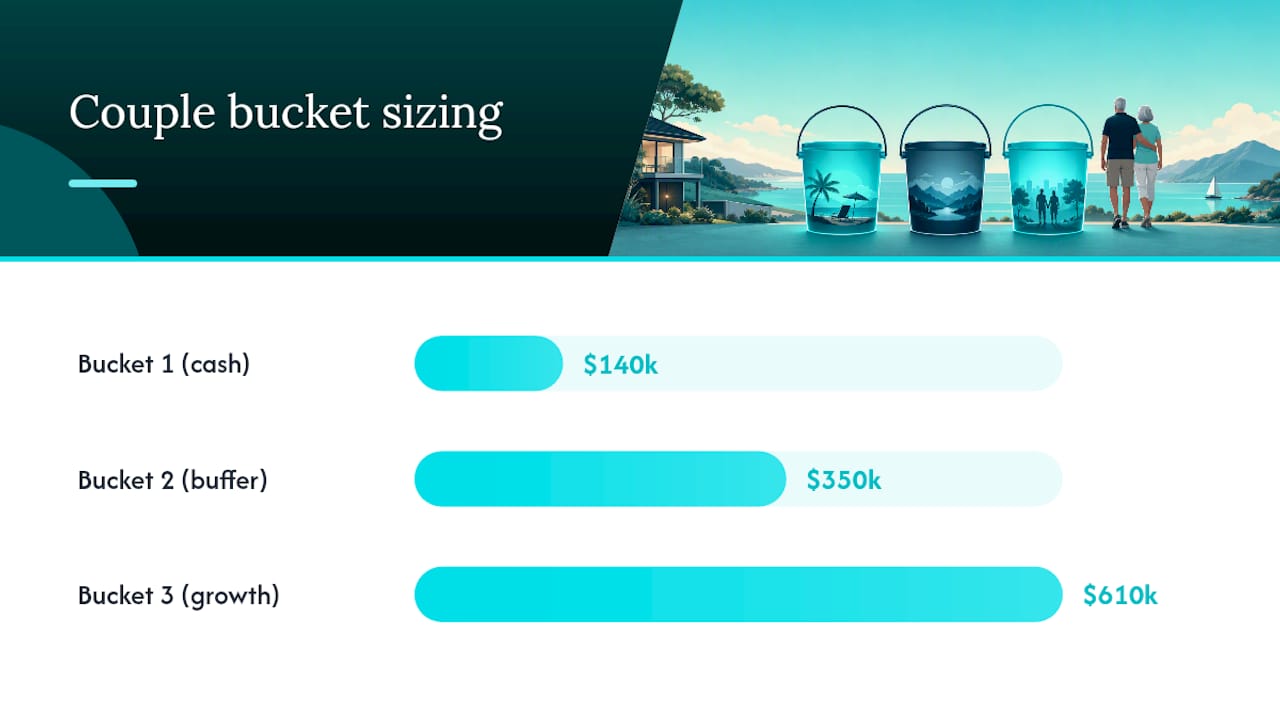
Having around seven years’ worth of spending outside the market, combining cash and a buffer, generally covers most severe historical downturn recoveries while balancing opportunity cost, based on CFV’s analysis of sequence risk. Adjustments can be made for individual risk tolerance, pension situations, and retirement length.
Australian Rules That Change How You Build Buckets
Superannuation and Age Pension rules aren’t optional add-ons to a bucket strategy in Australia. They shape the sizing from day one.
The ATO sets minimum annual drawdown rates for account-based pensions based on age, and that minimum withdrawal has to come out regardless of what the market is doing. If your Bucket 1 cash holding isn’t large enough to cover a bad year’s minimum drawdown, you can be forced to sell growth assets at the worst possible time, which is precisely what SuperGuide flags as a common planning gap. Build your cash bucket around your actual minimum drawdown obligation, not just your discretionary spending.
Age Pension means-testing adds another layer. How you hold your buckets, and how much cash sits outside super versus inside an account-based pension, affects your assessable assets and deemed income under Centrelink’s tests. A large cash buffer sitting outside super can shift your part-pension entitlement more than the same amount invested inside a pension structure.
Running all three buckets as different investment options inside one account-based pension, rather than three separate accounts, usually cuts fees and paperwork significantly, a structure several advisers recommend. On tax, drawing pension income in retirement phase is generally tax-free for those over 60, but selling growth assets inside an accumulation account can still trigger CGT considerations before you’ve moved fully into pension phase.
| Rule | Why It Matters for Buckets |
|---|---|
| ATO minimum drawdown | Size Bucket 1 to cover the minimum, not just discretionary spending |
| Age Pension assets test | Where you hold cash affects assessable assets and part-pension rates |
| Single pension account | Reduces fees and administrative overlap across buckets |
| Pension-phase tax treatment | Income drawn after 60 is generally tax-free; CGT can still apply pre-pension phase |
Keeping Your Buckets on Track Year to Year
A bucket strategy isn’t a set-and-forget system. It needs a maintenance rhythm, or the buckets drift out of shape within a couple of years.
- Review annually, and also after any market move of roughly 10% or more in either direction, a trigger point James Hayes recommends for reassessing allocations.
- Refill in order: cash first from the buffer, then top up the buffer from growth, but only after a year where growth assets have posted a gain.
- Harvest opportunistically in strong markets by trimming some growth gains into the buffer, rather than waiting until cash runs dry.
- Set a spending trigger, such as cutting discretionary spending if your growth bucket falls more than 20% below its target weighting, so you’re not making that call under stress.
Pro Tip: If you find yourself checking your growth bucket balance weekly during a downturn, that’s a signal your cash and buffer sizing is too thin for your comfort level, not a signal to sell.
Removing too much growth exposure to feel safer today raises the risk of running short later. Morningstar’s research on bucket allocation makes the point plainly: buckets manage sequencing risk, not longevity risk, and the two require different fixes.
Aerowealth’s Take: Turning Bucket Rules Into Your Numbers
Generic multiples like two years cash and five years buffer are a solid starting point, but they ignore your actual Age Pension eligibility, your minimum drawdown schedule, and whether you own an investment property that changes your cash flow entirely.
- Aerowealth models your super, investments, and any property or mortgage in one plan, rather than three disconnected spreadsheets
- Side-by-side scenario comparisons show how a 2/5 cash-buffer split performs against a 3/6 split under the same market assumptions
- Stress tests apply market downturns to your specific plan and show the dollar impact on each bucket, not just a generic average
The value of scenario modelling isn’t a prettier chart. It’s seeing your actual bucket dollar targets, your probability of the plan holding up, and how a market fall interacts with your specific Age Pension position, before you’ve committed a single dollar.
If you want to see your own numbers rather than someone else’s example, you can build a plan with Aerowealth.
Choosing Investments for Each Bucket
Bucket 1 belongs in high-interest savings accounts or term deposits, nothing fancier. The goal is capital certainty, not yield, so resist the urge to chase a marginally better rate with any credit risk attached.
Bucket 2 typically holds a mix of term deposits, government and corporate bonds, and conservative or defensive multi-sector managed fund options available through most super platforms. A small equity tilt of 10% to 20% can help this bucket keep pace with inflation over its five-year horizon without exposing it to sharp swings.
Bucket 3 is where diversified growth options inside your super fund, direct shares, index funds, or investment property earn their place. Many super funds offer pre-built “growth” or “high growth” multi-sector options that function as a ready-made Bucket 3 without needing to pick individual shares. Reviewing the investment options available within Australian super funds is a sensible starting point before deciding whether to add direct holdings alongside them.
The mistake to avoid is holding the same asset class across all three buckets under different labels. If your “buffer” and your “growth” bucket are both sitting in a balanced fund, you haven’t actually built three buckets. You’ve built one bucket with a spreadsheet split layered on top, and it won’t behave the way the strategy intends when markets fall.
Bucket Strategy vs. Other Retirement Income Approaches
The bucket strategy competes with a handful of other retirement income strategies, and none of them is universally better.
A pure percentage-based drawdown, where you withdraw a fixed percentage of your balance each year regardless of market conditions, is simpler to administer but offers no structural protection against sequence risk. You’re selling assets proportionally every year, including in a crash.
An annuity or partial annuity locks in guaranteed income for life, which solves longevity risk directly but sacrifices flexibility and, in many cases, caps your upside if markets perform well. Some retirees blend a partial annuity with a smaller bucket structure for the remainder of their savings, layering the two strategies rather than choosing one exclusively. Exploring alternative retirement income structures is worth doing before ruling annuities out.
A total-return approach, where you spend from whichever asset class has performed best that year with no fixed buckets, requires more active management and discipline than most retirees want in their seventies or eighties.
The bucket strategy’s real advantage isn’t higher returns, it’s behavioral. It gives you a rule to follow when markets fall, instead of a decision to agonize over. For retirees who value simplicity and a psychological buffer against panic-selling, that structure tends to outweigh the modest cash drag of holding two years of spending in a low-yield account.
Adjusting Bucket Sizes as Markets and Age Change
Your bucket sizes on day one of retirement shouldn’t be the same sizes you’re using ten years later. Two forces push you to adjust: market performance and aging itself.
After a strong growth year, your Bucket 3 balance swells relative to Buckets 1 and 2. That’s the moment to harvest some gains and push them into the buffer, restoring your target ratios rather than letting growth exposure creep up unchecked. After a weak year, resist the instinct to sell growth assets to “rebalance” back to target. Let Bucket 1 and Bucket 2 absorb the shortfall instead, exactly as designed.
Aging changes the calculation differently. As you move from your sixties into your seventies and eighties, your investment horizon shortens, and your ATO minimum drawdown percentage increases automatically under superannuation rules. Both push toward holding a slightly larger cash and buffer allocation relative to growth than you held at the start of retirement. A retiree who started with a 2/5/remainder split at 65 might reasonably shift toward a 3/5 split by 80, trading a small amount of long-term growth for a shorter runway to protect.
There’s no fixed formula for exactly when to make this shift. It depends on your health, your spending needs, and how your growth bucket has actually performed. Reviewing it annually, alongside your regular retirement income strategy check-in, keeps the adjustment gradual rather than reactive.
Modeling Your Buckets: Tools Beyond a Spreadsheet
Most Australians who attempt a bucket strategy start with a spreadsheet, and most spreadsheets fall apart within a year because they don’t update automatically for market movements, super contributions, or changing Age Pension thresholds.
A dedicated modelling tool solves the tracking problem differently. Aerowealth lets you input your superannuation balance, any investment property, mortgage offset arrangements, and other savings into a single plan, then shows how a specific bucket split performs across different market scenarios. Instead of guessing whether a 2/5 split or a 3/6 split suits your situation, you can run both side by side and see the projected probability of your plan holding up through retirement.

The stress-testing feature is particularly useful for bucket sizing specifically, because it applies a market downturn to your actual numbers and shows you which bucket absorbs the impact and for how long. That answers the question every retiree actually has: not “what’s the textbook split,” but “will my split get me through a bad three years without selling shares at the bottom?” Life events also change the calculation. A divorce or a change in family circumstances can shift your entire savings base, which is exactly when re-running your bucket model matters most, not just at initial retirement.
What the Research Actually Supports
The conventional bucket advice you’ll find in most guides treats the 2/5/remainder split as a fixed formula, and that’s where the advice falls short. The multiples are a starting point drawn from historical downturn recovery periods, not a rule that fits every balance sheet. A retiree with a part Age Pension, an investment property, and no debt has a completely different risk profile than one relying solely on super with a mortgage still running.
What the research does support clearly is the behavioral case for buckets. The rule matters more than the exact numbers, because a written refill order stops you from making an emotional decision during a downturn. That’s worth more than perfectly optimized multiples you never actually follow when markets fall.
If there’s one place to prioritize effort, it’s checking your Bucket 1 sizing against your actual ATO minimum drawdown, not against a generic two-year rule of thumb. That single check catches the most common implementation mistake before it costs you a forced sale in a bad year.
— Aerowealth Team
Sources
- Sequence of returns risk — The Bucket Strategy Explained | CFV
- Managing retirement income with a bucket strategy — SuperGuide
- The bucket approach to retirement allocation — Morningstar Australia
- Investing During Retirement — James Hayes
FAQ
What Is the Bucket Strategy in Retirement Planning?
It’s a method of splitting retirement savings into three time-based pools, cash, defensive buffer, and growth, so you can fund near-term spending without selling growth assets during a market fall.
How Much Cash Should I Hold in Bucket 1?
A common default is two years of annual spending, sized to cover your ATO minimum pension drawdown even in a weak market year.
Does a Bucket Strategy Affect My Age Pension?
Yes. Where you hold your cash and buffer, inside or outside your account-based pension, affects your assessable assets and deemed income under Centrelink’s means test.
Can a Bucket Strategy Run Out of Money?
Yes, if too much is held in cash and buffer at the expense of growth, which raises longevity risk even as it lowers sequence-of-returns risk. Balancing both is the point of the strategy.