Capital Gains Tax on Shares Australia: Investor’s Guide

Yes, capital gains tax applies to shares in Australia. Every time you sell, gift, or otherwise dispose of shares, you trigger a CGT event that must be reported in your tax return for that income year. The single most important thing you can do right now is pull your broker records, confirm the acquisition date and cost base for each parcel, and check whether any holding has crossed the 12-month mark for the 50% CGT discount.
A few things to do before you sell:
- Identify each parcel separately (same company, different purchase dates = different parcels)
- Record the acquisition date, purchase price, and all incidental costs (brokerage, stamp duty)
- Check whether any parcel was acquired before September 20, 1985 (pre-CGT assets are exempt)
- Confirm your Australian tax residency status, since non-residents face different rules
- Separate dividends from disposals: dividends are taxed as ordinary income, not as capital gains
Pro Tip: MoneySmart (ASIC) has a plain-English investing and tax overview that pairs well with ATO guidance if you want a consumer-facing starting point before diving into the technical rules.
Table of Contents
- CGT discount and indexation: which method applies to you?
- How capital losses work and how to use them
- Special situations: DRPs, buy-backs, scrip rollovers, ESS, and inherited shares
- Record-keeping, CGT event timing, and how to report gains
- How modelling scenarios helps you estimate CGT before you sell
- Partial disposals and off-market transfers: how the numbers work
- How CGT applies to foreign residents and non-residents
- Options, derivatives, and CGT on share-related instruments
- Bonus issues and other corporate actions: when does the CGT clock start?
- Key Takeaways
- The case for modelling before you sell
- Model your CGT scenarios with Aerowealth
- Official links and further reading
- FAQ
CGT discount and indexation: which method applies to you?
The standard rule for Australian resident individuals is straightforward: hold a CGT asset for at least 12 months and you can reduce the gross capital gain by 50% before adding it to your taxable income. Superannuation funds get a one-third discount instead; companies get none.
The 12-month clock starts the day after acquisition and ends on the day of disposal (the contract date for share sales). Miss it by a day and the full gain is assessable.
Key points on the discount and indexation choice:
- 50% discount applies to assets acquired on or after September 21, 1999, held for 12+ months by an Australian resident individual
- Indexation is available for assets acquired before September 21, 1999 and held for at least 12 months. It adjusts the cost base for inflation up to September 30, 1999 using the Consumer Price Index
- You cannot apply both methods to the same asset. Once you choose indexation for a pre-1999 parcel, the 50% discount is off the table for that parcel
- For most pre-1999 parcels with significant gains, the 50% discount will produce a lower taxable amount than indexation — but the math depends on your specific cost base and gain, so run both calculations
The practical decision rule: if you acquired shares before September 21, 1999, calculate the gain under both methods and pick the lower result. If you acquired after that date and held for 12+ months, the 50% discount is your only concession — indexation is not available.
Non-residents and foreign residents cannot access a CGT discount for assets held at least 12 months on gains accrued after May 8, 2012 (more on residency rules below).
How capital losses work and how to use them
A capital loss arises when your capital proceeds are less than the reduced cost base (not the full cost base). The reduced cost base excludes certain ownership costs that the full cost base includes, so the test for a loss uses a slightly lower figure.
The ordering rules matter:
- Apply current-year capital losses against current-year capital gains first
- Then apply any net capital losses carried forward from prior years
- Apply the 50% discount after losses have been offset, not before
- Capital losses cannot be offset against ordinary income — only against capital gains
Carry-forward mechanics are simple but easy to overlook. If your capital losses exceed your capital gains in a given year, the net capital loss carries forward indefinitely. There is no time limit. You just cannot use it until you have a capital gain to offset.
Practical planning steps:
- Check your prior-year tax returns or ATO myTax records for any carried-forward net capital losses
- Tag parcels in your portfolio that are currently sitting at a loss
- Before June 30, model whether crystallizing a loss in the current year would offset a gain you have already realized
- Remember that the discount applies to the net gain after losses, so a large carried-forward loss can wipe out a discountable gain entirely
Special situations: DRPs, buy-backs, scrip rollovers, ESS, and inherited shares
These are the cases where investors most often get the CGT treatment wrong. The ATO’s Part B guidance on share disposals covers each in detail.
| Situation | CGT treatment summary |
|---|---|
| Dividend reinvestment plan (DRP) | Each reinvestment creates a new parcel; cost base = market value on reinvestment date; selling those shares triggers a CGT event |
| Share buy-back | Off-market buy-backs split the proceeds between dividend and capital components; the capital component affects cost base or creates a gain/loss |
| Non-assessable payments (return of capital) | Reduce the cost base of the shares; if cost base reaches zero, excess is a capital gain |
| Scrip-for-scrip rollover | Eligible shareholders can defer the gain when shares are exchanged in a qualifying takeover; new shares inherit the original cost base |
| Employee share schemes (ESS) | Complex rules; shares may have been taxed as income on acquisition, which affects the cost base for CGT on disposal |
| Inherited shares | Generally acquired at market value on the date of death (or the deceased’s original cost base for pre-CGT assets); seek advice for estate situations |
- Always keep company communications: buy-back notices, takeover documents, and DRP statements all contain the figures you need to calculate cost base adjustments
- For ESS shares, check whether the discount was included in your income in the year of acquisition — this affects your CGT cost base on disposal
- Scrip-for-scrip rollovers require a formal election; they are not automatic
Pro Tip: For corporate actions like takeovers and demergers, the company or its share registry usually issues a tax statement with the relevant cost base allocation. File it with your records immediately — these are hard to reconstruct years later.
Record-keeping, CGT event timing, and how to report gains
The ATO requires you to keep records for five years after you dispose of an asset (or longer if a dispute is open). For shares, that means:
- Acquisition date and purchase price for every parcel
- Brokerage and stamp duty paid on acquisition and disposal
- Corporate action documents: buy-back notices, takeover offers, DRP statements
- Distribution statements from managed funds or ETFs showing capital gains components
- Any valuations used for gifts or non-arm’s-length transactions
- Records of carried-forward capital losses from prior years
Timing examples that catch investors out:
- A share sale contract signed on June 28 is a CGT event in the current income year, even if settlement falls in July
- A gift of shares on June 30 is reported in the current year at market value on that date
- A worthless-share declaration by a liquidator triggers the CGT event on the declaration date, not when the company was wound up
Reporting goes in the supplementary section of your tax return (Item 18 for individuals). You enter total current-year capital gains, apply capital losses (current year and carried forward), and report the net capital gain. ATO myTax pre-fills some data from share registries, but it does not capture all parcels or cost base components — always reconcile against your own records.
Pro Tip: The ATO’s CGT record-keeping tool and myTax both provide worked examples. Cross-check your parcel-level calculations against these before lodging.
How modelling scenarios helps you estimate CGT before you sell
Which parcel you sell matters as much as whether you sell. Selling a parcel acquired 13 months ago versus one acquired 11 months ago can be the difference between paying tax on half the gain or the full gain.
A short scenario illustrates this. Suppose you hold two parcels of the same stock:
- Parcel A: 500 shares, acquired 14 months ago, cost base $5,000, current value $8,000. Gross gain = $3,000. After 50% discount: $1,500 assessable.
- Parcel B: 500 shares, acquired 9 months ago, cost base $5,000, current value $8,000. Gross gain = $3,000. No discount: $3,000 assessable.
Selling Parcel A instead of Parcel B halves the taxable gain. That is a real dollar difference at any marginal tax rate.
Other scenarios worth modelling before you sell:
- Spreading disposals across two income years to stay within a lower marginal tax bracket
- Crystallizing a loss parcel in the same year as a gain to offset the two
- Comparing after-tax proceeds for selling now versus waiting until a parcel crosses the 12-month mark
Pro Tip: Export your full transaction history from your broker, tag each parcel with its acquisition date and cost base, and run the numbers for at least two or three sell scenarios before you act. A CGT calculator comparison can help you find the right tool for this.
Partial disposals and off-market transfers: how the numbers work
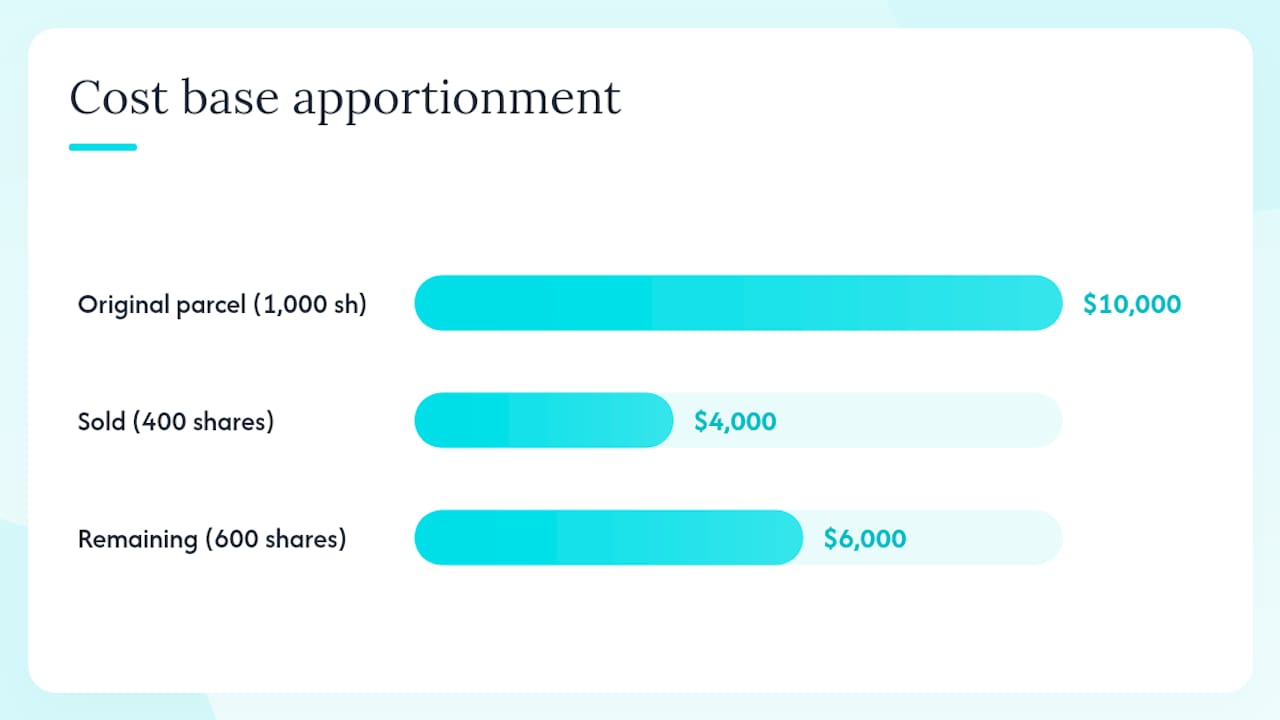
Selling part of a parcel is straightforward in principle: you apportion the cost base pro-rata across the shares sold. If you bought 1,000 shares for $10,000 (cost base $10 per share) and sell 400, the cost base for those 400 shares is $4,000. The remaining 600 shares retain a cost base of $6,000.
Off-market transfers (transfers not executed through a stock exchange) follow the same CGT rules as on-market sales. The capital proceeds are the market value of the shares on the transfer date if the transaction is not at arm’s length. The ATO will substitute market value for proceeds if it considers the stated price to be below market, particularly for transfers between related parties.
For partial disposals across multiple parcels, you need to identify which parcel the sold shares come from. The ATO does not prescribe a mandatory identification method for shares, but you must be consistent and keep records supporting your choice. Selecting the parcel with the highest cost base (to minimize the gain) or the oldest parcel (to maximize discount eligibility) are both legitimate approaches, provided you can document the identification.
How CGT applies to foreign residents and non-residents
Australian residents pay CGT on worldwide assets, including foreign shares. Non-residents and foreign residents are only subject to Australian CGT on taxable Australian property, which generally does not include shares in Australian listed companies unless those shares represent an interest in Australian real property.
Key rules for non-residents:
- Foreign residents cannot access a CGT discount for assets held at least 12 months on gains that accrued after May 8, 2012. Gains accrued before that date may still be eligible for a partial discount, calculated on a time-apportionment basis.
- Temporary residents are generally exempt from CGT on foreign assets but are taxable on Australian assets.
- If you were an Australian resident when you acquired shares and later became a non-resident, a deemed disposal at market value may apply on the date you ceased to be a resident (subject to an election to defer).
- Double tax agreements between Australia and other countries can affect which country has taxing rights on share gains. Always check the relevant treaty.
For investors planning to move overseas or return to Australia, the residency change date and the deemed disposal rules can create unexpected CGT events. This is one situation where professional tax advice is worth the cost before you act.
Options, derivatives, and CGT on share-related instruments
Options and derivatives tied to shares are CGT assets in their own right. The CGT treatment depends on whether you are the option writer or the option holder, and what happens at expiry or exercise.
- Warrants and exchange-traded options — follow similar principles but have specific ATO guidance on timing and cost base treatment.
The 12-month holding period for the CGT discount applies to options and derivatives just as it does to shares. Given that most options are short-dated, the discount rarely applies.
Bonus issues and other corporate actions: when does the CGT clock start?
A bonus issue (where a company issues additional shares to existing shareholders at no cost) is generally not a CGT event at the time of issue. The new shares are treated as acquired on the same date as the original shares, and the cost base of the original shares is spread across both the original and bonus shares.
For example: you hold 1,000 shares with a cost base of $5,000 ($5 per share). The company issues a 1-for-10 bonus, giving you 100 additional shares. Your total holding is now 1,100 shares with the same $5,000 cost base, spread at approximately $4.55 per share. The acquisition date for the bonus shares is the same as the original shares for discount purposes.
Other corporate actions and their CGT timing:
- Demergers: — a qualifying demerger can trigger a cost base reset for both the original and demerged shares, with specific ATO rules on allocation. Company tax statements usually provide the required figures.
Always check the company’s investor tax statement for corporate actions. The figures in those statements are what you use in your tax return.
Key Takeaways
Australian resident individuals pay CGT on share disposals at their marginal tax rate, reduced by the 50% discount for assets held at least 12 months, making parcel-level tracking and timing the two most powerful levers for managing tax outcomes.
| Point | Details |
|---|---|
| CGT applies on disposal | Selling, gifting, buy-backs, and most corporate actions trigger a CGT event reported in that income year. |
| 50% discount after 12 months | Australian resident individuals halve the gross gain if the parcel was held for at least 12 months before disposal. |
| Cost base reduces your gain | Include purchase price, brokerage, and stamp duty; accurate records directly lower your taxable gain. |
| Losses carry forward indefinitely | Net capital losses offset future gains with no time limit; check prior returns before planning a sale. |
| Aerowealth models CGT scenarios | Aerowealth lets you compare after-tax outcomes across parcels and sale timings before you commit to a disposal. |
The case for modelling before you sell
Most investors focus on the gain. The smarter question is which parcel to sell, and when. The difference between selling a parcel one month before and one month after the 12-month mark can be thousands of dollars at a 37% or 45% marginal rate. That is not a technicality; it is a planning decision that costs nothing to get right and can be expensive to get wrong.
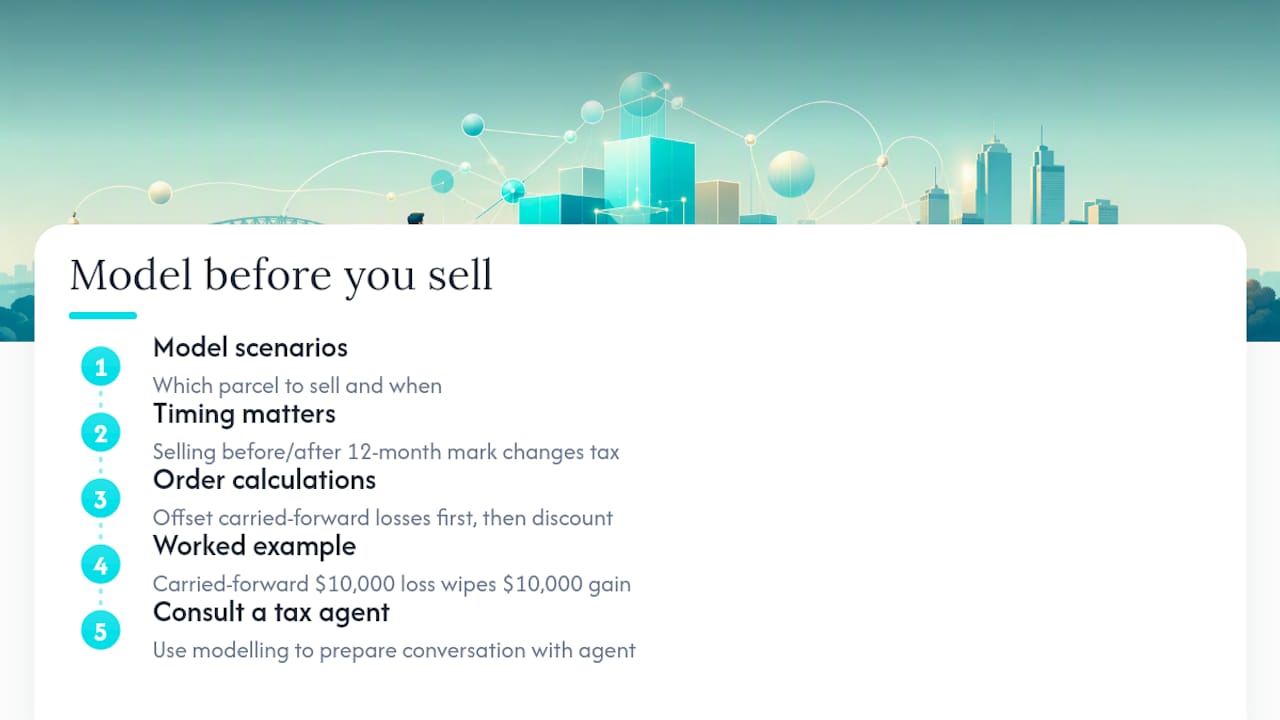
The other thing investors underestimate is the interaction between carried-forward losses and the discount. The discount applies after losses are offset. If you have a $10,000 carried-forward loss and a $10,000 gross gain, the loss wipes the gain entirely. No discount needed. But if you apply the discount first (which you cannot legally do), you would think you have a $5,000 gain and a $10,000 loss, netting to a $5,000 loss to carry forward. The correct calculation gives you zero taxable gain and zero carried-forward loss. The ordering matters, and getting it wrong in either direction produces the wrong tax outcome.
For employee share schemes, inherited shares, and major corporate actions, modelling is preparation for a conversation with a registered tax agent, not a substitute for one. The rules are complex enough that the value of a tool is in helping you arrive at that conversation with the right questions already formed.
Model your CGT scenarios with Aerowealth
Knowing the rules is one thing. Running the numbers before you sell is where the real planning happens.

Aerowealth is built for Australian investors who want to see the after-tax impact of a share disposal before they commit. The platform lets you model parcel-level CGT scenarios side by side, compare the tax outcomes of selling older versus newer parcels, and stress-test different sale timings against your marginal rate and any carried-forward losses. It also integrates with bridge-year and retirement income planning, so a share sale decision does not sit in isolation from the rest of your financial picture.
For investors planning early retirement or managing a drawdown strategy, that integration matters. A gain realized in a bridge year before super preservation age lands differently than one realized in full employment. Aerowealth shows you both.
Start modelling your scenarios on the Pro plan, or explore the free tier at aerowealth.net to see how the tool handles your portfolio. For complex situations involving employee share schemes, estate transfers, or major corporate actions, always confirm your position with a registered tax agent.
Official links and further reading
The ATO and MoneySmart are the two authoritative sources for Australian CGT rules on shares. Use these directly for worked examples, calculators, and official guidance:
- When CGT applies to shares and units (ATO) — explains which events trigger CGT, the dividend carve-out, and the share trader distinction
- Disposing of shares (ATO) — covers sale, gift, buy-back, and corporate action outcomes with reporting obligations
- Personal investors guide, Part B (ATO) — worked examples for shares, DRPs, scrip rollovers, and non-assessable payments
- List of CGT assets and exemptions (ATO) — authoritative list of which instruments and distributions have CGT consequences
- Investing and tax (MoneySmart) — consumer-facing overview of how investment returns are taxed, with practical examples and links to ATO calculators
| Resource | Best used for |
|---|---|
| ATO CGT events table | Confirming which event applies and its exact timing |
| ATO How to calculate your CGT | Running the discount vs indexation comparison |
| ATO Part B personal investors guide | Worked examples for DRPs, buy-backs, and rollovers |
| MoneySmart investing and tax | Plain-English overview and links to online calculators |
This article is general information only, not tax advice. Confirm your specific position with a registered tax agent or the ATO before lodging your return.
FAQ
Do you pay CGT when you sell shares in Australia?
Yes. Selling shares is a CGT event for Australian residents, and any capital gain must be reported in your tax return for the income year the contract was signed.
How much tax do you pay if you sell shares in Australia?
Your capital gain is added to your assessable income and taxed at your marginal rate. If you held the shares for at least 12 months, a CGT discount for assets held at least 12 months reduces the assessable gain by half before it is added to your income.
How do you avoid CGT on shares in Australia?
You cannot avoid CGT entirely, but you can reduce it: hold shares for at least 12 months to access the 50% discount, offset gains with capital losses (including carried-forward losses), and time disposals across income years to stay in a lower marginal tax bracket.
Are dividends subject to CGT in Australia?
No. Dividends are taxed as ordinary income in the year you receive them and are not CGT events. CGT applies only to disposals such as sales, gifts, and buy-backs.
Can Aerowealth help me model CGT on my shares?
Yes. Aerowealth lets you run parcel-level CGT scenarios, compare after-tax outcomes for different sale timings, and integrate share disposal decisions into your broader retirement plan. Visit aerowealth.net to get started.