Co-Contribution Income Thresholds 2026: What You Need to Know

For 2026–27, the government co-contribution lower income threshold is $49,293 and the higher threshold is $64,293. The maximum entitlement is $500, paid at 50 cents for every $1 of eligible personal after-tax super contributions. Your entitlement phases out progressively between those two thresholds and hits zero once your total income reaches $64,293.
Three quick eligibility flags to check right now:
- You made a personal after-tax (non-concessional) super contribution and did not claim it as a tax deduction.
- Your total income for the year falls below $64,293.
- Your super fund holds your Tax File Number (TFN).
If all three apply, you likely qualify. The ATO pays the co-contribution automatically after you lodge your tax return — no separate application needed.
Key Takeaways
| Point | Details |
|---|---|
| 2026–27 income thresholds | Lower threshold $49,293; higher threshold $64,293; entitlement phases out between them. |
| Maximum co-contribution | $500, earned at 50 cents per $1 of eligible after-tax contribution. |
| Eligible contribution type | Personal non-concessional contributions not claimed as a tax deduction only. |
| 10% income test | At least 10% of total income must come from employment or business — passive income doesn’t count. |
| Aerowealth scenario modelling | Compare co-contribution vs. concessional strategies side-by-side to find the better long-term outcome. |
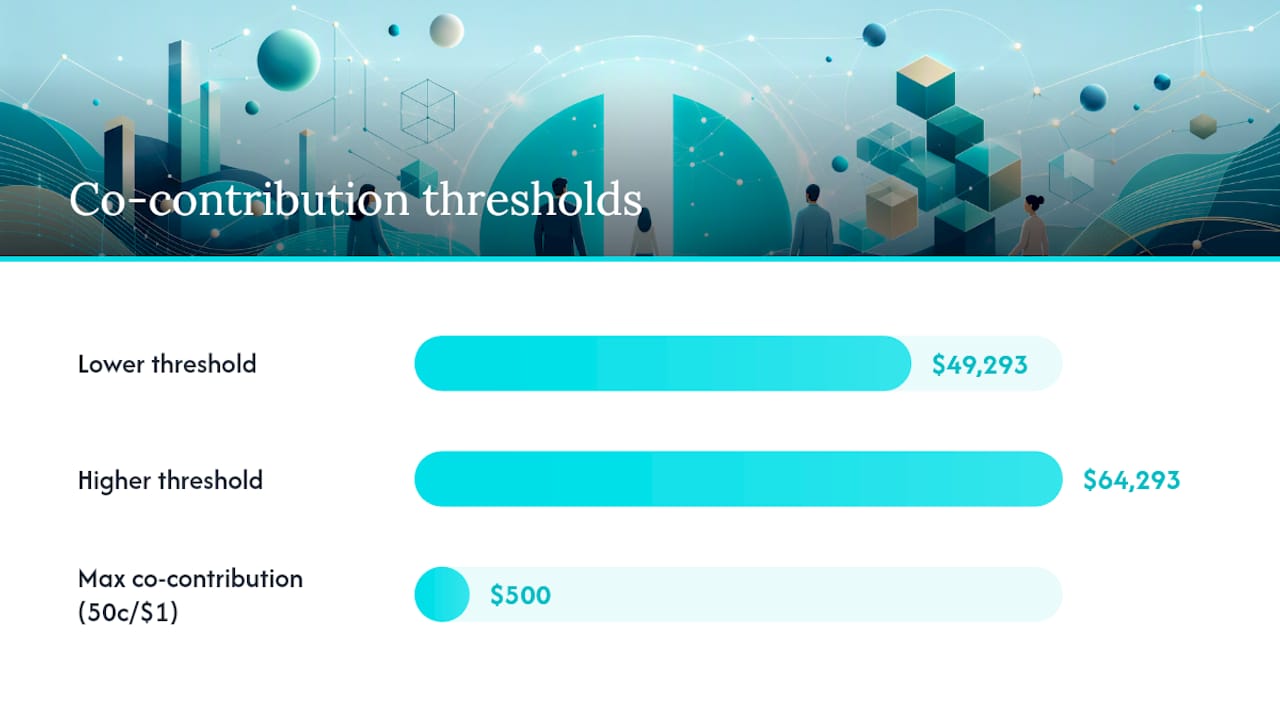
Table of Contents
- What are the official 2026–27 co-contribution income thresholds?
- Which eligibility tests does the ATO actually require you to pass?
- How is ‘total income’ actually calculated for the co-contribution test?
- How does the ATO estimate and pay the co-contribution?
- When does the co-contribution actually beat a tax deduction or salary sacrifice?
- The Aerowealth team’s take on making this decision
- Model your co-contribution vs. concessional strategy with Aerowealth
- Sources
- FAQ
What are the official 2026–27 co-contribution income thresholds?
The ATO’s thresholds table for 2026–27 is straightforward:
| Threshold | Amount |
|---|---|
| Lower income threshold | $49,293 |
| Higher income threshold | $64,293 |
| Maximum co-contribution | $500 |
Thresholds are indexed to Average Weekly Ordinary Time Earnings (AWOTE) each year, so the numbers shift annually. Always verify the current year’s figures directly on the ATO site rather than relying on older guides.
How the math works
At or below $49,293, you receive 50 cents per $1 contributed, up to the $500 cap. That means a $1,000 after-tax contribution earns the full $500. Contribute less and you get proportionally less — a $600 contribution yields $300.
Between the thresholds, your maximum entitlement reduces progressively at roughly 3.333 cents per $1 above the lower threshold. The formula:
Reduced maximum = $500 − [(total income − $49,293) × 0.03333]
A quick example: total income of $56,793 puts you $7,500 above the lower threshold. Multiply $7,500 by 0.03333 to get $250. Your maximum co-contribution drops to $250, so you need a $500 after-tax contribution to claim it in full. The ATO also applies a $20 minimum payment rule — if your calculated entitlement falls below $20, no payment is made.
Which eligibility tests does the ATO actually require you to pass?
The ATO’s eligibility checklist covers more ground than most people expect. You must satisfy every one of these conditions:
- Income threshold test: Total income below $64,293 for the financial year.
- 10% eligible income test: At least 10% of your total income must come from eligible employment or business activities — salary, wages, business income, or partnership distributions. Passive income (dividends, rent, trust distributions) does not count toward this 10%.
- Age: Under 71 at the end of the financial year.
- Visa status: Must not hold a temporary visa (with narrow exceptions for certain visa subclasses).
- Tax return: Must lodge a tax return for the relevant financial year.
- Total Superannuation Balance (TSB): Must be below the general transfer balance cap at the start of the financial year.
- Non-concessional contributions cap: Must not have exceeded the non-concessional cap for the year. See the super contributions cap rules for how these interact.
- Contribution type: Only personal after-tax (non-concessional) contributions not claimed as a deduction are eligible. Employer contributions, salary-sacrifice contributions, and downsizer contributions are all excluded.
If your salary is small relative to your passive income, run the numbers before making a contribution — you may not qualify even if your total income sits below $49,293.*
How is ‘total income’ actually calculated for the co-contribution test?
The ATO defines total income for co-contribution purposes as:
Assessable income + reportable fringe benefits + reportable employer super contributions (RESC) − FHSS released amounts − allowable business deductions
RESC is the amount your employer contributes above the Superannuation Guarantee minimum, often through a salary-sacrifice arrangement. It adds to your total income for this test, which can push some taxpayers above the lower threshold even when their take-home pay looks modest. Excess concessional contributions can also affect your RESC figure.
Two short examples show how this plays out:
- Salaried employee, no extras: Gross salary $47,000, no reportable fringe benefits, no RESC. Total income = $47,000. Sits below the lower threshold; eligible for the full $500 with a $1,000 contribution.
- Contractor with business deductions: Assessable business income $58,000, allowable business deductions $9,000. Total income = $49,000. Also below the lower threshold and eligible for the full $500 — the deductions matter here.
Self-employed Australians often underestimate how much their deductions can reduce total income for this test, sometimes pulling them back below the lower threshold when they assumed they were phased out.
How does the ATO estimate and pay the co-contribution?
The process is largely automatic, but you still need to take a few deliberate steps.
- Make your personal after-tax contribution to your super fund before June 30 of the relevant financial year.
- Confirm your fund holds your TFN — without it, the ATO cannot match the payment to your account.
- Lodge your tax return for that financial year, reporting your eligible personal super contributions.
- The ATO calculates your entitlement automatically using your tax return data and the fund’s contribution records.
- Payment goes directly into your super account — no form, no claim, no follow-up required.
To estimate your entitlement before lodging, use the ATO super co-contribution calculator. It asks for your income, personal super contributions, reportable fringe benefits, RESC, and any business deductions if you’re self-employed. The output tells you the estimated co-contribution amount for the year.
Before relying on the result, verify:
- Your contribution is classified as non-concessional (not claimed as a deduction).
- Your fund has reported the contribution correctly.
- Your TFN is registered with the fund.
When does the co-contribution actually beat a tax deduction or salary sacrifice?
The co-contribution has a fixed ceiling of $500. That cap is the key variable in any comparison with concessional strategies.
Industry analysis confirms that for taxpayers on higher marginal rates, claiming a personal concessional deduction or salary-sacrificing into super typically delivers more value than the $500 co-contribution. Here’s why the decision splits by income:

Scenario A — Low-income earner (income $42,000): A $1,000 after-tax contribution earns $500 from the government. Hard to beat at this income level.
The co-contribution is partially phased out, but it may still win here — the gap narrows.
Scenario C — Earner near the higher threshold ($62,000): The co-contribution entitlement is minimal. A concessional deduction strategy almost certainly delivers more value, especially when compounding inside super is modelled over 20+ years.
The decision variables: your marginal tax rate, whether you can claim a deduction for personal contributions, and your TSB relative to the non-concessional cap. Running both scenarios through the ATO calculator first, then modelling the long-term compounding difference with Aerowealth, gives you the clearest picture. A $500 co-contribution growing inside super for 25 years at a modest return rate compounds into a figure that surprises most people — which is exactly why the short-term comparison alone can mislead.
The Aerowealth team’s take on making this decision
Most Australians treat the co-contribution as a binary question: “Do I qualify?” But the more useful question is: “Which strategy adds the most to my retirement balance over time?”
The $500 maximum sounds small.
What we see consistently is that people at the lower end of the income range leave the co-contribution unclaimed simply because they didn’t know they qualified. And people near the higher threshold sometimes chase it when a salary-sacrifice strategy would have served them better. The retirement income strategies that actually work are the ones built on numbers, not assumptions. Model both scenarios before you commit — the difference in projected retirement balance can be meaningful.
Model your co-contribution vs. concessional strategy with Aerowealth
Knowing the thresholds is step one. Knowing which strategy actually grows your retirement balance faster is where the real decision lives.

Aerowealth lets you run side-by-side scenario comparisons of co-contribution and concessional contribution strategies using your actual income, super balance, and tax position. You can model the long-term compounding effect of a $500 co-contribution against a tax-deductible personal contribution at your marginal rate — and see the projected difference in retirement balance, not just the year-one tax saving. Features relevant to this decision include scenario comparison, contribution cap alerts, CGT and tax impact modelling, and an AI assistant that explains results under Australian rules.
Start modelling your scenarios at Aerowealth — the free plan covers the core comparison, and you’ll have a clear answer within minutes.
Sources
- Government contributions | Australian Taxation Office
- How the government co-contribution scheme works (including calculator)
This article is general information, not a substitute for advice from a qualified financial advisor. Consult a qualified financial professional about your own circumstances before acting on anything here.
FAQ
What income threshold qualifies you for the full $500 co-contribution?
Your total income must be at or below $49,293 for 2026–27 to receive the maximum $500. Above that, entitlement reduces progressively until it cuts out at $64,293.
What is the maximum government super co-contribution for 2026–27?
The maximum is $500, paid at 50 cents per $1 of eligible personal after-tax contributions. You need to contribute at least $1,000 after tax to trigger the full amount.
What happens if I contribute more than the non-concessional cap?
Contributions above the non-concessional cap are subject to excess contributions tax and disqualify you from the co-contribution for that year. Check the current cap before contributing — the super contributions cap guide covers the 2026 limits in detail.
What is the concessional contributions cap for 2026–27?
The concessional cap is a separate limit applying to employer and salary-sacrifice contributions. Exceeding it can affect your RESC figure and, by extension, your total income for the co-contribution test — so it’s worth modelling both caps together before the end of the financial year.
Does the ATO pay the co-contribution automatically?
Yes. Once you lodge your tax return and your super fund has your TFN on record, the ATO calculates and deposits the co-contribution directly into your super account. No separate application is required.