Are ETF Capital Gains Distributions Taxable in Australia?

Yes. If your ETF distributed a capital gain this financial year, it’s assessable income whether you received cash, reinvested it, or never sold a single unit. The Australian Taxation Office (ATO) taxes you on what your fund’s AMMA (Attribution Managed Investment Trust Member Annual) statement says you’re attributed, not on what hit your bank account. That distinction trips up more investors than any other part of ETF tax reporting, because most people assume “distribution I received” and “amount I owe tax on” are the same figure. They frequently aren’t.
Here’s what to do before you open your tax return software:
- Pull your AMMA statement from your fund manager’s investor portal (Betashares and SSGA both publish these online, usually by the end of August).
- Check whether any capital gain is listed as a “discounted capital gain” and whether it’s already grossed up, or whether you need to multiply it by two yourself.
- Look for a cost base adjustment line, an amount that will change what your units actually cost you for future CGT purposes.
- Reconcile any reinvested distributions (DRP) against your statement, not your bank feed, since reinvested amounts never touch your account as cash.
Pro Tip: Keep every AMMA statement you’ve ever received in one folder, even for ETFs you’ve long since sold. AMIT cost base adjustments compound over multiple years, and if you can’t reconstruct the adjustment history, you’ll either overpay or underpay CGT on eventual disposal, sometimes by a meaningful margin.
Key Takeaways
Distributed capital gains from ETFs are assessable in the year your AMMA statement attributes them, not the year cash arrives or units are sold.
| Point | Details |
|---|---|
| Get your AMMA statement first | Download it from your fund manager’s portal; it overrides your bank statement for tax purposes. |
| Gross up discounted gains | Multiply undiscounted AMMA figures by two before reporting at label 18. |
| Apply cost base adjustments annually | Downward adjustments reduce cost base and raise future gains; upward adjustments do the reverse. |
| Track reinvested (DRP) units separately | Each reinvestment creates a new parcel with its own acquisition date and cost base. |
| Model the long-term impact | Use a tool like AeroWealth to see how ETF cost base changes affect your retirement projections over time. |
Table of Contents
- How ETF Distributions Work in Australia
- When Does a CGT Event Occur for ETF Investors?
- Reading Your AMMA Statement and Applying Cost Base Adjustments
- How Do You Calculate and Report ETF Capital Gains on Your Tax Return?
- Worked Example: A Reinvested Distribution and Its Cost Base Effect
- Common ETF Tax Reporting Mistakes (and How to Fix Them)
- Where to Find Authoritative Guidance and Reporting Tools
- See How ETF Capital Gains Affect Your Retirement Plan
- Sources
- FAQ
How ETF Distributions Work in Australia
An ETF distribution isn’t one number. It’s a bundle of different income types the fund passes through to you, and each one gets taxed differently. Most Australian-domiciled ETFs are structured as AMITs, which means instead of a simple dividend statement, you get an AMMA that breaks the payment into attributed components.
A typical AMMA statement separates the distribution into:
- Ordinary income (interest, rental income from underlying assets, or non-discounted gains).
- Franked dividends, which come with attached franking credits you can use to offset your tax bill.
- Foreign income, which may carry foreign tax already paid, relevant to your foreign income tax offset.
- Discounted capital gains, the portion that gets special treatment because the fund held the underlying asset for more than 12 months before selling.
- Cost base adjustment amounts, which don’t get taxed directly but change what your units are deemed to have cost you.
An Australian equity ETF distribution often skews toward franked dividends and discounted capital gains, since most of the underlying stock disposals inside the fund qualify for the 12-month discount. An international ETF, by contrast, typically shows more foreign income and fewer franking credits, since offshore dividends rarely come franked under Australian imputation rules. That difference matters when you’re comparing similar-looking ETFs at tax time, because two funds with identical headline distribution yields can produce very different tax outcomes.
When Does a CGT Event Occur for ETF Investors?
There are two separate triggers for capital gains tax, and confusing them is one of the most common mistakes investors make.
The first is straightforward: you sell your ETF units. That’s a standard CGT event, calculated the way most people expect: sale price minus cost base, discount applied if held over 12 months.
The second is less intuitive: the fund manager sells assets inside the ETF, and that gain gets distributed to you as an attributed amount, even though you didn’t sell anything. This happens constantly with index-tracking ETFs during rebalancing, and it’s the reason ETF distributions can be taxable even when you never touch your holding.
Timing works differently for each event too:
- A disposal CGT event is taxed in the financial year you sell.
- A distributed capital gain is taxed in the financial year the AMMA statement says it was attributed, regardless of when the cash lands in your account or whether you reinvest it.
A quick way to sort which calculation applies: if you sold units this year, you need a disposal CGT calculation. If you held units all year and received (or reinvested) a distribution, you need to report the attributed amounts from your AMMA statement. Many investors need to do both in the same year.
Reading Your AMMA Statement and Applying Cost Base Adjustments
The AMMA statement is the single most important document in this entire process, and it’s the one investors most often ignore in favor of their online broker’s cash summary. That’s a mistake, because the attributed amounts on your AMMA can differ materially from cash received due to tax components, franking credits, and timing differences between attribution and payment.
Here’s how to work through one:
- Locate the “attributed income components” section and separate income items from capital gains items.
- Check whether any capital gain is flagged as “discounted” and whether the fund has already grossed it up for you.
- Find the cost base adjustment line, usually labeled as a net increase or decrease amount.
- Apply that adjustment to your existing cost base for those units before you calculate anything else.
- Record the new adjusted cost base somewhere durable. You’ll need it next year, and the year after.
AMIT cost base adjustments move in one of two directions. A downward adjustment (sometimes called an “excess” distribution) reduces your cost base, which means a bigger capital gain when you eventually sell. An upward adjustment (a “shortfall”) increases your cost base, shrinking your future gain. Both must be applied at the end of each income year, and they accumulate.
| AMMA Line Item | Investor Action |
|---|---|
| Discounted capital gain (not grossed up) | Multiply by 2, report grossed-up amount at label 18 |
| Discounted capital gain (already grossed up) | Report the AMMA figure as shown, no further gross-up |
| Cost base decrease amount | Subtract from unit cost base immediately |
| Cost base increase amount | Add to unit cost base immediately |
| Franked distribution amount | Include income and franking credit in your return |
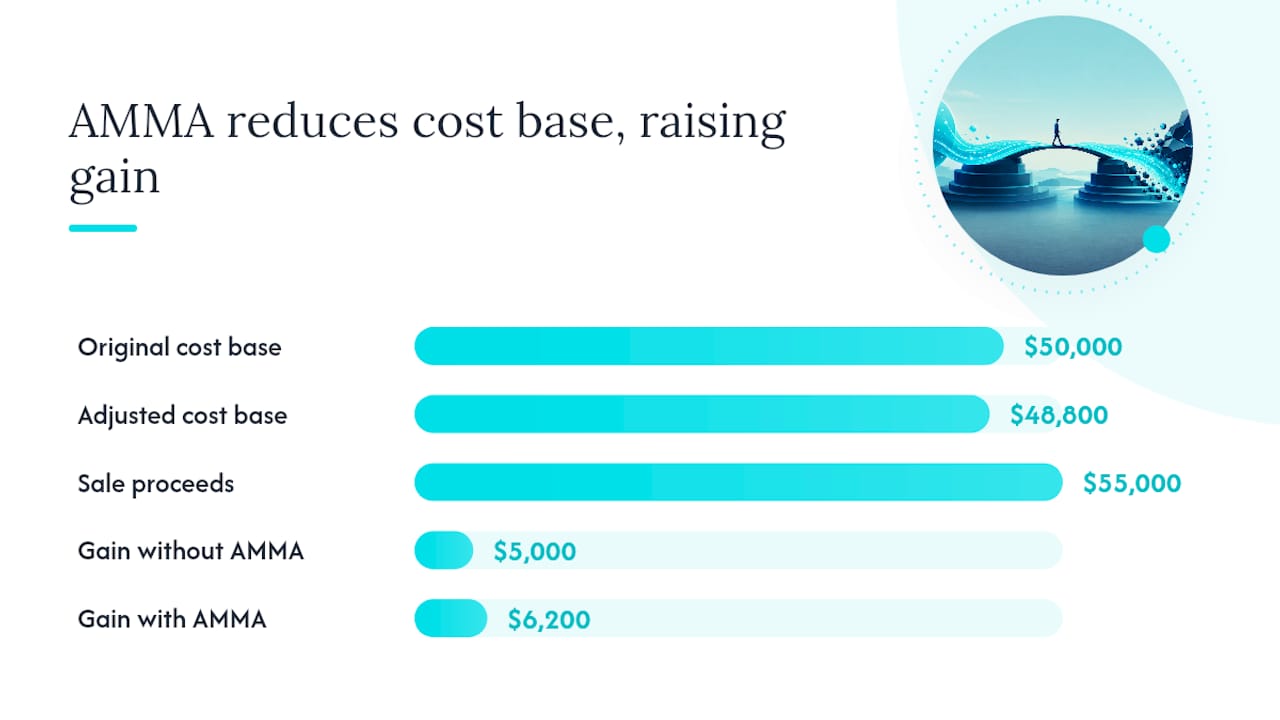
Say you bought 1,000 units in an ETF at $50 each, a $50,000 cost base. This year’s AMMA shows a cost base decrease of $1.20 per unit. Your new cost base becomes $48,800. If you sold those units next year for $55,000, your capital gain is now $6,200 instead of $5,000, purely because of an adjustment most investors never see coming.
Pro Tip: The single most expensive habit in ETF tax reporting is using your bank statement or broker cash summary as your source of truth. It shows what landed in your account. It says nothing about franking credits, foreign tax offsets, or cost base movements, all of which only appear on the AMMA.
How Do You Calculate and Report ETF Capital Gains on Your Tax Return?
Once you have your AMMA statement in hand, the calculation itself follows a predictable sequence.
- Separate income from capital gains. Pull the attributed income components apart from the capital gains components on your statement.
- Gross up discounted gains. If a capital gain is labeled as discounted and the fund hasn’t already grossed it up, multiply it by two before entering it anywhere. Skipping this step is one of the most common ways investors under-report.
- Apply cost base adjustments first. Update your unit cost base with this year’s AMIT adjustment before running any disposal CGT calculation, since the order matters for accuracy.
- Apply the 50% discount where eligible. If you’ve held the units for 12 months or more before a disposal, you can generally discount that portion of the gain by half. Note this applies to a unit sale, not to the fund’s already-discounted distributed gain, which is a separate calculation.
- Map the numbers to the right labels. Grossed-up discounted capital gains distributed by the fund typically go to label 18 in the supplementary section of your tax return, alongside the total current year capital gains figure.
A quick worked mapping: if your AMMA shows a $400 discounted capital gain not yet grossed up, you report $800 at label 18 as your total capital gain, then apply the CGT discount concession where it applies to arrive at your net taxable gain.
Before you lodge, run through this checklist:
- AMMA statement collected and cross-checked against your investor portal, not your bank feed.
- Discounted gains identified and grossed up if the fund hasn’t already done it.
- Cost base adjustments applied to every parcel you still hold.
- Foreign income and franking credit amounts entered in their correct sections, separate from capital gains.
Worked Example: A Reinvested Distribution and Its Cost Base Effect
Distribution reinvestment plans (DRPs) confuse a lot of investors because no cash ever moves, yet the tax obligation is exactly the same as if you’d been paid in full and bought new units yourself.
Say your ETF attributes a $600 discounted capital gain for the year, and you’re enrolled in the DRP, so it’s automatically reinvested into 12 new units at $50 each.
- The fund attributes $600 as a discounted capital gain on your AMMA statement.
- If it isn’t already grossed up, you gross it up to $1,200 for reporting purposes and apply the discount where it flows through to your assessable amount.
- The $600 in reinvested value buys you 12 new units, which get their own acquisition date (the reinvestment date) and their own cost base of $50 per unit.
- Separately, the fund’s AMMA shows a cost base adjustment on your original holding, say a $0.80 per unit decrease across your existing 500 units, reducing that parcel’s cost base by $400.
This means you’re now tracking two different things for the same ETF: the original parcel with its adjusted cost base, and the new DRP parcel with its own acquisition date and cost base. When you eventually sell either parcel, the CGT discount eligibility is judged separately based on each parcel’s own 12-month clock.
Keep a simple running register with three columns: parcel acquisition date, original cost base, and cumulative cost base adjustments applied each year. It sounds tedious for one ETF. It becomes essential once you’re holding four or five funds across a decade of DRP reinvestments.
Common ETF Tax Reporting Mistakes (and How to Fix Them)
The same handful of errors show up year after year in amended assessments, and nearly all of them stem from treating the ETF distribution as simpler than it actually is.
- Using cash received instead of AMMA attributions. The two figures rarely match exactly once franking credits, foreign tax, and cost base items are involved.
- Forgetting to gross up discounted capital gains. This under-reports your assessable income and is one of the most frequently cited errors among retail ETF investors.
- Ignoring AMIT cost base adjustments entirely. This is the most common reason DIY investors need to amend a return years later, because the error only surfaces at disposal.
- Double counting distributions and disposal gains. This happens when investors report the full distributed capital gain and then separately calculate a disposal gain without adjusting cost base first.
- Overlooking franking credits or foreign income components. Both affect your total tax position and, in the case of foreign tax paid, your available offsets.
To fix these before you file:
- Reconcile every AMMA statement against your actual bank or brokerage records line by line.
- Use tax software with AMIT-aware calculations, or hand off multi-year cost base tracking to a tax agent once it gets complicated.
- Keep a dedicated distribution register updated every year, not reconstructed retroactively when the ATO asks questions.
Where to Find Authoritative Guidance and Reporting Tools
The ATO’s own ETF and managed fund pages are the first stop for anything you’re unsure about, particularly around AMIT reporting requirements and how myTax prefill handles managed fund data. Prefill is a convenience, not a guarantee. You’re still responsible for verifying that the pre-populated figures match your actual AMMA statements, especially if you hold carry-forward losses or capital gains from other assets that need to be integrated correctly.
Your fund manager is where the AMMA statement itself lives. Betashares and SSGA both publish these through investor login portals, typically available a few weeks after the financial year closes, well ahead of the October lodgment deadline.
| Option | Best For | Limitation |
|---|---|---|
| ATO myTax prefill | Simple, single-ETF holdings with no reinvestment history | Doesn’t catch cost base errors or multi-year adjustments |
| Portfolio tracking software | Investors with several ETFs and DRP reinvestments | Still requires manual verification against AMMA data |
| Modelling tools like AeroWealth | Seeing how CGT and cost base changes affect long-term retirement projections | Not a substitute for lodging your actual tax return |
| Registered tax agent | Complex histories, multi-year adjustments, carry-forward losses | Costs more than DIY, but catches errors software often misses |
Reach for a tax agent when you’ve got several years of unreconciled AMIT adjustments, when carry-forward losses need to be applied against this year’s gains, or when you simply can’t reconstruct a cost base history that’s been through multiple downward and upward adjustments over time.
Timing and What Professional Help Tends to Cost
The rule that trips people up most: your distribution is assessable in the financial year the AMMA states it relates to, full stop, regardless of when the cash actually lands or whether it’s reinvested through a DRP.
For a single-ETF investor with a clean history, DIY reconciliation usually takes under an hour once you have the AMMA statement in hand. Someone holding five or six ETFs across multiple years, with a mix of DRP reinvestments and inherited cost base adjustments from prior years, can easily spend several hours reconstructing an accurate picture, particularly the first time they do it properly.
- A basic tax return including straightforward ETF distributions is usually within the scope of standard tax agent fees.
- Complex multi-year cost base reconstructions or carry-forward loss applications generally cost more, reflecting the extra reconciliation work involved.
- If you’re spending more than a couple of hours untangling adjustments across several years, the time saved by a professional often justifies the fee, particularly if it prevents a future amended assessment.
Why Careful Tracking Actually Pays Off Long-Term
Most investors treat ETF distributions as a once-a-year admin chore, something to survive rather than understand. That’s a mistake, and not just a compliance one.
Every AMIT cost base adjustment you ignore doesn’t disappear. It sits there, quietly changing what you’ll owe the day you eventually sell, often years down the track when you’ve long forgotten the details. We’ve found that investors who model these adjustments as part of a broader retirement plan, rather than treating tax time as an isolated event, make noticeably better decisions about when to hold, when to sell, and how ETF gains interact with everything else in their portfolio, including superannuation and property. Aerowealth’s approach to scenario modelling exists precisely because these small annual adjustments compound into large differences over a 20 or 30 year horizon.

The investors who get burned aren’t the ones who make a single big mistake. They’re the ones who let a small, unreconciled cost base error repeat for five years running, then discover the true size of the problem the year they finally sell.
See How ETF Capital Gains Affect Your Retirement Plan
Reconciling this year’s AMMA statement tells you what you owe right now. It doesn’t tell you what a decade of AMIT cost base adjustments, reinvested distributions, and eventual disposals will do to your retirement income. That’s a different question, and it’s the one AeroWealth was built to answer.

AeroWealth lets you model how ETF holdings, cost base movements, and eventual CGT events interact with your superannuation, property, and mortgage position, side by side, without spreadsheets. You can stress-test what selling a large ETF parcel in your 50s does to your retirement age compared with holding it inside super, or compare a reinvestment strategy against taking distributions as cash. Aerowealth’s planning models report high success rates for users tracking toward a defined retirement outcome, and an AI assistant explains projections in plain terms under Australian rules. Start with the free plan and see your current ETF and super position projected forward, then upgrade if you want deeper scenario comparisons through Aerowealth’s pricing page.
Sources
- AMIT reporting requirements — ATO
- Cost base adjustments for AMIT members — ATO
- 5 Ways Your ETFs Get Taxed in Australia Without You Ever Selling in 2026 — TaxNextGen
FAQ
How are ETF distributions taxed in Australia?
They’re taxed as ordinary assessable income in the financial year your AMMA statement attributes them, split across categories like franked dividends, foreign income, and discounted capital gains, each taxed under its own rules.
Do ETFs pay capital gains distributions?
Yes. When a fund manager sells assets inside the ETF at a profit, that gain is attributed to unit holders as a distributed capital gain, even if you personally never sold any units that year.
How is capital gains tax calculated on ETFs in Australia?
Take the AMMA statement’s attributed capital gain, gross it up by two if it’s a discounted gain not already grossed up, apply any cost base adjustment to your units first, then apply the 50% discount if you’ve held for 12 months or more before a disposal.
What is the 7% rule in ETF?
There’s no ATO rule by that name in Australian ETF taxation.
What’s the most common mistake investors make with ETF distributions?
Relying on cash received rather than the AMMA statement, which causes investors to miss grossed-up discounted gains and cost base adjustments that materially change what they owe.