Avoid CGT: 5% Contribution First ETF Rebalancing for Australians

The most reliable ETF rebalancing strategy is a rules-based one: check your allocation against a set threshold, usually 5%, and correct drift with new contributions or dividend reinvestment before resorting to sell/buy trades. For most Australian investors, that means annual reviews with threshold triggers in between, not calendar-driven trades alone. The right cadence still shifts with your tax situation, brokerage costs, and portfolio size, all covered below alongside the actual mechanics.
TL;DR:
- Rebalancing thresholds should be set at around 5% to 10% to balance tax and trading costs effectively, with wider bands suitable for smaller portfolios or taxable accounts.
- Contribution-based rebalancing often outperforms sell/buy trades over the long term when factoring in tax implications and transaction costs.
- Tax considerations include tracking capital gains and adjustments from dividend reinvestment plans, which complicate accounting and may influence rebalancing choices.
- The ideal frequency is typically annual, with more frequent checks only justified for larger portfolios where costs are negligible, and setting minimum trade sizes can prevent excessive costs.
- Using scenario modeling tools helps to compare different rebalancing rules and optimize strategies based on individual tax, contribution, and cost circumstances.
Table of Contents
- What Is an ETF Rebalancing Strategy and Which Method Works Best?
- How to Choose Your Rebalancing Frequency and Threshold
- Tax and Transaction Costs You Can’t Ignore in Australia
- A Step-by-Step Rebalance Checklist You Can Actually Follow
- How Scenario Modeling Changes the Rebalancing Decision
- A Prioritized Checklist for DIY ETF Investors
- Model Your Own Rebalancing Rules Before You Commit
- Sources
- FAQ
What Is an ETF Rebalancing Strategy and Which Method Works Best?
Rebalancing means selling what has grown too large a share of your portfolio and buying what has shrunk, restoring your original target mix. It exists to control risk, not to chase returns. Morningstar Australia frames it plainly: rebalancing is a risk-management discipline, not a reliable way to boost performance.
There are three core methods, and each behaves differently under the same market conditions.
- Time-based rebalancing resets your portfolio on a fixed schedule, typically annually or quarterly, regardless of how far it has drifted.
- Threshold-based rebalancing waits until an asset class moves a set percentage away from target, commonly 5%, then triggers a trade.
- Hybrid rebalancing combines both: you check quarterly but only act if drift exceeds your threshold.
Vanguard’s research on multi-asset portfolios found hybrid approaches cut unnecessary trading while staying responsive to real drift, a balance neither pure method achieves alone.
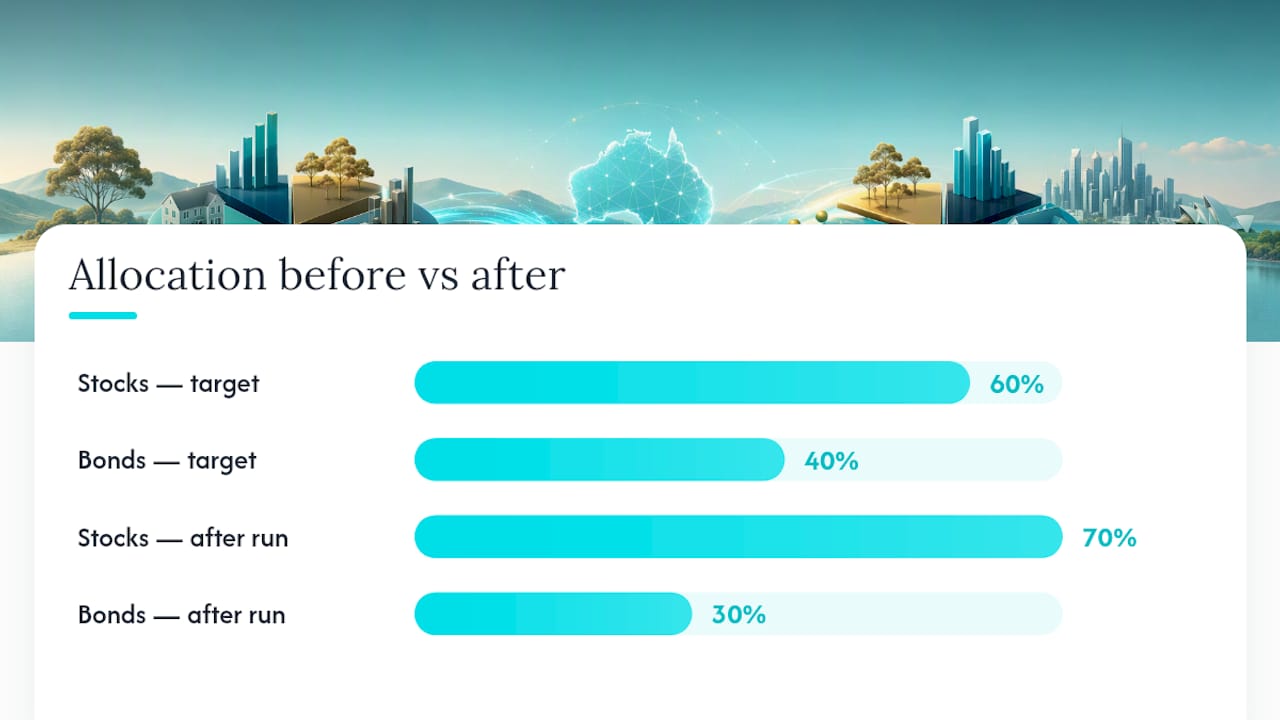
Picture a 60/40 stock/bond ETF split that drifts to 70/30 after a strong equity run. A strict annual reviewer might let that ride for months before acting, exposed to a bigger equity correction the whole time.
How to Choose Your Rebalancing Frequency and Threshold
Match your rule to three things: how much trading costs you, whether the account is taxable, and how often you add money.
- Trading costs and portfolio size. Smaller portfolios lose more (proportionally) to brokerage fees on frequent trades, so wider bands make sense.
- Account type. Inside superannuation, CGT concerns disappear, so tighter thresholds cost less. In a taxable brokerage account, wider bands reduce triggered gains.
- Contribution cadence. If you invest monthly, you have built-in rebalancing opportunities through where you direct new money.
As a starting rule of thumb, most investors do well with an annual review and a 5% threshold, checking more often (quarterly) only once the portfolio grows large enough that costs become negligible relative to balance. Rask Invest uses 5% to 10% divergence bands in practitioner models specifically to avoid over-trading. Cost-sensitive accounts can widen that to 10% and still stay within reasonable risk control, according to Morningstar’s testing on rebalancing frequency, which found daily or monthly rebalancing actually underperforms due to excess turnover.
Pro Tip: Set a minimum trade size (say, $500 or 1% of portfolio value) so you never trigger a rebalance trade that costs more in brokerage and tax than the drift it’s correcting.
Tax and Transaction Costs You Can’t Ignore in Australia
Selling ETF units outside superannuation is a CGT event. Full stop. You need your cost base, adjusted for any AMIT/AMMA attributions from the fund issuer, and you may qualify for the 50% CGT discount if you’ve held the units over 12 months.
A few specific traps catch investors who don’t track this carefully:
- AMIT cost-base adjustments from your ETF issuer change your recorded cost base annually, even without you trading, and missing these adjustments can understate your eventual capital gain.
- Dividend reinvestment plans (DRPs) add new parcels at new cost bases every time a distribution reinvests, which complicates (and often helps) your rebalancing math.
- Wash-sale behavior, selling a losing position purely to harvest the loss and immediately buying back a near-identical exposure, draws direct scrutiny. The ATO has publicly warned it disallows losses from these transactions.
ETFs are generally more tax-efficient than actively managed funds thanks to lower turnover, but that efficiency evaporates fast if you’re triggering CGT events every quarter to chase a tight threshold. When trading costs or expected tax drag outweigh the benefit of tight tracking, contribution-only rebalancing wins.
A Step-by-Step Rebalance Checklist You Can Actually Follow
- Measure. Pull current holdings and calculate each asset’s weight against your target allocation.
- Decide. Pick your correction method for this round: new contributions first, dividend reallocation second, sell/buy only if drift still exceeds your threshold after those.
- Execute. Order trades to minimize CGT (sell tax-advantaged parcels first, use minimum trade sizes, batch trades to cut brokerage).
- Record. Keep AMMA statements, broker confirmations, and cost-base notes for at least five years.
Walk through it: your 60/40 has drifted to 70/30. Instead of selling $15,000 of equities outright, you redirect your next three months of contributions entirely into bonds, closing most of the gap without a single CGT event. One trade instead of a full portfolio overhaul, and less tax to show for it.
How Scenario Modeling Changes the Rebalancing Decision
Running the numbers on paper often surprises people. What looks like the “correct” tight threshold on a whiteboard can lose to a looser, contribution-first rule once you actually model after-tax, after-fee outcomes over ten or twenty years.
Worth testing side by side:
- Annual review with a 5% threshold versus contribution-only correction with no forced sells.
- Different brokerage costs, DRP settings, and your actual marginal tax rate.
- How each rule performs across a volatile five-year stretch versus a calm one.
Rask’s analysis points to exactly this: contribution-routing frequently beats immediate sell/buy rebalancing once tax drag on long-held positions is properly modeled, a result that only shows up when you run the scenario rather than guess. Aerowealth’s side-by-side scenario comparisons and stress-testing let you build both versions of your portfolio, apply your real contribution amounts and tax bracket, and see which rule actually leaves you wealthier after fees and CGT, not just which one feels tidier on a spreadsheet.
Some rules that look identical in steady growth diverge sharply when volatility spikes and asset correlations shift.*

A Prioritized Checklist for DIY ETF Investors
Rebalancing is risk management, not a return booster, so treat it that way. Favor contribution redirection and dividend reallocation over selling whenever the tax math allows it, and reserve sell/buy trades for drift that genuinely changes your risk exposure. Automate the measurement, set calendar reminders, and resist the urge to fine-tune your threshold based on last month’s headlines.
— Aerowealth Team
Model Your Own Rebalancing Rules Before You Commit
Aerowealth was built for exactly that kind of side-by-side comparison, letting you stress-test different rebalancing rules against real Australian tax settings instead of guessing which one sounds more disciplined.
You can start with the free plan and build two versions of your portfolio: one rebalancing on a strict threshold, one leaning on contributions, then compare the projected retirement income and net worth each one produces. If the comparison convinces you it’s worth deeper scenario work, bridge years, or mortgage offset modeling, current prices are available on the pricing page and you can unlock the full toolkit by upgrading. Either way, the Aerowealth platform gives you a clearer answer than another afternoon with a spreadsheet.
Sources
For the tax rules on ETF sales, see the ATO’s guidance on exchange traded funds. For methodology comparisons, review Vanguard’s rebalancing research and Rask Invest’s practitioner steps. For broader asset allocation planning, Asset Protection Planning offers useful background on portfolio risk structure.
- Exchange traded funds — ATO
- Is it time to rebalance your investment portfolio? — Morningstar Australia
- Why, how and when multi-asset investors should rebalance — Vanguard
FAQ
How Do You Rebalance an ETF Portfolio?
You compare your current asset weights against your targets, then correct the gap using new contributions, dividend reinvestment, or, if drift is severe, selling the overweight ETF and buying the underweight one. Most Australian investors check this annually and act only if drift exceeds a set threshold, commonly 5%.
What Is the 7% Rule in ETF Investing?
There’s no universally recognized “7% rule” in ETF rebalancing methodology. The widely used and evidence-backed figure is a 5% to 10% drift band, popularized by practitioner guides like Rask Invest, where you rebalance once an asset class moves that far from its target weight.
What Is the 5/25 Rule for Rebalancing?
It’s a stricter variant of standard threshold rebalancing, designed to catch drift in both large and small allocations proportionally.
What Is the Best Rebalancing Strategy for Most Investors?
Tools like Aerowealth let you model this rule against your own tax rate and contribution schedule before committing to it.
Should I Rebalance Differently for Bond ETFs Versus Equity ETFs?
Bond ETFs typically drift less dramatically than equity ETFs, so they often need less frequent correction, but interest rate cycles can still push fixed income allocations off target quickly. Many investors set wider thresholds for bond ETFs and tighter ones for volatile equity or sector ETFs, reflecting each asset’s typical drift pattern.