Your FIRE Number in Australia: How to Calculate It

Your FIRE number is the size of the portfolio you need to fund your spending indefinitely without a paycheck. Two formulas get you there fast: multiply your annual spending by 25 (the rule of 25), or divide it by your chosen safe withdrawal rate. Most Australian FIRE planners lean toward a 3% to 3.75% withdrawal rate rather than the American 4%, because our retirements often run longer and the tax and pension rules differ. The catch for anyone retiring before 60: superannuation is locked away, so you need a separate bridge fund to cover the gap.
- Annual spending × 25 = rough FIRE number
- Annual spending ÷ safe withdrawal rate (SWR) = more precise FIRE number
- If you plan to retire before your super preservation age, you need bridge assets outside super, sized to cover every year until you can access it
Key Takeaways
Your Australian FIRE number depends less on picking the perfect withdrawal rate than on correctly splitting your plan into a bridge fund and a super balance sized around your actual preservation age.
| Point | Details |
|---|---|
| Use a conservative SWR | A 3.5% withdrawal rate on $60,000 of spending requires about $1.71 million, versus $1.5 million at 4%. |
| Bridge fund is non-negotiable before 60 | Retiring at 50 means funding a full decade of spending from liquid assets outside super. |
| ASFA benchmarks are a sanity check | A comfortable retirement lump sum sits at roughly the ASFA benchmark for a comfortable lifestyle assuming home ownership and part Age Pension. |
| Tax treatment favors patience | Assets held over 12 months outside super get a 50% capital gains tax discount; super withdrawals after 60 are typically tax-free. |
| Model it, don’t guess it | AeroWealth’s calculator runs bridge and super scenarios side by side, including CGT and stress tests against weak early returns. |
This article is general information, not a substitute for advice from a qualified financial advisor. Consult a qualified financial professional about your own circumstances before acting on anything here.
Table of Contents
- How Do You Calculate Your FIRE Number in Australia?
- How Does Superannuation Change Your FIRE Plan?
- What Do the ASFA Retirement Standards Say You Need?
- Worked Example: $60,000 a Year, Retiring at 50
- How AeroWealth Helps You Model Your Bridge Years
- How Does Tax Affect Your FIRE Number?
- How Should Inflation and Returns Change Your Target?
- What About Healthcare Costs in Early Retirement?
- Can You Boost Super Contributions to Reach FIRE Sooner?
- Could Policy Changes Affect Your FIRE Plan?
- Why Most FIRE Advice Gets the Australian Bridge Wrong
- Model Your Own FIRE Number With AeroWealth
- Sources
- FAQ
How Do You Calculate Your FIRE Number in Australia?
The rule of 25 comes from the Trinity Study, the 1998 research that tested historical US market returns against a 4% annual withdrawal rate over 30-year retirements. Flip 4% into a multiple and you get 25 times your spending. It’s a decent back-of-envelope number, but it wasn’t built with Australian tax rules, super preservation rules, or 40 to 50-year early-retirement horizons in mind.
The more useful version of the math works backward from a withdrawal rate you actually trust: annual spending ÷ SWR = FIRE number. Spend $60,000 a year and use a 4% SWR, and you land on $1.5 million. Drop to 3.5%, a rate many Australian FIRE calculators now recommend for long retirements, and the target jumps to roughly $1.71 million.
Three things push Australians toward a more conservative withdrawal rate:
- Longer time horizons mean money may need to last many decades.
- Early retirement market downturns cause notable risks due to asset sell-downs at low prices.
- Tax on earnings outside super reduces effective returns compared to concessional super environments.
Statistic Callout: On $70,000 of annual spending, a 4% SWR requires $1.75 million. That’s an extra $250,000 sitting between the optimistic assumption and the conservative one.
How Does Superannuation Change Your FIRE Plan?
Superannuation is the single biggest wrinkle in Australian FIRE planning, and it’s why copying a US FIRE blog word for word gets people into trouble. Your preservation age sits at 60 for anyone born after June 1964, which covers virtually everyone currently planning early retirement. Retire at 45 and your super is untouchable for 15 years, no matter how large the balance grows.
That gap is why FIRE planning in Australia really means planning two separate pools of money, not one.
- The bridge fund covers every year between your retirement date and preservation age. It needs to be liquid and accessible, which is why index ETFs, managed funds, and direct shares held outside super are the usual building blocks rather than illiquid property or locked-up super contributions.
- The superannuation fund keeps compounding in the background, taxed concessionally, until you can draw on it and, later, potentially supplement it with a part Age Pension.
The Age Pension matters more than most FIRE calculators admit. Because it can act as a partial income floor later in life, some published Australian retirement benchmarks actually assume part Age Pension receipt when they calculate how much you need saved, effectively lowering the private capital hurdle for a comfortable retirement.
Pro Tip: Stress-test your bridge fund against a bad first five years, not just an average return. A modeller that lets you shift the retirement date and rerun the numbers will show you exactly how thin the bridge gets if markets fall early.
What Do the ASFA Retirement Standards Say You Need?
The Association of Superannuation Funds of Australia publishes the most widely cited retirement benchmarks in the country, and they’re a useful sanity check against whatever number your own FIRE math spits out.
- Comfortable retirement lump sums for couples and singles reflect current benchmarks for a comfortable lifestyle.
- Modest retirement lump sums for couples and singles reflect current benchmarks for a modest lifestyle.
These figures assume you own your home outright and receive at least a part Age Pension eventually, an assumption ASFA spells out in its methodology. Renters need to add ongoing housing costs on top, which can push a “comfortable” target well past those lump sums.
The gap shows exactly how much the pension does the heavy lifting in these figures.*
Where this gets useful for FIRE planning: treat “modest” as roughly a lean FIRE floor, “comfortable” as a rough regular FIRE target if you already own your home, and anything above that as fat FIRE territory you’ll need to calculate yourself, since ASFA doesn’t publish a benchmark for it.
Worked Example: $60,000 a Year, Retiring at 50
Here’s the arithmetic laid out step by step, using a retiree who wants $60,000 a year in today’s dollars and plans to stop working at 50.
- Total FIRE number at 4% SWR: $60,000 ÷ 0.04 = $1.5 million
- Total FIRE number at 3.5% SWR: $60,000 ÷ 0.035 = $1.71 million, a more conservative Australian-style estimate modeled by Savings Mate
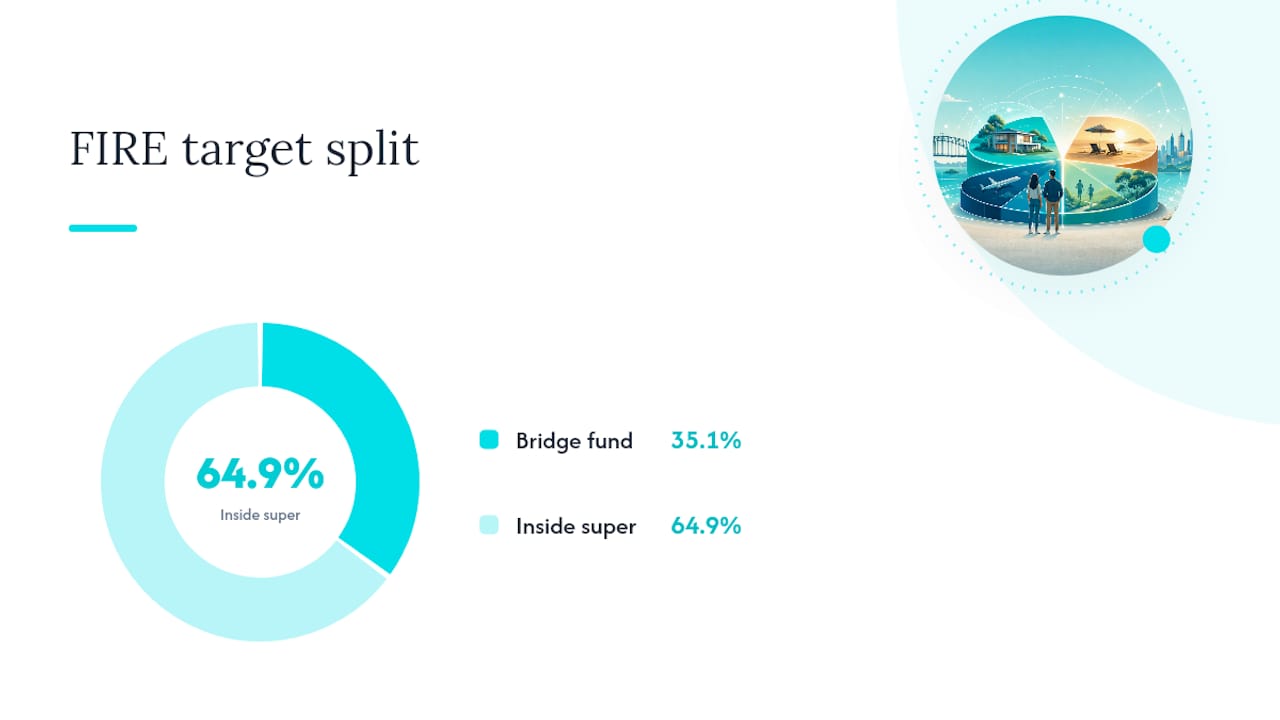
- Bridge fund needed: retiring at 50 means a 10-year gap until super access at 60. At $60,000 a year with no growth assumption, that’s $600,000 held outside super in liquid assets
- Super target at 60: the remainder of the FIRE number, funded by whatever’s already accumulated in super plus employer and voluntary contributions compounding for another decade
| Input | Value |
|---|---|
| Annual spending target | $60,000 |
| FIRE number at 3.5% SWR | $1,710,000 |
| Bridge fund (10 years, no growth) | $600,000 |
| Remaining target inside super by 60 | $1,110,000 |
That $600,000 bridge figure is deliberately conservative. It ignores investment growth during the drawdown years, which most real portfolios would generate. Run the same scenario through the MoneySmart retirement planner or a dedicated modeller, and you can test what a 5% average return during the bridge years does to that number, along with different retirement ages and contribution rates.
How AeroWealth Helps You Model Your Bridge Years
Spreadsheets can do this math, but they break down fast once you’re testing multiple retirement ages, contribution scenarios, and market assumptions side by side. AeroWealth’s retirement calculator was built specifically around the Australian bridge-and-super split, so you’re not manually recalculating preservation-age timing every time you tweak an assumption.
- Models super balances alongside bridge-fund drawdowns in a single timeline
- Runs side-by-side scenario comparisons, like retiring at 50 versus 55, without rebuilding a spreadsheet
- Stress-tests assumptions such as a market downturn in your first bridge years
- Accounts for capital gains tax and mortgage offset strategies that affect real after-tax spending power
Pro Tip: Run your worked example through a modeller with a below-average early return assumption before locking in a retirement date. Sequence-of-returns risk is the single most underestimated threat to a tight bridge fund.
How Does Tax Affect Your FIRE Number?
Tax treatment changes how much you actually need to save, not just how much you keep. Investments held outside super, your bridge fund, generate income and capital gains taxed at your marginal rate.
Inside super, the environment is far gentler. That asymmetry is exactly why the two-bucket approach matters: money outside super does more tax work for you if it’s structured around long-term holdings and the discount, while money inside super should be left to compound largely undisturbed until preservation age.
Withdrawal sequencing matters too. Drawing from your bridge fund first, rather than triggering an early access application to super (generally not available anyway before preservation age except in narrow hardship cases), keeps your concessionally taxed super balance compounding for longer. Model the after-tax version of your spending target, not the pre-tax one, since a $60,000 lifestyle funded by taxable bridge assets might require selling down closer to $65,000 or $70,000 gross once tax on gains and income is accounted for.
How Should Inflation and Returns Change Your Target?
Every FIRE number above is expressed in today’s dollars, and inflation will erode that buying power steadily over a multi-decade retirement. If you retire at 45, your $60,000 lifestyle could need close to $120,000 in nominal terms by your late 60s just to maintain the same standard of living.
The standard fix is to build your FIRE number using real returns, meaning investment returns minus inflation, rather than nominal ones. That real-return figure is what should drive your withdrawal rate assumptions, not the headline market return you see quoted in a fund’s marketing.
It builds in a buffer against inflation running hotter than expected during a bad decade, which happened through parts of the 1970s in the original US retirement research and again more recently through 2022 and 2023. Revisit your target every few years rather than setting it once, adjusting for actual inflation and actual portfolio performance instead of assuming the plan you built at 40 still holds at 50.
What About Healthcare Costs in Early Retirement?
Healthcare is one of the most commonly underestimated line items in Australian FIRE budgets, largely because Medicare quietly covers so much of it during your working years that people forget to price it in for retirement. Private health insurance premiums climb with age and tend to outpace general inflation, and the Lifetime Health Cover loading penalizes anyone who drops or delays cover after turning 31, an incentive that pushes most FIRE planners to maintain continuous private hospital cover rather than lapse it to save money in the early bridge years.

Out-of-pocket costs, dental, optical, specialist gap fees, and allied health, also tend to rise as you age, and they sit outside what Medicare or a basic private policy covers. The ASFA modest and comfortable benchmarks already build in an allowance for private health insurance and reasonable ancillary costs, which is one more reason those figures work as a useful cross-check against your own number.
If you’re retiring well before 65, budget healthcare as its own line item rather than folding it into general living costs. A sudden hospital admission or a chronic condition diagnosed at 52 doesn’t care that you’d planned your bridge fund down to the dollar. Building a small buffer, or holding slightly more conservative bridge assets than the bare minimum, gives you room to absorb a bad health year without derailing the whole plan.
Can You Boost Super Contributions to Reach FIRE Sooner?
Superannuation’s tax concessions make it one of the most efficient places to direct extra savings, provided you’re comfortable with money being locked away until preservation age.
The annual concessional contributions cap limits how aggressively you can do this in any given year, and unused cap amounts can sometimes be carried forward for up to five years if your total super balance sits under the relevant threshold, letting higher earners catch up after a lower-income year. Non-concessional contributions, made from after-tax money, offer a different lever: no immediate tax deduction, but they still get super’s concessional earnings tax environment going forward.
The trade-off against FIRE goals is straightforward: every extra dollar into super strengthens your future super bucket but does nothing for your bridge fund. If you’re retiring at 45 or 50, over-indexing on super contributions at the expense of building bridge assets can leave you asset-rich and cash-poor for a decade. The balance that works for most early retirees is maximizing employer contributions and modest voluntary top-ups, while keeping most surplus savings outside super, liquid and building toward the bridge, until the bridge years are comfortably funded.
Could Policy Changes Affect Your FIRE Plan?
Superannuation and Age Pension rules have changed repeatedly over the past two decades, and there’s no reason to expect that pattern to stop. Preservation age itself shifted upward for people born after 1960, contributions caps get indexed and occasionally overhauled, and Age Pension asset and income test thresholds move every year. Building a FIRE plan that assumes today’s rules stay frozen for 40 years is optimistic at best.
The practical response isn’t to guess at future legislation. It’s to build in margin and revisit your plan regularly. A bridge fund sized with a buffer above the bare-minimum calculation absorbs a preservation age that creeps up another year or two.
Treat your FIRE number as a living calculation, not a one-time answer. Rerun it whenever a major policy change lands, whenever your spending shifts, and at minimum every couple of years regardless. Property investors adjusting bridge-fund allocations should also keep an eye on broader market conditions that affect valuations feeding into net worth calculations, since a bridge fund partly backed by property carries different risk than one held in liquid ETFs.
Why Most FIRE Advice Gets the Australian Bridge Wrong
Australians who copy that advice line for line end up with a FIRE number that’s technically correct in isolation and practically useless, because it ignores the decade-plus gap between quitting work and touching super.
The bigger miss isn’t the withdrawal rate debate, it’s the assumption that FIRE is a single number at all. It’s two numbers: a bridge fund sized for a fixed number of years, and a super balance that keeps compounding whether you touch it or not. Treating them as one blended pile of money is how people either retire with far more bridge capital than they need, sitting idle in low-growth assets out of caution, or retire with too little, and discover the gap only when markets turn against them in year three.
But neither number means much without stress-testing the actual sequence of returns during your specific bridge years, which is where most manual calculations quietly fall apart.
Model Your Own FIRE Number With AeroWealth
Aerowealth is built for exactly the calculation this article just walked through: splitting your plan into a bridge fund and a superannuation balance, then testing what happens when markets, contribution rates, or your retirement date change. Instead of rebuilding a spreadsheet every time you want to compare retiring at 50 versus 55, you get side-by-side scenario comparisons that update instantly.

The platform layers in the details a generic calculator skips: capital gains tax on bridge-fund drawdowns, mortgage offset strategies if you’re carrying debt into retirement, and stress tests against a bad early sequence of returns. It’s built specifically around Australian super and preservation-age rules, so you’re not adapting a US-style calculator to fit local rules after the fact.
Start with the free retirement calculator to map your own bridge fund and super target, then check the pricing page if you want the Pro scenario comparisons for testing multiple retirement ages side by side.
Sources
- ASFA — Retirement Standard: Super balances needed for comfortable retirement reach all-time high
- MoneySmart — Retirement planner
- Savings Mate — Your FIRE Number in Australia 2026
FAQ
Is $1,000,000 Enough to Retire at 60?
For many Australians, yes.
Can I Retire at 40 with 2 Million Dollars?
The bigger question at 40 is liquidity: you’d need a large slice of your savings held outside super to bridge the multi-decade gap until preservation age.
What’s My FIRE Number?
On $60,000 a year, that works out to roughly $1.71 million; running the calculation through a tool like AeroWealth’s retirement calculator lets you test different rates and ages against your own numbers.
Can I Retire at 60 with $600,000 in Super?
It’s tight against the ASFA comfortable benchmark of $630,000 for a single retiree, but workable for a modest lifestyle, especially combined with a part Age Pension. At 60, super is generally accessible, which removes the bridge-fund problem entirely and lets the whole balance start working immediately.