What Healthcare Really Costs You in Australian Retirement

Budget for a moderate annual amount in routine out-of-pocket healthcare costs once you retire, and set aside a separate buffer for episodic events like elective surgery, which can add a significant extra cost in a single year. The biggest cost drivers are specialist gap fees, dental and vision care, and private hospital admissions, none of which Medicare fully covers.
Three things to do this week:
- Check Medical Costs Finder before booking any specialist to compare typical gap fees by provider.
- Confirm whether you are close to the Medicare Safety Net thresholds, since crossing them lifts your Medicare rebate significantly for the rest of the year.
- Check your prescriptions against the PBS Safety Net, because once your household hits the threshold, remaining scripts for the calendar year cost far less.
Pro Tip: Most retirees underestimate dental and hearing costs, not GP visits. Medicare barely touches either, so they deserve their own line in your budget, not an afterthought.
Key Takeaways
Healthcare costs in retirement rise with age and depend heavily on how well you use Medicare Safety Nets, the PBS Safety Net, and concession card eligibility to reduce out-of-pocket spending.
| Point | Details |
|---|---|
| Budget in tiers, not one number | Separate routine ($1,000 to $2,500), specialist and ongoing ($1,500 to $4,000), and episodic high-cost care into distinct budget lines. |
| Track Safety Net thresholds | Only verified, paid-in-full amounts count toward Medicare and PBS Safety Net thresholds, which reset every January 1. |
| Check card eligibility annually | The income-tested Commonwealth Seniors Health Card can unlock the lower concessional PBS Safety Net threshold even for self-funded retirees. |
| Inflate healthcare separately | Apply a higher escalation rate to healthcare and insurance costs than to general retirement expenses when projecting long term. |
| Model scenarios before you need them | Use a tool like Aerowealth to stress-test a chronic condition and a major surgery scenario against your actual drawdown plan. |
Table of Contents
- Ways to Manage Healthcare Costs in Retirement
- What Medical Services Actually Cost in Retirement
- Should You Keep Private Health Insurance in Retirement?
- Building Healthcare Into Your Retirement Plan
- Testing Healthcare Scenarios Before They Happen
- Concession Cards Worth Checking Before You Assume You’re Ineligible
- What Routine, Specialist, and Emergency Care Actually Cost You
- How Aging Changes Your Healthcare Costs Over Time
- Rebates That Reduce Your Private Health Insurance Bill
- Planning for Aged Care Costs Later in Retirement
- Why Healthcare Inflation Deserves Its Own Line in Your Budget
- Tax Rules That Affect Your Healthcare Spending
- Sources
- FAQ
Ways to Manage Healthcare Costs in Retirement
You don’t need a financial degree to cut your healthcare spending in retirement. You need a system, and most retirees never build one.
- Find bulk-billing GPs first. A regular bulk-billed GP can save you a typical gap payment of several tens of dollars per visit compared with a gap-charging practice, and many bulk-bill pensioners and concession card holders as standard practice.
- Ask about public-patient treatment. For non-urgent procedures, being treated as a public patient in a public hospital is usually free under Medicare, even if you hold private cover.
- Register and track your Safety Net progress. Only verified payments, meaning amounts paid in full before you claim, count toward the Medicare Safety Nets thresholds, so keep receipts and claim promptly.
- Build a dedicated healthcare buffer. Keep this separate from your general emergency fund since a knee replacement or cataract surgery can hit in the same year as a car repair.
- Review your private health insurance every year. Cover that made sense at 55 often doesn’t fit at 70, and premiums rise faster than most other retirement costs.
Pro Tip: Set a calendar reminder for January 1, when Safety Net thresholds reset. Starting the year knowing your rough annual specialist and script spend puts you ahead of most retirees who only notice the thresholds after they’ve already blown past them.
What Medical Services Actually Cost in Retirement
The gap between what Medicare pays and what you actually owe is where most retirement healthcare budgets fall apart. Here’s the breakdown by service type.
GP visits. Bulk-billed appointments cost you nothing, but where gap fees apply, expect a typical gap payment of several tens of dollars out of pocket per visit. If you see a GP monthly for chronic disease management, that gap alone can add $500 or more a year.
Medical Costs Finder lets you compare typical fees by provider and procedure before you book, which is the single fastest way to avoid an unpleasant surprise.
Hospital care. Treatment as a public patient in a public hospital is generally free. Choosing to be treated as a private patient, whether in a public or private hospital, brings premiums, possible gap fees from surgeons and anesthetists, and excess payments that can run into thousands of dollars for elective procedures like hip replacements.

Medicines. The PBS subsidizes the cost of many prescription medicines, and the PBS Safety Net further reduces per-script costs once your household spending hits the annual threshold, with a lower threshold for concession cardholders. If you manage multiple chronic conditions, tracking toward that threshold matters as much as tracking your Medicare Safety Net.
Dental, optical, hearing, and allied health. None of these are meaningfully covered by Medicare. Budget a moderate amount annually for routine dental, more if you need crowns or implants. The Hearing Services Program helps eligible pensioners access subsidized hearing aids, and some states run low-cost public dental schemes worth checking.
Mental health. A GP Mental Health Treatment Plan unlocks Medicare-subsidized psychologist sessions, and a Chronic Disease Management plan can unlock rebates for physiotherapy, podiatry, and other allied health services, so ask your GP about both.
Average health expenditure per person in Australia rises steadily with age, according to the Australian Institute of Health and Welfare, which is the clearest evidence that your healthcare line item won’t stay flat through a 25 or 30 year retirement.
Should You Keep Private Health Insurance in Retirement?
Private hospital cover and extras cover solve different problems, and conflating them is where most retirees overspend. Hospital cover pays toward private hospital admissions and gives you choice of doctor and shorter elective surgery waits. Extras cover reimburses part of your dental, optical, physio, and other allied health costs, up to annual limits that are often lower than people expect.
Lifetime Health Cover loading is the sleeper issue here. If you didn’t take out hospital cover before the July 1 following your 31st birthday, you pay a 2% loading per year you were without cover, capped at 70%, for as long as you hold a policy, as detailed by the ATO. Dropping cover now to save money can be expensive if you ever want to rejoin later.
Run this audit annually:
- Does your hospital tier actually cover the procedures you’re likely to need in the next five years?
- What are the waiting periods and exclusions, and have any new ones been added at renewal?
- Are you paying for extras like pregnancy cover or gym rebates you’ll never use?
- Would the premium be better spent building your own healthcare buffer, given your specific risk profile?
Pro Tip: Private cover earns its premium when you have a scheduled elective procedure on the horizon, chronic conditions likely to need specialist input, or a strong preference for choice of surgeon. If your health is solid and you’re comfortable relying on public hospitals for anything non-urgent, redirecting that premium into savings can be the smarter money.
Building Healthcare Into Your Retirement Plan
Treating healthcare as a fixed, minor line item is the single most common budgeting error retirees make. Treat it instead as a variable cost with a predictable baseline and an unpredictable tail.
- Set a baseline figure. Use your last two years of GP, specialist, and pharmacy bills, cross-check gap fees on Medical Costs Finder, and add PBS costs based on your current scripts.
- Add a contingency layer. Set aside a separate amount, on top of your baseline, sized to cover one moderate procedure or hospital stay without disrupting your regular income drawdown.
- Separate recurring costs from one-off events. Recurring costs (GP, scripts, dental cleans) belong in your annual budget; episodic costs (surgery, a hearing aid replacement) belong in your buffer.
- Schedule an annual check. Review your private insurance, your Safety Net and PBS Safety Net progress, and any card eligibility changes every January.
- Bring the right paperwork to a financial adviser. A current medication list, the last twelve months of medical bills, and your insurance policy documents let an adviser give you real numbers instead of guesses. This kind of preparation fits naturally into a broader retirement budgeting exercise rather than a standalone healthcare conversation.
Testing Healthcare Scenarios Before They Happen
Most retirement budgets treat healthcare as one flat number, which is exactly why they fail the first time someone needs a hip replacement. A scenario modeller like Aerowealth lets you run your retirement plan against several healthcare realities side by side, not just one optimistic average.
Try three versions of your plan: a baseline scenario using your routine annual out-of-pocket figure, a chronic condition scenario with elevated specialist and medicine costs sustained over several years, and a major surgery scenario with a large one-off private hospital cost. Compare what each does to your drawdown rate and how fast it eats into your buffer.
Feed in your average annual out-of-pocket spend, a realistic private health premium escalation rate, and where you currently sit against PBS and Medicare Safety Net thresholds. Stress-testing these numbers, rather than assuming they stay flat, is what separates a plan that survives a bad health year from one that doesn’t.
Pro Tip: Run the major surgery scenario at an age five to ten years older than you are now. Healthcare shocks tend to cluster later in retirement, and testing your plan against that timing, not just today’s numbers, is where a modeller earns its keep.
Concession Cards Worth Checking Before You Assume You’re Ineligible
The Commonwealth Seniors Health Card and Pensioner Concession Card are two of the most underused levers in retirement healthcare budgeting, largely because eligibility rules confuse people into not applying.
The Pensioner Concession Card comes automatically with most Age Pension and eligible payment types, and it unlocks bulk-billed GP visits from many practices, cheaper PBS medicines, and state-based discounts on things like council rates, car registration, and public transport.
The Commonwealth Seniors Health Card is the one self-funded retirees overlook. It’s not asset-tested, only income-tested, so a retiree with substantial superannuation and low assessable income can still qualify. It gets you cheaper PBS medicines, access to the PBS Safety Net at the concessional threshold rather than the general one, and in many states a Seniors Energy Supplement or utility concessions.
Neither card is automatic just because you’ve retired. You need to apply through Services Australia and meet the specific test for each. If your income sits near the threshold, it’s worth checking annually, because a small change in assessable income, such as a shift in how you draw down your super, can move you in or out of eligibility. Given the concessional PBS Safety Net threshold is meaningfully lower than the general one, qualifying for the Commonwealth Seniors Health Card alone can materially cut your annual medicine spend if you take several regular prescriptions.
What Routine, Specialist, and Emergency Care Actually Cost You
Lumping all healthcare spending into one number hides the fact that three very different cost patterns are stacking on top of each other every year.
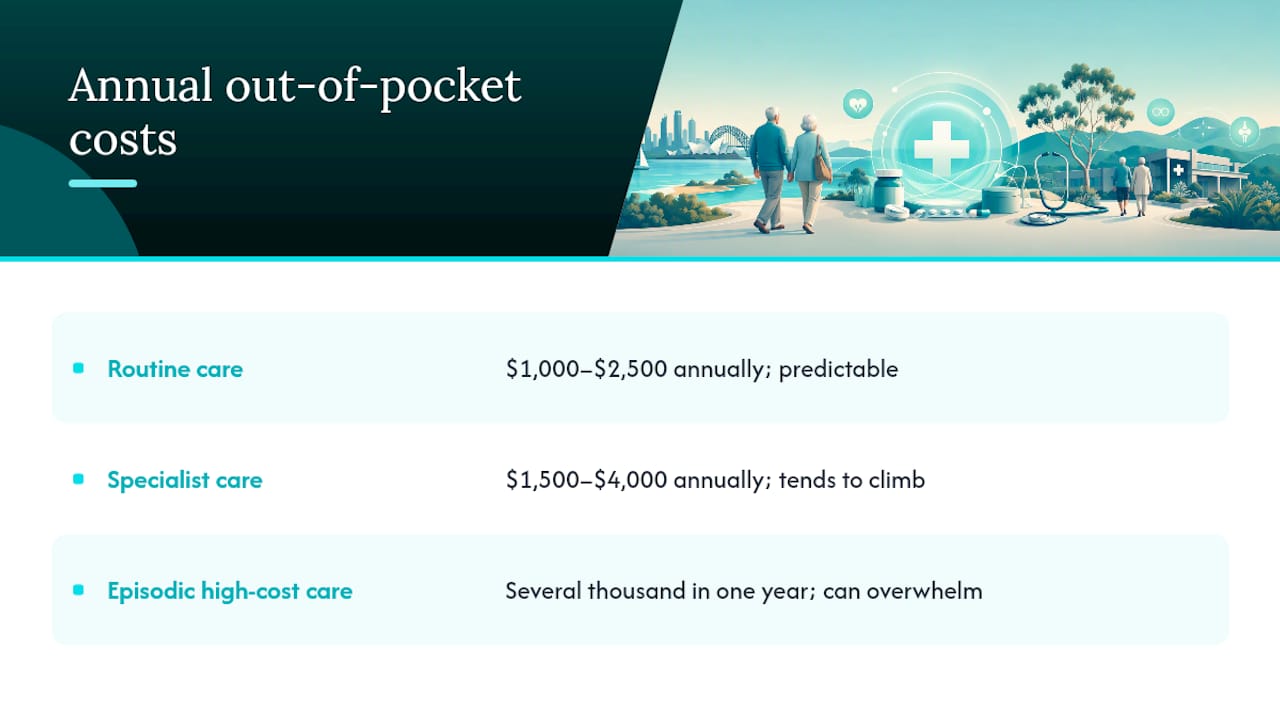
Routine care covers regular GP visits, standard scripts, and basic dental cleans. For most healthy retirees, this sits somewhere between $1,000 and $2,500 annually, and it’s the most predictable part of your budget.
Specialist and ongoing management care covers conditions that need regular monitoring, such as cardiology follow-ups, diabetes management, or physiotherapy for a chronic joint issue. This tier typically adds another $1,500 to $4,000 a year once you factor in specialist gap fees and allied health rebased costs, and it tends to climb rather than plateau as you age.
Episodic high-cost care is the tier that wrecks unprepared budgets: elective surgery, a hospital admission, a major dental procedure, or a sudden diagnosis requiring intensive specialist input. A single private hospital stay for elective surgery can add several thousand dollars in gap and excess payments in one year, even with private cover in place.
The mistake most retirees make is budgeting only for the first tier and treating the second and third as hypothetical. They aren’t. MoneySmart’s guidance on retirement health costs is explicit that using public services, tracking concessions, and reviewing insurance regularly are the practical levers that keep the second and third tiers from overwhelming a fixed retirement income. Treat your contingency fund as the line item that absorbs tier three, not your regular cashflow.
How Aging Changes Your Healthcare Costs Over Time
Healthcare spending in retirement isn’t a flat line. It’s a slow climb that accelerates once chronic conditions set in, and planning for the retiree you are at 65 without accounting for the retiree you’ll be at 80 is a common planning gap.
Health expenditure per person rises consistently with age, and the AIHW’s national health expenditure data confirms this pattern holds across the system, not just anecdotally. In your 60s, spending tends to concentrate on preventive care, routine checks, and the occasional elective procedure. By your late 70s and into your 80s, chronic disease management, more frequent specialist visits, and higher medicine use typically push annual costs well above where they started.
This progression matters for two practical reasons. First, a static healthcare budget set at retirement age will almost certainly understate your costs a decade or two later. Second, the timing of major health events interacts with your PBS and Medicare Safety Net thresholds. If you’re managing two or three chronic conditions simultaneously, you may cross both thresholds earlier in the calendar year, which changes your effective annual cost far more than a single condition would.
Building an age-adjusted assumption into your plan, rather than a flat annual figure, gives you a more honest picture. Even a rough rule, such as increasing your assumed out-of-pocket healthcare cost by a modest percentage every five years past 65, is better than assuming your 65 year old costs will hold steady to 85.
Rebates That Reduce Your Private Health Insurance Bill
The Australian Government subsidizes private health insurance premiums through the Private Health Insurance Rebate, and the amount you receive depends on your income and your age, with older Australians generally eligible for a higher rebate tier than younger policyholders.
The rebate applies as a percentage reduction on your premium and can be taken either as a reduced premium directly from your insurer or claimed back at tax time, depending on how you set it up. Because the rebate is income-tested, a retiree drawing a modest income from superannuation in retirement phase may qualify for a meaningfully higher rebate percentage than they did while working, even holding the same policy.
This is worth revisiting the year you retire. If your assessable income drops once you shift from salary to super drawdowns and the Age Pension, you may move into a higher rebate bracket without doing anything except notifying your insurer of your updated income estimate. Insurers don’t always prompt you to update this, so the responsibility sits with you.
Separately, the Lifetime Health Cover loading discussed earlier interacts with the rebate. You still get the rebate percentage applied to your premium even while paying a loading, but the loading itself isn’t rebated, so it’s pure additional cost on top of whatever tier you’re already paying. If you’re weighing whether to reinstate lapsed cover, factor in both the rebate you’d receive and the loading you’d be locked into, since the two can partially offset each other, but rarely cancel out completely.
Planning for Aged Care Costs Later in Retirement
Aged care sits in a different cost category from the medical expenses covered so far, and it’s the one most retirement budgets ignore entirely until it’s urgent. Costs scale sharply depending on the level of support needed.
Home care is the least expensive tier, covering help with cleaning, personal care, and basic health monitoring while you remain in your own home. Costs depend on the level of government-subsidized home care package you’re assigned, with means-tested contributions on top for those with higher income or assets.

Assisted living and retirement villages sit in the middle, generally involving an upfront ingoing contribution plus ongoing service fees, with significant variation between providers and locations.
Residential aged care (nursing homes) is the highest-cost tier, involving a Refundable Accommodation Deposit or daily payment, plus a basic daily care fee and potentially a means-tested care fee, depending on your assets and income. These fees are set and regulated federally, and your specific contribution depends on an assessment of your financial position at the time you enter care.
The critical planning point is that aged care costs are means-tested against your assets and income at the point you need care, not at the point you retire. A plan that looks comfortable at 65 can look very different if a spouse needs residential care at 82 and the family home or investment assets factor into that means test. For readers concerned about a catastrophic care event that goes beyond typical aged care, such as care following a serious injury, resources on claiming future care costs outline how compensation claims can factor into long-term care funding. Modelling a residential aged care scenario now, even roughly, beats discovering the real numbers during a family crisis.
Why Healthcare Inflation Deserves Its Own Line in Your Budget
General inflation and healthcare inflation are not the same number, and treating them as interchangeable is one of the quieter ways retirement budgets fall short. Private health insurance premiums, in particular, have historically risen faster than the broader Consumer Price Index most retirement calculators use as their default inflation assumption.
This matters more the longer your retirement runs. A healthcare budget that looks adequate in year one can fall well behind by year fifteen if you’re inflating it at the general CPI rate rather than a healthcare-specific rate. Specialist gap fees, private hospital excesses, and dental costs all tend to track above general inflation over long periods, partly because they’re driven by wage costs in a labor-intensive sector and partly because premium increases get approved annually regardless of broader price movements.
The practical fix isn’t complicated: apply a higher inflation assumption specifically to your healthcare budget line than you do to groceries or utilities when you’re projecting your retirement cashflow. If your overall retirement plan assumes a general inflation rate, layer a healthcare-specific escalation on top of your medical and insurance line items rather than applying one blended rate to everything. This is exactly the kind of variable that’s easy to state in principle and easy to get wrong in practice without running it through an actual model, which is where testing a few different escalation assumptions against your projected balance becomes more useful than a single static guess.
Tax Rules That Affect Your Healthcare Spending
A handful of tax mechanics directly affect what healthcare actually costs you net of any offset or rebate, and missing them means overpaying without realizing it.
The Private Health Insurance Rebate, covered earlier, is the most direct lever, reducing your premium based on an income test that can shift favorably once you move into retirement income. The Medicare Levy Surcharge works in the opposite direction: higher-income earners without private hospital cover pay an additional surcharge on top of the standard Medicare Levy, which is part of why many retirees with higher retirement incomes maintain hospital cover even when their health needs are modest.
If you’re still working part-time or drawing a taxable income in retirement, it’s worth checking whether you sit above the Medicare Levy Surcharge income thresholds, since dropping private hospital cover to save on premiums could cost you more in surcharge than you save.
For self-funded retirees managing significant medical costs, it’s worth noting that the previous Net Medical Expenses Tax Offset was phased out federally some years ago, so most Australians can no longer claim a general offset for out-of-pocket medical costs at tax time outside specific, narrow categories. This makes the PBS Safety Net, Medicare Safety Nets, and concession card eligibility discussed earlier even more important, since they function as your primary cost-reduction tools rather than a tax-time offset.
None of this replaces advice from a tax professional or financial adviser familiar with your specific circumstances, particularly if you’re balancing investment property, super drawdowns, and healthcare costs in the same tax year.
What Actually Trips Up Retirees Planning for Healthcare Costs
The two mistakes we see most often aren’t dramatic. They’re quiet under-budgeting for dental, hearing, and allied health, because none of those show up in a Medicare statement, and never checking Safety Net progress until the year is nearly over, by which point the opportunity to time a procedure strategically has passed.
Good planning looks less like a single number and more like a tested range. Retirees who model a chronic condition scenario and a major surgery scenario against their actual drawdown plan make calmer decisions when something happens, because they’ve already seen what it does to their numbers. That confidence is worth more than any specific dollar figure.
— Aerowealth Team
See What a Health Cost Shock Does to Your Retirement Plan
Reading about gap fees and Safety Net thresholds only gets you so far. What actually changes your decisions is seeing how a $15,000 hospital excess or three extra years of specialist visits plays out against your own superannuation balance and drawdown rate, not a generic example.

Aerowealth’s free tier lets you build a baseline retirement scenario and then clone it into a chronic condition version and a major surgery version, comparing all three side by side instead of guessing. Enter your expected annual out-of-pocket costs, a private health premium escalation assumption, and where you sit against the PBS and Medicare Safety Net thresholds, and watch how each scenario affects your buffer and retirement age. If the major surgery scenario drains your buffer faster than you expected, you’ll know now, while you still have time to adjust contributions or insurance, rather than finding out during the event itself. Start a scenario at Aerowealth and stress-test your healthcare assumptions before you need to rely on them.
Sources
- What are the Medicare Safety Nets thresholds - Services Australia
- Medical Costs Finder
- Pharmaceutical Benefits Scheme (PBS)
- Health expenditure — Australia (AIHW)
FAQ
Is Private Health Insurance Worth It in Retirement?
It depends on your likely need for elective surgery, your tolerance for public hospital wait times, and whether you’d already face Lifetime Health Cover loading if you dropped and later rejoined cover. For retirees with chronic conditions or a strong preference for choice of surgeon, hospital cover is usually worth the premium; for those in good health relying mainly on public care, redirecting that premium into a healthcare buffer can work out better.
What Is the Biggest Expense for Retirees?
Housing and everyday living costs typically outrank healthcare in raw dollar terms for most retirees, but healthcare is the fastest-growing and least predictable line item, particularly once chronic conditions or a major procedure enter the picture in later retirement years.
How Much Super Do I Need to Retire on $70,000 a Year?
The exact figure depends on your expected retirement length, investment returns, and whether you own your home outright, and it’s worth including healthcare cost growth explicitly rather than folding it into a general expense estimate. Running your own numbers through a scenario tool that models drawdown against age-related cost increases gives a far more reliable answer than a generic rule of thumb.
What Is the Biggest Mistake People Make in Retirement Planning?
Treating healthcare as a fixed, minor cost rather than a rising, variable one is one of the most consistent planning gaps, alongside failing to track Medicare and PBS Safety Net progress until the calendar year is nearly over.