How to Use AI for Retirement Planning in Australia

AI is a genuinely useful assistant for retirement planning — it can model scenarios, translate jargon, and help you prepare for adviser meetings — but it is not licensed to give you personal financial advice, and treating it as such will cost you.
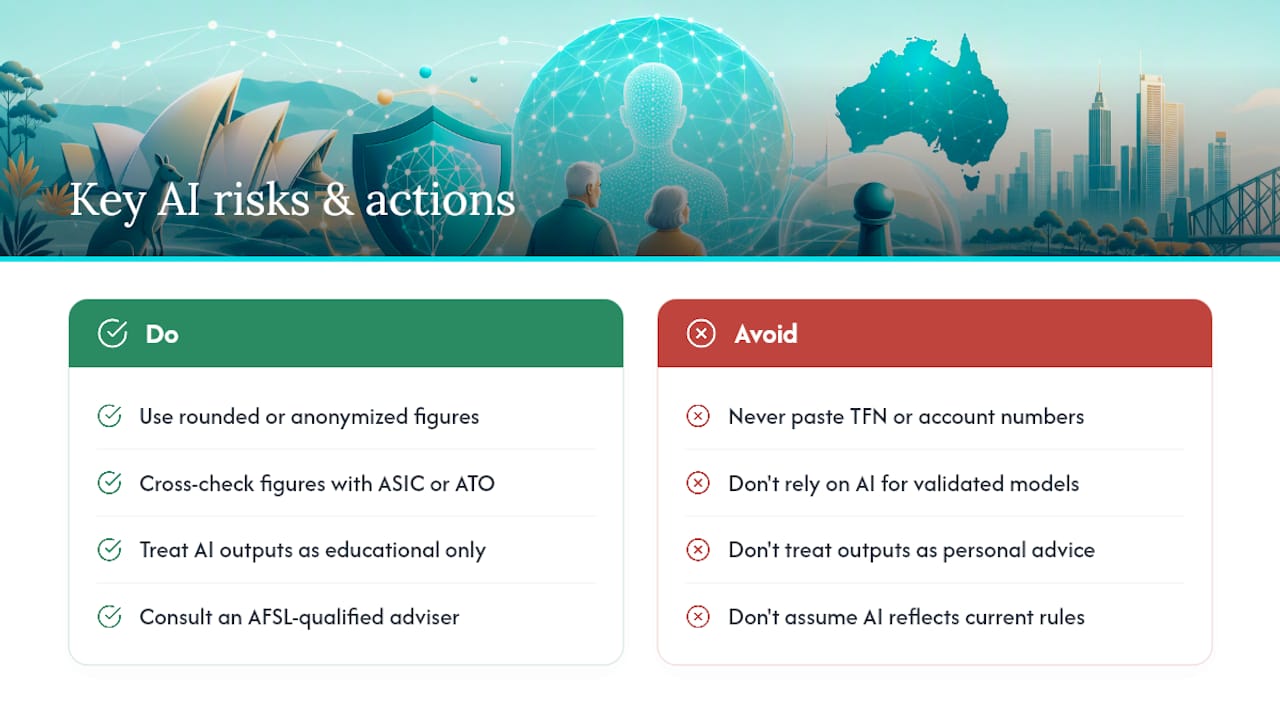
Here is what to do right now, and what to avoid:
- Do ask AI to explain how superannuation preservation rules work, or to run a quick what-if on retiring at 60 vs. 65.
- Do not share your Tax File Number, account numbers, or exact super balances in any public AI chat window.
- Do verify every projection with an AFSL-licensed financial adviser before making major decisions about contributions, drawdown, or property.
According to ASIC’s MoneySmart guidance, publicly available AI is useful as a learning tool and for breaking down complex financial concepts, but it is not a substitute for licensed personal financial advice. That is the frame for everything that follows.
Pro Tip: Before you run any AI scenario, write down your key assumptions (expected return, inflation rate, retirement age) separately. That way, when you bring outputs to an adviser, you can show exactly what the model assumed rather than just a number.
Key Takeaways
AI works best as a retirement planning assistant when you treat its outputs as hypotheses to verify, not decisions to act on.
| Point | Details |
|---|---|
| Use AI for scenarios, not decisions | AI accelerates scenario exploration and plain-language summaries but cannot replace AFSL-licensed advice. |
| Protect your personal data | Never share your TFN, account numbers, or exact balances in a public AI chat window. |
| Document every assumption | Record the inputs and assumptions behind every AI projection before bringing it to an adviser. |
| Verify with licensed advice | Confirm material outputs with an AFSL-licensed adviser before changing contributions, drawdown, or investment strategy. |
| Aerowealth for governed modelling | Aerowealth combines Australian super and tax-aware modelling with an AI assistant that explains projections under local rules. |
Table of Contents
- How AI helps you with retirement planning today
- What AI cannot do and where the real risks are
- A step-by-step workflow for using AI responsibly
- Prompt templates you can copy for Australian retirement scenarios
- Which tools should you actually use in Australia?
- When should you bring in a licensed financial adviser?
- What the Aerowealth team has learned about AI and retirement planning
- Aerowealth gives you a governed starting point for every scenario
- Sources
- FAQ
How AI helps you with retirement planning today
AI earns its place in the planning process by doing the tedious, iterative work fast. The tasks where it genuinely accelerates progress fall into four categories.
Scenario exploration and sensitivity testing. You can ask ChatGPT, Claude, or Gemini to model what happens to your retirement age if you increase super contributions by $200 a month, or what a 1% drop in average returns does to your drawdown runway. These what-if loops used to take hours in a spreadsheet. With a well-structured prompt, you get a structured response in minutes. The Pension Research Council at Wharton recommends focusing on accessibility and explainability through conversational interfaces, so members can explore scenarios through dialogue rather than static forms.
Plain-language translation. Retirement modelling outputs are often dense. AI can convert a table of projections into a clear paragraph your partner or family member can read, or turn a fund’s PDS into a bulleted summary of what actually matters for your situation. MIT Sloan research confirms that AI can make retirement planning more accessible by translating technical modelling results into plain-language explanations layered over validated calculators.
Behavioral nudges and automation ideas. AI can suggest expense categories to track, flag months where spending patterns diverge from your savings target, or draft a simple monthly review checklist. These are low-stakes tasks where the cost of an error is minimal and the time savings are real.
Data synthesis. The Center for Retirement Research identifies combining and analyzing multiple data sources as AI’s biggest potential benefit for retirement planning, enabling new insights from transaction data, employer records, and public data together. You are not there yet with consumer tools, but even basic synthesis — pulling together your super balance, mortgage offset, and investment property equity into one coherent picture — is something AI can help structure.
Pew Research documents growing AI adoption in everyday life alongside mixed trust levels, which tracks with retirement planning: people are using these tools, but cautiously. That caution is warranted.
What AI cannot do and where the real risks are
The limits matter as much as the capabilities, especially in Australia where superannuation rules, tax treatment, and Age Pension eligibility interact in ways that trip up even experienced planners.
AI can be wrong, and confidently so. Different tools given the same inputs can produce materially different retirement projections. Hands-on experiments with ChatGPT and other LLMs show that quick outputs vary significantly by tool, and none of them carry the actuarial validation of a purpose-built modelling engine. The Actuaries Institute notes that static assumptions in retirement calculators are a known problem, and AI does not automatically fix this — it can inherit or amplify those assumptions.
General-purpose AI is not licensed to give personal financial advice in Australia. Under ASIC’s framework, providing personal financial advice requires an Australian Financial Services Licence (AFSL). ChatGPT, Claude, and Gemini hold no such licence. They can explain concepts, but the moment an output is tailored to your specific financial situation and implies a recommendation, you are in territory that requires a licensed adviser.
Privacy is a genuine risk. Public AI chat interfaces are not designed to handle sensitive financial data. Never paste your Tax File Number, account numbers, exact super balances, or employer details into a general-purpose AI prompt. Use rounded or anonymized figures instead (“approximately $320,000 in super” rather than your exact balance). Australia’s Privacy Act and the Australian Privacy Principles govern how personal data must be handled, and most general-purpose AI tools are not compliant with those standards for financial data.
Australia-specific rules are easy to get wrong. Super preservation ages, concessional contribution caps, the transfer balance cap, and Centrelink income tests change regularly. AI training data has a cutoff date and may reflect outdated rules. Always cross-check any regulatory figure against ASIC MoneySmart or the ATO directly before acting on it.
A step-by-step workflow for using AI responsibly
This sequence takes roughly 30–90 minutes for a first run and produces outputs you can actually bring to an adviser.
- Gather and sanitize your data. Collect your current super balance, estimated annual contributions, expected retirement age, rough investment return assumption, and planned drawdown rate. Round balances to the nearest $10,000 and remove any identifying numbers (TFN, account numbers, fund member IDs).
- Choose the right tool for the job. Use a general-purpose LLM (ChatGPT, Claude, Gemini) for learning, concept explanation, and drafting scenarios. Use a purpose-built Australian planning platform for tax-aware projections and adviser-ready reports.
- Set your baseline scenario. Enter your sanitized data and ask the AI to project your retirement balance at your target age, using a nominated return rate and inflation assumption. Write down every assumption the model uses.
- Run stress tests. Ask the AI to rerun the scenario with a 1% lower return, a retirement age five years earlier, and a lifespan of 95 rather than 85. These three variations reveal how sensitive your plan is to the assumptions that matter most.
- Document everything. Copy the AI’s output, the prompt you used, and the assumptions into a document. This becomes your working paper for the adviser meeting.
- Verify with a licensed adviser or a regulated modelling engine. Before changing contribution levels, drawdown strategies, or investment allocations, confirm the outputs with an AFSL-licensed adviser or a governed planning platform. AI outputs are a starting point, not a final answer.
- Store outputs safely. Keep your planning documents in an encrypted folder or a secure cloud service. Do not store them in the same AI chat thread where you entered financial data.
Pro Tip: Run the same scenario in two different tools and compare the outputs. If they diverge significantly, that gap tells you exactly which assumptions to interrogate with your adviser.
Prompt templates you can copy for Australian retirement scenarios
Structured prompts produce far more useful outputs than vague questions. The format that works best includes: an instruction, your context (anonymized), your input data, the output format you want, and your audience.
Baseline retirement projection prompt:
Sensitivity test prompt:
Adviser preparation prompt:
Part-time work bridge prompt:
These prompts work with ChatGPT, Claude, and Gemini. For Australian-specific rules, always cross-check outputs against current ATO and ASIC guidance, since LLM training data may not reflect the latest contribution caps or preservation age changes.
Pro Tip: Ask the AI to “list all assumptions you used in this projection” after every scenario. That single follow-up prompt surfaces hidden defaults (like an assumed tax rate or drawdown percentage) that can materially change the result.
For a deeper look at retirement income strategies and how drawdown rates interact with super balances, the Aerowealth blog covers Australian-specific scenarios in detail.
Which tools should you actually use in Australia?
The right tool depends on what you need: quick education, a formal projection, or an adviser-ready report.
General-purpose LLMs (ChatGPT, Claude, Gemini) are best for learning, concept explanation, and drafting scenarios. They are free or low-cost, widely available in Australia, and capable of producing useful structured outputs from well-formed prompts. The trade-offs: no Australian regulatory awareness built in, no AFSL licence, and no guarantee that the modelling assumptions match current ATO rules. Privacy handling varies by provider, and none are designed for sensitive financial data.
Fund-backed or regulated assistants sit on top of proprietary modelling engines. Australian super funds have started deploying conversational AI layers that explain projections while the actual calculations remain driven by governed engines. These are more trustworthy for projection accuracy but limited to your fund’s own products and rules.
Purpose-built Australian planning platforms like Aerowealth combine governed modelling with an AI assistant that explains outputs under Australian rules. This is the category that closes the gap between “interesting scenario” and “adviser-ready plan.”
| Feature | General-purpose LLMs | Fund-backed assistants | Aerowealth (SaaS platform) |
|---|---|---|---|
| Australian super and tax rules | Limited | Fund-specific | Yes |
| Side-by-side scenario comparison | Manual | No | Yes |
| Personal data handling | Not designed for it | Fund-governed | Platform-governed |
| AFSL-licensed advice | No | No | No (modelling tool) |
| Adviser-ready report output | With prompting | Limited | Yes |
| Cost | Free or low | Included with fund | Freemium/Pro |
The Actuaries Institute makes the case that layering conversational AI over validated modelling engines is the right architecture, rather than replacing core calculations with LLM outputs. Aerowealth’s approach follows that logic: the modelling engine handles the numbers, and the AI assistant explains what they mean.
For context on super choices and how they interact with modelling assumptions, the Aerowealth guide covers the key decisions Australians face.
When should you bring in a licensed financial adviser?
AI can take you a long way, but certain situations require an AFSL-licensed adviser. Knowing the line saves you from acting on a projection that looks right but misses a critical variable.
Consult a licensed adviser when:
- You are within five years of your target retirement date and making concrete decisions about contribution levels or drawdown strategy.
- You are considering early retirement before your super preservation age (currently 60 for most Australians born after June 30, 1964) and need to model a bridge strategy using non-super assets.
- A major tax event is approaching: selling an investment property, triggering capital gains, or restructuring a business.
- Your estate planning intersects with super (binding death benefit nominations, reversionary pensions, or blended family arrangements).
- You want to understand your Age Pension or Centrelink eligibility, since the income and assets tests are complex and change regularly.
- AI outputs produce materially different results across two or more tools, and you cannot identify why.
How to bring AI outputs to an adviser meeting:
Bring a one-page document that includes: the assumptions you used, the scenarios you ran, the outputs (as a table), and three specific questions the results raised. Advisers work faster when they can see your starting point. The World Economic Forum notes that AI is widening access to financial advice through conversational interfaces, but governance and human oversight remain central to safe outcomes.
For a broader look at retirement planning in Australia, including when professional advice is most valuable, the Aerowealth guide covers the full planning lifecycle.
What the Aerowealth team has learned about AI and retirement planning
The most common mistake we see is treating AI outputs as answers rather than questions. A ChatGPT projection that says “you can retire at 62 with $85,000 per year” is not a plan. It is a hypothesis built on assumptions the model chose for you, some of which may be wrong for your situation.
The approach that actually works is layered: use a general-purpose LLM to get oriented and draft your first scenarios, then run those scenarios through a governed modelling engine that understands Australian super rules, tax treatment, and preservation constraints. The AI assistant’s job is to explain what the numbers mean, not to produce the numbers from scratch.
One practical example: a user runs a baseline scenario in Aerowealth, sees a projected shortfall at age 72, and does not understand why. The AI assistant explains that the model assumed a conservative drawdown rate and that the shortfall reflects a specific combination of return assumptions and contribution history. That explanation is worth more than the number alone, because it tells the user exactly what to change and what to ask their adviser.
Pro Tip: Use AI to translate your Aerowealth projections into plain language before your adviser meeting. Paste the key outputs (not your personal data) into ChatGPT or Claude and ask for a 100-word plain-English summary. It makes the conversation faster and more productive.
Verify every material output with a licensed adviser before acting. That is not a disclaimer — it is the workflow.
Aerowealth gives you a governed starting point for every scenario
Most Australians using general-purpose AI for retirement planning hit the same wall: the tool is helpful for concepts but cannot model super contributions, CGT events, mortgage offsets, and bridge-year income in one coherent plan. That is the gap Aerowealth fills.
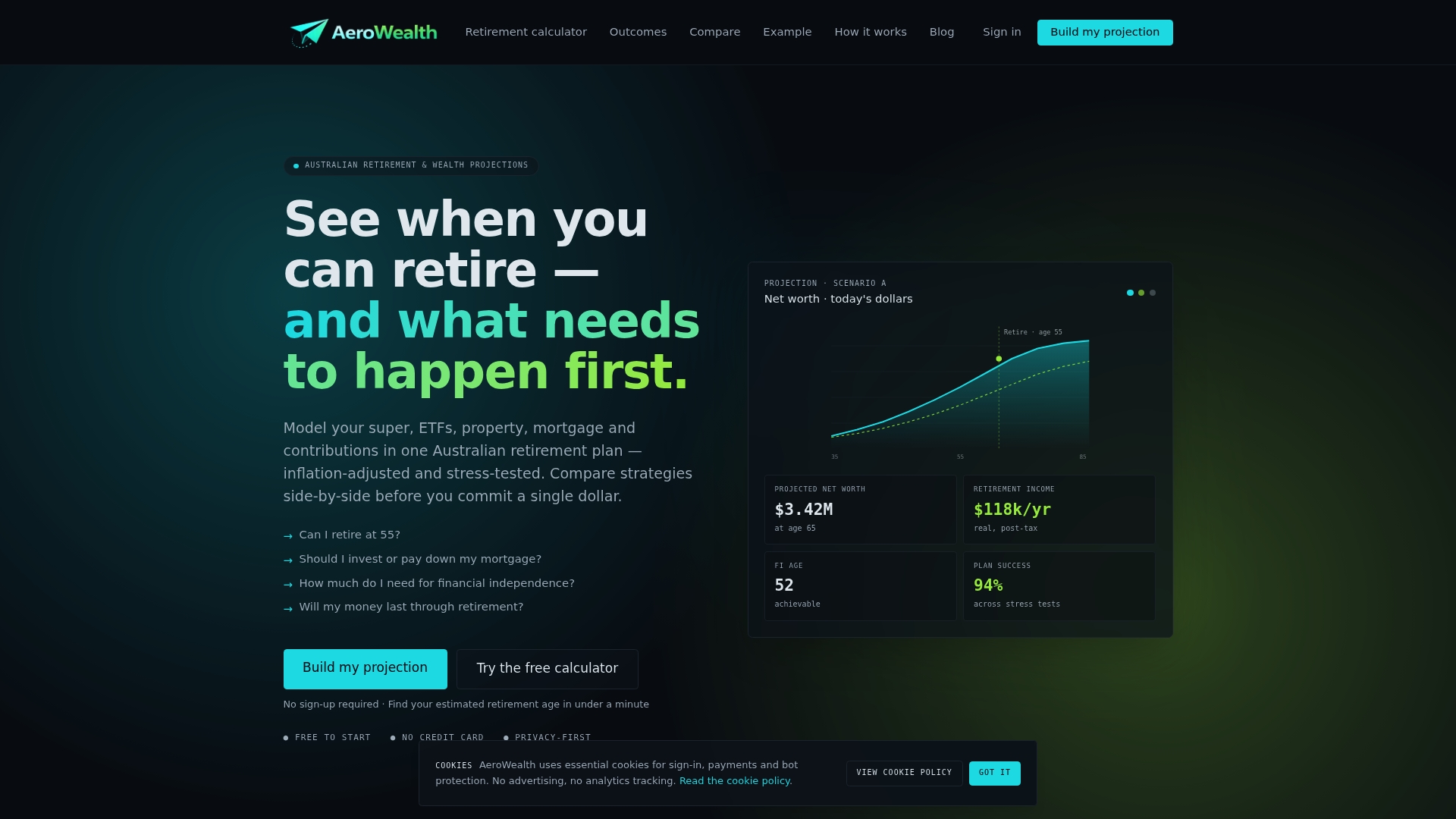
Aerowealth is built specifically for Australians modelling retirement with real complexity: superannuation balances, investment property, ETFs, and mortgages in one plan. Side-by-side scenario comparisons let you see the difference between retiring at 60 and 65 without rebuilding your assumptions from scratch. The AI assistant explains projections in plain language under Australian rules, and the modelling engine handles the numbers with the kind of governance a general-purpose LLM cannot match.
It is the right tool for Australians planning early retirement, optimizing super contributions, or stress-testing property scenarios before talking to an adviser. Start modeling your retirement scenarios on Aerowealth for free, or explore Pro features including bridge-mode and advanced scenario planning if you need the full toolkit.
Sources
These sources are worth bookmarking for cross-checking AI outputs and preparing for adviser meetings.
- Moneysmart
- Want to use AI to plan your retirement? Here’s how to proceed - MIT Sloan
- Retirement Calculators Are Broken – Can AI Fix Them? - Actuaries Institute
- Enhancing retirement planning with AI-based tools - Pension Research Council (Wharton)
- How Will AI Affect Financial Planning for Retirement? - Center for Retirement Research (CRR)
- AI in Americans’ lives: awareness, experiences, and attitudes - Pew Research
FAQ
What is the best AI tool for retirement planning in Australia?
For governed, Australia-specific modelling, Aerowealth is purpose-built for superannuation, tax, and property scenarios. For general learning and scenario drafting, ChatGPT, Claude, and Gemini are all capable starting points when used with well-structured prompts and verified against current ATO and ASIC guidance.
Is it safe to use AI for retirement planning?
It is safe for learning, concept exploration, and scenario drafting, provided you never share identifying financial data (TFN, account numbers, exact balances) in a public chat interface. Always verify outputs with an AFSL-licensed adviser before making material financial decisions.
Can you use ChatGPT as a financial adviser?
No. ChatGPT holds no Australian Financial Services Licence and cannot provide personal financial advice under ASIC’s regulatory framework. It can explain concepts and model scenarios, but any output tailored to your specific situation requires verification by a licensed professional.
What is the $1,000 a month rule for retirement?
A common rule of thumb is that you need a substantial savings balance to generate desired retirement income assuming a certain drawdown rate. This is a rough orientation tool, not a plan, and it does not account for Age Pension entitlements, super tax treatment, or individual longevity risk.