Interest Only vs Principal and Interest: Which Fits You?

Principal and interest (P&I) is generally the better fit for owner-occupiers who want to build equity and cut their total interest bill over time. Interest-only (IO) can make sense for some property investors and short-term holders who need to prioritize cash flow now, provided they plan explicitly for what happens when the IO period ends. MoneySmart, APRA, and the RBA all point the same way: IO buys flexibility today at the cost of a bigger bill later.
- Cash flow now vs total cost later: IO repayments are lower month to month, but you pay more interest across the life of the loan because the balance never shrinks during the IO term.
- Repayment shock is real: when IO ends, your payment jumps because you’re now repaying principal over a shorter remaining term.
Key Takeaways
Choosing between interest-only and principal-and-interest comes down to weighing lower repayments now against a 30 to 40% payment jump and higher total interest later.
| Point | Details |
|---|---|
| P&I suits owner-occupiers | Building equity and minimizing total interest usually outweighs any short-term cash flow benefit. |
| IO suits specific investors | Works best for short-term holders or investors actively redirecting freed-up cash into other assets. |
| Expiry causes real payment shock | Expect a roughly 30 to 40% repayment increase when a 5-year IO period ends and P&I resumes. |
| IO carries a rate premium | Interest-only loans typically cost more per dollar borrowed than the equivalent P&I rate. |
| Plan two to three years ahead | Stress-test your budget and build offset savings well before your IO period expires. |
Table of Contents
- Interest Only vs Principal and Interest: What Each One Actually Means
- How Long Can You Stay on Interest Only?
- Interest-Only vs Principal-and-Interest: Weighing the Trade-Offs
- What Happens When Your Interest-Only Period Ends?
- What Does Interest-Only Actually Cost You Over 30 Years?
- Why Do APRA and the RBA Care About Your Repayment Type?
- Which Repayment Type Actually Fits Your Situation?
- How Do You Model IO vs P&I for Your Own Numbers?
- When We’d Choose Interest-Only, and When We Wouldn’t
- Ready to Model Your Own Repayment Scenario?
- Where to Verify These Numbers Yourself
- Sources
- FAQ
Interest Only vs Principal and Interest: What Each One Actually Means
Every home loan charges you interest on the outstanding balance. The question is whether your monthly repayment also chips away at that balance, or just covers the interest charge.
A principal and interest repayment splits your payment two ways: part covers the interest owed for that month, part reduces the loan balance itself. Over a 30-year term, the mix shifts. Early on, most of your payment is interest; by the later years, most of it is principal.
An interest-only repayment covers just the interest. The loan balance sits exactly where it started, no matter how many payments you make, for as long as the IO arrangement runs.
It’s worth being clear on one thing lenders like Canstar stress constantly: IO and P&I aren’t separate loan products. They’re repayment structures you can choose within the same mortgage, and most lenders let you switch between them (within limits) over the life of the loan.
- P&I: balance falls every month; you build equity with every payment.
- IO: balance stays flat; your payment buys you time, not ownership.
How Long Can You Stay on Interest Only?
Most Australian lenders cap an interest-only period at five years at a time. That’s the standard block owner-occupiers get, and it’s usually the practical ceiling across the life of an owner-occupied loan too, following the serviceability tightening that followed 2015. Investors sometimes get longer cumulative IO allowances across a loan’s life, but the common five-year block still applies at each renewal point.
When the IO period ends, your loan automatically reverts to P&I for whatever term remains, unless you actively apply to extend IO or refinance elsewhere. Extensions aren’t guaranteed. Your lender will reassess your serviceability at that point, not just approve it as a formality.
The number that matters most here: the RBA’s own modeling estimates a representative borrower coming off a five-year IO period faces a required payment increase of roughly 30 to 40%. That’s not a rounding error. It’s the single biggest reason IO borrowers get caught out.
- Lenders test your ability to service P&I repayments at loan approval, not just the lower IO amount.
- APRA-influenced serviceability buffers mean banks assess you against a conservative interest rate buffer to absorb this kind of shock.
Interest-Only vs Principal-and-Interest: Weighing the Trade-Offs
The comparison boils down to eight things: how the repayment works, what you pay each month at the start, what you pay in total interest, how bad the step-up is at IO expiry, who it typically suits, how investors are taxed on it, how long you can stay on it, and how flexible it is.
| Factor | Interest-Only | Principal & Interest |
|---|---|---|
| How payments work | Covers interest only; balance unchanged | Covers interest and principal; balance falls |
| Initial monthly repayment | Lower | Higher |
| Total interest over loan life | Higher | Lower |
| Repayment shock at expiry | Significant (often 30 to 40% step-up) | None; repayment stays steady |
| Best for | Investors, short-term holders | Owner-occupiers, long-term holders |
| Tax treatment (investors) | Full interest amount deductible; no principal deduction available anyway | Interest portion deductible; principal is not |
| Typical IO period | Usually up to 5 years per block | Full loan term by default |
| Flexibility (offset/redraw) | Often reduced or unavailable during IO | Full offset and redraw typically available |
There’s a catch that erodes the “IO saves you money” pitch before you even factor in the total interest gap: interest-only rates typically run higher than the equivalent P&I rate at the same lender. You’re paying more per dollar borrowed, on top of not reducing the balance.
IO’s real upside: freed-up monthly cash for investors who redirect it into other assets, or a genuine bridge for owner-occupiers managing a temporary income drop.
P&I’s real upside: every payment builds equity, and NAB’s own comparisons show the total interest gap compounds fast once you’re a decade into a 30-year loan.
What Happens When Your Interest-Only Period Ends?
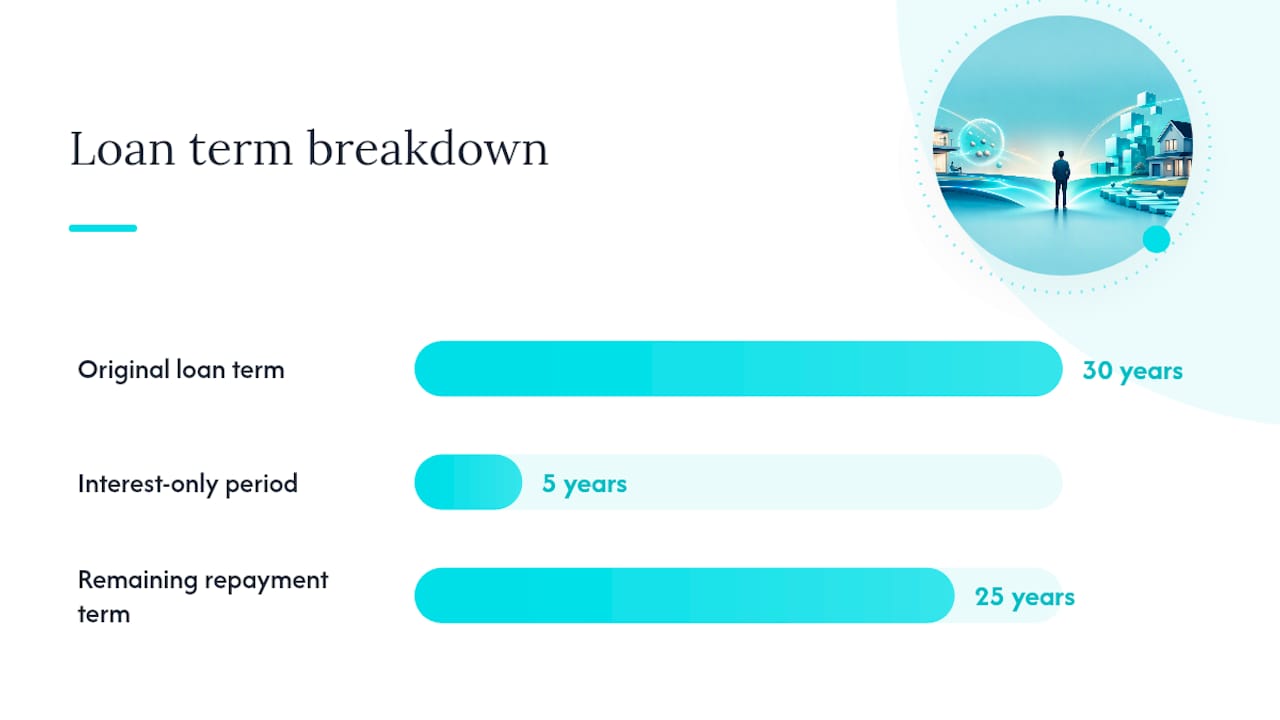
Your repayment jumps because you’re suddenly repaying the full principal balance over whatever term is left, not the original 30 years. If you took five years of IO on a 30-year loan, you’re now repaying that same balance over 25 years instead of 30, and that compressed timeline is what drives the jump.
You generally have four paths once IO expires:
- Roll onto P&I at your existing lender, at whatever rate applies to the remaining term.
- Apply to extend IO for another block, though approval depends on your servicing capacity at that time, not what qualified you originally.
- Refinance to another lender offering a fresh IO term or a better P&I rate.
- Sell if the property no longer fits your plan, particularly relevant for investors who bought IO with an exit strategy in mind.
The smart move is starting this conversation two to three years before expiry, not two to three months.
- Stress-test your budget against the higher P&I repayment using current rates plus a margin.
- Build offset or redraw savings during the IO period specifically earmarked for the transition.
- Gather income and expense documentation early. Lenders reassess serviceability from scratch at extension or refinance.
Pro Tip: Set up a separate savings transfer equal to the gap between your IO payment and the P&I payment you’ll eventually face. Treat it like a forced repayment. When the switch happens, you’ll already be used to living on that budget, and you’ll have a cash buffer sitting in offset.
What Does Interest-Only Actually Cost You Over 30 Years?
Take a $600,000 loan over 30 years at a 6% P&I rate, compared with the same loan running 5 years of interest-only (at a modest rate premium) before reverting to P&I for the remaining 25 years.
Consumer comparisons modeling similar 30-year scenarios put the extra total interest from a 5-year IO start somewhere in the $50,000 to $80,000 range, though the exact figure depends heavily on your rate, loan size, and IO premium.
- Assumptions matter enormously here. A higher IO rate premium or a longer IO block both push the gap wider.
- Run your own numbers rather than trusting a generic example. Loan size, rate, and IO length all move the outcome.
If you want to see this play out with your actual mortgage figures instead of a hypothetical, Aerowealth’s mortgage offset calculator walks through the same IO versus P&I math with adjustable assumptions.
Why Do APRA and the RBA Care About Your Repayment Type?
Interest-only lending isn’t just a personal finance choice in Australia. It’s something regulators actively watch, because a heavy concentration of IO loans coming due at once is a systemic risk, not just an individual one.
APRA requires lenders to assess your ability to service the eventual P&I repayment, not just the lower IO amount, using a serviceability buffer above the current rate. That’s why your borrowing capacity often looks tighter than the advertised rate would suggest.
The RBA’s own analysis documents how tightening after 2014 to 2015 pushed IO rates up relative to P&I and shrank the overall stock of IO loans in the market. That regulatory shift is a direct reason IO now costs more and is harder to get approved for than it was a decade ago.
- Expect a documented cap on IO term length at most major lenders, typically five years per block.
- Expect to provide fresh income evidence if you want to extend IO or refinance near expiry.
- Expect the advertised IO rate to sit above the equivalent P&I rate at the same lender.
Which Repayment Type Actually Fits Your Situation?
Match your borrower profile to the repayment structure before you talk to a lender, not after.
- Owner-occupier building a long-term home: P&I almost always wins here. You want equity growth and the lowest total interest cost, and you don’t have a tax reason to favor IO.
- Long-term investor holding for growth: consider IO if you’re actively redirecting the freed-up cash into other income-producing assets, and you have a clear plan for the eventual step-up.
- Short-term investor or flipper: IO often makes sense if you expect to sell before the IO period ends, since you’re not planning to hold long enough for the equity gap to matter.
- Cash-flow constrained borrower: IO can bridge a temporary squeeze, but treat it as a temporary fix, not a long-term strategy.
- Risk-averse borrower of any type: default to P&I. The certainty of a stable repayment usually outweighs a short-term cash saving.
Ask your lender directly: what’s the maximum IO term you’ll approve, is there a rate premium and how much, and exactly how will you reassess my serviceability at IO expiry? For investors, weigh the tax deductibility of interest against the higher rate and eventual repayment jump. A tax deduction on IO interest doesn’t offset a rate premium that outlasts it.
How Do You Model IO vs P&I for Your Own Numbers?
Generic examples only get you so far. Your rate, loan size, and time horizon change the outcome enough that you need to run your own scenario before committing either way.
Start with your baseline: current rate, loan balance, and remaining term under straight P&I. Then build an alternate scenario with an IO block, a plausible rate premium, and the automatic reversion to P&I afterward. Add a stress test on top: what happens if rates rise a percentage point, your income drops, or the property’s value falls before you refinance.
Aerowealth’s scenario modeling lets you run these side by side and see the net-wealth outcome, not just the monthly repayment. That distinction matters because a lower IO payment freed up for investing elsewhere can sometimes offset the extra interest cost, but only if you actually invest the difference rather than spend it.
- Model both cash flow and net wealth: total interest paid, equity built, and what the freed-up IO cash actually earned if invested.
- Rerun the scenario with a rate rise and an income drop applied together, not separately.
Pro Tip: Don’t just compare monthly repayments. Compare your net worth at year 10 under each scenario, including whatever you did with the cash IO freed up. That’s the number that actually tells you which choice paid off.
When We’d Choose Interest-Only, and When We Wouldn’t
If you’re buying a home to live in for the next decade or more, P&I is the boring, correct answer almost every time. Equity built early compounds, and the interest saved over 30 years usually dwarfs any short-term convenience IO offers.
Where IO earns its place is narrower than marketing suggests: a genuine short-term investor with an exit plan, or an owner-occupier navigating a defined, temporary income gap with a real plan to switch back. Outside those cases, the 30 to 40% repayment step-up tends to catch people who treated IO as a permanent discount rather than a deferred bill.
Pro Tip: If you go IO, put the monthly saving somewhere you can’t casually spend it. Discipline during the IO years is what makes the strategy work rather than backfire.
Ready to Model Your Own Repayment Scenario?
The 30 to 40% repayment jump at IO expiry is the single biggest number in this decision, and it only tells you something useful when it’s run against your own loan balance and rate, not a generic example.
Aerowealth’s platform lets you build side-by-side scenarios for IO and P&I against your actual mortgage, super, and investment property assumptions, then stress-test them against rate rises or income shocks before you commit. You can see the projected net-wealth outcome, not just the repayment schedule, which is the number that actually determines whether IO helped or hurt.
Explore how Aerowealth’s scenario modeling handles your mortgage alongside the rest of your retirement plan, or check the Pro plan features if you want advanced mortgage offset and bridge-year modeling included.
Where to Verify These Numbers Yourself
Check the primary sources directly if you want to confirm any figure before making a decision. MoneySmart’s guidance on interest-only mortgages covers the regulator’s consumer-facing risk warnings, while the RBA’s speech on interest-only loans contains the worked repayment-shock modeling referenced throughout this article.
- NAB’s IO versus P&I comparison for lender-specific worked examples.
- CommBank’s interest-only home loan page for current rate premium and switching mechanics.
- Aerowealth’s mortgage offset calculator guide and investment property ROI calculator for running your own numbers.
- Wealth Nest’s property investment insights for broader investor strategy context.
This article is general information, not a substitute for advice from a qualified financial advisor. Consult a qualified financial professional about your own circumstances before acting on anything here.
Sources
- Australia’s interest-only mortgages (MoneySmart / ASIC)
- Speech: Some evidence on the effect of interest-only loans (RBA)
- Interest Only home loans (CommBank)
- Interest-only vs. Principal & Interest (Canstar)
FAQ
What are two disadvantages of an interest-only loan?
Your loan balance doesn’t shrink during the IO period, so you pay more total interest, and you face a repayment increase of roughly 30 to 40% when the IO period ends and P&I resumes over a shorter remaining term.
How long can I go interest-only?
Most Australian lenders cap interest-only periods at five years per block, and while investors sometimes access longer cumulative allowances, owner-occupier IO terms are generally limited to that same five-year cap.
Is it wise to get an interest-only mortgage?
It depends on your profile: it can suit short-term investors or borrowers managing a temporary cash-flow gap, but for most owner-occupiers building long-term equity, principal-and-interest repayments cost less overall and avoid the eventual repayment shock.
Do interest rates differ between interest-only and principal-and-interest loans?
Yes. Interest-only rates typically run higher than the equivalent principal-and-interest rate at the same lender, which erodes part of the monthly saving IO appears to offer.