Main Residence Exemption CGT: An Australian Owner’s Guide

If you lived in the property the whole time you owned it, never earned income from it, and hold two hectares or less of land, your capital gain is fully ignored. Rented out a room, ran a business from home, or moved out and leased the place before selling? You’re likely looking at a partial exemption, calculated on a proportion of days or floor area. The fastest way to get a real number is the Australian Taxation Office’s free CGT property exemption tool, which tells you whether your gain is fully ignored or partly taxable. If your situation involves multiple properties or a deceased estate, get advice before you sign a contract.
Key Takeaways
Whether your home sale is fully exempt, partially exempt, or taxable comes down to residency, occupancy, income use, and land size, verified fastest through the ATO’s own exemption tool.
| Point | Details |
|---|---|
| Four eligibility conditions | Australian residency, full-period occupancy, no income production, and land of two hectares or less. |
| Partial exemption formula | Capital gain × (days used to produce income ÷ total ownership days) determines the taxable portion. |
| Six-year rule flexibility | A former rented home can keep main residence status for six years, or indefinitely if left vacant. |
| Records make or break claims | Contracts, occupancy dates, utility bills, and ATO tool outputs are your evidence if questioned. |
| Model before you sell | AeroWealth lets you compare sale-date and rental scenarios side by side to estimate CGT before listing. |
Where to Read More on ATO Rules
- The eligibility page sets out the four core conditions in full.
- The treating former home guidance covers the six-year rule and election timing.
- The CGT property exemption tool calculates your specific exemption percentage.
- ITAA 1997 section 118.185 provides the legislative basis for the partial exemption formula.
This article is general information, not a substitute for advice from a qualified financial advisor. Consult a qualified financial professional about your own circumstances before acting on anything here.
Table of Contents
- Do You Qualify for the Main Residence Exemption CGT Rules?
- What Counts as Your Main Residence Under ATO Rules?
- How Does the Partial Main Residence Exemption Work?
- The 6-Year Rule: Treating a Former Home as Your Main Residence
- Special Cases: Foreign Residents, Estates, Trusts, and Big Blocks
- When and How Do You Claim the Exemption?
- Using the ATO’s CGT Property Exemption Tool
- Why Modelling Your Sale Date Changes the Outcome
- Sources
- FAQ
Do You Qualify for the Main Residence Exemption CGT Rules?
Run through this list before you assume anything about your sale.
- You were an Australian tax resident for the relevant period.
- You (and your partner and dependants) lived in the dwelling for the entire time you owned it.
- The property was never used to produce assessable income, no rent, no home business claiming a tax deduction for a dedicated work area.
- The land, including the area under the dwelling, is two hectares or less.
Meeting all four means the full exemption applies and any capital gain or loss is disregarded entirely for tax purposes. Miss one, and you’re usually in partial exemption territory rather than losing the exemption outright.
A surprising number of owners assume renting out a spare room for a few months voids the whole exemption. It doesn’t. It just means the ATO apportions your gain across the income-producing period, not the entire ownership period.
If land exceeds two hectares, or you weren’t an Australian resident when the CGT event happened, read the special cases section below before you go further.
What Counts as Your Main Residence Under ATO Rules?
The ATO doesn’t just ask “did you own it?” It asks whether the dwelling actually functioned as your home. The indicators it looks at include where you and your family actually slept and ate, where your personal belongings were kept, and whether your mail, electoral enrollment, and utility connections (power, gas, internet) were registered at that address.
A few edge cases trip people up regularly:
- Vacant land alone never qualifies. The exemption attaches to a dwelling, so land without a house on it, even if you intend to build, doesn’t count until construction is complete and you move in.
- A garage or storeroom sold with the home can be covered by the exemption because it’s treated as part of the dwelling, but a separate structure sold independently usually isn’t.
- Granny flat arrangements can affect eligibility depending on how the arrangement is structured and when it was entered into.
Pro Tip: Keep a simple folder, digital or physical, with your electoral roll address history, a few utility bills from each address you’ve owned, and any mail redirection records. It costs nothing to set up and it’s exactly what the ATO wants to see if your occupancy history is ever questioned.
How Does the Partial Main Residence Exemption Work?
Once part of your ownership period involved earning income from the property, or the property itself only became your home partway through, you move from a full exemption to a partial one. The statutory basis sits in section 118.185 of the Income Tax Assessment Act 1997, and the practical calculation follows a straightforward days based formula.
- Work out your total capital gain on the sale (sale price minus cost base, including purchase costs and eligible improvements).
- Count the days the property was used to produce assessable income and divide that by your total ownership days.
- Multiply your capital gain by that fraction to find the assessable (taxable) portion.
Say you owned a property for a period and rented it out for part of that time before selling, with a total capital gain amount. Your taxable portion is calculated by multiplying the capital gain by the fraction of days rented over total ownership days. The remaining $240,000 stays exempt. If part of your home (say a converted garage) was used for a home business rather than the whole dwelling, the ATO generally expects you to apportion by floor area first, then by time.
Cost base adjustments matter here too. If your home was first used to produce income after you’d already been living in it, the home first used to produce income rule can require you to use the market value at that point as your new cost base, rather than your original purchase price. Get that valuation done properly and keep it on file; it can significantly change your final number.
Pro Tip: The 50% CGT discount for assets held over twelve months applies to the taxable portion after apportionment, not before. Calculate the exempt fraction first, then apply the discount to what’s left.
The 6-Year Rule: Treating a Former Home as Your Main Residence
Moving out doesn’t automatically end your exemption. If you rent out your former home after moving out, you can continue treating it as your main residence for up to six years. If it sits vacant and earns no income at all, that period extends indefinitely, there’s no six year cap in that scenario.
A few things make this rule sharper edged than most owners expect:
- The election to treat a former home as your main residence must be made in the income year the CGT event actually happens, not whenever you get around to it.
- You can stop the election early, say, after three years of a possible six, if that produces a better outcome for a different property you now consider your main residence.
- You cannot run two main residences at once, except for a brief six month overlap when moving from one home to a newly purchased one.
Here’s where it gets genuinely tricky for owners with more than one property. Electing the six year rule on a former home you’re renting out can lock you out of claiming the exemption on the home you currently live in, for that same overlapping period. If you buy a second property, move into it, and keep renting the first, you need to actively choose which one gets main residence treatment, because you can’t have both running simultaneously.
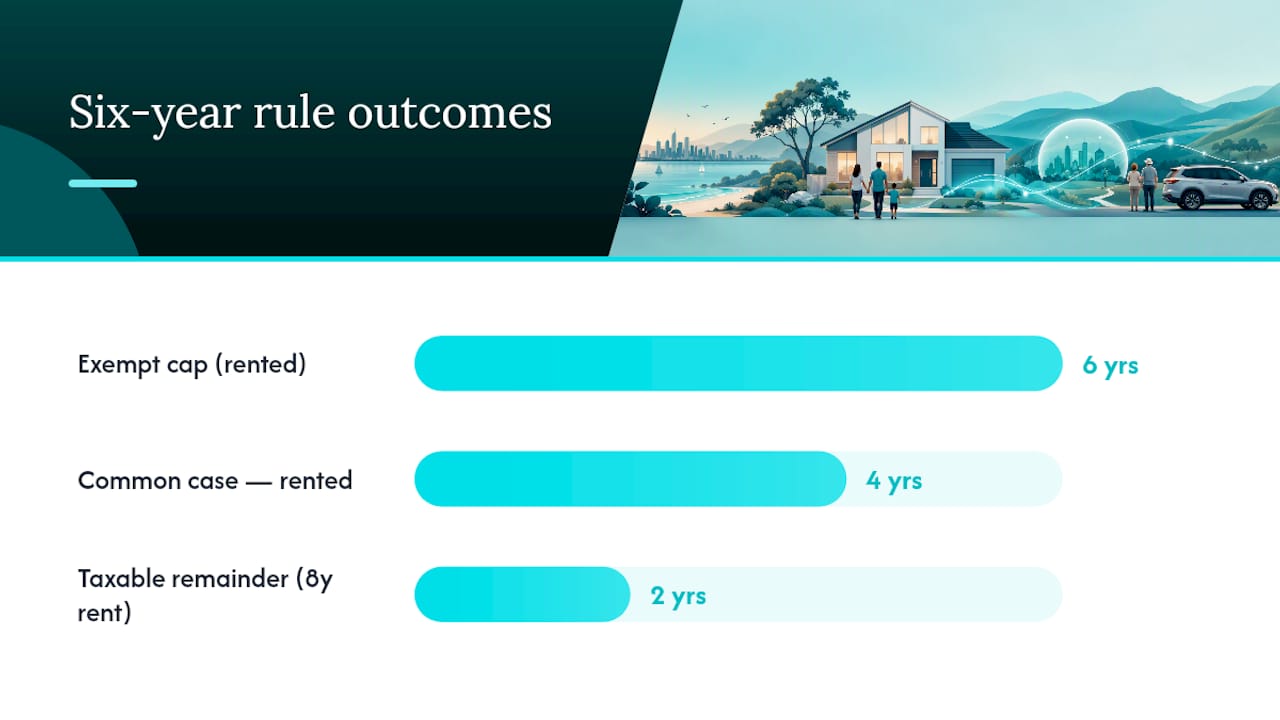
Take a common case: you live in a home for five years, move out and rent it for four years, then move back in for a final two years before selling. The rental period falls inside the six year window, so it’s covered. If instead you’d rented it for eight years, the first six would be exempt under the election and the remaining two years would be apportioned as taxable, using the same days based formula from the previous section.
Pro Tip: If you’re not certain which property will ultimately deliver the bigger tax saving, model both scenarios before you elect anything. Once you’ve claimed the exemption on one property for a given period, unwinding that choice retrospectively is far harder than getting it right upfront.
Special Cases: Foreign Residents, Estates, Trusts, and Big Blocks
A handful of situations sit outside the standard rules entirely.
- Foreign residents generally cannot claim the main residence exemption for CGT events happening after 30 June 2020, with only limited exceptions such as terminal illness or death of the owner during the relevant period.
- Deceased estates: a beneficiary or trustee may still be entitled to a full or partial exemption depending on when the deceased acquired the property and how quickly it’s sold after death.
- Land over two hectares: only two hectares gets the exemption; the excess is treated as a separate, taxable asset, valued proportionally.
- Subdivided land: subdividing part of your home’s land and selling it separately can trigger a CGT liability on the subdivided block, even though your actual home remains exempt.
- Trusts and super funds face additional constraints around the main residence exemption that don’t apply to individual owners, and small business CGT concessions can interact with main residence rules in ways that need specialist review.
Pro Tip: If any of these apply to you, don’t try to self-assess from general guidance alone. These are the scenarios where a registered tax agent earns their fee many times over.
When and How Do You Claim the Exemption?
You report the CGT event, and any exemption you’re claiming, in your tax return for the income year the contract of sale was signed, not the settlement date. Get your paperwork sorted well before then.
Keep these on hand:
- The original purchase and final sale contracts, plus settlement statements.
- A clear record of occupancy dates for every address you’ve owned.
- Rental agreements and lease dates, if the property was ever tenanted.
- Utility bills and electoral roll extracts showing residency.
- Any output you’ve saved from the ATO’s exemption tool.
Pro Tip: Hold onto every renovation invoice and receipt for capital improvements, even ones from a decade ago. They add to your cost base and directly reduce your taxable gain, but only if you can actually produce them when it counts.
Using the ATO’s CGT Property Exemption Tool
Running your numbers through the tool takes a few minutes once you have your dates and figures ready.
- Enter your ownership dates (settlement to settlement) and any periods the property was rented or used for business.
- Add cost base details, including purchase price, buying costs, and eligible improvements.
- Review the result, which shows your exemption percentage and, in many cases, states plainly that “any capital gain is fully ignored” if you qualify outright.
The tool automatically adjusts for absences under the six year rule and handles some capital loss scenarios without you needing to calculate them manually. Save or export the result as a PDF and file it with your other CGT records; it’s useful evidence if the ATO ever asks how you arrived at your figure.
Pro Tip: Run the tool before you list the property, not after you’ve signed a contract. If the numbers surprise you, you may still have time to adjust your sale timing or stop renting the property earlier.
Why Modelling Your Sale Date Changes the Outcome
The exemption tool tells you where you stand today. It won’t tell you what happens if you sell in eight months instead of eight weeks, or what stopping a tenancy six months early does to your taxable portion. That’s where scenario modelling earns its place alongside the ATO’s own tools.
- Compare a full exemption scenario against a partial one side by side, using your actual dates.
- Factor in renovation costs to see how they shift your cost base and final taxable gain.
- Test what happens if you end a rental before listing, versus selling with a tenant in place.
Change a sale date by even a few months in a modelled scenario and you can watch the taxable proportion shift in real time, often revealing an outcome nobody would have guessed from a static formula.
Pro Tip: Export whatever scenarios you build and bring them to your accountant. It turns a vague “what if we sold in spring” conversation into a specific, numbers backed decision.
AeroWealth’s Take: What Trips Up Property Owners Most
Document occupancy from day one, don’t wait until you’re selling. Run the ATO tool early, and consider stopping rental income before your settlement date if the numbers support it. The most common mistake we see isn’t ignorance of the rules, it’s owners assuming a vacant period automatically qualifies without checking, or mismanaging elections across two properties at once. When in doubt, model it or ask a tax professional before you sign anything.
Model Your CGT Outcome Before You List the Property
Running the ATO tool gives you today’s number. AeroWealth shows you how that number moves if you sell six months later, stop renting first, or spend on renovations before listing, letting you compare scenarios side by side instead of guessing.

The platform pulls your property, super, and mortgage details into one model, so you can see how a CGT outcome on one property affects your broader retirement timeline, not just your tax bill for the year. Build a scenario, export it, and hand it straight to your accountant instead of trying to explain a spreadsheet over the phone. Try AeroWealth free and run your first sale scenario in minutes, or check the Pro plan if you need to model multiple properties or bridge years before retirement.
Sources
- Eligibility for main residence exemption | Australian Taxation Office
- Capital gains tax property exemption tool | Australian Taxation Office
- Treating former home as main residence | Australian Taxation Office
- INCOME TAX ASSESSMENT ACT 1997 - SECT 118.185 | AustLII
FAQ
Who is eligible for the main residence CGT exemption in Australia?
You qualify for the full exemption if you’re an Australian resident who lived in the property for your entire ownership period, never used it to produce income, and the land is two hectares or less.
How do you avoid CGT on your primary residence?
Meeting the four full-exemption conditions avoids CGT entirely; if you’ve rented out part of the home or moved out and leased it, the six-year rule or a partial exemption calculation can still reduce or eliminate your taxable gain.
What property is exempt from capital gains tax in Australia?
Your main residence and dwelling, including a garage or storeroom sold with it, are exempt when the eligibility conditions are met; vacant land alone is never exempt on its own.
What happens to the main residence exemption after a divorce or separation?
Marriage or relationship breakdown can affect timing and choices around which property is treated as the main residence, particularly when both parties owned separate homes, so reviewing your occupancy history with an adviser before any property settlement is worthwhile.