Offset Account Investment Property: Australian Investor Guide

For Australian property investors, an offset account linked to an investment loan is usually the preferred structure because it preserves the loan’s tax-deductible status while keeping your savings fully liquid. The ATO’s position, confirmed through interest deductibility guidance and Taxation Ruling TR 93/6, is clear: a correctly structured offset does not alter the loan’s character, so interest remains deductible under section 8-1 of the ITAA 1997. The trade-off is real, though. Offset-feature loans often carry higher rates or annual fees, and a low offset balance can mean those costs outweigh the interest saved.
Key Takeaways
An offset account preserves full interest deductibility on an investment loan while keeping your savings liquid, making it the preferred structure for most Australian property investors under ATO guidance.
| Point | Details |
|---|---|
| Offset vs. redraw core difference | Offset keeps savings separate from loan principal; redraw reduces principal and can contaminate deductibility if used privately. |
| ATO ruling TR 93/6 | Acceptable offset arrangements preserve interest deductibility and the offset benefit is not assessable income, provided no deposit interest is paid. |
| Contamination risk | A single private-purpose redraw from an investment loan requires interest apportionment and may need refinancing to fix. |
| When offset makes financial sense | Investors with consistent offset balances above $50,000 and higher marginal tax rates gain the clearest net benefit after fees. |
| Aerowealth modeling | Aerowealth models offset, redraw, and extra-repayment scenarios side-by-side with tax-aware retirement projections for Australian investors. |
Table of Contents
- How offset accounts work for investment property loans
- Offset vs. redraw: why the tax difference is critical
- How offset accounts affect negative gearing and after-tax returns
- When offset is the right call, and the traps to avoid
- How to set up and manage an offset linked to an investment loan
- A modeled example showing what an offset can save
- Your immediate next steps as an Australian investor
- Model your offset strategy with Aerowealth
- Sources
- FAQ
How offset accounts work for investment property loans
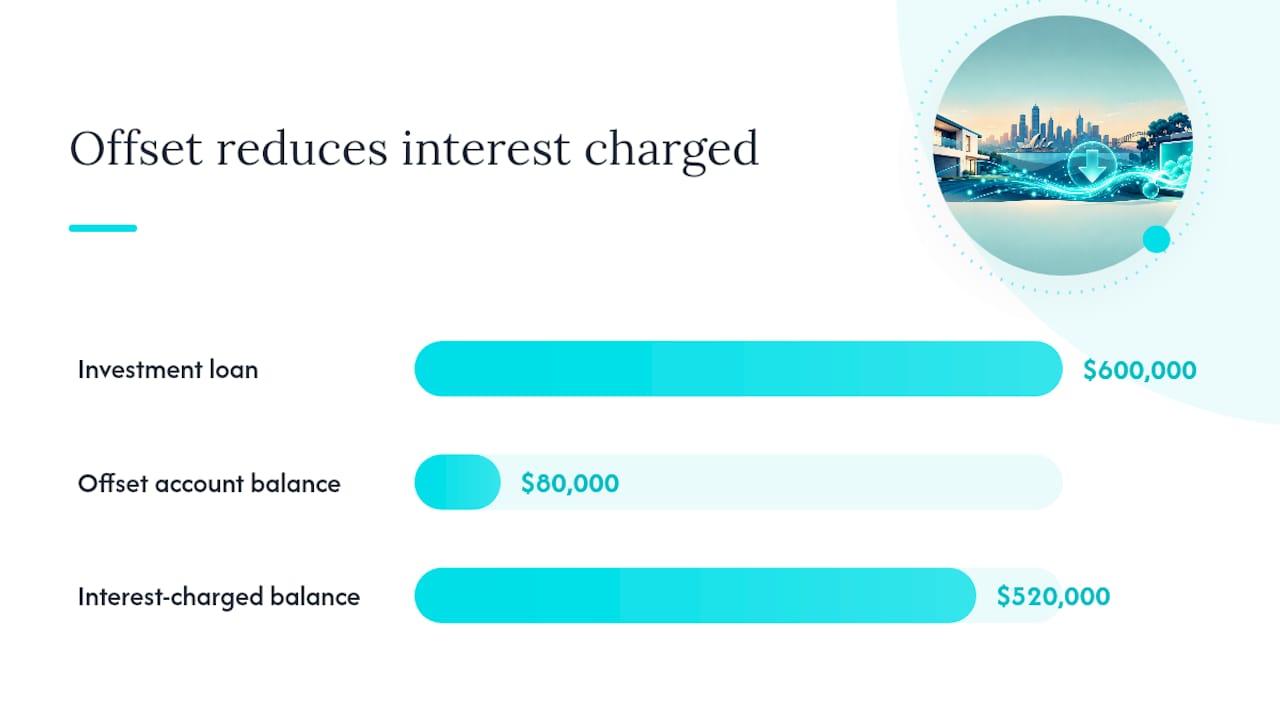
An offset account is a transaction account linked to your mortgage. The lender calculates interest daily on the difference between your outstanding loan balance and the credit balance sitting in the offset. If your investment loan is $600,000 and you hold $80,000 in the offset, you pay interest on $520,000 — not $600,000. The Moneysmart guide on mortgage offset accounts explains this daily calculation clearly and lists the consumer questions worth asking your lender before signing up.
That daily timing matters more than most investors realize. A salary deposited on the 1st of the month and withdrawn on the 28th still reduces your interest charge for those 27 days. Conversely, a large withdrawal on the 2nd of the month means you lose almost the entire month’s offset benefit on that amount.
Key operational rules to know:
- The offset account must be in the same name or names as the loan account. A mismatch in account holders can invalidate the offset arrangement under TR 93/6.
- The account must not pay interest on its credit balance. An account that earns deposit interest is not an acceptable offset under ATO rulings and can create an assessable income issue.
- Some lenders offer “partial offset” products that only apply the offset to a portion of the loan balance. Confirm with your lender whether the offset applies to the full outstanding balance.
- Offset accounts are separate transaction accounts. Withdrawals from the offset do not reduce the loan principal, which is the critical tax distinction covered in the next section.
Pro Tip: Ask your lender for a copy of the product disclosure statement and confirm in writing that the offset account does not pay interest on credit balances. This one check protects your deductibility position before you deposit a single dollar.
Offset-feature loans typically sit at a slightly higher interest rate than basic variable loans, and many carry annual package fees of $300–$400. For a small offset balance, those costs can easily exceed the interest saved. The math only works reliably when your offset balance is consistently meaningful relative to the loan size.
Offset vs. redraw: why the tax difference is critical
This is where investors most often get into trouble. The distinction sounds technical, but the tax consequences are significant and, in some cases, permanent.
An offset account is a separate transaction account. Funds you deposit there never reduce the loan principal. When you withdraw, you are simply spending your own money. The loan balance stays unchanged, the loan’s purpose stays unchanged, and the interest on the full original balance remains deductible.
A redraw facility works differently. Extra repayments you make go directly against the loan principal, reducing the outstanding balance. If you later redraw those funds for a private purpose — a holiday, a car, home renovations — the ATO treats the redrawn amount as a new borrowing for that private purpose. Interest attributable to the private-use portion becomes non-deductible. TaxDigital’s worked examples show exactly how this contamination plays out in practice and why it can be difficult to unwind.
ATO ruling TR 93/6 sets out the conditions an offset arrangement must meet to be “acceptable.” The offset benefit — the interest reduction — is not assessable income when the arrangement is acceptable, and interest on the loan remains deductible provided the loan is used for income-producing purposes. The ruling requires a dual-account structure with no entitlement to deposit interest on the offset account balance.
The ATO’s data-matching capability has expanded significantly. The ATO cross-references rental income, loan data from financial institutions, and bank transaction records. An investor who redraws from an investment loan for private spending and claims the full interest as a deduction is precisely the profile that triggers a review. The ATO’s interest expenses guidance addresses apportionment directly: when a loan is used for both private and investment purposes, only the investment-purpose proportion of interest is deductible.
Tax outcome scenarios at a glance:
- Fully deductible: Offset account linked to investment loan, no deposit interest paid on offset, account names match loan, funds in offset never mixed with loan principal.
- Partially deductible: Redraw facility used for a mix of investment and private purposes; interest must be apportioned based on the proportion of the loan used for each purpose.
- Non-deductible (contaminated): Redraw used entirely for private spending; the redrawn amount’s interest is not deductible, and the taint can be difficult to remove without refinancing.
Once a loan is contaminated by a private-purpose redraw, fixing it typically requires refinancing to split the loan into separate investment and private tranches — a process that costs time, fees, and sometimes a higher rate. Keeping savings in an offset avoids this problem entirely.
How offset accounts affect negative gearing and after-tax returns
The headline effect is counterintuitive for some investors: a larger offset balance reduces your interest expense, which reduces your net rental loss, which reduces the tax benefit from negative gearing. That sounds like a bad thing. It is not.
Lower interest expense means better cash flow. The tax deduction from negative gearing is worth, at most, your marginal tax rate on the loss — typically 32.5–45 cents per dollar. The interest you avoid paying is worth a full dollar. Reducing a $10,000 interest bill saves $10,000 in cash. The lost negative gearing deduction on that same $10,000 costs you at most $4,500 in forgone tax benefit; you are still $5,500 ahead.
Worked example: offset vs. savings account
That gap widens as the loan rate rises — a point the Reserve Bank of Australia’s rate commentary reinforces, since higher official rates amplify the dollar benefit of every dollar sitting in offset.
Additional considerations for investors:
- Interest-only loans: The offset reduces the interest charged each period but does not accelerate principal repayment. For investors on interest-only terms, this is often the preferred setup because it maximizes deductible interest while the offset balance handles liquidity.
- Principal-and-interest loans: The offset reduces the interest component of each repayment, which means a slightly larger portion of each payment goes to principal. The loan pays down faster, which can reduce total interest paid over the life of the loan.
- LVR and borrowing capacity: Funds held in an offset do not reduce the loan balance on paper, so they do not improve your loan-to-value ratio (LVR) or directly affect your borrowing capacity for future purchases. Extra repayments via redraw do reduce the loan balance, which can improve LVR — but at the tax cost described above.
When offset is the right call, and the traps to avoid
Offset accounts suit most Australian property investors, but not all. The benefit depends heavily on how much you keep in the account and whether the lender’s product actually delivers what it promises.
Core benefits:
- Savings stay liquid and accessible without triggering any tax event or changing the loan’s character.
- The interest reduction is effectively a tax-free return — it reduces a deductible expense rather than creating assessable income.
- Bookkeeping stays clean. There is no need to apportion interest or track which funds came from where.
- Investors planning to convert a main residence to a rental in the future benefit particularly: keeping savings in an offset rather than making extra repayments preserves the full investment debt base, which means more deductible interest once the property becomes income-producing.
Costs and trade-offs:
- Offset-feature loans typically carry higher rates or annual package fees. Annual fees on offset accounts can consume a significant portion of interest savings when offset balances are relatively low compared to the loan balance, affecting net benefit.
- Some lenders cap the offset benefit or apply it only to a portion of the loan. Always read the product disclosure statement.
- Offset accounts require active management. A balance that drifts to near-zero delivers almost no benefit while the higher rate or fee continues.
Red flags and pitfalls:
- Offset accounts that pay deposit interest: These fail the TR 93/6 acceptable-arrangement test. The interest income becomes assessable, and the ATO may challenge the deductibility of the loan interest.
- Related-entity loans: Loans between related parties (family trusts, SMSFs, companies) face additional scrutiny. The offset arrangement must still meet all acceptable-offset criteria.
- Mismatched account names: An offset account held in a different name from the loan does not qualify. This is a common administrative error with joint-ownership properties.
- Using redraw on an investment loan: Even once. A single private-purpose redraw contaminates the loan and requires apportionment going forward.
- Products that mask offset limits: ASIC’s 2026 media release on hidden mortgage offset failures found systemic shortcomings in some offset-style products that cost Australians millions in lost interest savings. The regulator’s warning is to verify that the lender’s calculation method actually applies the full offset balance daily.
Who benefits most: Investors with consistent liquid savings of $50,000 or more, those on higher marginal tax rates, and anyone who may convert a home to a rental property in the future. Investors with minimal savings buffers may find a basic variable loan with a lower rate delivers better net outcomes.
How to set up and manage an offset linked to an investment loan
Getting the structure right from day one is far easier than correcting it later.
Setup steps:
- Confirm the product is a true offset. Ask the lender in writing: “Does this account pay any interest on the credit balance?” If yes, it is not an acceptable offset under TR 93/6.
- Match account names exactly. The offset account must be in the same name or names as the loan. For jointly held investment properties, both borrowers must be named on the offset account.
- Document the setup. Keep the loan contract, offset account terms, and product disclosure statement. These are your evidence that the arrangement met acceptable-offset criteria from the start.
- Confirm the daily calculation method. Ask the lender how the offset balance is applied — end-of-day balance, average daily balance, or another method. End-of-day is the most common and most favorable.
- Set up salary and income deposits into the offset. Every dollar sitting in the offset for even one day reduces that day’s interest charge.
Operational best practices:
- Keep a separate everyday transaction account for personal spending if you want a clean audit trail. Depositing and withdrawing from the offset is fine, but a clear record of what went in and came out supports your position if the ATO ever queries the arrangement.
- Never use the redraw feature on an investment loan for personal expenses. If your lender’s product combines offset and redraw in a single account, ask them to disable the redraw function or switch to a product that separates them.
- Review the offset balance quarterly. If the balance has dropped significantly, model whether the product fee still makes sense relative to the interest saved.
- Schedule a review with your accountant before each tax return to confirm the offset arrangement is still compliant and that no transactions have inadvertently changed the loan’s character.
Who to involve:
Your mortgage broker can identify lenders with true offset products and compare rates and fees. Your accountant confirms the tax treatment and checks that the arrangement meets TR 93/6 criteria. The lender’s credit team can confirm the daily calculation method in writing. For complex structures — trusts, SMSFs, or multiple investment loans — a tax adviser with property experience is worth the cost before you set anything up.
A modeled example showing what an offset can save
The numbers below use a straightforward scenario to show the order of magnitude of offset savings. They are modeled projections, not guaranteed outcomes, and actual results depend on your lender’s rate, fees, and offset calculation method.
Scenario assumptions:
| Variable | Value |
|---|---|
| Loan amount | $700,000 |
| Interest rate | a typical interest rate |
| Loan term | 30 years |
| Repayment type | Interest-only (5 years), then P&I |
| Offset balance (consistent) | $100,000 |
| Annual offset account fee | an annual package fee |
Modeled results over 10 years:
Over 10 years, the net benefit after fees is approximately $58,050 in this model. The AeroWealth mortgage offset calculator lets you plug in your own loan size, rate, and balance to see how the numbers shift for your situation.
Sensitivity note: If the offset balance drops to $40,000 (a common scenario when investors draw on savings for renovations or emergencies), the annual interest saving falls to roughly $2,480. Higher interest rates, as the RBA’s rate environment has demonstrated in recent years, amplify every dollar in offset — the same $100,000 saves more when the rate is 6.5% than when it is 4.5%.

For investors wanting to model offset outcomes alongside superannuation contributions, capital gains tax events, and retirement income projections, Aerowealth’s scenario comparison tools are built for exactly that kind of multi-variable planning. The investment property ROI calculator is a useful starting point for seeing after-tax returns with offset strategies factored in.
Your immediate next steps as an Australian investor
- Pull out your loan documents and confirm whether your current account is a true offset or a redraw facility. Check whether the account pays any deposit interest.
- Contact your lender in writing and ask them to confirm the daily offset calculation method and whether the account meets TR 93/6 acceptable-arrangement criteria.
- Check account name matching. If the investment property is jointly owned, verify that both names appear on the offset account in the same order as the loan.
- Book a session with your accountant before the next tax return to review the offset arrangement, confirm deductibility, and check that no redraw transactions have occurred on the investment loan.
- Review the ATO’s interest expenses guidance and the Moneysmart offset account page to understand your rights as a consumer and the questions worth asking your lender.
- Model your offset scenarios using a tool like Aerowealth to compare after-tax outcomes across different offset balances, loan rates, and repayment types before making any structural changes.
- If you are considering converting your home to a rental, read the ATO guidance on the six-year rule and speak with your accountant about preserving the investment debt base through an offset rather than extra repayments.
The Aerowealth team’s perspective on offset accounts and retirement planning
Most investors focus on the immediate tax saving from an offset account. What gets underestimated is the compounding effect over a 20- or 30-year investment horizon. An investor who consistently holds $80,000–$120,000 in an offset on a $700,000 loan does not just save interest this year. They preserve cash flow that can be redirected into superannuation contributions, additional property deposits, or retirement income bridges — all of which Aerowealth models in a single integrated plan.
The other thing worth saying plainly: the compliance risk from getting the offset vs. redraw distinction wrong is not theoretical. The ATO’s data-matching program is sophisticated, and an investment loan contaminated by a private-purpose redraw can require years of apportionment records or a costly refinance to fix. Getting the structure right at the start is a retirement planning decision, not just a tax one.
Model your offset strategy with Aerowealth
Aerowealth is built for Australian investors who want to see the full picture before making a structural decision. The platform models mortgage offset strategies alongside superannuation, investment property cash flows, and retirement income projections — all in one place, with side-by-side scenario comparisons so you can see exactly how a $50,000 vs. $100,000 offset balance changes your retirement age, net worth, and tax position over time.

Key modeling capabilities relevant to offset strategies:
- Side-by-side scenario comparisons: offset vs. redraw vs. extra repayments, with after-tax outcomes shown for each.
- Tax-aware projections: the platform accounts for negative gearing, CGT events, and the interaction between offset savings and taxable income.
- Sensitivity testing: model what happens to your retirement timeline if interest rates rise, your offset balance drops, or you convert a PPOR to a rental.
- Exportable figures: generate projections your accountant can review alongside your tax return.
See your numbers on Aerowealth or review Pro plan features to access advanced mortgage and offset modeling.
Sources
- Interest expenses | Australian Taxation Office
- Mortgage offset accounts | Moneysmart
- Hidden mortgage offset failures costing Australians millions in lost interest savings | ASIC
- Rental Property Loan Interest Deductibility – Redraw Vs Offset | TaxDigital
This article is general information, not a substitute for advice from a qualified financial advisor. Consult a qualified financial professional about your own circumstances before acting on anything here.
FAQ
Is it worth having an offset account for an investment property?
For most Australian investors with meaningful savings, yes. An offset account reduces interest costs, preserves full tax deductibility under ATO guidance, and keeps funds liquid without contaminating the loan’s investment purpose.
What is the downside of an offset account?
Offset-feature loans typically carry higher interest rates or annual fees of $300–$400, which can outweigh the interest saved if your offset balance is consistently low. ASIC has also flagged that some products fail to apply the offset correctly, so verifying your lender’s calculation method is essential.
Can I buy an investment property with a 5% deposit in Australia?
What is the six-year rule for investment property in Australia?
The six-year rule allows you to treat a former main residence as your principal place of residence for CGT purposes for up to six years after you move out and rent it. During this period, no CGT applies on a sale, provided you do not nominate another property as your main residence. Speak with a tax adviser to confirm eligibility for your specific situation.