Pension Drawdown Rates Australia: 2026–27 Minimum Table

Australia’s mandatory minimum pension drawdown rate depends entirely on your age at 1 July each year, ranging from 4% for retirees under 65 up to 14% for those 95 and older. These percentage factors, set out in Schedule 7 of the SIS Regulations, apply unchanged for the 2026–27 financial year.
The full breakdown looks like this:
- Under 65: 4%
- 65 to 74: 5%
- 75 to 79: 6%
- 80 to 84: 7%
- 85 to 89: 9%
- 90 to 94: 11%
- 95 and over: 14%
Quick fact: The Australian Taxation Office confirms these are the standard rates for 2026–27, with no temporary reduction currently in place. Every account-based pension holder needs to recheck their percentage bracket each 1 July, since your balance changes and your age bracket eventually shifts too, and payments must be made by 30 June or the pension risks being treated as if it never properly started that year.
Key Takeaways
Australia’s account-based pension drawdown rules require a percentage-based minimum withdrawal calculated on your 1 July balance and age bracket, with strict rounding and reporting obligations for SMSF trustees.
| Point | Details |
|---|---|
| Minimum rates by age | Range from 4% (under 65) to 14% (95 and over), unchanged for 2026–27. |
| Calculation basis | Multiply your 1 July balance by your age bracket’s percentage, then round to the nearest $10. |
| Mid-year pensions | Pro-rate based on days remaining in the year; no payment required if commencement is on or after 1 June. |
| Missing the deadline is costly | A missed 30 June payment deems the pension ceased from the start of that year and forfeits ECPI. |
| Plan beyond compliance | Aerowealth lets you stress-test whether the minimum, or a higher drawdown, actually supports your retirement timeline. |
Table of Contents
- Pension Drawdown Percentages by Age (2026–27)
- How Your Minimum Pension Payment Is Actually Calculated
- SMSF Trustee Duties and What Happens if You Miss the Deadline
- Have Minimum Rates Ever Changed Before?
- Worked Examples: Calculating Your Minimum Payment
- Beyond Compliance: Should You Take More Than the Minimum?
- Model Your Own Drawdown Strategy Before You Commit to One
- Where to Verify the Rules Yourself
- Sources
- FAQ
Pension Drawdown Percentages by Age (2026–27)
Here is the complete table super funds and SMSF trustees use to work out the minimum annual payment for account-based pensions and transition to retirement income streams:
| Age at 1 July | Minimum Drawdown Percentage |
|---|---|
| Under 65 | 4% |
| 65–74 | 5% |
| 75–79 | 6% |
| 80–84 | 7% |
| 85–89 | 9% |
| 90–94 | 11% |
| 95 or older | 14% |
These figures come straight from the ATO’s superannuation rates and thresholds page, which mirrors the statutory table in Schedule 7. A few practical notes:
- The percentage is fixed for the whole financial year based on your age on 1 July, even if you have a birthday that pushes you into a higher bracket in October.
- Once the dollar figure is calculated, it gets rounded to the nearest $10, and an amount landing on exactly $5 rounds up rather than down.
- Transition to retirement income streams (TRIS) that haven’t met a condition of release cap the maximum annual payment at 10% of the balance, on top of the same minimum rules above.
How Your Minimum Pension Payment Is Actually Calculated
The core formula is simple: take your account balance at 1 July, multiply it by the percentage factor for your age bracket, and that’s your minimum payment for the year. A 68-year-old with a $500,000 balance multiplies by 5%, landing on a $25,000 minimum for the year.
It gets more nuanced when a pension starts partway through the year. In that case, the ATO’s income stream rules require a pro-rata calculation based on the days remaining in the financial year divided by 365 (or 366 in a leap year). One quirk trips up a lot of new retirees: if the pension commences on or after 1 June, no minimum payment is required at all for that first partial year.
Here’s the process to follow, step by step:
- Confirm your account balance as at 1 July (or the commencement date, if the pension started that year).
- Identify your age on that same date, since that sets your percentage bracket.
- Multiply the balance by the applicable percentage factor from the table above.
- If the pension started mid-year, apply the pro-rata adjustment based on remaining days.
- Round the final dollar figure to the nearest $10, rounding up on an exact $5.
One detail worth flagging: partial commutations don’t count toward your minimum. Since 1 July 2017, only actual pension payments count towards the minimum requirement; partial commutations or lump sum transfers do not satisfy minimum payment rules. The Schedule 7 rounding rule is precise enough that even a $5 miscalculation can technically put a fund out of compliance.
SMSF Trustee Duties and What Happens if You Miss the Deadline
Self-managed super fund trustees carry the full weight of this compliance burden themselves, unlike members of large industry or retail funds where the administrator handles it automatically. That means confirming member ages, locking in the 1 July balance, scheduling payments, and keeping clean records that show the calculation and rounding were done correctly.
The deadline is firm: the minimum must be paid by 30 June, with no grace period into the new financial year. Miss it, and the consequences are serious rather than a slap on the wrist:
- The pension is deemed to have ceased from the start of that financial year, not just from 30 June.
- The fund loses access to Exempt Current Pension Income (ECPI), meaning investment earnings that would have been tax-free become taxable.
- Any payments already made get reclassified as ordinary superannuation lump sums instead of pension payments.
- The ATO can apply further sanctions where it identifies a pattern of non-compliance.
Industry commentary consistently points out that trustees who wait until late June to organize payments run the highest risk of missing the cutoff, particularly with bank processing delays around the holiday and end-of-financial-year period.
Pro Tip: Set up automated monthly or quarterly transfers from the fund to the member’s bank account rather than relying on a single manual payment in June. It removes the risk of a processing delay costing you ECPI for the entire year.

If you discover a shortfall after the fact, contact your tax agent immediately rather than trying to fix it quietly. Attempting to backdate documents or disguise a missed payment is treated as a serious compliance breach, not an administrative fix.
Have Minimum Rates Ever Changed Before?
Yes, and it’s worth knowing this because it shapes how much you should trust any “standard” figure long-term. The government halved every bracket’s minimum percentage from 2019–20 through 2022–23, first as drought and bushfire relief, then extended through the pandemic to help retirees avoid drawing down shrinking balances during volatile markets.
Normal rates resumed from 1 July 2023, and the standard table has applied ever since, including for the 2026–27 year covered in this article.
A few things to keep in mind:
- Temporary reductions are announced by the government, not automatic, and typically respond to major economic shocks.
- There’s no current indication of another reduction for 2026–27.
- Always check the ATO website directly before relying on any percentage you’ve seen quoted elsewhere, especially in older articles that may still reference the halved rates.
Worked Examples: Calculating Your Minimum Payment
Example 1: Full financial year. Margaret is 72 with an account-based pension balance of $620,000 as at 1 July. Her age bracket calls for 5%. That’s $620,000 × 0.05 = $31,000. Since it already lands on a round number divisible by $10, no further rounding adjustment is needed.
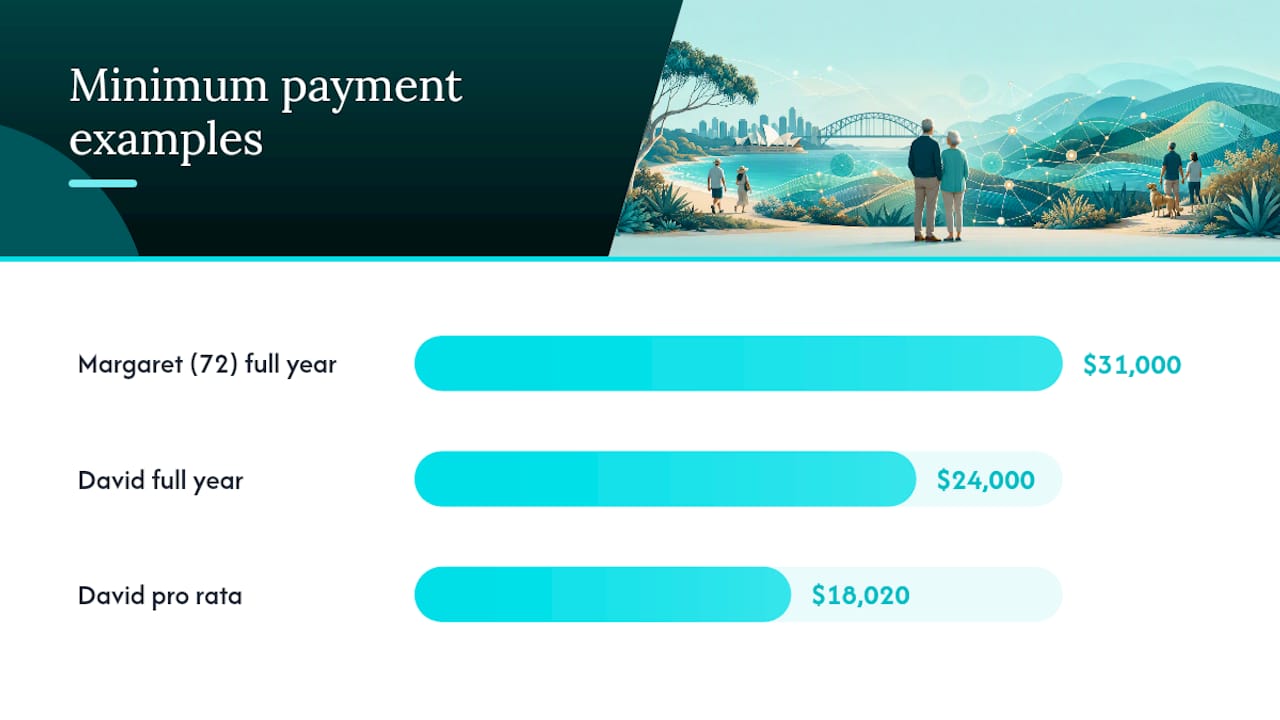
Example 2: Mid-year commencement. David starts a pension on 1 October with a balance of $480,000, and he’s 66. His annual factor is 5%, giving a full-year figure of $24,000. But there are 274 days left in the financial year after 1 October, so the pro-rata calculation is $24,000 × (274 ÷ 365) = $18,024.66, which rounds to $18,020.
To replicate these yourself or check your fund’s math:
- Pull your exact balance statement dated 1 July (or your pension start date).
- Match your age to the correct bracket.
- Run the multiplication, then apply pro-rata if it’s a first partial year.
- Round to the nearest $10.
- Confirm at least one payment has been made by 30 June, whether as a single transfer or several across the year.
Large super funds handle every one of these steps automatically through their administration systems. SMSF trustees don’t get that luxury, so it’s worth using a reputable calculator or a spreadsheet template to cross-check your own math before relying on it.
Beyond Compliance: Should You Take More Than the Minimum?
Meeting the minimum keeps your fund compliant, but it says nothing about whether that withdrawal rate actually supports the retirement you want for as long as you need it. A 65-year-old drawing only 5% might be leaving money in the fund that could support a better lifestyle now, or conversely, drawing the minimum every year without checking against inflation and market returns can quietly erode a balance faster than expected over two or three decades.
This is where scenario modelling earns its keep. Comparing a “minimum only” strategy against a smoothed drawdown approach, under a range of return and inflation assumptions, shows whether your balance realistically outlasts you.
Aerowealth lets you build these comparisons side by side, stress-testing your retirement income projections against different market conditions and visualizing how each choice plays out over time. It’s a planning tool, not personal financial advice, and readers should treat any projection as a starting point for a conversation with a licensed adviser.
Pro Tip: Run at least three scenarios: a conservative return with higher inflation, an average case, and a downturn year early in retirement. Sequencing risk hits accounts drawing above the minimum harder than most people expect.
Practical perspective: how we recommend Australians approach drawdown planning
Treat the minimum percentage as a compliance floor, not a strategy. Confirm your bracket every July, and if you’re an SMSF trustee facing a shortfall, involve your tax agent immediately rather than waiting. Then model whether that minimum actually supports your retirement over the decades ahead.
Model Your Own Drawdown Strategy Before You Commit to One
Calculating this year’s minimum is a five-minute task. Working out whether that withdrawal rate still leaves you comfortable at 85 is a much harder question, and it’s one spreadsheets and compliance calculators were never built to answer. Aerowealth is built specifically for that second question: it lets you run your account-based pension balance through multiple drawdown scenarios side by side and see how each one plays out against different investment returns, inflation assumptions, and life expectancy ranges.

None of this replaces personal financial advice. Aerowealth is a modelling tool, not a licensed adviser, and any projection should be checked against your own circumstances with a qualified professional before you make decisions. What it does give you is a clear, visual way to test “minimum only” against alternative strategies before you lock in a number for the year. Start with the free plan and run your own balance through a scenario comparison to see where you’d land in ten, twenty, or thirty years.
Where to Verify the Rules Yourself
For the current percentage table and any future rate changes, check the ATO’s payments from super page directly rather than relying on secondhand summaries. SMSF trustees should also review the income stream rules and payments guidance and the statutory text in Schedule 7 of the SIS Regulations for the exact legal wording behind rounding and pro-rata rules.
This article is general information, not a substitute for advice from a qualified financial advisor. Consult a qualified financial professional about your own circumstances before acting on anything here.
Sources
- Payments from super
- SUPERANNUATION INDUSTRY (SUPERVISION) REGULATIONS 1994 - SCHEDULE 7 Minimum payment amount for a superannuation income stream
- Time running out for minimum pension drawdown deadline
- Minimum pension drawdown rates (2026–27) and calculator
FAQ
What is a good pension drawdown percentage?
There’s no single “good” percentage. It depends on your balance, life expectancy, and other income sources; the minimum is a compliance floor, and modelling tools like Aerowealth can show whether drawing more sustains your lifestyle without depleting your balance too early.
How much super do I need to retire on $70,000 a year income?
The exact figure depends on your expected investment returns, age at retirement, and how long the balance needs to last, which is why running your own numbers through a retirement savings plan or scenario model gives a far more reliable answer than a generic rule of thumb.
What will the minimum pension drawdown rate be in 2026?
How many Australians have $1,000,000 in superannuation?
Balances of $1 million or more remain uncommon and are concentrated among older cohorts who’ve had decades of compulsory contributions; most retirees hold considerably less, which is part of why checking your own minimum drawdown calculation each year matters more than comparing yourself to headline balance figures.