Australians Model Portfolio Glide Path Outcomes Before Retirement

A glide path is a preset schedule for shifting your portfolio from growth assets like shares into defensive assets like bonds and cash as you approach and move through retirement. The point is to cut sequencing risk right when a market drop would do the most damage to your income. Aerowealth lets you model your own glide path against real scenarios later in this guide, so you can see the effect before you touch a single dollar.
TL;DR:
- “To” glide paths finish de-risking at retirement, while “through” glide paths de-risk gradually beyond retirement, affecting long-term income stability.
- Modeling your own scenario with real income sources, risk tolerance, and withdrawal plans predicts better outcomes than relying solely on age-based schedules.
- High market shocks near retirement can significantly harm retirement income unless your glide path effectively reduces growth risk beforehand.
- Rebalancing based on factors like remaining human capital and home equity can extend the optimal de-risking pace, especially for flexible retirees.
- Side-by-side scenario testing of “to” versus “through” designs reveals the true dollar impact on income and risk, guiding more personalized glide path choices.
Table of Contents
- Portfolio Glide Path Retirement Basics: Mechanics and Sample Schedules
- To vs. Through Glide Paths: Which Fits Your Retirement?
- Why Glide Paths Matter: Sequencing Risk and Longevity Risk
- Building a Glide Path: The Robust, Backward-Construction Method
- What to Check in Your Lifecycle or Default Super Option
- Modeling Your Glide Path Before You Commit
- Historical Performance and Empirical Evidence for Glide Path Strategies
- Adjusting Your Glide Path for Personal Risk Tolerance
- Glide Paths vs. Static Asset Allocation: What Changes
- How Investors React to Glide Paths During Market Swings
- AeroWealth Team Perspective: Model the Outcome, Not Just the Age
- See Your Own Glide Path Play Out Before You Commit to One
- Sources
- FAQ
Portfolio Glide Path Retirement Basics: Mechanics and Sample Schedules
A glide path works through periodic rebalancing rules tied to your age or years until retirement. Each year (or at set checkpoints), the portfolio trims growth exposure and adds defensive assets, following a formula rather than a gut reaction to headlines.
A typical illustrative schedule might gradually reduce shares and increase defensive assets as you age, for example starting with a high growth allocation around age 50 and shifting progressively toward more bonds and cash by retirement.
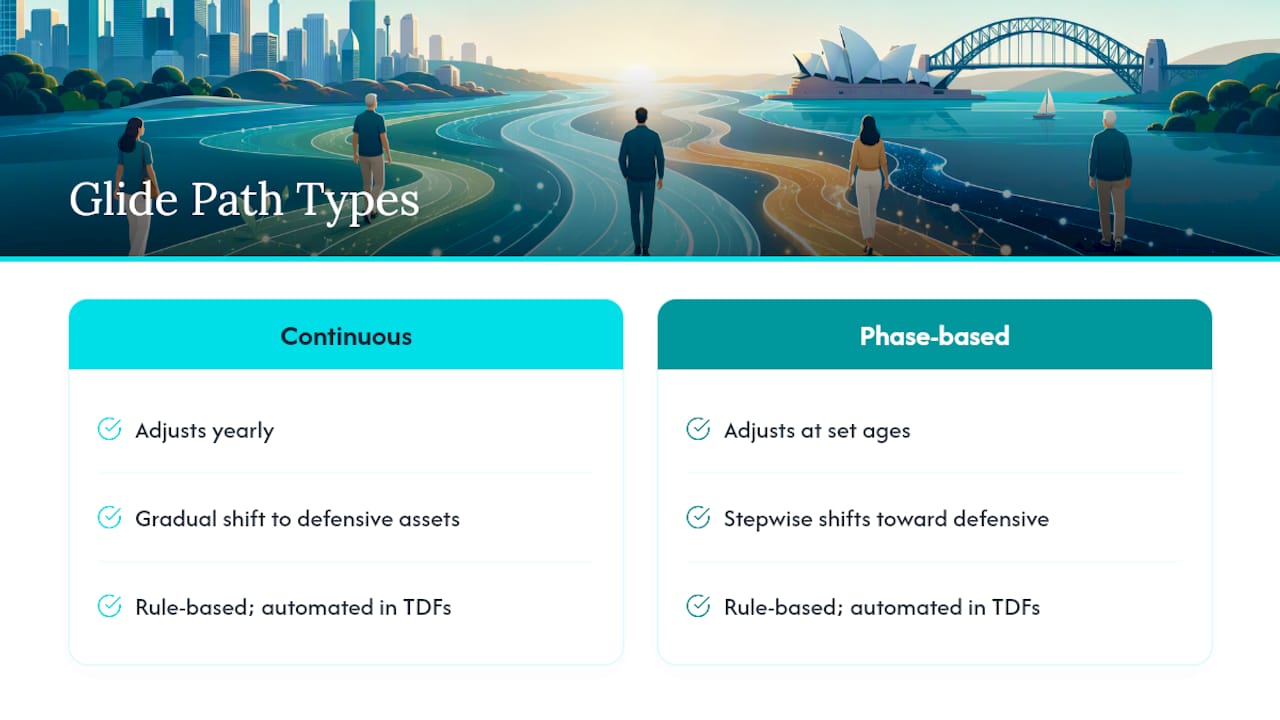
Real schedules vary a lot between products, and glide path examples from different providers rarely line up exactly. Some funds use continuous glide paths that adjust every year; others use phase based steps that jump at set ages. Target date and lifecycle funds automate this entirely, applying the rule based on your birth year without you lifting a finger.
To vs. Through Glide Paths: Which Fits Your Retirement?
A “to” glide path finishes de-risking right at your target retirement date, locking in a conservative mix meant to protect capital from that point on. A “through” glide path keeps de-risking gradually into and past retirement, holding onto more growth assets for longer to fight longevity risk.
Here’s how to think about the choice:
- Choose “to” if you have limited other income, a low risk tolerance, or plan to buy an annuity or draw down aggressively early.
- Choose “through” if you expect a long retirement horizon with multiple income sources and can tolerate short-term volatility.
- Reassess if your withdrawal rate is fixed and inflexible. A “to” glide path smooths income but can leave you exposed to running low on growth in a long retirement, while “through” trades short-term stability for longer-term staying power.
Why Glide Paths Matter: Sequencing Risk and Longevity Risk
Sequencing risk hits hardest when a market drop coincides with the years you start drawing income. A retiree who withdraws 5% from a portfolio during a 30% market fall locks in losses that a portfolio still accumulating could simply wait out. That’s the entire reason glide paths exist: to reduce growth exposure right before withdrawals begin, when a downturn does permanent damage instead of a temporary dip.
But de-risking too far creates the opposite problem. Industry analysis suggests that overly conservative default settings in the early 60s can starve a portfolio of the growth needed to last a 25 or 30 year retirement, raising the odds of running out of money late in life.
The trade-off in one line: de-risk too fast and you court longevity risk; de-risk too slow and you court sequencing risk. There’s no schedule that eliminates both at once. Matching the glide path to your specific retirement goals, other income, and withdrawal plan is the only way to lean the odds in your favor. Our guide to sequence of returns risk breaks down the mechanics with worked examples.
Building a Glide Path: The Robust, Backward-Construction Method
Practitioner research has moved past simple age-based rules toward optimization that explicitly weighs expected wealth against downside risk. BNP Paribas Asset Management describes a two-step “robust” design: first build a one-period efficient frontier for each stage of the glide path, then construct the full schedule recursively, working backward from the retirement date to keep downside risk in check while maximizing expected wealth. Academic work on optimal retirement glide paths backs the same shift away from age as the sole input.
You don’t need a PhD to apply the logic. A practical version looks like this:
- Set your retirement income goal. Know the number you’re targeting before you touch allocation.
- Pick a risk metric. Value-at-Risk or Expected Shortfall gives you a concrete downside boundary rather than a vague “moderate risk” label.
- Choose your final allocation. Decide how much growth exposure you want to still hold at your target date, and whether you’re building a “to” or “through” design.
- Simulate multi-year scenarios. Run the schedule against market shocks, slow recoveries, and long lifespans before committing.
- Set checkpoints and adjust. Revisit the glide path every few years, not just once at the start.
The metric you choose in step two acts as a real lever. BNP Paribas Asset Management notes that varying the Value-at-Risk confidence level or Expected Shortfall produces a more or less defensive final allocation, giving you a direct way to trade expected wealth for downside protection instead of guessing.
Pro Tip: Calibrate your de-risking speed against assets a spreadsheet often ignores, like remaining human capital (years you could still work) and home equity. Someone with a paid-off house and a flexible part-time income can afford to de-risk slower than someone relying entirely on their portfolio for every dollar of income.
What to Check in Your Lifecycle or Default Super Option
If you’re in a MySuper lifecycle or target-date default, an algorithm is already running a glide path on your behalf, shifting your asset mix based on your birth year. MoneySmart’s guidance on super investment options is direct about this: check your fund’s approach, because lifecycle designs vary widely from one provider to the next.
Before assuming the default fits you, check these:
- Final equity weight. Some lifecycle products settle at 30% growth assets by retirement; others hold 50% or more.
- Glide speed. How fast does the de-risking happen, and does it front-load the reduction or spread it evenly?
- Fees. Lifecycle products aren’t automatically cheaper than a self-selected option.
- “To” or “through” logic. Lifecycle fund performance varies materially depending on which philosophy the fund follows.
If the default doesn’t match your withdrawal plan or risk tolerance, most funds let you override it with a personal investment mix. That override decision deserves modelling, not a guess, which is where scenario tools earn their place.
Modeling Your Glide Path Before You Commit
Reading about glide paths only gets you so far. The real test is running your specific numbers through a handful of scenarios that reveal where the design actually breaks.
Four scenarios worth testing every time:
- A sudden market shock in the year before retirement, the classic sequencing risk stress test.
- A slow, grinding recovery that takes five or more years rather than a sharp V-shaped bounce.
- A longevity stress test spanning 20 to 30 years to see if a “to” glide path leaves you short late in life.
- Different withdrawal rates (say, 3% versus 5%) to see how sensitive your outcome is to spending discipline.
Side-by-side scenario comparison is where the “to” versus “through” decision stops being theoretical. Run both designs against the same market shock and withdrawal rate, and you’ll see the actual dollar gap in retirement income and shortfall risk rather than an abstract argument about growth exposure.
This is the exact gap Aerowealth is built to close. Pro Tip: Start with one core scenario, your current default fund’s glide path against a “through” alternative, before building out every stress test. One clear comparison beats ten half-finished ones.
Historical Performance and Empirical Evidence for Glide Path Strategies
Glide path research has largely moved past the question of “does de-risking help at all” toward “how fast should de-risking happen.” The consensus in practitioner literature isn’t that shares are dangerous near retirement. It’s that the sequencing risk from being fully exposed to a downturn right as withdrawals start outweighs the extra growth that full exposure would otherwise deliver.
The BNP Paribas Asset Management framework frames the entire design problem around maximizing expected wealth subject to a downside constraint, rather than picking an arbitrary allocation by age. That framing exists because naive age-based rules (the old “110 minus your age in shares” heuristic) don’t account for how sequencing risk actually behaves across different market conditions.
The practical evidence that matters most isn’t a single backtest. It’s the repeated finding across academic glide path research that the starting conditions at retirement, market valuation, interest rates, your specific withdrawal rate, shape outcomes more than the glide path’s exact shape. A well-designed “through” glide path outperforms a poorly calibrated “to” glide path in some environments, and the reverse holds in others. That’s an argument for testing your specific starting point rather than copying a generic schedule from an industry benchmark, because the environment you retire into does more work than most retirees assume.
Adjusting Your Glide Path for Personal Risk Tolerance
Age is a lazy proxy for risk capacity, and treating it as the only input is where most default glide paths fall short. Two people turning 65 in the same year can have wildly different capacity to absorb a market drop, depending on factors a birth-year algorithm never sees.
Consider what actually shifts the right glide path for you:
Other guaranteed income. A retiree with a defined-benefit pension or substantial rental income can afford a slower, “through” style de-risking schedule, because a market drop doesn’t threaten their baseline spending.
Health and expected longevity. Someone with a family history of long lifespans has more reason to hold growth exposure longer, since a 30-year retirement gives compounding more time to work in their favor.
Flexibility in spending. If your budget can flex in a downturn (delaying a renovation, cutting discretionary travel), you can tolerate more growth exposure than someone with fixed, non-negotiable withdrawal needs.
Emotional risk tolerance. A glide path that’s technically optimal but keeps you up at night during a 20% drawdown isn’t actually optimal, because panic selling at the bottom destroys more wealth than a slightly conservative schedule ever would.
The honest fix isn’t picking a different age-based table. It’s running your actual numbers, income sources, spending flexibility, and time horizon, through a model that shows what each glide path choice does to your specific plan, not a hypothetical average retiree’s plan.
Glide Paths vs. Static Asset Allocation: What Changes
A static allocation holds the same mix, say 60% shares and 40% bonds, for the entire retirement, rebalancing back to that target whenever markets drift. A glide path, by contrast, deliberately shifts the target itself over time.
The case for static allocation is simplicity: one target, no schedule to track, and no risk of the glide path’s assumptions aging poorly. It works reasonably well for retirees with a short, predictable horizon or substantial guaranteed income covering most expenses.
The case for a glide path is that retirement risk isn’t static. Sequencing risk is sharpest in the years right around retirement and fades as the portfolio survives its first decade of withdrawals. A static allocation ignores that timing entirely, holding the same growth exposure on day one of retirement as it does twenty years in, even though the consequences of a downturn are wildly different at each point.
The trade-off comes down to what you’re optimizing for, including considerations highlighted in Retirement Portfolio Diversification Explained for Retirees. Static allocation is easier to stick with and less prone to second-guessing, since there’s no shifting target to question. A glide path takes more setup and more monitoring, but it directly addresses the timing mismatch between when markets are dangerous (right before and after retirement) and when a portfolio can better absorb a hit (early accumulation, or late retirement once sequencing risk has largely passed). For most retirees without a large guaranteed income floor, that timing mismatch is real enough to justify the extra complexity.
How Investors React to Glide Paths During Market Swings
The theory of a glide path assumes an investor sits still and lets the schedule run. Real behavior rarely cooperates. When markets drop sharply, the instinct to “do something,” sell growth assets, pause contributions, override the default, kicks in exactly when the glide path’s design is supposed to be doing its quiet work in the background.
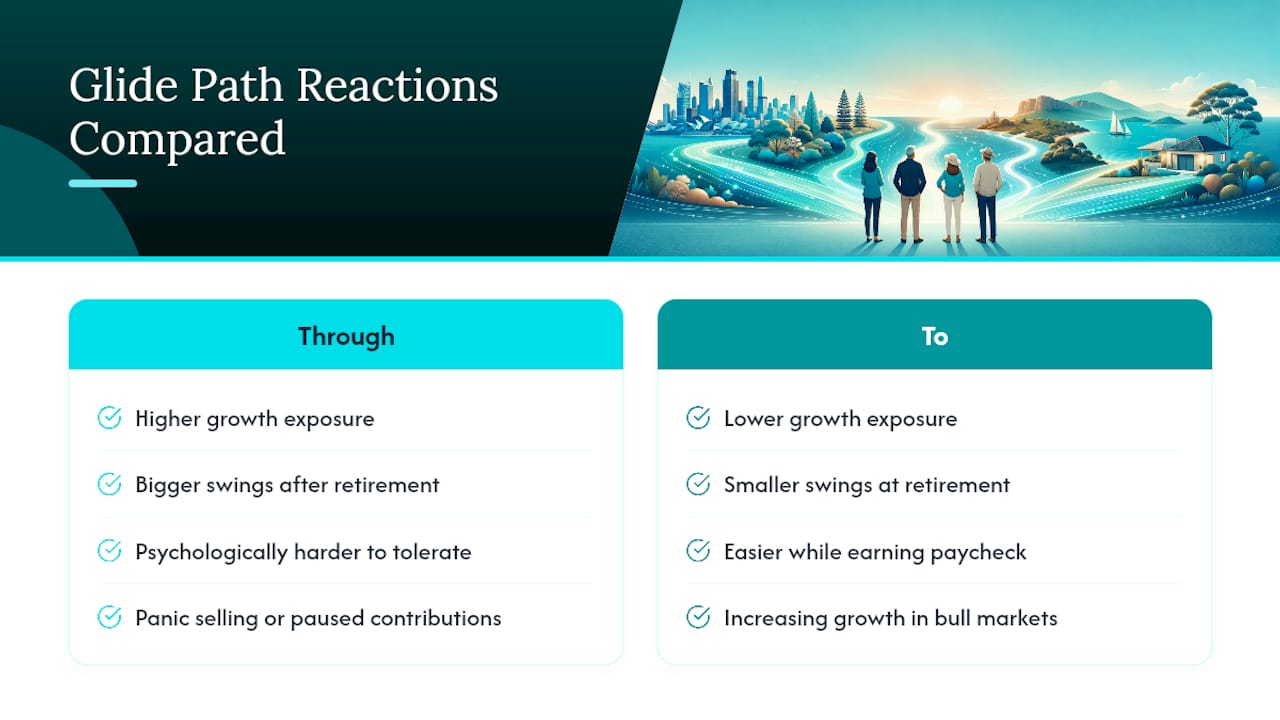
This matters more for “through” glide paths than “to” glide paths, because “through” designs deliberately hold more growth exposure into retirement, which means retirees following one will see bigger portfolio swings after they’ve stopped earning income. That’s psychologically harder than watching the same swing during the accumulation years, when there’s still a paycheck cushioning the blow.
The behavioral risk isn’t limited to selling in a panic. Some retirees do the opposite: they see a strong bull market and get anxious that their glide path is “too conservative,” pushing them to increase growth exposure right as the schedule intends to start de-risking. Both reactions undermine the entire point of a preset schedule, which exists precisely to remove ad hoc decisions from the highest-stakes years of the plan.
The practical defense against this isn’t willpower. It’s seeing the numbers ahead of time. A retiree who has already modeled what a 30% drawdown does to their specific income plan, and confirmed the glide path still gets them to their goal, has a much easier time sitting still than one reacting to a headline in real time. Running that scenario once, before the drop happens, does more for behavioral discipline than any amount of after-the-fact reassurance.
AeroWealth Team Perspective: Model the Outcome, Not Just the Age
Most glide path advice still treats age as the deciding variable. It shouldn’t be. The right approach is outcome-first: model your expected retirement income under your actual glide path before changing a single allocation, then stress-test both a “to” and a “through” version against a real market shock and a long lifespan. Age tells you almost nothing about whether you can absorb a bad sequence of returns; your other income, your spending flexibility, and your time horizon tell you nearly everything.
We’d rather see a retiree run three honest scenarios than adopt a textbook-perfect glide path they never tested. If you want a starting point, our piece on retirement income strategies walks through the withdrawal side of that equation, and a conversation with a licensed adviser is worth having before you lock in a final allocation.
— Aerowealth Team
See Your Own Glide Path Play Out Before You Commit to One
Reading about “to” versus “through” glide paths only tells you what happens to an average retiree. It doesn’t tell you what happens to your super balance, your mortgage, and your withdrawal plan if a downturn hits the year you stop working. Aerowealth replaces the spreadsheet guesswork with side-by-side scenario comparisons built specifically around superannuation, investment property, and mortgage decisions, the exact variables a generic glide path calculator ignores.

If you’re weighing a lifecycle default against a custom allocation, or trying to decide whether your retirement can handle a “through” strategy’s extra growth exposure, Aerowealth lets you run both and compare the actual income outcomes side by side. For a broader look at how different growth and defensive mixes perform over time, our retirement investment options guide is a useful companion read. Sign up and model your first scenario against your current super default to see exactly where the gap sits.
Sources
For deeper detail, see BNP Paribas Asset Management on robust glide path design, PIMCO’s comparison of “to” versus “through” glide paths, and SuperGuide’s overview of lifecycle super funds.
FAQ
What is a glidepath in retirement?
A glidepath in retirement is a scheduled shift in portfolio allocation, typically from growth assets like shares toward defensive assets like bonds and cash, as you approach and move through your retirement years.
What is the $1,000-a-month rule for retirees?
It’s a simplified guide, not a substitute for modelling your actual glide path and withdrawal plan against your own numbers.
What is the biggest mistake most people make regarding retirement?
Treating a single age-based rule, whether that’s a glide path schedule or a withdrawal percentage, as universally correct without testing it against their own income sources, spending flexibility, and expected lifespan.
What is a good balanced portfolio for a 70-year-old?
Checking your specific fund’s glide schedule matters more than following a generic percentage.