Super Recontribution Strategy: Reduce Tax for Beneficiaries

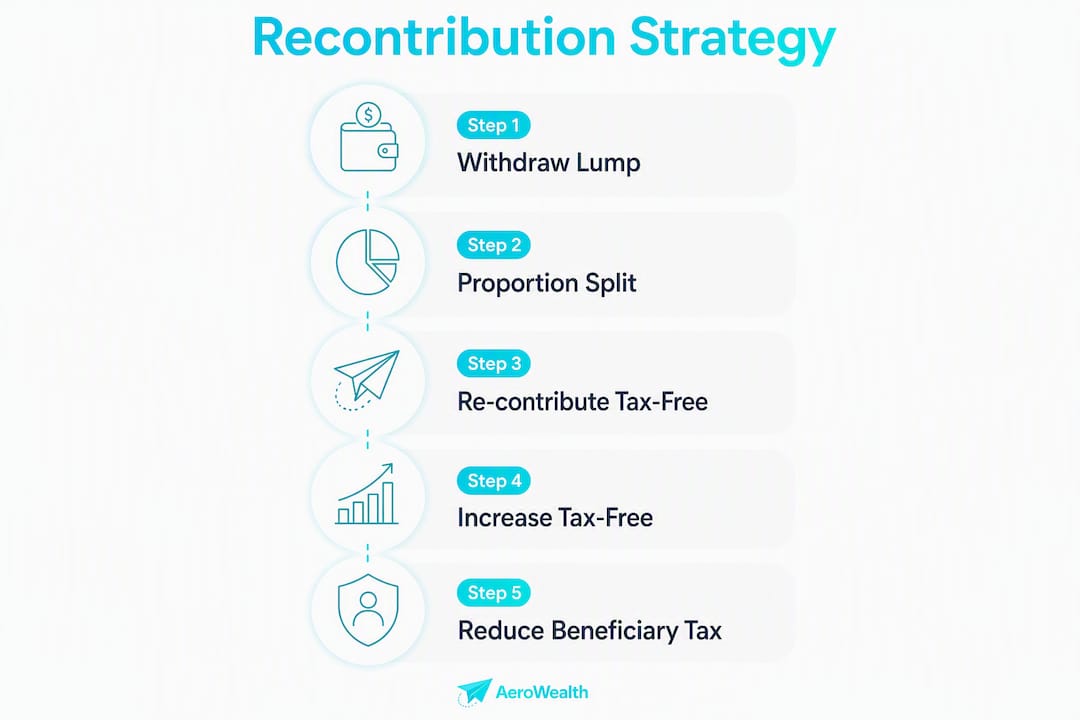
A recontribution strategy converts part of your super’s taxable component into tax-free component by withdrawing a lump sum from your fund and recontributing it as a non-concessional (after-tax) contribution. Your total balance stays the same. What changes is the proportion that will one day pass to your beneficiaries free of tax.

The primary beneficiary of this strategy is not you. If you’re already over 60, your super withdrawals are generally tax-free anyway. The real winner is an adult child or other non-tax dependant who would otherwise inherit a taxable super death benefit and pay up to 17% tax (including Medicare levy) on the taxable component. A well-executed recontribution strategy can materially reduce that bill.
Three things can block you before you start: you must meet a condition of release to withdraw the lump sum, you need non-concessional contribution cap headroom, and your total super balance (TSB) at the prior June 30 must not be so high that it eliminates your non-concessional cap entirely.
- Who benefits most: Anyone planning to leave super to adult children or other non-dependants.
- Core mechanism: Withdraw → deposit to personal bank account → recontribute as non-concessional.
- Immediate effect: Same total balance, higher tax-free proportion.
- Key blockers: Condition of release, non-concessional cap headroom, TSB and transfer balance cap limits.
Pro Tip: Modelling the outcome before any transaction is not optional. The benefit flows mostly to your beneficiaries, not to you personally. Run the numbers first, then act.
Table of Contents
- How does a recontribution strategy actually work?
- What are the tax-free and taxable components of super?
- How the proportioning rule limits what you can withdraw
- When does a recontribution strategy actually help?
- Are you eligible? Conditions, caps, and the bring-forward rule
- Step-by-step implementation guide
- Worked examples and how to use a recontribution calculator
- SMSF-specific considerations
- What are the key risks of a recontribution strategy?
- When a recontribution strategy won’t help you
- What should you do next?
- Key Takeaways
- Why modelling before you act is the only sensible approach
- Model your recontribution strategy with Aerowealth
- Useful sources
- FAQ
How does a recontribution strategy actually work?
The mechanics are straightforward, but the sequencing matters. Get the order wrong and the ATO may treat the recontribution as invalid.
- Withdraw to your personal bank account — The money must genuinely leave the fund. An internal ledger transfer does not qualify. The ATO and industry guides are explicit: the funds must clear your personal account before recontribution.
What happens to the components?
When you withdraw, the payment is split proportionally between your existing tax-free and taxable components (more on this in the next section). The recontribution, however, lands entirely in the tax-free component because it is an after-tax contribution with no deduction claimed.

If you hold a pension account, you will need to commute (stop) the pension to access the lump sum, which moves the balance back into accumulation phase. That matters because investment earnings in accumulation are taxed at 15%, whereas pension-phase earnings are tax-free. The component proportions that were “frozen” when you started the pension are also reset on commutation.
Quick example: single-round recontribution
| Item | Before | After |
|---|---|---|
| Total super balance | $500,000 | $500,000 |
| Tax-free component | a substantial portion | an increased proportion |
| Taxable component | the majority portion | a reduced proportion |
| Amount withdrawn | — | a significant withdrawal amount |
| Recontributed (non-concessional) | — | an equivalent recontributed amount |
The withdrawal amount is split according to the proportioning rule between tax-free and taxable components, and the full recontribution is classified as tax-free. Net result: tax-free component rises by the amount of the taxable component withdrawn, and the taxable component decreases by the same amount.
What are the tax-free and taxable components of super?
Every super balance is made up of two components, and the split determines how much tax your beneficiaries pay when they inherit your super.
Tax-free component includes:
- Non-concessional (after-tax) contributions you have made over your lifetime.
- Certain pre-July 2007 legacy components (crystallized at that date).
Taxable component includes:
- Concessional contributions (employer SG contributions, salary sacrifice, and personal deductible contributions).
- Investment earnings accumulated in the fund.
The practical consequence is significant. When a super death benefit is paid to a non-tax dependant — an adult child who is financially independent, for example — the tax-free component passes with zero tax. The taxable component is taxed at up to 15% plus the 2% Medicare levy, for a maximum effective rate of 17%.
For a spouse or financially dependent minor child (tax dependants), the entire death benefit is tax-free regardless of components. That distinction is why the strategy only makes sense when your intended beneficiaries are non-dependants.
Contribution types and their component
| Contribution type | Component it feeds |
|---|---|
| Employer SG contributions | Taxable |
| Salary sacrifice | Taxable |
| Personal deductible contributions | Taxable |
| Personal non-concessional contributions | Tax-free |
| Downsizer contributions | Tax-free |
| Government co-contributions | Tax-free |
One important nuance: investment earnings in accumulation phase are always added to the taxable component. So even if you make large non-concessional contributions today, future earnings will gradually dilute the tax-free proportion over time. Starting a pension “freezes” the component proportions at the point the pension begins, which is one reason some practitioners recommend converting to pension phase promptly after a recontribution round.
How the proportioning rule limits what you can withdraw
The proportioning rule is the legal constraint that prevents you from cherry-picking which dollars leave the fund. Under the ATO’s calculation rules, every payment from a super interest must reflect the same tax-free to taxable ratio as the whole interest at the time of payment.
The formula
If your balance has a certain split between tax-free and taxable components, then any withdrawal is proportionally divided between those components. You cannot instruct your fund to take only from the taxable component.
Why this creates diminishing returns
Each round of recontribution improves the tax-free proportion, but the proportioning rule means subsequent rounds are less efficient. After the first round in the example above, your balance is $500,000 with 44% tax-free. A second $120,000 withdrawal now pulls $52,800 tax-free and only $67,200 taxable. The recontribution still adds $120,000 to the tax-free component, but the net gain in tax-free proportion per dollar withdrawn is smaller.
- Round 1: Tax-free rises from 20% to 44% on a $120,000 recontribution.
- Round 2 (same balance, same cap): Tax-free rises from 44% to approximately 63%.
- Round 3: Gains continue but each round moves the needle less.
This is why advisers typically recommend staged recontributions across multiple years rather than a single large transaction. Spreading rounds also helps manage cap constraints and reduces the risk of a single large CGT event inside the fund.
If you hold super in two separate accounts or funds, you can run the proportioning calculation on each independently. Keeping recontributed funds in a separate account preserves the new tax-free component without dilution from the existing taxable balance.
When does a recontribution strategy actually help?
The strategy produces meaningful value in three main scenarios. Outside these, it often costs more in execution than it saves in tax.
Estate planning for adult children. This is the dominant use case. If your estate plan directs super to adult children who are financially independent, the taxable component of your death benefit will be taxed at up to 17% in their hands. A $400,000 taxable component could cost your children up to $68,000 in tax. Shifting even half of that to tax-free through staged recontributions can produce a material saving.
Couples managing transfer balance headroom. When one partner has a significantly larger super balance, recontributions can reduce that partner’s total super balance, which may preserve non-concessional contribution eligibility and keep both partners under the general transfer balance cap threshold. This matters most when one partner’s TSB is approaching the point where non-concessional contributions become restricted or nil.
Preserving contribution eligibility. Some members use recontributions to manage their TSB before June 30, maintaining headroom for future non-concessional contributions under the bring-forward rule. This is a secondary benefit and only relevant if the member expects to make further contributions.
- Single retiree, adult children as beneficiaries: Staged recontributions over 2–3 years can shift the majority of the taxable component to tax-free, substantially reducing the death-benefit tax bill.
- Couple, unequal balances: The higher-balance partner recontributes to reduce their TSB; the lower-balance partner may benefit from increased contribution room.
- SMSF member managing pension phase: Commute pension, recontribute, restart pension with improved component proportions.
Are you eligible? Conditions, caps, and the bring-forward rule
Eligibility has two independent gates: you must be able to withdraw, and you must be able to recontribute. Both must be satisfied.
Conditions of release
To withdraw a lump sum from super, you must meet one of the following:
- Age 65 or over — unrestricted access regardless of employment status.
- Preservation age (currently 60) and retired — permanently left the workforce, or left an employer after turning 60 (even if you later return to work elsewhere).
- Preservation age and a transition-to-retirement income stream — but note that TTR withdrawals are limited to 10% of the account balance per year and cannot be taken as a lump sum unless you meet full retirement conditions.
- Terminal medical condition, permanent incapacity, or severe financial hardship — these are valid but rarely the basis for a planned recontribution.
Preservation age is 60 for anyone born after June 30, 1964. For those born before that date, it may be lower, but the practical majority of people planning this strategy are 60 or older.
Non-concessional contribution caps
The non-concessional cap for 2024–25 is $120,000. The bring-forward rule allows you to access multiple years of non-concessional contribution caps in advance, with the maximum allowable amount decreasing as your total super balance increases at the relevant date, and no non-concessional contributions are allowed if your total super balance exceeds a certain threshold.
If your total super balance at the prior June 30 exceeds the general transfer balance cap threshold, your non-concessional contributions cap is zero. You cannot make any non-concessional contributions, and the recontribution strategy is blocked entirely until your balance falls below that threshold.
Age 75 rule
From age 75, you generally cannot make non-concessional contributions except downsizer contributions (available from age 55 for eligible property sales). If you are approaching 75, the window to execute this strategy is closing.
Eligibility checklist
- Confirm you meet a condition of release for a lump sum withdrawal.
- Check your TSB at the prior June 30 against the table above.
- Confirm your age is under 75 (or that you qualify for downsizer contributions).
- Calculate available cap headroom, accounting for any non-concessional contributions already made this financial year.
- Verify your transfer balance account has not been fully used (relevant if you plan to restart a pension after recontributing).
Step-by-step implementation guide
Running this process in the right order prevents the most common mistakes. Here is the operational sequence with approximate timeframes.
Pre-execution checks (1–4 weeks)
- Confirm condition of release with your fund or adviser.
- Obtain your current component breakdown from your fund’s member statement.
- Check your TSB and confirm non-concessional cap headroom.
- Model the outcome (see the next section) to confirm the net benefit justifies execution costs.
- Identify whether assets inside the fund need to be sold and estimate CGT exposure.
Execution steps
- Request a lump sum withdrawal from your fund (accumulation account, or commute pension first if in pension phase).
- Allow 5–15 business days for the fund to process the payment and clear to your personal bank account.
- Once funds are in your personal account, lodge a non-concessional contribution with your fund (or a different fund if you want to keep the tax-free component separate).
- Submit a valid contribution notice — do not claim a tax deduction.
- Allow 3–10 business days for the fund to receive and process the contribution.
Documentation to retain
- Bank statements showing the withdrawal clearing your personal account.
- Bank statements showing the recontribution leaving your personal account.
- Contribution receipt from the fund.
- For SMSFs: trustee minutes recording the decision, the genuine transaction, and the updated component calculations.
- Updated member statement confirming the new component proportions.
Pro Tip: Consider recontributing into a separate super account or a different regulated fund. Keeping the new tax-free component isolated prevents it from being diluted by future taxable earnings in the same account, and it allows you to make targeted beneficiary nominations on that account specifically.
Worked examples and how to use a recontribution calculator
Example 1: Single-round recontribution
Inputs: Balance $500,000 (20% tax-free / 80% taxable). Age 62, retired. TSB under $1.68 million. Bring-forward available: $360,000. Decision: withdraw $120,000 and recontribute.
| Step | Calculation | Result |
|---|---|---|
| Tax-free withdrawn | 20% × $120,000 | — |
| Taxable withdrawn | 80% × $120,000 | — |
| New tax-free component | $100,000 − — + $120,000 | — |
| New taxable component | $400,000 − amount withdrawn taxable portion | — |
| New tax-free % | — ÷ $500,000 | — |
| Potential tax saving for adult child | taxable portion withdrawn × 17% | — |
One round increases the tax-free proportion and reduces the eventual death-benefit tax for a non-dependant beneficiary by the tax rate applied to the taxable portion withdrawn.
Example 2: Staged recontributions using the bring-forward rule
Inputs: Same starting balance. Member uses the full $360,000 bring-forward in year one (three years’ worth of caps), then waits three years before the next bring-forward cycle.
| Round | Amount recontributed | Tax-free % after round |
|---|---|---|
| Starting position | — | 20% |
| Year 1 (bring-forward) | $360,000 | — |
| Year 4 (next bring-forward, if eligible) | Up to $360,000 | Approaches 90%+ |
The first round produces the largest single gain. By year 4, if the member remains eligible, a second bring-forward can push the tax-free proportion above 90%, leaving only a small taxable residual for beneficiaries.
Note that investment earnings between rounds will add to the taxable component, which slightly erodes the gains. Modelling must account for assumed returns and the resulting component drift.
Using a recontribution calculator
A good calculator needs these inputs:
- Current total balance and component split (tax-free % and taxable %).
- Proposed withdrawal amount and recontribution amount.
- Assumed annual investment return (to project component drift between rounds).
- TSB at prior June 30 (to confirm cap headroom).
- Number of planned rounds and timing.
The output should show projected tax-free and taxable proportions after each round, estimated death-benefit tax saving for a non-dependant beneficiary, and sensitivity to different return assumptions. An Australian retirement calculator that models super components alongside other retirement variables gives you the most complete picture.
Common modelling pitfalls:
- Ignoring CGT inside the fund when assets are sold to fund the withdrawal.
- Assuming no earnings between rounds (taxable component will grow).
- Forgetting that commuting a pension to accumulation phase means earnings are taxed at 15% until a new pension starts.
- Failing to account for transfer balance cap when restarting a pension after recontribution.
SMSF-specific considerations
Running a recontribution strategy inside a self-managed super fund adds trustee obligations that retail and industry fund members do not face.
Account separation. An SMSF member typically holds a single accumulation interest. After recontributing, the new tax-free amounts sit in the same pool as the existing taxable component. To preserve the improved proportions, some practitioners recommend transferring the recontributed amount to a separate regulated fund (an industry or retail fund) where it can be held in a distinct account with its own beneficiary nomination. Rolling funds out of an SMSF triggers its own paperwork and potential costs, so weigh this against the benefit.
Trustee minutes and documentation. The ATO expects a genuine transaction. Trustee minutes must record:
- The decision to withdraw and the amount.
- Confirmation that funds cleared the member’s personal bank account.
- The decision to accept the recontribution and the contribution type (non-concessional).
- Updated component calculations signed off by the trustee.
CGT inside the SMSF. Selling assets to fund the withdrawal can trigger CGT at the fund level. The SMSF’s CGT rate in accumulation phase is 15% (or 10% with the one-third discount for assets held over 12 months). This cost must be factored into the net benefit calculation before proceeding.
Audit trail. The SMSF’s annual audit will scrutinize the transaction. Poor documentation — missing bank records, no trustee minutes, or a contribution that appears to be an internal transfer — can result in the contribution being reclassified or the fund facing compliance action.
Common trustee mistakes:
- Treating the transaction as an internal journal entry rather than a genuine withdrawal and recontribution.
- Failing to update the member’s component register after the recontribution.
- Overlooking the proportioning rule when calculating the new component split.
- Not checking whether the recontribution triggers a new bring-forward period and how that interacts with future planned contributions.
What are the key risks of a recontribution strategy?
The strategy is legal and widely used, but several risks can turn a planned tax saving into an unexpected liability.
-
Exceeding non-concessional caps. If you contribute more than your available cap (including bring-forward), the excess is taxed at your marginal rate plus an interest charge. The ATO’s contribution rules are enforced automatically, and ATO practice guidance makes clear that the Commissioner is unlikely to exercise discretion to excuse cap breaches in recontribution scenarios. Plan within the standard caps.
-
Transfer balance cap blocking a pension restart. If you commute a pension to execute the recontribution and your transfer balance account is already at or near the general transfer balance cap ($1.9 million for 2024–25), you may not be able to restart a pension with the full recontributed amount. The excess would remain in accumulation, where earnings are taxed at 15%.
-
Total super balance eliminating non-concessional eligibility. A TSB at or above $1.9 million at the prior June 30 makes your non-concessional cap nil. You withdraw the lump sum, it sits in your bank account, and you cannot recontribute. This is a serious planning error that leaves you with a lower super balance and no tax benefit.
-
Part IVA anti-avoidance risk. The ATO can apply Part IVA of the Income Tax Assessment Act 1936 to arrangements that lack genuine commercial substance. A recontribution strategy executed as a genuine transaction with real funds clearing a personal bank account is generally not at risk. An artificial arrangement — same-day in-and-out with no genuine personal receipt — could attract scrutiny. Document everything.
-
CGT and transaction costs. Selling assets inside the fund to fund the withdrawal crystallizes CGT. Buy/sell spreads on managed funds and brokerage on shares add further friction. These costs reduce the net benefit and must be modelled before proceeding.
-
Centrelink and Age Pension impacts. A lump sum withdrawal that sits in your personal bank account, even briefly, may affect your Centrelink assets test. The recontribution restores the super balance, but the timing gap can cause a temporary change in assessed assets. Get advice if you receive or are approaching eligibility for the Age Pension.
-
Loss of liquidity. Once recontributed, the funds are back inside super and subject to preservation rules. If you need access to cash in the short term, do not recontribute more than you can afford to lock away.
When a recontribution strategy won’t help you
Not every super account holder benefits. Rule it out quickly if any of the following apply.
-
Your beneficiaries are tax dependants. A spouse, de facto partner, or financially dependent child already receives super death benefits entirely tax-free, regardless of components. There is no tax to save, so the strategy produces no benefit and only costs you transaction fees and CGT.
-
You have no non-concessional cap headroom. If your TSB at the prior June 30 was $1.9 million or more, your non-concessional cap is nil. The strategy is blocked.
-
You are 75 or older. From age 75, non-concessional contributions are not permitted (except downsizer contributions for eligible property sales). The recontribution cannot be made, so the withdrawal achieves nothing except removing money from the concessional tax environment of super.
-
The execution costs exceed the projected tax saving. CGT inside the fund, buy/sell spreads, adviser fees, and lost investment returns during the transition period can easily exceed $10,000–$20,000 for a single round. If the projected death-benefit tax saving for your beneficiaries is smaller than those costs, the strategy destroys value rather than creating it.
-
Your super balance is predominantly tax-free already. If 80–90% of your balance is already tax-free (from a lifetime of non-concessional contributions), the marginal gain from further recontributions is small and may not justify the effort.
What should you do next?
Moving from understanding to execution requires a specific sequence. Skipping steps, particularly the modelling and cap-check steps, is where most mistakes happen.
-
Run a model first. Before contacting your fund or adviser, build a projection that shows your current component split, the effect of one or more recontribution rounds, and the estimated death-benefit tax saving for your beneficiaries. Use realistic return assumptions and account for CGT and transaction costs. Aerowealth’s scenario comparison tools let you run multiple rounds side by side and stress-test assumptions before committing to any transaction.
-
Confirm eligibility and caps. Check your TSB at the prior June 30 against the bring-forward table above. Confirm your condition of release. Verify your age relative to the 75-year cutoff.
-
Estimate execution costs. Ask your fund or SMSF accountant for the estimated CGT on any asset sales required, plus any buy/sell spreads or brokerage. Compare this to the modelled tax saving.
-
Prepare documentation. Gather your current member statement showing component proportions, your most recent TSB figure, and any prior contribution records for the current financial year.
-
Speak to a financial adviser or tax agent. Specific questions worth asking:
- What is my current tax-free to taxable component split, and what would it be after one and two rounds?
- Does my TSB or transfer balance account create any restrictions?
- What is the CGT exposure inside my fund if I sell assets to fund the withdrawal?
- How does this interact with my Centrelink entitlements?
- Is there any Part IVA risk given my specific circumstances?
-
Execute in the correct order. Withdraw first, confirm the funds clear your personal account, then recontribute. Never reverse the order or attempt an internal transfer.
-
Retain all records. Bank statements, contribution receipts, trustee minutes (SMSF), and updated member statements. Keep these for at least five years.
Pro Tip: If you are using an SMSF, consider whether the recontributed funds should be rolled into a separate retail or industry fund account. A separate account with its own binding death benefit nomination targeting your adult children preserves the tax-free component in isolation and avoids future dilution from ongoing taxable earnings in the SMSF.
For broader retirement planning context, including how this strategy fits alongside income streams and property investments, Aerowealth’s planning guides cover the full picture.
Key Takeaways
A recontribution strategy reduces death-benefit tax for non-dependant beneficiaries by converting the taxable component of super into tax-free component through a genuine withdrawal and non-concessional recontribution.
| Point | Details |
|---|---|
| Primary beneficiary | Adult children and other non-dependants, not the account holder personally. |
| Non-concessional cap | $120,000 per year for 2024–25; up to $360,000 via the bring-forward rule if TSB is under $1.68 million. |
| Proportioning rule | Every withdrawal is split tax-free/taxable in the same ratio as the whole balance; you cannot withdraw only the taxable component. |
| Key blockers | TSB at or above $1.9 million at prior June 30 makes non-concessional cap nil; age 75 closes the window. |
| Aerowealth modelling | Aerowealth’s side-by-side scenario tools let you project component changes and estimate beneficiary tax savings before any irreversible transaction. |
Why modelling before you act is the only sensible approach
The recontribution strategy is one of those ideas that sounds straightforward until you sit down with the actual numbers. The proportioning rule alone surprises most people: they expect to withdraw the taxable dollars cleanly, and instead they pull out a blend. Then there’s the TSB check, the CGT inside the fund, the transfer balance cap interaction when restarting a pension, and the question of whether the whole exercise is worth it given what your beneficiaries would actually save.
The honest answer is that the strategy works well for a specific profile: a retiree over 60 with a high taxable component, adult children as intended beneficiaries, a TSB below $1.9 million, and enough cap headroom to move meaningful amounts. Outside that profile, the costs often swallow the benefit.
What changes the decision is running the numbers properly, not once but across multiple scenarios with different return assumptions, different round sizes, and different timing. A projection that shows the tax-free proportion drifting back down because of investment earnings between rounds is a very different picture from a static calculation. So is one that factors in the CGT hit from selling a concentrated position inside an SMSF.
The conventional wisdom says “do a recontribution strategy if you want to reduce tax for your kids.” The more useful framing is: model it first, cost it properly, and only proceed if the net benefit to your beneficiaries is clear and material. A $5,000 tax saving that costs $8,000 to execute is not a strategy. It’s an expensive lesson.
Consult a qualified financial adviser or tax agent for advice specific to your circumstances before acting on any of the above.
Model your recontribution strategy with Aerowealth
Knowing the theory is one thing. Seeing your own numbers move in real time is what actually drives a decision.

Aerowealth is built specifically for Australians planning retirement, and the recontribution strategy is exactly the kind of multi-variable problem the platform handles well. You can model your current tax-free and taxable component split, project what happens after one or two recontribution rounds, and stress-test those projections against different return assumptions, all in side-by-side scenario views. The transfer balance cap and contribution cap rules are baked into the modelling, so you see immediately whether your TSB or age creates a constraint before you take any irreversible steps.
The free plan gives you a working model. The Pro plan adds deeper scenario capability, bridge-year modelling for early retirement, and adviser-ready reports you can take directly into a conversation with your financial planner. For a strategy where the numbers genuinely determine whether it’s worth doing, having a clear projection in front of you before the first withdrawal is the difference between a deliberate plan and an expensive guess.
Start modelling your recontribution scenarios at Aerowealth and see the projected impact on your beneficiaries’ tax bill before you move a dollar.
Useful sources
- Tax on super benefits — Australian Taxation Office
- Contributions caps — Australian Taxation Office
- Calculating components of a super benefit — Australian Taxation Office
- Retirement withdrawal: lump sum or income stream — Australian Taxation Office
- Personal super contributions — Australian Taxation Office
- Taxation of super benefits — Australian Taxation Office
- ATO practice statement on Commissioner discretion — Australian Taxation Office
- Tax and super — Moneysmart.gov.au
- Aerowealth retirement modelling tools
FAQ
What is a recontribution strategy in superannuation?
A recontribution strategy involves withdrawing a lump sum from your super and recontributing it as a non-concessional (after-tax) contribution to increase the tax-free component of your balance, primarily to reduce death-benefit tax for non-dependant beneficiaries such as adult children.
How does turning 75 affect a super recontribution strategy?
From age 75, you can no longer make non-concessional contributions (except downsizer contributions for eligible property sales), which means the recontribution step is blocked. Anyone approaching 75 should act before that birthday if the strategy is appropriate for their circumstances.
What is the recontribution strategy in an SMSF?
In an SMSF, the mechanics are the same — withdraw to a personal bank account, then recontribute as non-concessional — but trustees must record the genuine transaction in minutes, manage any CGT from selling assets to fund the withdrawal, and update the member’s component register. Poor documentation is the most common SMSF-specific failure point.
Is it better to leave super in accumulation phase or use a recontribution strategy?
Leaving super in accumulation phase means investment earnings continue to build the taxable component over time, which increases the potential death-benefit tax for non-dependants. A recontribution strategy reduces that taxable proportion, but only makes financial sense when the projected tax saving for beneficiaries exceeds the execution costs, including CGT and transaction fees.
Can a recontribution strategy reduce my own tax bill?
For most retirees over 60, super withdrawals are already tax-free regardless of components, so the strategy produces no personal income tax benefit. The value flows to beneficiaries, not to the account holder directly.