Retirement Planning in Australia: Your 2026 Guide

Effective retirement planning in Australia means managing superannuation, estimating income needs, choosing the right contribution strategies, understanding tax rules, and knowing when to call in professional help. Most Australians will also need to factor in the Age Pension, which acts as a genuine income floor rather than a bonus. Here is a quick map of what a complete plan covers:
- Superannuation management: Check balances, consolidate accounts, update beneficiary nominations, and review insurance inside super.
- Income estimation: Calculate what you actually need to live on, accounting for housing status, healthcare, and lifestyle goals.
- Contribution strategies: Use salary sacrifice, non-concessional contributions, and government co-contributions to build your balance faster.
- Accessing super: Understand preservation age, conditions of release, and the tax treatment of withdrawals.
- Tax planning: Know how super benefits are taxed before and after age 60, and how withdrawals interact with the Age Pension means test.
- Professional advice: Engage a licensed financial adviser for complex decisions, especially around aged care, defined benefit schemes, or self-managed super funds (SMSFs).
- Lifestyle and estate planning: Budget for retirement spending, update your will, and nominate super beneficiaries separately from your estate.
- Phased retirement: Consider a transition to retirement (TTR) strategy if you want to reduce work hours before fully stopping.
How to check and manage your superannuation balance
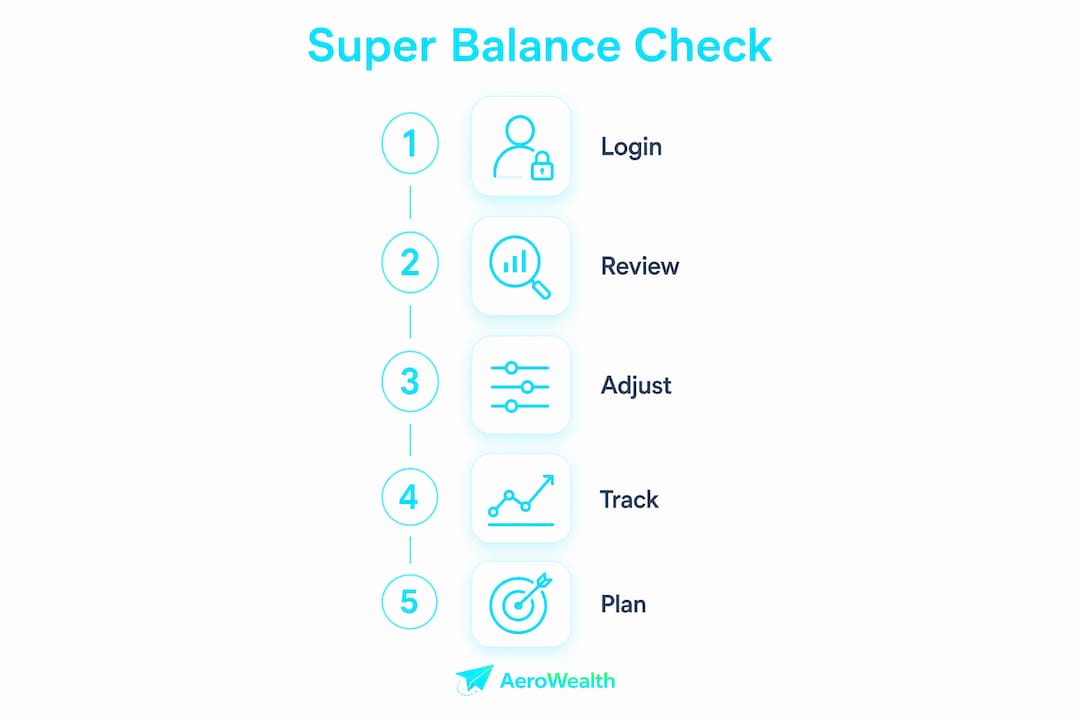
Your super balance is the foundation of every other retirement decision, so knowing exactly where it stands is the first step. Log in to myGov and link the ATO service to see all your super accounts in one place, including any lost or unclaimed amounts. If you have multiple accounts from different employers, consolidating them into one fund usually cuts duplicate fees and simplifies tracking.
Beyond the balance, keep these details current with your fund:
- Contact information: An outdated address or email means you miss statements and risk your account being classified as lost.
- Beneficiary nominations: A binding nomination overrides your will for super purposes. Review it every three years or after major life events.
- Insurance inside super: Most funds include default life, total and permanent disability (TPD), and income protection cover. Check whether the premiums are eroding your balance unnecessarily.
- Investment option: The default “balanced” option suits many people in their 40s, but as retirement approaches, gradually shifting toward lower-risk options can protect against a market drop at the worst possible time.
| Metric to track | Why it matters | Where to find it |
|---|---|---|
| Account balance | Baseline for income projections | myGov / fund portal |
| Annual fees (admin + investment) | Fees compound against you over decades | Fund’s annual statement |
| Insurance premiums | Can silently drain small balances | Fund’s member portal |
| Investment option | Drives long-term growth and risk exposure | Fund’s investment menu |
| Beneficiary nomination | Determines who receives your super | Fund’s online form |
Pro Tip: If you have not logged into myGov in a while, search for “ATO super” after linking the service. The ATO holds billions in unclaimed super, and some of it may be yours.
How much income will you actually need in retirement?
The ASFA Retirement Standard is the most widely used benchmark in Australia. For a couple, a “comfortable” retirement requires meaningfully more than a “modest” one, and the gap widens further if you rent rather than own your home. Renters typically need substantially more savings than homeowners to sustain a modest retirement lifestyle, a factor most generic calculators quietly ignore.
The Age Pension plays a bigger role than many people expect. Financial adviser James Hayes points out that DIY calculators often omit the Age Pension entirely, which leads people to set inflated savings targets. For a homeowner couple, the full Age Pension provides a meaningful income floor that reduces the amount super needs to generate.
A few practical pointers for estimating your number:
- List your current spending by category (housing, food, transport, health, travel) and adjust for retirement. Most retirees spend more in their early active years and less later.
- Account for healthcare costs, which tend to rise after 70 regardless of how healthy you feel now.
- Apply the 4% rule as a rough check, not a precise target. It suggests withdrawing 4% of your portfolio annually, but as Morningstar Australia notes, the rule embeds assumptions about returns, inflation, and spending patterns that rarely match any individual’s real life. Use it to sense-check a plan, not to set one.
- Model bridge years carefully if you plan to retire before your preservation age. Experts recommend holding two to three years of living expenses in cash or short-term bonds to avoid selling growth assets during a downturn.
Practical strategies to grow your super faster
The single most tax-effective way to build retirement savings is through concessional contributions, which are taxed at 15% inside super rather than at your marginal rate. Salary sacrifice is the most common method: you redirect pre-tax salary into super, reducing your taxable income and boosting your balance simultaneously.
Here are the main contribution levers available in 2026:
- Salary sacrifice (concessional): Pre-tax contributions up to the concessional cap. Check the current ATO cap before contributing, as it adjusts periodically.
- Non-concessional contributions: After-tax money you add voluntarily, subject to a separate annual cap. Useful if you have received an inheritance, sold a property, or want to top up closer to retirement.
- Government co-contribution: If you earn below the income threshold and make a personal after-tax contribution, the government may add a co-contribution to your fund.
- Spouse contributions: Contributing to a lower-income spouse’s super can attract a tax offset and helps even out balances between partners.
- Carry-forward unused concessional cap: If your super balance is below $500,000, you can use unused concessional cap amounts from the previous five years in a single year, a useful catch-up tool for people who took career breaks.
- Transition to retirement (TTR) pension: Once you reach preservation age, you can draw a TTR income stream while still working, potentially allowing you to salary sacrifice more into super without reducing your take-home pay.
Diversifying your super’s investment mix across growth and defensive assets also matters. Staying in a high-growth option too close to retirement exposes you to sequence-of-returns risk, where a market fall just before you stop working can permanently reduce your income.
Accessing super and understanding the tax implications

You can access your super once you reach your preservation age and meet a condition of release, most commonly retiring or turning 65. For most Australians born after June 30, 1964, the preservation age is 60. Withdrawals after age 60 from a taxed super fund are generally tax-free, which is one of the most powerful tax advantages in the Australian system.
Key points on access and tax:
- Before preservation age: Accessing super is restricted to specific hardship or compassionate grounds. Withdrawals in this scenario are taxed at your marginal rate minus a 15% tax offset.
- Age 60 to 64 (retired): Lump sums and income streams from a taxed fund are tax-free.
- Age 65 and over: Full access regardless of employment status; withdrawals remain tax-free from a taxed fund.
- Age Pension means test: Super account balances count as assets and the income drawn from them counts as income under Centrelink’s means test. Timing your withdrawals and structuring your assets carefully can affect how much Age Pension you receive.
- Minimum pension drawdowns: Once you convert super to an account-based pension, the ATO requires minimum annual withdrawals based on your age. These minimums do not dictate how much you spend, only how much you must take out of the tax-advantaged environment.
For those considering an SMSF, the same preservation and tax rules apply, but the administrative responsibility sits entirely with you as trustee. SMSFs suit people with larger balances who want direct control over specific assets like property.
Why professional retirement advice pays for itself
Retirement decisions involving super, the Age Pension, aged care, and estate planning interact in ways that are genuinely complex. A licensed financial adviser who specializes in retirement can identify entitlements you would otherwise miss, structure withdrawals to minimize tax, and model scenarios you had not considered. The cost of advice is often recovered in the first year through better Age Pension outcomes alone.
When choosing an adviser, ask:
- Are you licensed under an Australian Financial Services Licence (AFSL)?
- Do you accept commissions, or do you charge a flat or hourly fee?
- Do you specialize in my situation (public sector super, aged care, SMSF, retirement villages)?
- Can you show me a sample statement of advice?
- How do you integrate the Age Pension into your projections?
Advisers registered with the Financial Adviser Register (accessible via ASIC’s Moneysmart) have their qualifications and any disciplinary history publicly listed. Always verify before engaging. For a broader financial independence strategy, pairing professional advice with your own modelling gives you the clearest picture.
1. Retirement Essentials
Retirement Essentials focuses on making retirement financial guidance affordable and accessible. The firm helps Australians maximize entitlements including Age Pension claims and Commonwealth Seniors Health Card applications, working through issues one at a time rather than requiring a full financial plan upfront. It suits retirees who want targeted help with a specific question rather than ongoing advice.
2. Financial Foundations Australia
Financial Foundations Australia works across generations, handling wealth growth and transition planning for families with complex financial structures. The firm holds a Trusted Firms Badge and uses technology-driven personalized action plans. It fits clients who need advice that spans multiple family members or involves layered assets.
3. Paterson Retirement Planning
Paterson Retirement Planning specializes in retirement advice for education and public sector employees, covering superannuation, aged care planning, and Centrelink concession advice. The firm operates as an Authorised Representative of Fortnum Private Wealth Ltd (AFSL 357306). If your super is tied to a public sector scheme, sector-specific expertise here is worth the conversation.
4. Retire Advice
Retire Advice holds a Masters of Financial Planning and SMSF accreditation, and accepts no commissions. The firm specializes in defined benefit public sector schemes including PSS, CSS, and MSBS, which have rules that differ substantially from standard accumulation funds. A Super and Retirement health check session is priced at $260.
5. Aged Care Financial Planning
Aged Care Financial Planning is registered with the FPA as an Aged Care Specialist and with the Tax Practitioners Board. The firm helps clients reduce nursing home and residential aged care fees, access pension entitlements, and manage the tax and cash flow impacts of aged care transitions. This is a narrow specialty that most generalist advisers handle poorly.
6. Balance Retirement & Aged Care Specialists
Balance Retirement & Aged Care Specialists focuses on the intersection of retirement income and aged care funding. The firm supports clients navigating the financial decisions that arise when moving into supported living, including asset structuring and pension optimization. Pricing is not publicly listed.
7. Wealthlab Financial Advisor
Wealthlab provides financial advice with a retirement planning focus, helping clients build and manage portfolios suited to their retirement timeline. The firm’s positioning emphasizes personalized advice over product sales. Specific certifications and pricing are not publicly listed.
8. Retirement Village Financial Advice
Retirement Village Financial Advice fills a gap most advisers skip entirely: the financial modelling specific to retirement village contracts, including deferred management fees, cash flow, taxes, and pension entitlements for village residents. Founder Shaun Ganguly is an authorised representative of Prime Years Pty Ltd (AFSL 559807). A free initial 15-minute consultation is available.
See your retirement numbers before you commit to a plan

Aerowealth is built specifically for Australians who want to model their retirement before making irreversible decisions. The platform lets you run side-by-side scenario comparisons across superannuation, investment property, ETFs, and mortgages, and stress-test your assumptions against market downturns and different retirement ages. It also models bridge years for those planning to retire before their preservation age, and includes CGT and tax impact modelling so you can see the real after-tax picture. An AI assistant explains every projection under Australian rules, without jargon.
Start modeling your retirement with Aerowealth’s free plan, or upgrade to Pro for expanded scenarios, advanced mortgage features, and higher AI assistant access. View pricing here.
Key Takeaways
Effective retirement planning in Australia requires integrating superannuation management, realistic income estimation, tax-aware contribution strategies, and professional advice long before you stop working.
| Point | Details |
|---|---|
| Median super balances are lower than expected | Men aged 60–64 hold a median super balance of about $220,000 and women $163,000 as of mid-2023—far below the often cited $1 million figure. |
| Renters need significantly more savings | Renters require $240,000–$285,000 more than homeowners to sustain a modest retirement lifestyle. |
| The Age Pension is a real income floor | Factoring in the Age Pension often reduces the super balance you actually need to accumulate. |
| Tax-free withdrawals start at 60 | Withdrawals from a taxed super fund after age 60 are generally tax-free, making timing decisions critical. |
| Professional advice targets specific gaps | Sector-specific advisers (public sector, aged care, retirement villages) deliver value generalist planners often miss. |