The Six-Year Rule for Investment Property: ATO Guide

The ATO’s six-year rule (formally s118-145 of the ITAA 1997) lets you treat a former main residence as CGT-exempt for up to six years while it earns rental income. Leave it vacant instead, and the exemption runs indefinitely with no six-year cap. The single most important action: confirm the property was genuinely your main residence before you moved out, log the exact move-out date and the date it first produced income, and model your sale timing before you sign a contract.
Key investor facts at a glance:
- The six-year clock starts when the property begins producing income, not when you move out.
- Vacant periods do not count toward the income-producing six-year limit.
- You can only nominate one main residence at a time, with a limited overlap period when changing homes.
- The election to claim the absence rule is made in your tax return for the year you sell the property, not when you first rent it out.
- Aerowealth’s scenario tools let you model “sell inside six years” versus “rent beyond six years” side by side before you decide.
Pro Tip: Run your numbers before you list the property. The difference between selling in year five and year seven can mean tens of thousands of dollars in CGT — and Aerowealth’s side-by-side scenario tool makes that comparison straightforward.
Key Takeaways
The six-year rule preserves a full CGT main residence exemption for up to six years of income-producing absence — but only if the property was genuinely your home first, and only if you sell before the clock runs out.
| Point | Details |
|---|---|
| Six-year income-producing limit | The CGT exemption covers up to six years of rental; any income-producing period beyond that attracts CGT on a pro-rata basis. |
| Vacant periods are unlimited | Leaving the property empty means the main residence exemption continues indefinitely, with no six-year cap. |
| Get a valuation early | Commission a formal market valuation on the day the property first produces income to lock in a defensible cost base. |
| Election is made at sale | You claim the absence rule in the tax return for the year of sale, not when you first move out or start renting. |
| Model before you decide | Aerowealth lets you compare “sell inside six years” versus “rent longer” side by side, with CGT and retirement income impacts included. |
Table of Contents
- How the six-year rule actually works, step by step
- Who qualifies, and what evidence the ATO expects
- How CGT is calculated when you exceed six years
- Common investor scenarios and their tax outcomes
- What records to keep and when to get a valuation
- Planning strategies that use the six-year rule effectively
- What to model numerically before you decide
- What planners actually see when they run these numbers
- Model your six-year rule scenarios with Aerowealth
- Sources
- FAQ
How the six-year rule actually works, step by step
The rule is simpler than most investors expect, but the mechanics matter.
- You occupy the property as your genuine main residence. This is the non-negotiable starting point. The property must have been your home, not an investment you moved into briefly.
- You move out. The clock does not start here.
- The property first produces income (typically the day a tenant moves in). The six-year clock starts on this date.
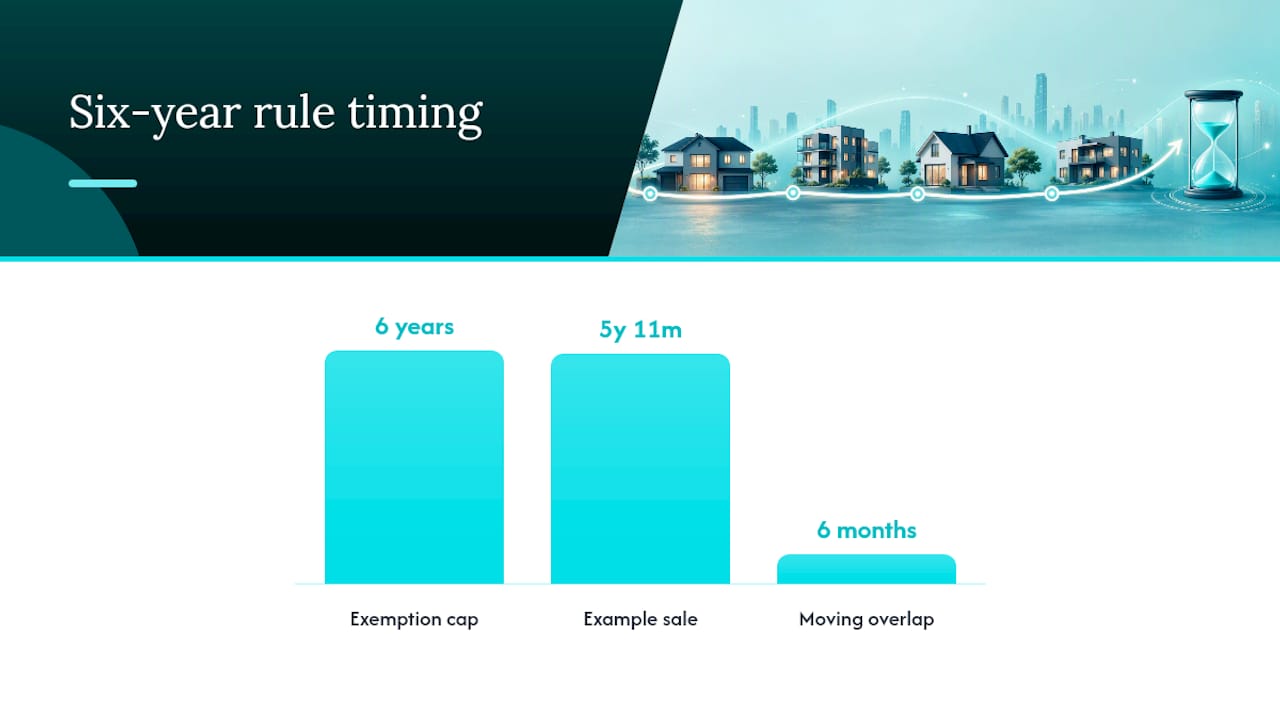
- You sell within six years of that first-income date. Full main residence CGT exemption applies, provided you have not nominated another property as your main residence during the same period (a six-month overlap when moving between homes is permitted).
- You sell after six years of income production. CGT applies to the portion of the gain attributable to the period beyond six years, with a cost-base reset to market value at the first-income date.
If the property sits vacant between your move-out and a future tenancy, those vacant months do not consume any of the six-year allowance. The ATO is clear: the six-year cap applies only to income-producing periods.
“The six-year absence rule is an election you make in the tax return for the year you sell — you don’t lodge anything with the ATO when you first rent the property.” — PropAutoPilot, ITAA 1997 s118-145 guide
Typical timeline: Move out January 2018 → tenant in March 2018 (clock starts) → sell February 2024 (five years, eleven months of income production) → full exemption. Sell March 2025 instead, and you have crossed the six-year mark.
Genuine reoccupation resets the clock. Move back in, live there as your main residence, then move out again, and a fresh six-year period begins from the next income-producing date. The ATO assesses genuineness on objective facts, so a two-week stay while your furniture is in storage will not cut it.
Who qualifies, and what evidence the ATO expects
The qualifying conditions are strict. Miss one and the exemption fails entirely.
- The property was your genuine main residence before you moved out — not a property you bought as an investment and occupied briefly.
- The land is no more than two hectares (the standard main residence land limit).
- You are an Australian tax resident at the time of sale.
- You have not nominated another property as your main residence during the same absence period (except within the permitted six-month overlap).
- The property was not used to produce income before you first moved in — partial pre-move income use (such as renting a room) can permanently exclude a portion of the property from the exemption.
The ATO tests genuineness by looking at where you actually lived, where your mail was delivered, your electoral roll enrolment, and your utility usage. No single document is enough on its own.
“Properties bought purely as investments that were never lived in do not qualify for the six-year rule — the main residence must have been established genuinely before the absence period begins.” — Bentleys, CGT exemption guide
How CGT is calculated when you exceed six years
While the six-year rule protects the first six years of income-producing absence, any income-producing period beyond that attracts CGT on a pro-rata basis.
The cost-base reset rule: When a property is first used to produce income, the ATO treats its market value at that date as the cost base for calculating the taxable portion of any future gain. This is why an early formal valuation matters so much — it locks in a defensible number before the property appreciates further.
Worked example:
- Purchase: January 2015 for $600,000.
- Lived in as main residence: January 2015 to January 2018 (three years).
- First rented: January 2018. Market value at that date: $750,000 (this becomes the cost base for the taxable period).
- Sold: January 2026 (eight years of rental, two years beyond the six-year limit).
- Sale price: $1,100,000.
Pro Tip: Commission a formal valuation on the day your property first produces income — or as soon as practicable after. A dated formal valuation is the document the ATO will want if you ever need to defend the cost-base reset figure.
Common investor scenarios and their tax outcomes
Scenario A — Sell inside six years (full exemption): You moved out in 2019, rented the property, and sell in 2024. Five years of income production.
Scenario B — Rent beyond six years (partial exemption): Seven years of rental before sale. Two years fall outside the six-year window. Taxable fraction: 2 ÷ total ownership years. This scenario should trigger an immediate valuation review and a conversation with a registered tax agent.
Scenario C — Leave vacant indefinitely (indefinite exemption): You move out, leave the property empty, and sell 10 years later. Because the property never produced income, the six-year cap never applied. Result: full CGT exemption, no cost-base reset required.
“The indefinite exemption for vacant properties is one of the most underused planning levers in Australian property tax — but it only works if you genuinely forgo the rental income.” — Austax
Scenario D — Reoccupy and reset: You rent for four years, move back in genuinely for two years, then rent again. The first four-year absence is closed. A fresh six-year clock starts from the second tenancy. Each absence period has its own six-year allocation, making genuine reoccupation a legitimate planning tool when documented thoroughly.
What records to keep and when to get a valuation
The ATO can audit a main residence claim years after the sale. Build your file from day one.
Documents to collect:
- Tenancy agreements and lease commencement dates
- Rental ledgers and bank statements showing rental income
- Utility bills at the property during your period of residence
- Electoral roll enrolment records
- Mail redirection confirmations
- Council rates notices addressed to you at the property
- Dated photos of your personal belongings in the home
- Correspondence (bank, Medicare, employer) showing the property as your address
When to get a valuation:
- On the day the property first produces income (or as soon as practicable after).
- Again if you reoccupy and then re-rent, to establish the new cost-base reference point.
- Before you list the property for sale, to model the taxable gain accurately.
“A formal market valuation dated to the day the home first became income-producing is the document practitioners most often find missing when a client’s CGT position is challenged.” — PropertyTaxTools, CGT absence rule guide
Audit risk triggers: Contradictory residency evidence (e.g., electoral roll at a different address during the claimed residence period), simultaneous main residence nominations, and missing valuations are the three most common reasons the ATO scrutinizes a claim.
Planning strategies that use the six-year rule effectively
The rule is a genuine planning lever, but it rewards deliberate decisions, not reactive ones.
Options and trade-offs:
- Keep renting (deductions now, six-year limit applies): You claim interest, depreciation, and property tax deductions while the clock runs. Sell before the six-year mark for a full exemption. Sell after, and you pay CGT on the excess period.
- Leave vacant (indefinite exemption, no rental income): Works when capital growth is strong enough to outweigh foregone rent. No six-year pressure, but carrying costs with no offset.
- Reoccupy to reset the clock: Genuine reoccupation restarts a fresh six-year period. The ATO assesses genuineness on facts, not intent, so document everything. Brief or nominal stays will not satisfy the test.
- Nominate which property is your main residence: If you own two properties, you choose which one to nominate. The choice is made retrospectively in the year of sale, giving you flexibility — but you cannot claim both simultaneously.
Decision points to model before acting:
- Expected capital growth rate over the remaining hold period.
- Net rental yield versus the CGT cost of exceeding six years.
- Your tax residency status at the expected sale date.
- Whether partial exemption still produces acceptable after-tax proceeds.
- How the sale proceeds feed into your retirement income projections.
Contact a registered tax agent when you are within 12 months of the six-year threshold, when you are considering reoccupation as a planning move, or when you own two properties and need to choose which to nominate.
What to model numerically before you decide
Whether you use a spreadsheet or a dedicated tool, these are the inputs that drive the calculation.
Inputs to gather:
- Purchase price and date, plus acquisition costs (stamp duty, legal fees)
- Date you first occupied the property as your main residence
- Exact move-out date
- Date the property first produced income (first tenancy start date)
- Market valuation at the first-income date
- Expected sale date and sale price scenarios
- Total rental income and deductible expenses by year
- Whether Division 40/43 depreciation claims have reduced the cost base
Scenario templates to run:
- Sell inside six years: Calculate exempt fraction as 100%. Compare net proceeds after agent fees and legal costs.
- Rent beyond six years with cost-base reset: Apply the pro-rata formula (exempt years ÷ total ownership years), apply the 50% CGT discount to the assessable gain, and calculate the after-tax net proceeds.
- Leave vacant and sell later: No cost-base reset required. Model the opportunity cost of foregone rent against the CGT saving.
Modelling checklist:
- Valuation date field (must match first-income date)
- Day-count for exempt days versus total ownership days
- 50% CGT discount eligibility (held more than 12 months)
- Sensitivity tests at 2%, 4%, and 6% annual capital growth
- After-tax internal rate of return for each scenario
- Impact on retirement income if sale proceeds fund drawdown
An investment property ROI calculator can handle the basic return math, but CGT-adjusted retirement modelling requires a tool that connects property outcomes to superannuation and drawdown projections.
What planners actually see when they run these numbers
The six-year rule is one of the few places in Australian tax law where the timing of a single decision — sell now versus rent one more year — can shift a client’s after-tax outcome by more than the entire annual rental income. That asymmetry is what makes it worth modeling carefully rather than estimating.

The trap most investors fall into is treating reoccupation as a simple administrative fix. Move back in for a few months, reset the clock, move out again. The ATO’s test is whether you genuinely established the property as your main residence — and a short stay with your furniture still in storage, your mail still going elsewhere, and your kids still enrolled at a school near your other address will not pass. The AusTax.tools guidance on genuine reoccupation is direct on this: the ATO looks at objective facts, not stated intentions.
The other underappreciated point: the six-year rule stacks with rental deductions. You can claim interest and depreciation while renting, and those deductions do not automatically disqualify the CGT exemption. But if your exemption later fails for part of the ownership period, those deductions will have already reduced your cost base — meaning the taxable gain on the non-exempt portion is higher than you might expect. Early valuation and careful modelling are the only way to see that interaction clearly before it becomes a problem.
Model your six-year rule scenarios with Aerowealth
The CGT math on a former main residence is straightforward once you have the right inputs. The hard part is knowing which scenario actually produces the best after-tax outcome for your retirement plan.

Aerowealth is built for exactly this kind of decision. Plug in your move-out date, first-income date, and expected sale scenarios, then run “sell inside six years” against “rent beyond six years” side by side. The platform models CGT impact, after-tax proceeds, and how each outcome flows into your retirement income and superannuation projections — no spreadsheet juggling required. You can also stress-test capital growth assumptions at different rates to see how sensitive your decision is to property price movements.
When you are ready to act, pair Aerowealth’s projections with advice from a registered tax agent for binding guidance on your specific situation. Start modeling your property scenarios at Aerowealth — the free plan covers the core scenario comparisons, and the Pro plan adds bridge-year modelling for early retirement planning.
Sources
- Treating former home as main residence | Australian Taxation Office
- Capital Gains Tax 6-Year Absence Rule (Australia)
- Austax
FAQ
What is the six-year rule for investment property in Australia?
The ATO’s six-year rule lets you treat a former main residence as CGT-exempt for up to six years while it produces rental income. If the property is left vacant, the exemption continues indefinitely.
Does the six-year clock reset if I move back in?
Yes — genuine reoccupation restarts a fresh six-year period from the next time the property produces income. The ATO assesses genuineness on objective evidence, so a brief or nominal stay will not qualify.
When do I make the election to use the six-year rule?
You make the election in your tax return for the year you sell the property, not when you first move out or start renting. No separate lodgment is required at the time of the absence.
What happens if I rent the property for more than six years?
CGT applies to the portion of the gain attributable to the income-producing period beyond six years. The cost base for that taxable portion resets to the property’s market value on the date it first produced income.
Can I claim rental deductions and still use the six-year CGT exemption?
Yes. Claiming rental deductions does not automatically disqualify the CGT exemption. However, those deductions reduce your cost base, which can increase the taxable gain on any non-exempt portion of the ownership period.
This article provides general information only and is not a substitute for professional tax advice. Confirm your specific circumstances with a registered tax agent or the ATO before making decisions based on the six-year rule.