Model Transfers to Protect Your $2.1m Transfer Balance for Australians

The general transfer balance cap sits at $2.1 million for 2026–27, the ceiling on how much you can move into a tax-free retirement phase income stream. If you’re nearing retirement, the immediate move is to check your transfer balance account via myGov before you start or add to a pension, then model the transfer against your personal cap so you don’t trigger excess transfer balance tax you never saw coming.
TL;DR:
- Transfers should be conservative initially, with full amounts topped up later after confirming your actual personal cap space.
- Partial commutations help manage liquidity without risking the loss of tax-free status on remaining pension balances.
- Accurate modeling of reversionary events and timing is essential to avoid unexpected breaches or excess transfer balance tax.
- Couples can increase combined tax-free capacity by splitting super balances evenly and using strategic contributions and rebalancing.
- Always check your TBAR history and valuation methods before any transfer, and consider professional advice when close to caps or dealing with complex scenarios.
Table of Contents
- What Is a Transfer Balance Cap Strategy?
- What Counts Toward Your Transfer Balance Cap
- What Happens if You Exceed Your Transfer Balance Cap
- Strategies to Maximise Your Tax-Free Pension Phase
- Couples Strategies: Splitting, Equalising and Division 296
- Your Transfer Balance Cap Checklist
- How Scenario Modelling Clarifies Transfer Balance Decisions
- A Conservative, Practical Approach for Near-Retirees
- Model Your Transfer Balance Decisions Before You Commit
- Sources
- FAQ
What Is a Transfer Balance Cap Strategy?
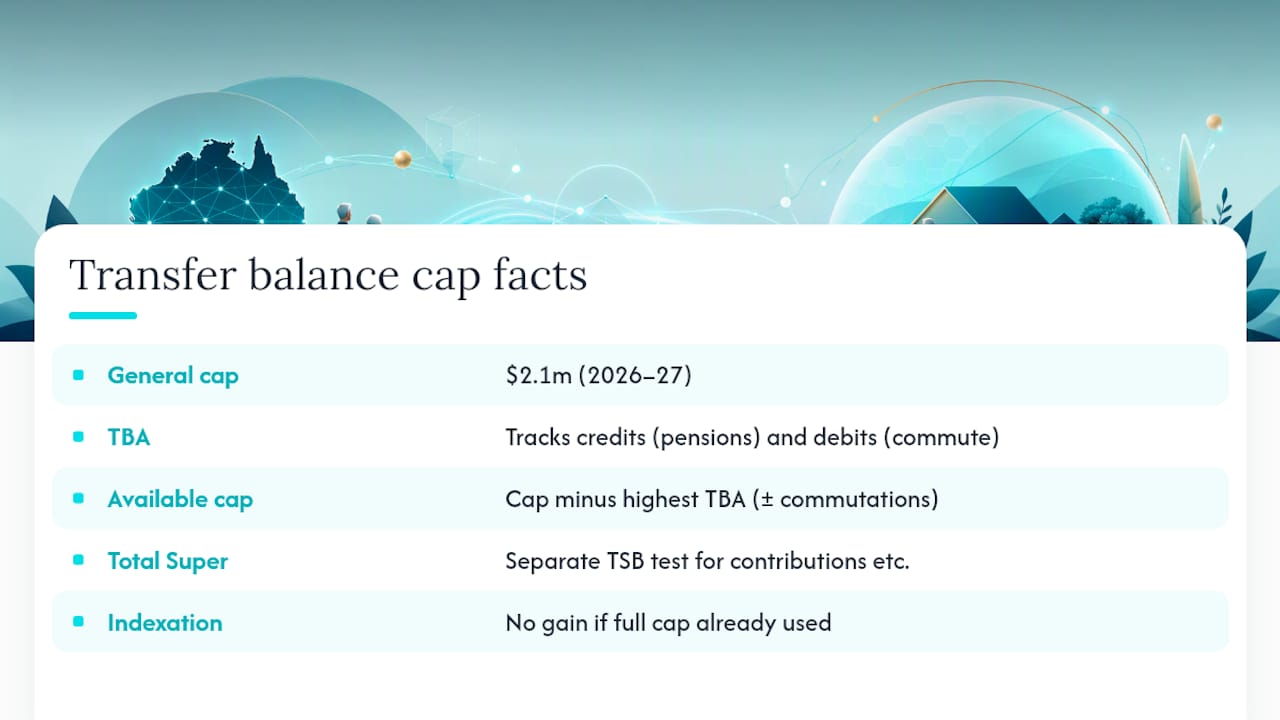
A transfer balance cap strategy is simply the plan you use to move super into retirement phase without breaching your personal limit, and to make the most of whatever cap space you have left. The $2.1 million figure is the general cap for anyone starting their first retirement phase income stream in 2026–27. But your personal cap can be lower, depending on when you first used any of it.
Here’s the mechanic that trips people up: your transfer balance account (TBA) tracks credits and debits, not your super balance. A credit happens when you start a pension. A debit happens when you commute money back to accumulation or take a lump sum. Your available cap space is the general cap minus your highest ever TBA balance, adjusted for any commutations.
This is different from your total super balance (TSB), which is a separate figure used to test eligibility for non-concessional contributions, the $1.9 million transfer threshold for co-contributions, and other caps. A retiree with a $1.8 million TBA and a $2.3 million TSB (because part of their super is still in accumulation phase) faces different rules on each front. Confusing the two is one of the most common errors in retirement planning, and it’s an easy one to make when both numbers move in the same direction most of the time.
Proportional indexation only helps if you haven’t already used your full cap. Someone who transferred $1.9 million against an $1.9 million cap in 2023 gets zero benefit from later indexation increases. It’s a genuinely counterintuitive rule, and it rewards people who transferred conservatively early on.
What Counts Toward Your Transfer Balance Cap
Not every dollar in your super is treated the same way once it enters retirement phase, and the rules around defined benefits, TRIS accounts, and reversionary pensions catch a lot of people off guard.
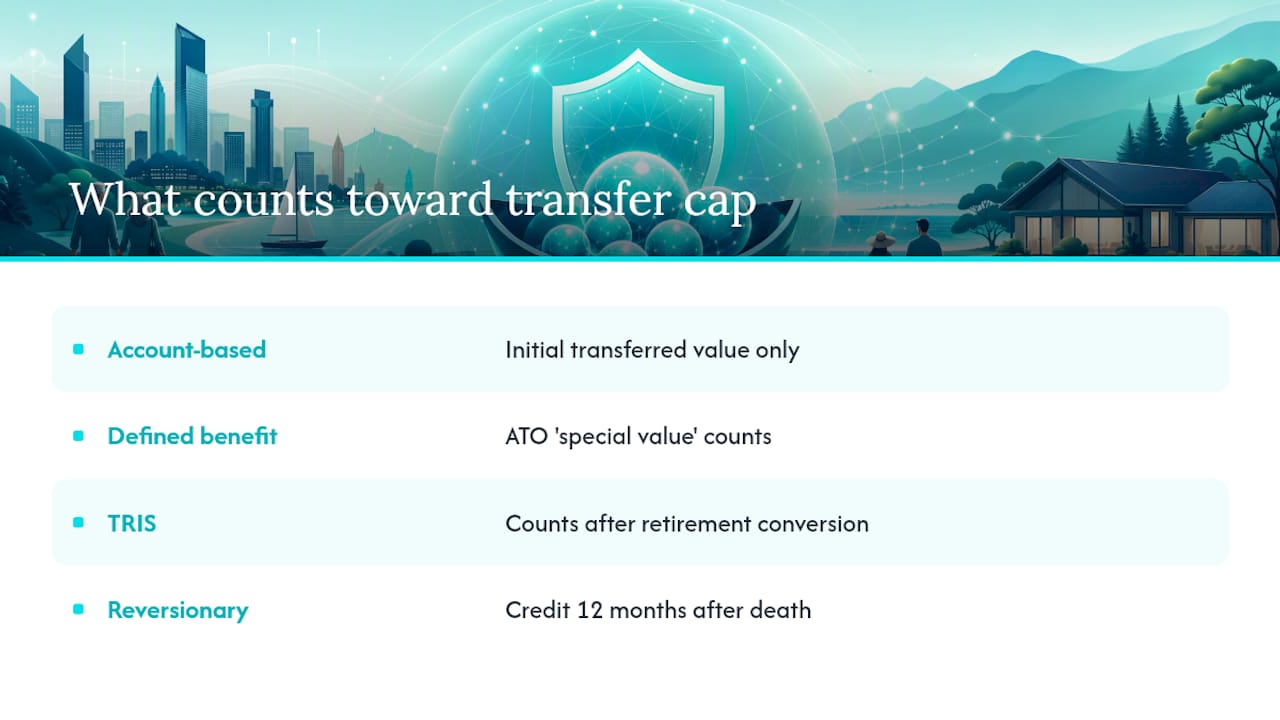
Account-based pensions are the simplest case. The value transferred in when you start the pension is what counts as your credit. Later investment growth inside that pension doesn’t add to your TBA, even if your balance doubles. That’s a real advantage of starting a pension earlier with a smaller amount and letting it grow tax free inside the cap, rather than waiting and transferring a larger lump sum later.
Capped defined benefit income streams are valued differently. The ATO assigns a “special value” to the income stream using a formula based on annual entitlement, not the account balance, and this special value counts toward your cap alongside any account-based pensions you hold.
Transition-to-retirement income streams (TRIS) only trigger a TBA credit once they convert to retirement phase, typically when you turn 65 or meet a condition of release and notify your fund. Get the conversion date wrong, and you can misjudge your available cap space by months.
Reversionary pensions create a credit for the surviving partner, usually 12 months after death, at the pension’s value at that date. If both partners are near their personal caps, an unreviewed reversionary nomination can push the survivor into an unexpected breach.
What Happens if You Exceed Your Transfer Balance Cap
If your TBA balance exceeds your personal cap, the ATO requires you to commute the excess, either back to accumulation phase or out of super as a lump sum. You’ll also owe excess transfer balance tax on notional earnings calculated from the day the excess arose, at 15% for a first breach and 30% if it happens again.
The debit only counts on the day the commuted amount is actually removed, not the day you decide to act. That gap matters: notional earnings keep accruing daily until the money moves, so delaying a commutation by a few weeks has a real dollar cost.
If you don’t act, the ATO issues an excess transfer balance determination specifying the amount to commute and a 60-day deadline. Ignore that, and the ATO can issue a commutation authority directly to your fund, forcing the transfer whether you’ve decided which pension to reduce or not. That removes your choice over which income stream takes the hit, which is exactly the scenario you want to avoid.
Practical first steps: pull your TBAR history from myGov, call your fund to confirm which events they’ve reported, and get an adviser involved before signing off on any large transfer if your numbers are close to the cap. A same-day phone call to your fund is often the difference between fixing an error quietly and receiving a formal ATO notice.
Strategies to Maximise Your Tax-Free Pension Phase
Once you understand the mechanics, the real work is sequencing decisions so you use cap space efficiently rather than accidentally locking yourself out of future flexibility.
- Transfer conservatively first, top up later. If you’re close to the cap, start your pension with less than the full available amount. That preserves cap space for a future top-up if you get an inheritance or sell an asset.
- Sequence contributions around your total super balance at June 30. Your TSB on that date determines your non-concessional contribution cap for the following year. A large TBA credit close to June 30 can shift your TSB above a threshold and cut off contribution room you were counting on.
- Choose partial commutation over full commutation when you just need liquidity. A partial commutation frees up cash for a one-off expense while keeping the rest of the pension, and its tax-free earnings, running. Full commutation gives up that tax treatment on the entire balance for what might be a temporary cash need.
- Run the trade-off as a real comparison, not a guess. Pension income is tax-free in retirement phase; money sitting in accumulation is taxed at up to 15% on earnings. But accumulation phase gives you more flexibility if Centrelink asset tests are a live concern. The right call depends on your specific numbers, which is exactly the kind of comparison that benefits from side-by-side retirement income streams modelling rather than a rule of thumb.
Pro Tip: Before you commute anything, model the notional earnings you’d owe if you waited three more months versus acting today. The daily accrual on excess transfer balance tax means procrastination has a measurable price tag, and seeing that number in dollars tends to speed up decisions.
Couples Strategies: Splitting, Equalising and Division 296
Two people each have their own $2.1 million cap. A couple who concentrates $3 million in one partner’s name wastes cap space the other partner will never use, while a couple who splits it $1.5 million each captures the full combined tax-free pension capacity available to them.
- Contribution splitting lets you redirect up to 85% of a year’s concessional contributions to your spouse’s account, useful when one partner’s balance is running well ahead of the other’s.
- Spouse contributions work in the other direction, letting the higher earner contribute directly into a lower-balance partner’s fund, sometimes attracting a tax offset if the receiving spouse earns under the relevant threshold.
- Division 296 introduces an extra tax on earnings for balances above $3 million per person, so equalising balances between partners can also reduce combined exposure to that additional tax.
- Centrelink timing matters too: moving assets between accumulation and pension phase can shift how they’re assessed under the assets test, so age pension eligibility should be checked alongside any transfer decision.
A couple with $2.4 million and $600,000 respectively who rebalances to $1.5 million each, for example, both stay comfortably under their personal caps and materially increase their combined tax-free retirement phase capacity compared to leaving the imbalance in place.
Your Transfer Balance Cap Checklist
Before you make any transfer or commutation decision, work through this list:
- Log into myGov and pull your current TBAR history to confirm your reported credits and debits match what you expect.
- Ask your fund to confirm the valuation method used for any defined benefit special value, and check it against your annual statement.
- Review reversionary pension nominations now, not after a health event, since they create delayed credits that can catch a surviving partner off guard.
- Confirm your TRIS conversion date in writing if you’re near the age-65 automatic conversion trigger.
- Ask your fund or adviser directly: “What is my current TBA balance, what’s my personal cap, and how much unused cap space do I have if indexation applies?”
Red flags worth escalating immediately include a TBAR entry you don’t recognize, a fund valuation that doesn’t match your expected pension balance, or an ATO letter referencing a determination you weren’t expecting.
How Scenario Modelling Clarifies Transfer Balance Decisions
Add a reversionary event to the model and you can see, in dollar terms, whether a surviving partner’s cap holds up.
This is the kind of comparison Aerowealth’s modelling is built around: proportional indexation, commutation timing, and couples scenarios run side by side rather than worked out on paper. Whatever tool you use, ask for the same outputs: after-tax income across each scenario, remaining cap space in dollars, and the impact of any reversionary or Division 296 events on the numbers.
A Conservative, Practical Approach for Near-Retirees
The safest path we’ve seen work is a boring one: check your TBAR before you touch anything, model the transfer against your actual personal cap, and don’t assume indexation applies to you until you’ve confirmed how much of your prior cap you actually used.
Preserving tax-free pension capacity is usually worth more than the extra liquidity of leaving money in accumulation, but not always. If you’re carrying a defined benefit interest, a blended family estate, or a balance close to $3 million, that’s the point to bring in a qualified adviser rather than freelancing it. Model first, decide second, and keep a written record of why you chose the path you did.
— Aerowealth Team
Model Your Transfer Balance Decisions Before You Commit
Aerowealth is the way to see a commutation or timing decision play out in numbers before you ask your fund to act on it. Instead of a spreadsheet full of assumptions, you get side-by-side scenarios covering super, mortgage, and property together, projected under Australian rules so you can see how a transfer today compares to waiting for indexation next year.

None of this replaces tailored tax or financial advice, particularly if you’re dealing with a defined benefit interest or a balance near the Division 296 threshold. What it does is give you a clear before-and-after picture, the kind advisers usually charge by the hour to produce, so your conversation with them starts from real numbers rather than guesswork. Start a free scenario at Aerowealth and see what your own transfer balance cap decision looks like projected out five and fifteen years.
Sources
- Transfer balance cap | Australian Taxation Office
- Transfer balance cap (TBC) for super pensions: How it works | SuperGuide
This article is general information, not a substitute for advice from a qualified financial advisor. Consult a qualified financial professional about your own circumstances before acting on anything here.
FAQ
What Is the Current Transfer Balance Cap in Australia?
The general transfer balance cap is $2.1 million for 2026–27. Your personal cap may be lower if you started a retirement phase pension before the most recent indexation increase.
How Many People Have $1 Million in Super in Australia?
The ATO doesn’t publish a simple headline count, and the figure shifts with indexation and market performance each year, but seven figure balances remain uncommon and typically involve decades of consistent contributions or a defined benefit interest.
What Is Considered a Wealthy Retiree in Australia?
There’s no official threshold, but a retiree approaching or exceeding the transfer balance cap of $2.1 million, or a couple with $3 million or more combined, sits well above what most Australians hold in super at retirement.
How Much Super Do I Need to Retire on $70,000 a Year?
Rules of thumb vary, but most modelling suggests a couple aiming for a comfortable retirement lifestyle needs a combined super balance that depends on factors like home ownership, age pension eligibility, and expected retirement length. Running your own numbers through a modelling tool like Aerowealth gives a far more precise figure than any generic rule of thumb.
Does Money Growing Inside My Pension Count Toward My Cap?
No. Only the amount transferred in when you start the pension counts as a credit to your transfer balance account. Investment growth after that point doesn’t add to your TBA, even if your pension balance rises well past $2.1 million.