90 Days to Submit: Downsizer Contribution for Australians 55+

If you’re 55 or older and selling your main residence, you can put up to $300,000 of the sale proceeds into super as a downsizer contribution, or $600,000 combined for a couple. It’s a one-off, after-tax contribution that skips the usual contribution caps. But it only works if you meet the ATO’s ownership and timing rules, and it can quietly shrink your Age Pension if you don’t model the effect first.
TL;DR:
- Downsizer contributions can allow individuals 55 or older to deposit up to $300,000, or $600,000 for couples, from home sale proceeds directly into super without affecting contribution caps.
- To qualify, sellers or their spouses must have owned the home for at least 10 years, and the property must be their main residence eligible for CGT exemption.
- Making the contribution requires submitting the NAT 75073 form before or at the time the money lands in the super fund, with a 90-day window from settlement.
- Moving sale proceeds into super can reduce Age Pension eligibility, as super assets are counted under the assets test immediately upon transfer.
- Carefully model the financial impact beforehand, as the benefits depend heavily on individual circumstances, including existing super balances and pension thresholds.
Table of Contents
- What Is a Downsizer Contribution Strategy?
- Who Qualifies for a Downsizer Contribution?
- How Much Can You Contribute, and How Does It Affect Your Super Caps?
- How Do You Actually Make a Downsizer Contribution?
- Will a Downsizer Contribution Reduce Your Age Pension?
- Downsizer Checklist: What to Do Before and After Settlement
- Downsizer Contribution Examples: Single and Couple Scenarios
- How Should You Model Downsizer Scenarios Before Selling?
- What the Aerowealth Team Thinks You’re Getting Wrong
- See Your Downsizer Numbers Before You List the House
- Official Downsizer Contribution Resources
- Sources
- FAQ
What Is a Downsizer Contribution Strategy?
A downsizer contribution is a one-off, after-tax payment into super made from the proceeds of selling your main residence. It sits outside the normal contribution machinery: no concessional or non-concessional cap applies, and the fund can’t tax it 15% on the way in, unlike most other super deposits.
That doesn’t mean it’s invisible to the system, though. The ATO confirms downsizer contributions still count toward your Total Superannuation Balance, and if you move the money into pension phase, it counts against your Transfer Balance Cap too. This is why calling it a “free” boost to super is a bit misleading. It’s cap-free on entry, but it still affects the ceilings that govern how much you can hold in a tax-free pension account later.
Who Qualifies for a Downsizer Contribution?
The eligibility rules are specific, and missing one disqualifies the whole contribution. Here’s what the ATO actually checks:
- You (or your spouse) must be at least the eligible age set by the ATO at the time you make the contribution, with no upper age limit.
- You or your spouse must have owned the home for 10 years or more immediately before the sale.
- The property must qualify for the main residence capital gains tax exemption, in full or in part. Investment properties that were never your home don’t count, and neither do caravans, houseboats, or vacant land without a dwelling.
- Each eligible spouse can contribute up to their individual eligible maximum under current rules, even if only one spouse’s name was on the title. The catch: combined contributions from both spouses can’t exceed the total sale proceeds.
Couples often trip up on that last point, assuming both partners automatically get $300,000 regardless of what the house actually sold for.
How Much Can You Contribute, and How Does It Affect Your Super Caps?
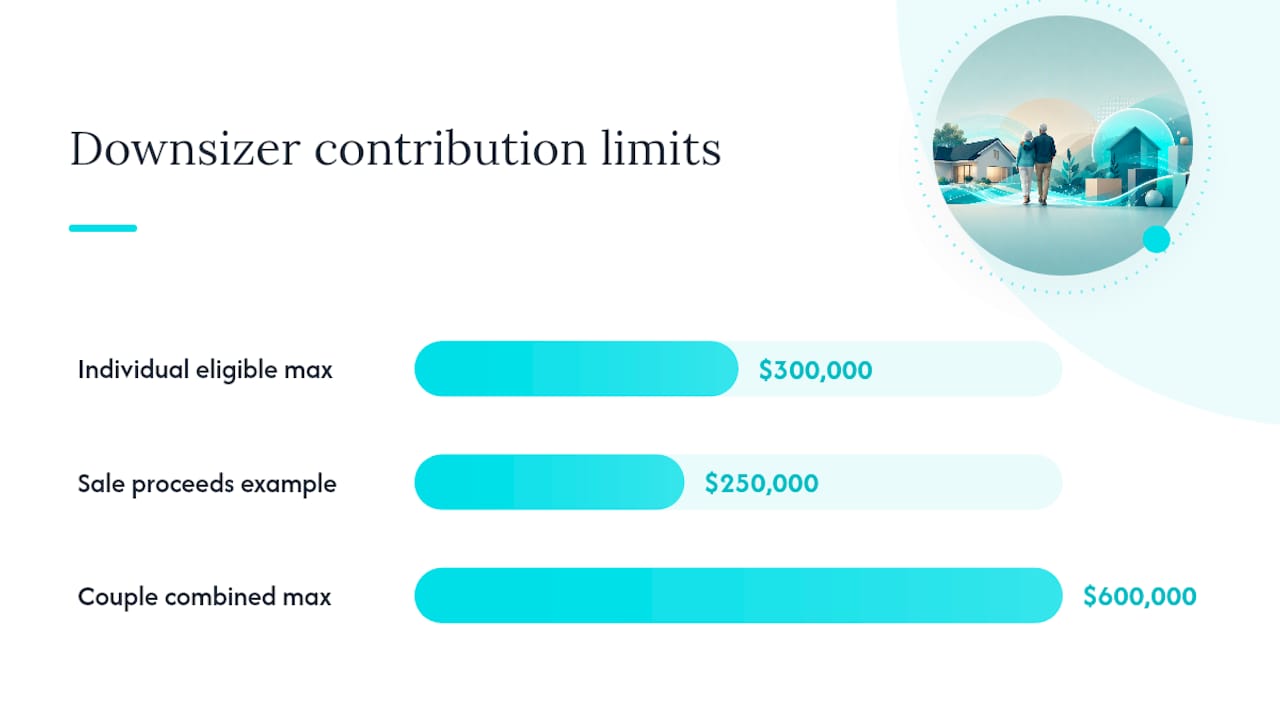
The headline individual maximum contribution is capped at the lesser of the eligible maximum or the home sale proceeds. If your house sells for $250,000, that’s the ceiling, not $300,000, because the contribution can never exceed sale proceeds.
Here’s where it gets useful for planning:
- Downsizer contributions don’t touch your concessional or non-concessional contribution caps, so you can still make regular super contributions in the same year.
- They aren’t taxed going in, unlike concessional contributions, which lose 15% to contributions tax.
- They do increase your Total Superannuation Balance, which affects your eligibility for future non-concessional contributions and the bring-forward rule.
A useful number to anchor your planning: a couple selling a home for $700,000 or more can move up to $600,000 combined into super, under current ATO thresholds. That’s on top of whatever normal super balance they already hold, and it goes straight into the accumulation or pension side depending on how the fund processes it.
How Do You Actually Make a Downsizer Contribution?
The process is straightforward on paper but timing-sensitive in practice. Miss the window and there’s no fixing it after the fact.
- Call your fund first. Confirm it accepts downsizer contributions and ask whether it goes into an accumulation account or directly into pension phase, since that changes your Transfer Balance Cap exposure.
- Complete the ATO’s approved form. You need the Downsizer contribution into super form (NAT 75073), given to your fund before or at the same time as the contribution. No form, no valid downsizer contribution.
- Make the contribution within 90 days. The contribution period begins at settlement, when the sale proceeds are received.
- Submit a separate form for each payment if you’re contributing in installments rather than a single lump sum.
- Apply for an extension if needed, but do it before the 90 days run out. The ATO may grant extensions for genuine delays, but extensions will not be granted solely to meet age eligibility requirements.
Pro Tip: Get the NAT 75073 form to your fund before the money lands, not after. Funds have processed contributions without it and later had to reclassify them as ordinary non-concessional contributions, which drags them straight into your cap and undoes the whole point of the strategy.
Will a Downsizer Contribution Reduce Your Age Pension?
This is the part most guides gloss over, and it’s the single biggest financial risk in the whole strategy. Your home, while you live in it, is exempt from the Centrelink assets test. The moment you sell and the proceeds become cash, shares, or super, they become assessable financial assets.

MoneySmart’s guidance is blunt about this: moving your home equity into super can reduce or eliminate your Age Pension, because super counts toward the assets test once you’re of Age Pension age, even in accumulation phase.
There’s a partial escape hatch. Services Australia allows a 24-month exemption on sale proceeds you genuinely intend to use to buy or build a new home. There’s no equivalent exemption if that same money instead goes into super.
The number worth sitting with: a couple who moves $600,000 into super instead of keeping it earmarked for a new home under the 24-month exemption could see their Age Pension reassessed almost immediately under the assets test, depending on their other assets.
Before you sell, contact Services Australia’s Financial Information Service for a free consultation, and model both paths side by side.
Downsizer Checklist: What to Do Before and After Settlement
Get the sequence wrong and you either lose the concession entirely or lock in a pension hit you didn’t see coming.
Before settlement:
- Confirm you meet the 10-year ownership and main residence tests.
- Call your super fund to confirm it accepts downsizer contributions.
- Get an adviser or a modelling tool to run the Age Pension and Transfer Balance Cap numbers before you list the property.
After settlement:
- Complete and submit the NAT 75073 form for each payment.
- Confirm the contribution was reported correctly through your MyGov or ATO online services within a few weeks.
- Check your Transfer Balance Account if any of the money moved into pension phase.
Pro Tip: The most common mistake isn’t missing the 90-day rule outright. It’s assuming the form can be “sorted out later” once the money is already in the fund. Funds are required to have the approved form before or at the time of the contribution, and a missing form can force reclassification as a standard non-concessional contribution.
Downsizer Contribution Examples: Single and Couple Scenarios
A few numbers make this concrete:
- Single seller, $350,000 sale: You can contribute up to $300,000, the per-person cap, not the full sale price. The remaining $50,000 stays outside super.
- Couple, $500,000 sale: Combined contributions can’t exceed $500,000, even though the individual cap is $300,000 each. One spouse might contribute $300,000 and the other $200,000, or split it evenly.
- Pension-impact comparison: A couple keeping $500,000 in a bank account earmarked for a new home (using the 24-month exemption) preserves their Age Pension longer than a couple who deposits the same amount into super, where it’s immediately assessable.
How Should You Model Downsizer Scenarios Before Selling?
Before listing your home, model the real numbers: current super balance, expected sale proceeds, whether you plan to buy again, your Age Pension status, and the retirement income you actually want.

A side-by-side scenario comparison, keep proceeds liquid versus contribute to super, versus split between both, shows the Age Pension and Transfer Balance Cap tradeoffs that a single “back of envelope” estimate misses.
Pro Tip: *Stress-test your assumptions against a lower investment return and an earlier pension eligibility age.
What the Aerowealth Team Thinks You’re Getting Wrong
Most people decide to sell first and ask about the pension later. That’s backwards. Run the Age Pension and Transfer Balance Cap numbers before you list the house, not after settlement. Downsizer contributions are genuinely useful, but they’re situational, not universal. If your estate is complex or you’re near a pension threshold, get regulated financial advice before you sign anything.
— Aerowealth Team
See Your Downsizer Numbers Before You List the House
There are other ways to work through this decision: a financial adviser, a Centrelink consultation, a spreadsheet built from scratch. All of them work, but none of them let you flip between scenarios in real time and watch how a $300,000 downsizer contribution actually reshapes your Age Pension, your Transfer Balance Cap headroom, and your retirement income in one view.

Aerowealth models the exact tradeoffs this article walks through: what happens to your Age Pension if proceeds go into super versus stay liquid, how much Transfer Balance Cap room a contribution uses up, and what your retirement cash flow looks like five, ten, and twenty years out under different assumptions. It’s not a replacement for a licensed adviser when your situation involves trusts, blended estates, or complex pension thresholds, those cases need a professional. But for seeing your own numbers before you commit to a sale, it beats guessing. Try a free scenario on Aerowealth and see what your downsizer contribution actually does to your retirement projection before you sign a contract.
Official Downsizer Contribution Resources
Start with the ATO’s downsizer contributions page for the full eligibility criteria, and download the NAT 75073 form directly from the ATO before contacting your fund. MoneySmart’s downsizer guide walks through plain-language examples, and Services Australia’s assets test page explains exactly how proceeds are assessed. For the tax side of a property sale, WealthStacker’s property tax guide covers strategies worth reviewing alongside your downsizer plan, and if the sale intersects with your estate plan, Simons George Legal’s guide on super and wills is worth a read.
This article is general information, not a substitute for advice from a qualified financial advisor. Consult a qualified financial professional about your own circumstances before acting on anything here.
Sources
- Downsizer super contributions | Australian Taxation Office
- Downsizer super contributions | MoneySmart
- Assets test for Age Pension | Services Australia
FAQ
What Is the 10-Year Rule for Downsizer Contributions?
You or your spouse must have owned the home, or an interest in it, for at least 10 years immediately before the sale for the proceeds to qualify for a downsizer contribution.
What Are the Rules for Downsizer Superannuation Contributions in Australia?
You must be 55 or older, meet the 10-year ownership and main residence CGT tests, contribute within 90 days of settlement, and submit the ATO’s NAT 75073 form to your fund before or at the time of the contribution.
What Are the New Rules for Pensioners Downsizing in Australia?
There’s no special downsizer exemption once proceeds move into super; the money becomes assessable under the Age Pension assets test, though a temporary 24-month exemption applies if you’re using the proceeds to buy or build a new home.
Can I Sell My House and Put the Money Into Super?
Yes. If you’re 55 or older and meet the eligibility rules, you can contribute up to $300,000 per person, or $600,000 per couple, from your home sale proceeds directly into super, without it counting toward your normal contribution caps.