See Your Pension Impact Before You Gift: Centrelink Rules for Retirees

Yes, gifts can absolutely affect your Age Pension. Services Australia lets you give away up to $10,000 in one financial year and $30,000 over five financial years without penalty. Go over either limit and the excess counts as a “deprived asset” for five years, meaning it stays on your books for both the assets test and the income test even though the money is gone.
TL;DR:
- Gifting more than $10,000 in a year or $30,000 over five years causes excess amounts to be treated as deprived assets for five years, reducing your pension eligibility.
- Gifts made below market value, forgiven debts, or transferring assets without adequate consideration trigger deprivation rules, while fair sales and routine expenses do not.
- Timing and proper reporting are critical, with gifts needing to be reported within 14 days to avoid overpayment debts and to potentially reverse deprivation effects.
- Staging gifts over multiple years and consulting modelling tools beforehand can help retirees stay within limits and protect their pension entitlements.
- Certain trusts, spouse transfers, and small everyday gifts are excluded from standard gifting caps but still impact the overall five-year total.
Table of Contents
- What Counts as a Gift Under the Centrelink Gifting Rules
- Gifting Guidelines Australia: The $10,000 and $30,000 Limits Explained
- How Excess Gifts Get Counted: Deprivation, Deeming, and Your Pension
- Reporting a Gift: Timing and Evidence That Protects You
- Exceptions: Trusts, Loans, and Everyday Gifts
- Worked Example: Tracking Gifts Across Five Years
- A Checklist to Run Before You Gift
- Why We Push Retirees to Model Before They Gift
- See What Gifting Does to Your Pension Before You Commit
- Where to Check the Official Rules
- Sources
- FAQ
What Counts as a Gift Under the Centrelink Gifting Rules
Centrelink’s definition of a gift is broader than most people expect. It’s any disposal of income or an asset where you get less than market value, or nothing at all, in return. Selling your car to a grandchild for half what it’s worth counts. So does forgiving a debt someone owes you.
Common transfers that trigger the gifting rules include:
- Selling a property or vehicle below market value
- Forgiving a loan you’d made to a family member
- Paying off someone else’s debt or mortgage
- Transferring assets into a trust without receiving adequate consideration in return
What doesn’t count is just as important. Receiving fair market value for something you sell isn’t a gift, even if the buyer is your son or daughter. Normal living expenses, like paying for groceries or a shared power bill, aren’t gifts either. Certain spousal transfers and a handful of specified exemptions also sit outside the deprivation rules entirely.
Gifting Guidelines Australia: The $10,000 and $30,000 Limits Explained
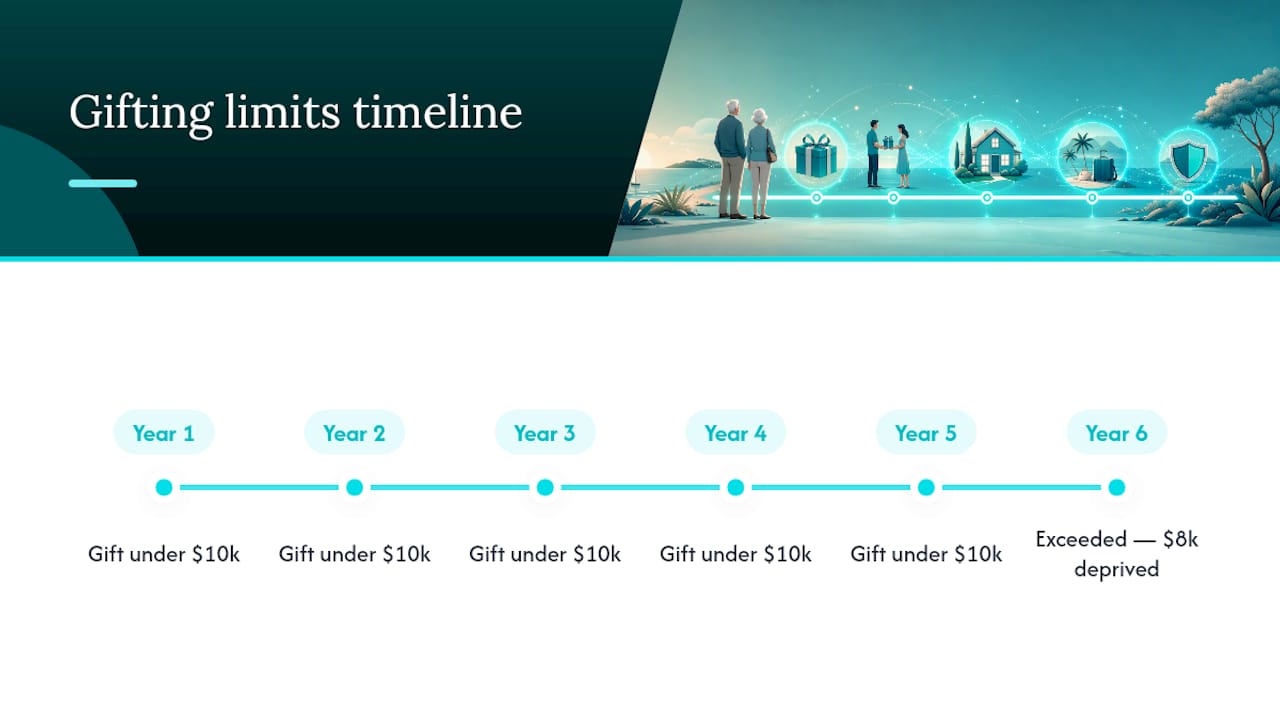
The gifting free area works on two levels at once, and the interaction between them trips up more retirees than the numbers themselves suggest. You can gift up to $10,000 in a single financial year. But you can’t gift more than $30,000 across any rolling five financial years. The five year window isn’t a fixed calendar block. It rolls forward continuously, so a gift made in 2022 drops out of the count once five years pass, freeing up room again.
Here’s how that plays out for someone gifting steadily over time:
That last row is where most people get caught out. Each individual gift sat under the $10,000 annual cap, yet the rolling total pushed past $30,000, so $8,000 becomes a deprived asset. Timing matters more than the size of any single gift.
How Excess Gifts Get Counted: Deprivation, Deeming, and Your Pension
Once you gift past the free area, Services Australia doesn’t just note it and move on. The excess amount becomes a deprived asset, and that has two separate consequences that hit at the same time.
- Assets test: the deprived amount is added back into your total assessable assets as if you still owned it, for five years from the date of the gift.
- Income test: that same amount gets deemed, meaning Centrelink assumes it’s earning income at the standard deeming rates, whether the money exists or not.
The practical effect can be sharp. A retiree who gifts $50,000 in one year, $40,000 over the free area, could see their pension drop noticeably for five straight years, purely on paper. There’s also a real risk of overpayment recovery if the gift isn’t reported and Centrelink discovers it later through data matching with the assets test review process.
Reporting a Gift: Timing and Evidence That Protects You
Get this part wrong and you risk an overpayment debt on top of the deeming hit. Report any gift within 14 days of making it, unless you already report income regularly, in which case report it on or before your usual reporting date.
- Notify Centrelink through myGov, the Express Plus app, or by phone as soon as the transfer happens.
- Keep bank statements showing the transfer date and amount.
- Hold onto receipts, loan agreements, or any paperwork proving the value exchanged.
- If you return a gifted asset or later receive adequate consideration for it, report that too, since it can stop the deeming clock.
Pro Tip: Call Centrelink before making a large gift, not after. Note the date of the call and, if you can, the officer’s name. That record can matter if there’s ever a dispute about when you disclosed something.
Exceptions: Trusts, Loans, and Everyday Gifts
Not every transfer falls under the standard gifting cap. A handful of arrangements get different treatment entirely.
- Special disability trusts can receive concessional treatment under the Social Security Guide’s deprivation provisions, outside the usual gifting limits.
- Certain spouse transfers and granny flat interests may be disregarded altogether rather than assessed as gifts.
- A properly documented loan stays on your books as a financial asset, not a gift. It only becomes deprivation if you later forgive it.
- Small, everyday gifts, birthday money, a bit of help with bills, are generally disregarded, but they still add up toward your annual and five year totals.
Worked Example: Tracking Gifts Across Five Years
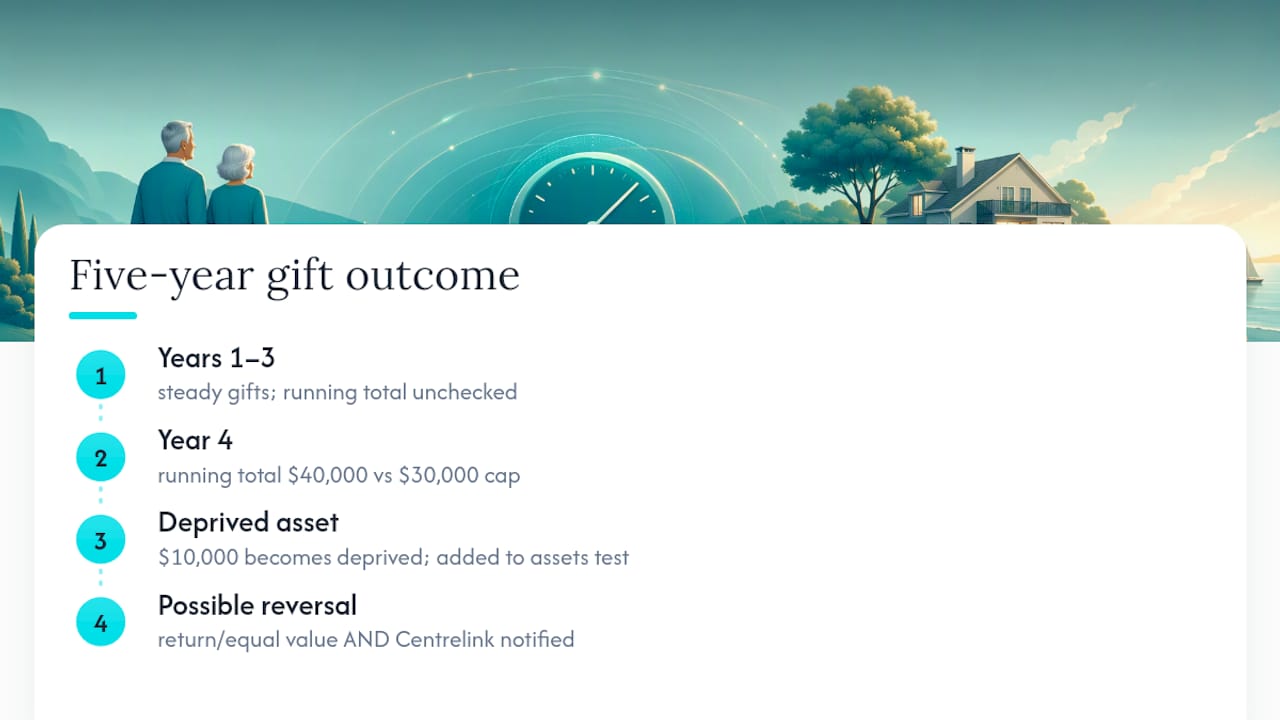
Picture a retiree who gifts steadily to help their kids, without checking the running total until year four.
By the fourth gift, the running total sits at $40,000 against a $30,000 five year cap. The most recent $10,000 becomes a deprived asset, deemed for income purposes and added into the assets test for five years from that date. If the family returns even part of that gift, or the retiree receives something of equal value in exchange, the deprived asset treatment can be reversed, but only once Centrelink is formally notified.
A Checklist to Run Before You Gift
Work through this before any transfer larger than a few hundred dollars leaves your account.
- Add up every gift made in the previous four financial years, then include your planned gift to see the rolling five year total.
- Call Centrelink for a pre-check and write down the date and outcome of that conversation.
- Keep bank transfer records and any signed receipts tied to the gift.
- Consider a documented loan or staged gifts spread across financial years instead of one lump sum.
- Model the pension impact before you act, rather than after.
Pro Tip: Staging gifts across separate financial years, rather than one large transfer, is one of the simplest ways to stay inside both the annual and five year caps. A planned gifting timeline can help you map that out before money moves.
Why We Push Retirees to Model Before They Gift
Most gifting mistakes we see aren’t about people trying to game the system. They’re about retirees who genuinely didn’t realize a rolling five year total existed until Centrelink recalculated their pension. Running the numbers before you transfer a dollar is the only real safeguard, because The projections account for deeming and assets test changes the way Australian policy actually applies them. Model the scenario, then confirm the specifics with Centrelink directly, and keep a record of that call.
— Aerowealth Team
See What Gifting Does to Your Pension Before You Commit
Aerowealth is built for exactly this moment, when a gifting decision could quietly cost you years of reduced pension payments and you want to see the number before you sign anything.

Instead of guessing how a $30,000 gift ripples through your assets test and deeming calculation, you can build the scenario inside Aerowealth and watch your projected Age Pension move side by side with your current plan. The platform models Australian rules directly, including how deprived assets affect both the income and assets tests over the five year window, so you’re not relying on a generic online calculator that ignores the rolling five year rule entirely. It’s not a replacement for confirming details with Centrelink, but it gives you a clear picture before you make a transfer you can’t undo. Start a free scenario at Aerowealth and see your projected pension change before you gift a single dollar.
Where to Check the Official Rules
For the exact legal wording, go straight to the source. Services Australia’s gifting pages set out the free areas and reporting duties in plain terms. The Social Security Guide covers the full deprivation provisions in policy detail, and CLIK’s DVA guidance is the equivalent reference if you receive a veterans’ payment.
This article is general information, not a substitute for advice from a qualified financial advisor. Consult a qualified financial professional about your own circumstances before acting on anything here.
Sources
- How much you can gift — Services Australia
- Social Security Guide: General provisions of deprivation
- 9.6.2 General Provisions of Deprivation | CLIK
- Deprivation rule overview — Shire Legal
FAQ
How much money can you gift on Centrelink?
You can gift up to $10,000 per financial year, capped at $30,000 across any rolling five financial years, without it affecting your pension.
How does Centrelink know if you gift money?
Centrelink relies on your reporting obligations and data matching with financial institutions, so undeclared gifts can surface later and trigger an overpayment review.
Can I gift my children $100,000?
You can, but only $10,000 of it falls inside the annual free area; the rest becomes a deprived asset assessed against both the income and assets tests for five years.
What is the best way to gift money to adult children?
Staging the gift across multiple financial years inside the $10,000 annual and $30,000 five year limits, or using a documented loan instead of an outright gift, keeps more of the transfer outside deprivation rules. Running the numbers through a modelling tool like Aerowealth before you transfer anything shows you the pension impact in advance.