Run Your Numbers: Sept 2026 Age Pension Deeming Rates for Australians

A further lift is planned for September 20, 2026, but it mainly affects retirees with larger financial holdings. Run your own numbers through the worked examples below before assuming it changes your pension.
TL;DR:
- The September 20, 2026 deeming rate increase will mostly impact retirees with large asset holdings above the thresholds of $64,200 for singles and $106,200 for couples.
- Deeming assumes fixed returns of 1.25% up to the threshold and 3.25% above it, regardless of actual market earnings or interest rates.
- Only financial assets like bank accounts, shares, and account-based super are subject to deeming, while primary homes, cars, and personal belongings are exempt.
- Calculators from Services Australia and Aerowealth can help estimate the precise impact of the rate increase on individual pension payments in different scenarios.
- Proper documentation and timing of asset sales, especially relating to principal-home proceeds, can qualify some retirees for lower deeming assessments or exemptions.
Table of Contents
- What Are the Current Age Pension Deeming Rates and Thresholds?
- How Does Deeming Work? Calculating Your Deemed Income
- Which Assets Get Deemed and Who Qualifies for an Exemption?
- Who Sets Deeming Rates and How Often Do They Change?
- How Much Will the Deeming Rate Rise Cost You?
- What Calculators Can Estimate Your Deeming Impact?
- What Should You Do About Deeming Rates Right Now?
- Getting Help With Deeming Exemptions and Next Steps
- The Mistakes We See Retirees Make With Deeming Changes
- Model Your Own Deeming Scenarios With Aerowealth
- Sources
- FAQ
What Are the Current Age Pension Deeming Rates and Thresholds?
Two rates apply, and which one hits your money depends on how much you hold in financial assets. From March 20, 2026, the Australian Government Actuary recommended a lower rate of 1.25% and an upper rate of 3.25%. A further 0.5% increase is scheduled for September 20, 2026, timed to line up with the regular pension indexation cycle.
Here’s how the two windows compare:
- March 20, 2026 to September 19, 2026: 1.25% below the threshold, 3.25% above it.
- From September 20, 2026: rates rise roughly 0.5 percentage points, while the asset thresholds themselves stay the same.
- Thresholds (unchanged across both periods): $64,200 for singles, $106,200 combined for couples.
Deeming snapshot: A single retiree with significant financial assets is deemed to earn the lower rate on the amount up to the threshold and the upper rate on the remainder, regardless of what the money actually earns in the bank or the market.
Whichever date your Centrelink review or new claim falls on determines which rate table applies to your assessment. If your payment is reviewed in August 2026, you’re assessed under the pre-September figures; a review in October uses the higher rate.
How Does Deeming Work? Calculating Your Deemed Income
Deeming assumes your financial assets earn a set rate of return, no matter what they actually pay you in interest or dividends. Services Australia doesn’t check your bank statements for real earnings. It applies a formula instead, and that formula is simpler than most people expect.
The calculation happens in two steps:
- Multiply the amount up to the threshold by the lower rate. For a single person, that’s the first $64,200 at 1.25%.
- Multiply everything above the threshold by the upper rate. Anything over $64,200 (single) or $106,200 (couple) is deemed at 3.25%.
- Add the two figures together, then convert to a fortnightly amount by dividing the annual total by 26.
Take a single retiree with financial assets just over the threshold. The amount up to the threshold is deemed at the lower rate, and the remainder is deemed at the upper rate, resulting in deemed income calculated accordingly.
For a couple with combined financial assets above the threshold, the amount up to the threshold is deemed at the lower rate, and the remainder is deemed at the upper rate, resulting in total deemed income calculated accordingly.
This worked figure from the AGA’s own recommendation then gets added to any other assessable income, like wages or a defined-benefit pension, before Centrelink applies the income test.
Which Assets Get Deemed and Who Qualifies for an Exemption?
Deeming applies to financial assets, not to everything you own. It covers bank accounts and term deposits, shares and managed funds, account-based superannuation pensions (once you’re over pension age), and gifted amounts above the allowable limit. It does not touch your car, your furniture, or your principal home, none of which face deeming at all.
- Savings accounts, term deposits, and cash management accounts
- Shares, exchange-traded funds, and managed investments
- Account-based pensions and allocated annuities
- Loans you’ve made to family members or private companies
- Superannuation in accumulation phase, once you reach Age Pension age
A common misunderstanding trips people up here: deeming ignores your actual returns entirely. If your term deposit pays 2% and deeming assumes 3.25%, you’re still assessed at 3.25%. Earning less doesn’t earn you a lower assessment, and it certainly doesn’t earn you an exemption. Genuine exemptions are rare and limited to specific circumstances, like funds tied up in a failed investment with formal evidence attached.
One notable carve-out: if you sold your principal home on or after January 1, 2023, sale proceeds set aside for a new home can be deemed at the lower rate only, rather than the standard two-tier calculation, provided you can show the funds are genuinely earmarked for that purpose.
Pro Tip: Keep a paper trail showing your intent to buy, like a signed contract of sale or real estate correspondence, before you approach Centrelink about the principal home rule. Verbal intentions won’t cut it.
Who Sets Deeming Rates and How Often Do They Change?
Deeming rates aren’t set by a formula that runs automatically. The Minister for Social Services sets them, but only after receiving a formal recommendation from the Australian Government Actuary, whose job is to model what returns are realistically available to pensioners holding conservative, low-risk portfolios.
- The AGA reviews deeming rates at least every six months, checking them against term deposit rates, cash rates, and typical super fund returns.
- Increases tend to happen in measured steps rather than jumping straight to match the cash rate, which is deliberate policy design.
- The upper rate is intentionally kept below typical superannuation returns, so pensioners with standard balanced portfolios aren’t penalized for earning more than they’re deemed to earn.
That gap between the deemed rate and real-world returns is the whole point. It gives retirees room to earn above the assumed rate without it dinging their pension.
How Much Will the Deeming Rate Rise Cost You?
Numbers on paper mean little until you see them against a real pension payment. Here’s how three household types fare before and after the September 20, 2026 increase, assuming financial assets are the only relevant income source.
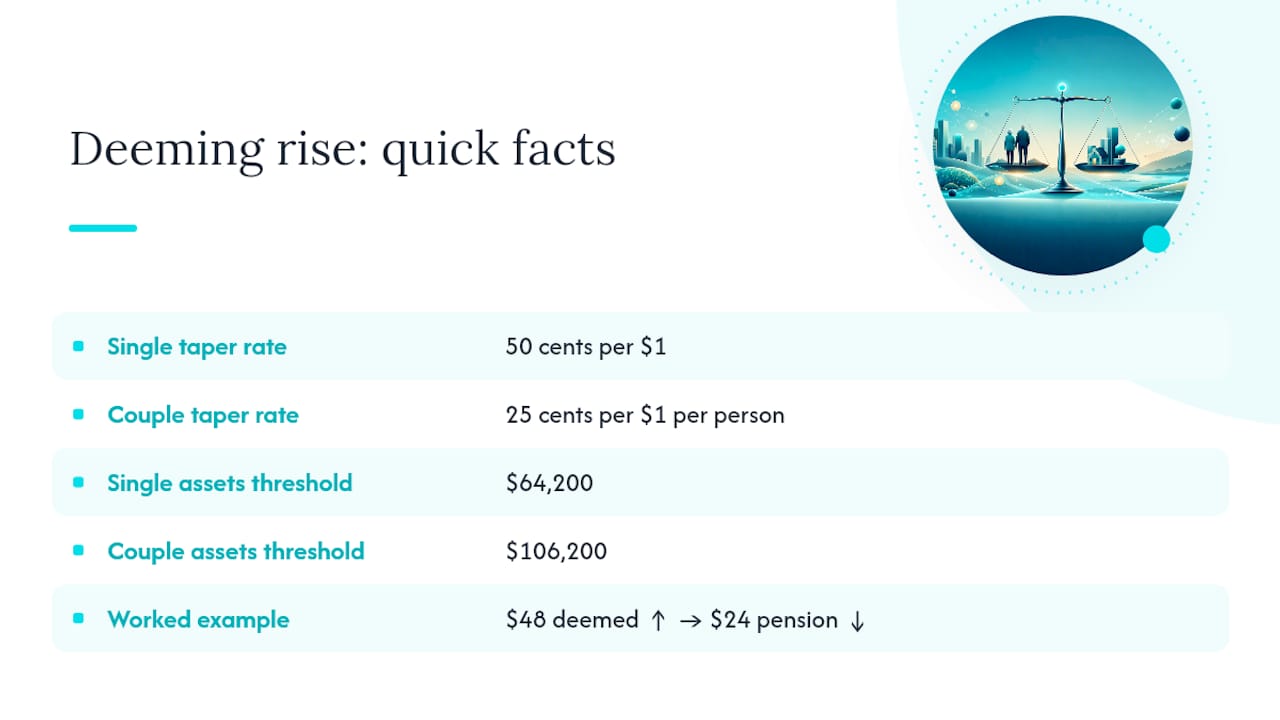
For most part-pensioners, this increase alone won’t tip them from a part pension into no pension. It nudges deemed income up, which then feeds into the income test: pension reduces by 50 cents per dollar over the income free area for singles, or 25 cents per dollar per member of a couple. A $48 fortnightly rise in deemed income for the larger single portfolio, for instance, only reduces the pension by $24 a fortnight once you apply the 50 cent reduction rate, assuming they’re already over the free area.
The rule of thumb: if your combined financial assets sit well under the threshold ($64,200 single, $106,200 couple), September’s rise barely touches you, since most of your money is still deemed at the unchanged lower rate. It’s the retirees with six-figure portfolios well above the threshold who’ll notice the difference on their statement. National Seniors modelling suggests the timing next to indexation should soften the net effect for most households, since the pension base rate typically rises at the same time.
What Calculators Can Estimate Your Deeming Impact?
The Services Australia payment and service finder gives you an official, plug-in-your-numbers estimate that reflects the exact rates Centrelink uses. It’s the right starting point if you want a number you can trust against your own assessment. SuperGuide’s deeming calculator is a solid second check, especially useful for comparing the pre and post-September figures side by side.
Before you sit down with any calculator, gather your account balances, share portfolio value, and any account-based pension statements. Round numbers get you a rough estimate; exact figures get you an answer you can actually plan around.
- Official Services Australia estimator for a Centrelink-aligned figure
- SuperGuide’s calculator for quick before-and-after comparisons
- Aerowealth’s modelling for running multiple asset allocations side by side and stress-testing how a rate change ripples through years of retirement income, not just this fortnight’s payment
What Should You Do About Deeming Rates Right Now?
Turning these numbers into a decision takes a bit of homework, but it’s not complicated — see our detailed guide on superannuation benefits and your will to understand how your super impacts broader estate planning. Start here:
- Pull together your asset statements. Bank balances, term deposits, share holdings, and account-based pension values, all as of today.
- Check your assessment date. Confirm whether your next Centrelink review falls before or after September 20, 2026, since that determines which rate table applies.
- Run your numbers through both rate periods. See the actual fortnightly difference rather than guessing at it.
- Document any principal-home-sale intentions in writing if you’re between properties and want the lower-rate treatment on those proceeds.
If you’re seeing an adviser or calling Centrelink directly, ask specifically how your asset mix is categorized, whether any of your holdings qualify for the home-sale exemption, and how a $10,000 or $50,000 shift between account types would change your deemed income. Simple, safe strategies like staggering term deposit maturities or timing an asset sale around your review date can smooth out the impact, though anything involving super drawdown or mortgage offset strategy is worth running past a licensed financial adviser first, given how it interacts with the assets test too.
Getting Help With Deeming Exemptions and Next Steps
Services Australia handles exemption requests through your usual Centrelink online account or a phone appointment, and they’ll ask for evidence, not just a description of your circumstances. Exemptions are granted narrowly, mostly for assets that are genuinely inaccessible, like funds frozen in a failed investment, and ministerial discretion applies.
- Have bank statements, investment records, and any relevant contracts ready before you call.
- For principal-home-sale cases, bring the settlement statement and evidence of your intended new purchase.
- Expect processing to take several weeks once documentation is submitted, longer if your case needs ministerial review.
The Mistakes We See Retirees Make With Deeming Changes
The biggest mistake isn’t misunderstanding the rates themselves. It’s treating a deeming increase as a one-off event instead of running it against every year of a retirement plan.
The second mistake is assuming low actual returns will protect them. They won’t. The third is delaying a principal-home-sale decision without documenting intent early, which forfeits the lower-rate treatment entirely. Scenario modelling tends to shift the timing of asset moves more than the decision itself. For a deeper look at how this fits your broader plan, see our income test breakdown.
— Aerowealth Team
Model Your Own Deeming Scenarios With Aerowealth
Aerowealth is the alternative to guessing at a Centrelink calculator once and hoping it still holds true next year. Where a one-off estimator gives you a single snapshot, Aerowealth lets you run your term deposits, shares, super balance, and account-based pension side by side across both the pre and post September 20 rate periods, and see exactly how a $20,000 asset shift changes your fortnightly payment five years out, not just today.

To get started, pull together your current asset statements the same way you would for the Services Australia estimator, then build a baseline scenario in Aerowealth and clone it to test a rate rise, an asset sale, or a super drawdown change against it. The free tier covers a single scenario comparison, and the Pro plan unlocks stress-testing across multiple assumptions at once. Start building your retirement model at Aerowealth and see where your numbers actually land before September’s rate change catches you off guard.
This article is general information, not a substitute for advice from a qualified financial advisor. Consult a qualified financial professional about your own circumstances before acting on anything here.
Sources
- Australian Government Actuary — Deeming rate recommendation (Feb 2026)
- Deeming — Services Australia (principal home rule)
- National Seniors — media release on gradual lift to deeming rates (Aug 2026)
FAQ
How much money can I have and still get the Age Pension?
It depends on whether you’re assessed under the income test or the assets test, whichever gives you the lower payment. For the income test specifically, deemed income from financial assets is added to other income, and payments reduce once you exceed the income free area, at 50 cents per dollar for singles and 25 cents per dollar for each member of a couple.
What assets are subject to deeming for the Age Pension?
Deeming applies to financial assets: savings and term deposit accounts, shares, managed funds, account-based pensions, and money you’ve loaned to others. Your home, car, and personal belongings are never deemed.
How can I calculate the deeming rate for my Age Pension?
Aerowealth and the official Services Australia estimator can both run this calculation against your actual figures.
Will the September 2026 deeming increase reduce my pension?
For most retirees with financial assets under the threshold, the effect is minor, since indexation of the pension base rate typically happens around the same time and offsets part of the increase. Retirees with larger financial asset balances above the threshold will see a more noticeable fortnightly reduction.