Hedged vs Unhedged ETFs: Test ASX Mixes for AUD Goals

There is no universal winner. Hedged ETFs remove currency swings for AUD-denominated goals, while unhedged ETFs add a currency return that can be positive or negative. Pairs like IVV and IHVV, or VGS and VGAD, show how the same underlying shares can produce very different results once currency enters the picture. Hedging costs are usually small, but currency moves can swing returns by far more.
TL;DR:
- Hedging major developed market ETFs typically costs 0.02% to 0.06% annually, while currency moves can add or subtract several percentage points.
- Matched pairs showed currency accounted for 23% to 41% of five year returns, while hedged funds led by 12% to 14% in the latest year.
- Use hedged exposure for near term Australian dollar goals; long horizon investors can favor unhedged funds, while a 50/50 split limits currency guesswork.
- Before switching, check liquidity, spreads, and capital gains tax, because repeated changes can add costs without reliably improving currency timing.
- Model fully hedged, unhedged, and split allocations against the same goal under stronger and weaker Australian dollar scenarios, focusing on downside outcomes.
Table of Contents
- How currency hedging actually works
- ASX ETF pair examples that show currency’s real impact
- Rules of thumb for choosing hedged, unhedged, or a split
- Costs, tax, and a pre-switch checklist
- Testing the choice with scenario modelling
- Simple rules that survive human behavior
- AeroWealth: model hedged vs unhedged outcomes for your goals
- FAQ
- Sources
How currency hedging actually works
A hedged ETF buys the same underlying shares as its unhedged twin, then layers on FX forward contracts that offset the gains or losses caused by currency movements. An unhedged fund leaves that currency exposure in place, so your return reflects both the index performance and the AUD’s movement against the foreign currency. The forwards are rolled, typically every month, which means the hedge is never a single set-and-forget transaction but an ongoing process managed by the fund.
The hedge ratio describes how much of the currency exposure is offset. Most ASX-listed hedged ETFs target close to 100%, though the actual ratio drifts slightly between rolls as the portfolio value changes. Hedging is not free: costs come from the bid-ask spread on forward contracts, the interest rate differential between Australia and the foreign market, and the operational work of rebalancing the hedge as markets move.
- Forwards lock in an exchange rate for a future date, offsetting currency gains or losses.
- Rolling the hedge monthly keeps the ratio close to its target as asset values shift.
- Costs stem from spreads, interest rate differentials, and rebalancing, not a flat fee.
Hedging costs for large, developed-market ETFs typically run between around 0.02% and 0.06% per year. That is a modest drag next to the multi-percent swings currency can add or subtract from an unhedged position over a year.
ASX ETF pair examples that show currency’s real impact
The clearest way to see what currency does to returns is to look at matched pairs trading on the ASX: the same index, one hedged and one not. IVV and IHVV both track the S&P 500, VGS and VGAD both track global developed shares, NDQ and HNDQ both track the Nasdaq-100, and QUAL and QHAL both track MSCI World Quality. The only structural difference is currency treatment, which makes them a clean test case for how much the AUD matters.
Across these pairs, currency has accounted for roughly 23% to 41% of total returns over five years, and in the most recent 12 months the hedged versions outperformed their unhedged siblings by around 12% to 14%. That reversal tracks a weaker AUD turning into a stronger one, since a rising Australian dollar erodes unhedged returns while a falling one boosts them.
- A falling AUD lifts unhedged returns because foreign earnings convert back into more Australian dollars.
- A rising AUD does the opposite, which is what drove recent hedged outperformance.
- On $100,000 invested, a currency contribution in the 23% to 41% range can mean a difference of tens of thousands of dollars over five years, before any difference in the underlying index performance.
These are not small rounding errors. They are the dominant swing factor in many international portfolios over multi-year stretches, often larger than the gap between the best and worst stock picks in the same portfolio.
Rules of thumb for choosing hedged, unhedged, or a split
Deciding between hedged and unhedged ETFs gets easier once you anchor it to what the money is actually for and how long it has to grow.
- Hedge when the goal is AUD-denominated and sits within a short to medium time frame, since currency swings can derail a target you need to hit on a schedule.
- Hedge when you specifically want pure exposure to foreign equity performance without the extra variable of currency movement.
- Stay unhedged when your horizon is long, since currency effects tend to average out over decades and unhedged exposure offers a natural offset during market downturns.
- Stay unhedged when you have no strong view on where the AUD is headed, since a hedge is effectively a bet that the AUD will rise.
- Consider a split, such as 50/50 between hedged and unhedged versions of the same index, when you want to reduce currency guesswork without eliminating the diversification benefit entirely.
Pro Tip: Rebalance a split allocation once or twice a year rather than reacting to short-term currency headlines; frequent adjustments usually cost more in fees and tax than they save.
Costs, tax, and a pre-switch checklist
The fee gap between hedged and unhedged share classes of the same ETF is usually small, often in the same 0.02% to 0.06% range as the hedging cost itself, which means fees rarely decide this question on their own. Currency swings of 20% or more over several years dwarf that gap, so the real decision rests on your time horizon and goal currency, not basis points.
Australian tax rules require foreign-currency amounts to be translated under specific ATO guidance when they are not already in the relevant functional currency, which matters for anyone holding unhedged international ETFs that distribute foreign income. Before switching between hedged and unhedged versions of a holding, a few checks are worth doing:
- Confirm the ETF’s liquidity and typical bid-ask spread, since thinner-traded funds can cost more to enter and exit.
- Understand the creation and redemption mechanics if you are trading in large volumes.
- Weigh the capital gains tax consequences of selling one share class to buy the other, since switching can trigger a taxable event.
Switching between hedged and unhedged share classes repeatedly tends to add transaction and tax costs that outweigh any currency timing benefit.
Testing the choice with scenario modelling

Guessing where the AUD will go over the next five or ten years is not a strategy. A more useful approach is modelling a range of hedge ratios against your actual goal, time horizon, and contribution plan, then comparing the outcomes side by side through expert investment property buying services in Sydney.
Useful inputs to vary include your asset allocation, the hedge percentage applied to international holdings, your investment horizon, a few AUD scenarios, and the fee difference between share classes. The outputs worth watching are the probability of meeting your target and the downside outcomes in weaker scenarios, not just the average case.
- Compare a fully hedged, fully unhedged, and split allocation side by side against the same goal.
- Stress-test each mix against a stronger and weaker AUD scenario to see how sensitive your plan really is.
- Use Australian-specific settings, including super contribution caps and preservation age, so the projection reflects your actual situation.
Modelling your current allocation this way turns an abstract currency debate into a concrete comparison of probabilities.
Simple rules that survive human behavior
The biggest risk in this decision is not picking the wrong share class. It is switching back and forth every time the AUD moves, which racks up costs and taxes while rarely improving results. Advisers and ETF issuers consistently warn that chasing recent currency performance tends to lock in the worst of both a market timing and a currency timing bet.
A durable approach beats a clever one: default to unhedged for long-term growth goals, carve out a partial hedge for AUD-denominated goals with a shorter runway, and model the mix before deciding rather than reacting to headlines.
— Aerowealth Team
AeroWealth: model hedged vs unhedged outcomes for your goals
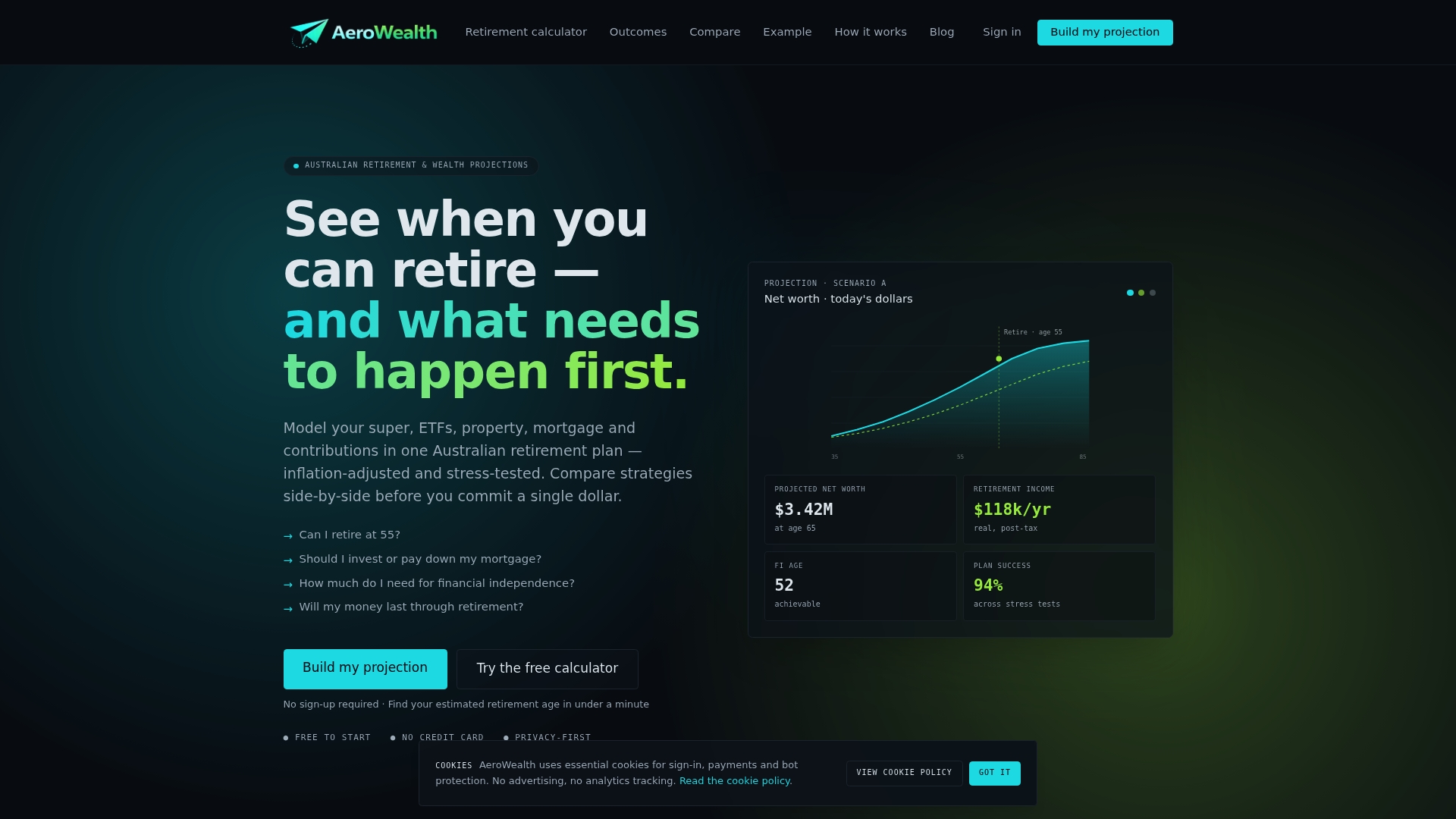
Choosing a hedge ratio becomes a lot clearer once you can see the actual numbers behind it rather than relying on a currency guess. We built our tool to let you run side-by-side scenario comparisons across hedged, unhedged, and split allocations, stress-test them against different AUD paths, and see how each choice shifts your probability of hitting a retirement or goal-based target under Australian rules.
- Compare a hedged, unhedged, or split allocation against the same retirement or goal timeline.
- Stress-test your plan against currency scenarios instead of guessing AUD direction.
- See projected income, retirement age, and net worth shift as you adjust the hedge mix.
Model your own allocation on our pricing page and see which mix moves your numbers the most.
This article is general information, not a substitute for advice from a qualified financial advisor. Consult a qualified financial professional about your own circumstances before acting on anything here.
FAQ
What does a hedged ETF mean?
A hedged ETF uses currency forward contracts to offset the effect of exchange rate movements, so your return tracks the underlying index without the extra swing from a rising or falling Australian dollar. The fund rolls these contracts regularly, which carries a small cost, typically in the 0.02% to 0.06% per year range for major developed-market funds.
What are 3 ETFs I can buy and hold forever?
There is no single list that fits every investor, since the right holdings depend on your goals, time horizon, and existing portfolio. Broad, low-cost index funds covering global developed shares, US shares, and quality-focused indexes, such as the pairs discussed above, are commonly used as long-term core holdings by Australian investors.
What is the 7% rule in ETF?
Definitions of a “7% rule” vary depending on the source and context, and there is no single widely recognized standard tied specifically to ETF investing. It is often used loosely to describe a long-term average return assumption, so it is worth checking the specific source before applying it to your own plan.
What is the difference between an ETF and a hedge fund?
An ETF is a listed fund that tracks an index or strategy and trades on an exchange like a share, with transparent, usually passive holdings. A hedge fund is a privately managed investment vehicle that can use a much wider range of strategies, including leverage and short selling, and is typically far less transparent and accessible than an ETF.
Are hedged ETFs worth it for Australian investors?
It depends on your goal and time horizon rather than being worth it universally. Hedged ETFs suit AUD-denominated goals with a shorter runway, while longer-term investors often default to unhedged exposure for the natural diversification it provides during market downturns.
Sources
- Hedging for currency risk — Morningstar
- Hedged vs Unhedged ETFs: When to Use Each (ReviewETF)
- Hedging a sharp tool to trim investment risk — AFR