Tax Free After 10 Years: Investment Bond 10 Year Rule For Australians

If you hold an Australian investment bond for at least 10 years and stick to the contribution rules, withdrawals are generally tax-free to you. Break those rules and part of the earnings becomes assessable, though a 30% tax offset softens the hit. The mechanics behind that simple sentence, the 125% contribution cap, the sliding-scale tax table, and how to calculate your own numbers, are where most investors get tripped up.
TL;DR:
- Exceeding the 125% contribution cap in any year resets the 10-year tax-free clock, so dry-run planning helps avoid accidental re-starts.
- Withdrawals made before completing 10 years are fully assessable, with taxes depending on the year of withdrawal and the sliding-scale rules.
- Contributing more than 125% in a year, skipping contribution years, or switching providers can unintentionally restart the tax-free period.
- After 10 years, withdrawals are completely tax-free, providing a significant advantage for long-term investment planning.
- Comparing bonds to super requires factoring in fees, flexibility needs, and whether the investor can meet contribution and withdrawal conditions properly.
Table of Contents
- What Is the Investment Bond 10 Year Rule?
- The 125% Rule: How Much You Can Add Without Resetting the Clock
- How Withdrawal Tax Works in Years 1 Through 10 and Beyond
- Three Worked Examples: What You’d Actually Owe
- Traps That Restart the Clock Without You Realizing It
- Do Investment Bonds Beat Super for Your Situation?
- Reporting Withdrawals: What Goes on Your Tax Return
- Modelling a Bond Against Your Own Numbers With Aerowealth
- What Happens if You’re a Non-Resident or Have Overseas Beneficiaries
- Weighing Stability Against Legislative Risk
- See Whether a Bond Fits Your Plan Before You Commit for a Decade
- Where to Verify the Rules Yourself
- Sources
- FAQ
What Is the Investment Bond 10 Year Rule?
The 10-year rule ties back to a specific date: your bond’s Account Start Date, sometimes called the commencement date or investment year anniversary. Every provider tracks this date, and it’s the clock that determines whether your withdrawal is tax-free or partially assessable.
Inside the bond, the earnings are already being taxed as they’re generated. Life insurance bond providers pay tax on investment income at a capped rate, commonly 30%, which is why these products get called “tax-paid” investments. That internal tax is why you don’t see the earnings show up on your annual tax return year after year the way you would with a managed fund outside super. If you never touch the money for 10 years and you’ve followed the contribution rules, MoneySmart confirms no further personal tax applies on withdrawal, because the tax has already been settled inside the structure.
What counts as a “withdrawal” for clock purposes isn’t always obvious. A full cash-out is the obvious case, but partial withdrawals also draw down against your assessable balance and can trigger tax depending on which year you’re in. Switching between investment options within the same bond structure usually doesn’t reset anything, since you’re not withdrawing capital, just reallocating it. Switching to a different provider entirely, however, generally means closing the old bond and opening a new one, which restarts the clock from zero.
Every provider’s Product Disclosure Statement defines “Account Start Date” and “investment year” slightly differently. Some count from the date your application was processed rather than the date you signed the paperwork, and that gap can matter if you’re withdrawing close to an anniversary. Read that definition in your own PDS before you assume you know which year you’re in.
The 125% Rule: How Much You Can Add Without Resetting the Clock
Your first year of contributions to an investment bond is unlimited. You can put in $5,000 or $500,000 with no cap. From year two onward, though, you’re restricted to 125% of whatever you contributed in the previous investment year.
Here’s how that plays out in practice:
- Year 1: You contribute a certain amount. No limit applies.
- Year 2: Your cap is 125% of your previous year’s contribution, so you can add only up to that adjusted limit.
- Year 3: If you contributed the full capped amount in year two, your new cap is 125% of year two’s contribution.
- Miss a year entirely: Your allowable contribution for the next year drops to zero, since 125% of nothing is nothing.
Breach that cap, even by a single dollar, and the entire 10-year clock resets from the year of the excess contribution, according to Australian Unity’s tax guide. Most providers build automatic rejection into their systems, bouncing back any contribution over the limit rather than accepting it and quietly restarting your clock. If you’re planning to add money regularly, setting up a formal regular investment plan with fixed contribution amounts is far safer than making ad hoc lump-sum top-ups you have to calculate manually every year.
How Withdrawal Tax Works in Years 1 Through 10 and Beyond
The Australian Taxation Office treats early withdrawals from investment bonds on a sliding scale. The proportion of your withdrawal that counts as assessable income shrinks the longer you’ve held the bond, until it disappears completely.
| Withdrawal Timing | Assessable Proportion of Earnings |
|---|---|
| Years 1–9 | All earnings assessable |
| Year 9 | Two-thirds assessable |
| Year 10 | One-third assessable |
| After year 10 | No earnings assessable (fully tax-free) |
That structure comes straight from the sliding-scale rules Canstar lays out for these products, and it’s the single most important table to bookmark if you’re weighing an early exit.
A 30% tax offset applies to whatever portion is assessable, reflecting the tax already paid inside the bond. This is the mechanism that stops the ATO from taxing the same earnings twice. If your marginal tax rate is above 30%, you’ll pay the difference on the assessable portion. Multiple withdrawals in the same investment year are usually assessed cumulatively against the same sliding-scale year, so pulling out cash twice in year 7 doesn’t reset anything, it just adds up.
Three Worked Examples: What You’d Actually Owe
Numbers make this concrete. Here’s how the tax plays out in three common scenarios.
- Full withdrawal in year 4. Say you invested $50,000 and the bond has grown to $65,000, meaning $15,000 in earnings. Because you’re withdrawing well before year 9, all $15,000 is assessable at your marginal rate. If your marginal rate is 37%, you owe 37% of $15,000, which is $5,550, minus a 30% offset of $4,500. Your net tax payable on the withdrawal is $1,050.
- Partial withdrawal in year 9. You withdraw $20,000, of which $6,000 represents earnings. Only two-thirds of that, $4,000, is assessable. At a 37% marginal rate that’s $1,480 in tax, offset by 30% of $4,000 ($1,200), leaving $280 owing.
- Withdrawal after year 10. Same $20,000 withdrawal, same $6,000 in earnings. None of it is assessable. You report nothing, and you owe nothing.
Pro Tip: Don’t try to calculate the assessable earnings yourself from account statements alone. Your provider issues a withdrawal letter showing the Total Taxable Component (TTC), the exact figure the ATO expects on your return, and that number accounts for internal cost-base adjustments you can’t easily reconstruct on your own.
Traps That Restart the Clock Without You Realizing It
Most clock resets aren’t deliberate. They happen because of contribution timing or administrative decisions nobody flagged until the withdrawal letter arrived.
- Contributing more than 125% of the prior year’s amount in any single investment year.
- Skipping a contribution year entirely, then resuming contributions the following year (your cap resets to zero, so any contribution that year is technically “excess”).
- Making a full withdrawal and then reinvesting the proceeds, which typically opens a fresh bond with a new start date.
- Switching providers, since most transfers close the existing bond rather than carrying its Account Start Date across.
- Contributing near a processing cutoff, where your provider counts the deposit against the wrong investment year due to bank transfer delays.
The fix is mostly administrative discipline. Several providers now send automatic alerts when a contribution would breach the cap, but don’t rely on that as your only safeguard.
Do Investment Bonds Beat Super for Your Situation?
That last point is where bonds genuinely outshine super. Superannuation caps concessional contributions and imposes preservation age rules that lock your money away until retirement. An investment bond has no preservation age at all, and after year 10 the proceeds pass to you, or to a nominated beneficiary, without the same restrictions. For readers weighing this trade-off directly against super contribution rules, the flexibility difference is often the deciding factor, not the tax rate alone.
But bonds aren’t automatically better. Fees matter too. Ongoing management fees on investment bonds can run higher than low-cost index super funds, and that fee drag compounds over a decade, quietly eating into the tax advantage you’re chasing.
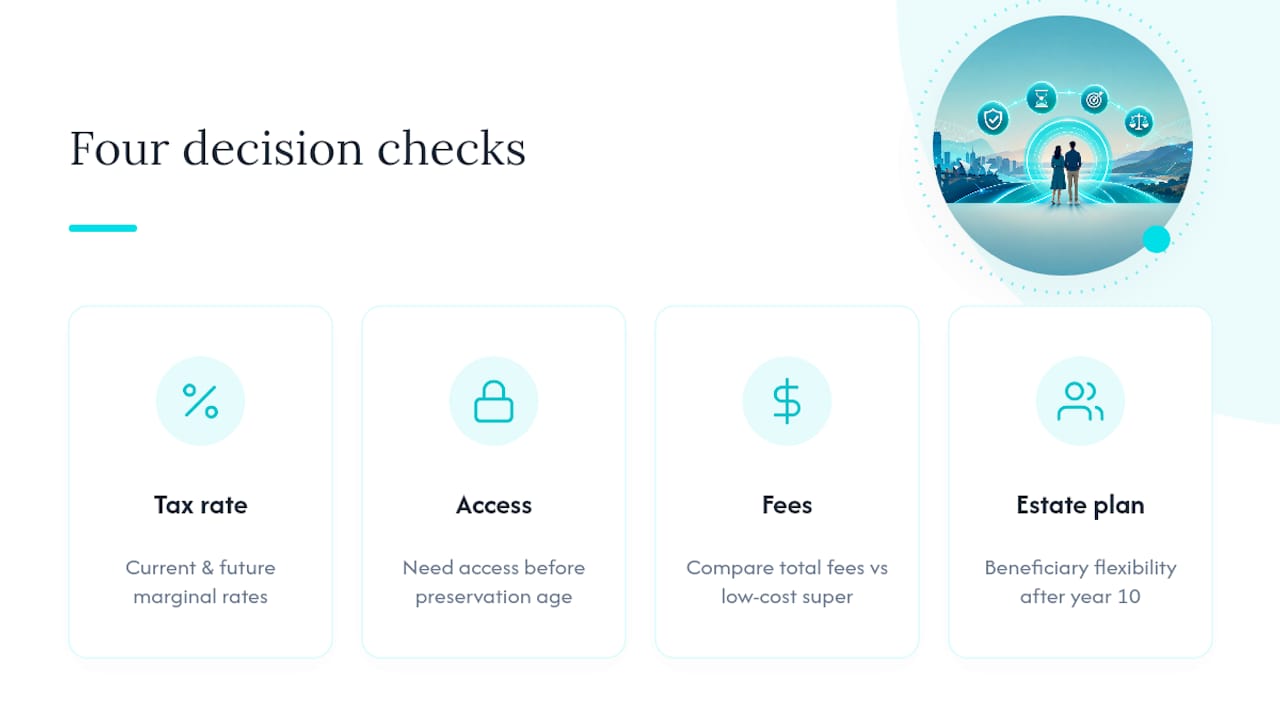
Before opening a bond, check four things: your current and expected future marginal tax rate, whether you need the money before preservation age, the bond’s total fee structure against alternatives, and whether estate planning flexibility outweighs the fee gap for your situation.
Reporting Withdrawals: What Goes on Your Tax Return
If you withdraw within the first 10 years, you need the Total Taxable Component from your provider’s withdrawal letter to complete your tax return correctly. That figure already accounts for the sliding-scale percentage and represents exactly what’s assessable.
Practical steps to keep this simple:
- Request or download the withdrawal letter from your provider immediately after any partial or full withdrawal.
- Read your annual statement even in years you don’t withdraw, since it tracks your contribution history against the 125% cap.
- Apply the 30% tax offset when you lodge, referencing the TTC figure, not the raw withdrawal amount.
- For balances above six figures or complex contribution histories, get a tax adviser to check the numbers against your PDS before lodging.
For the underlying legislative framework, the ATO’s guidance on investment income is the primary reference, and it’s worth checking before every tax season in case the rules shift.
Modelling a Bond Against Your Own Numbers With Aerowealth
A useful model needs those inputs on one side and a clear set of outputs on the other: projected after-tax balance at withdrawal, your effective tax rate under the sliding scale versus holding to year 10, how the proceeds pass to beneficiaries, and how much liquidity you’d sacrifice compared to a simple managed fund.
Aerowealth’s scenario modelling lets you test both levers against your actual numbers rather than a generic example, stress-testing what happens if fees run higher than expected or your marginal rate drops in retirement. It’s a planning tool for comparing outcomes, not a bond provider itself, but that’s exactly the gap it fills before you commit capital for a decade.
What Happens if You’re a Non-Resident or Have Overseas Beneficiaries
Australian tax residency status changes how bond withdrawals are treated. If you become a non-resident for tax purposes while holding a bond, the tax-paid structure inside the bond generally still applies the same way, since the tax is paid at the entity level by the provider, not assessed against your personal residency status in the same manner as unfranked dividends or foreign income.
Where it gets more complicated is with foreign beneficiaries or if you’re a non-resident receiving a death benefit or maturity payout. However, the beneficiary’s own country of residence may impose its own tax treatment on the proceeds once received, entirely separate from the Australian tax already settled inside the bond. That’s a foreign tax question, not an Australian one, and it depends entirely on the receiving country’s rules.
If you’re an Australian resident but plan to move overseas before your bond matures, or you’re naming a beneficiary who lives outside Australia, get specific advice before relying on general assumptions.
Weighing Stability Against Legislative Risk
The 10-year rule has held its shape for decades, which is unusual for anything in Australian tax law. That track record is real, but it’s also a policy setting, not a constitutional guarantee, and tax treatment of bonds is subject to legislative risk the same as any concessional structure.
Our view: treat the rule as durable but not immune. Check your PDS and the ATO’s current guidance at each EOFY, and pay attention to Federal Budget announcements, since retirement and investment tax settings are where policy shifts tend to surface first. For balances large enough to matter, pair that annual check with a conversation with a tax adviser rather than relying on a decade-old assumption about how the rule works.
— Aerowealth Team
See Whether a Bond Fits Your Plan Before You Commit for a Decade
The tool provides modelling that sits between you and that decision, letting you run your actual marginal tax rate, contribution pattern, and fee assumptions against alternatives like super or a simple ETF portfolio before you lock money away for 10 years.

The platform’s scenario comparisons and stress tests let you flex those assumptions, running a bond-heavy plan against a super-heavy one and watching how each holds up if your income or the fee structure shifts. If you’re weighing this decision against super caps or property, the same modelling framework extends to those comparisons too, including deeper detail in Aerowealth’s retirement planning guide. Head to Aerowealth and build a scenario using your own numbers before you sign anything.
Where to Verify the Rules Yourself
Start with MoneySmart’s investment and insurance bonds page for consumer-level guidance, then check the ATO’s investment income guidance for the legislative framework behind reporting obligations.
For provider-specific detail, Australian Unity’s tax guide is a useful representative example of how a PDS actually spells out the Account Start Date and 125% mechanics. Read that definition section in your own provider’s PDS closely, since small wording differences between providers can change which investment year a contribution counts toward.
This article is general information, not a substitute for advice from a qualified financial advisor. Consult a qualified financial professional about your own circumstances before acting on anything here.
Sources
- 2026 Budget: Are investment bonds a CGT shield? | Canstar
- 2025 Tax guide — Australian Unity (investment bonds)
FAQ
Is a 10-Year Investment Bond a Good Investment?
Tools like Aerowealth let you model your specific numbers before deciding.
Does Switching Providers Reset the 10-Year Clock?
Yes, in most cases. Transferring to a new provider typically closes your existing bond and opens a new one with a fresh Account Start Date, so the 10-year count starts over.