Avoid Five Figure Break Costs: Model 60:40 Split Loans for Australians

For most Australian homeowners juggling rate anxiety and budget planning, a loan split strategy pays off, and a 60:40 or 70:30 fixed-to-variable split is a sensible place to start. The right ratio still comes down to three things: how stable your income is, how big your cash buffer runs, and how soon you expect to refinance or sell. Get any of those wrong and break costs or wasted offset benefit can eat the upside fast.
TL;DR:
- Fixing a larger portion of your loan reduces exposure to rate increases but can incur substantial break costs if you need to refinance or sell early.
- The fixed rate on a split loan gets set by wholesale swap markets, which can cause the fixed portion to rise or fall independently of the Reserve Bank’s cash rate.
- Your offset benefits are limited on the fixed portion, meaning excess savings only reduce interest on the variable side, potentially wasting cash buffers.
- A recommended starting split is around 60:40 fixed-to-variable for stable-income borrowers, but it should be tailored based on your savings, timeline, and risk tolerance.
- Modeling different split scenarios with your real figures helps determine repayment stability, long-term interest costs, and break-cost risks before locking in a ratio.
Table of Contents
- What Is a Split Home Loan?
- How Split Loans Actually Work: Pricing and What Changes
- Common Split Ratios and What the Numbers Actually Show
- Pros, Cons, and Where Split Loans Can Actually Hurt You
- How to Choose Your Split: A Practical Framework
- Setting Up, Changing, or Exiting a Split Loan
- Model Your Split Before You Lock It In
- Our Take: Split Loans Are Risk Management, Not a Bet
- See Your Split Loan Decision Modelled Before You Commit
- Where to Read More
- Sources
- FAQ
What Is a Split Home Loan?
A split home loan divides your mortgage into two separate portions, one on a fixed rate and one on a variable rate, sitting under a single loan account but tracked and repaid independently. Most Australian lenders let you set this up at the time you take out the loan or change it later, and you generally choose the ratio yourself, whether that’s 50:50, 60:40, or something more lopsided. Fixed terms typically run one to five years, after which that portion rolls onto a new rate or reverts to variable.
A few terms come up constantly once you start comparing split loan options:
- Fixed portion: the slice of your loan locked at a set interest rate for an agreed term, giving you predictable repayments regardless of what happens in the broader rate environment.
- Variable portion: the slice that moves with your lender’s variable rate, which can rise or fall with market conditions and often carries features the fixed portion lacks.
- Offset account: a transaction account linked to your loan where your balance reduces the interest calculated on the linked portion, almost always the variable side only.
- Redraw facility: lets you pull back extra repayments you’ve made above the minimum, typically available on variable portions and sometimes restricted or unavailable on fixed ones.
- Break costs: fees charged if you exit or alter a fixed-rate portion early, covered in detail below.
Even though you’re managing two rate structures, most lenders bill it as a single monthly repayment, splitting the amount internally between the fixed and variable ledgers according to the ratio you set up.
How Split Loans Actually Work: Pricing and What Changes
Here’s the part most borrowers get wrong: fixing a portion of your loan isn’t a direct bet on what the Reserve Bank does next. Fixed rates are priced off wholesale swap markets, which reflect where banks expect interest rates to sit over the fixed term. That means a fixed rate can move up or down even when the RBA cash rate holds steady, because swap markets are pricing in expectations, not the current cash rate itself.
This pricing mechanism has practical consequences for which features you get on each portion:
- Offset accounts almost always apply only to the variable portion, not the fixed one.
- Redraw facilities are typically variable-only, though some lenders allow limited access on fixed portions.
- Extra repayments above the minimum usually flow to the variable side unless you specify otherwise.
- Some lenders permit modest prepayment on fixed portions, often up to around $30,000, before break-cost calculations kick in.
Break costs are where fixed splits bite hardest. They’re triggered when you refinance, sell the property, or make a large lump-sum payment during the fixed term, and lenders charge them to recover the difference between the rate you locked in and where wholesale rates have since moved. If swap rates have fallen since you fixed, the break cost can run into thousands of dollars, because the bank is losing the higher return it was expecting to earn from you.
Borrowers routinely underestimate these economic costs because they assume breaking a fixed loan works like breaking a phone contract. It doesn’t. The cost is tied to market movements outside your control, which is exactly why a full-fixed loan carries more hidden risk than most people realize when their circumstances might change.
Common Split Ratios and What the Numbers Actually Show
Numbers make this real in a way percentages alone never do. Say you’re borrowing $500,000 at a blended rate environment where the fixed portion sits around 6.00% and the variable portion around 6.30%. Financial advisers commonly point to 60/40 or 70/30 fixed-to-variable as a starting heuristic for long-term borrowers with stable income, and major banks illustrate similar scenarios using 60:40 or 65:35 splits in their own explainer material.
*Based on a 30-year term, fixed at 6.00% and variable at 6.30%, principal and interest repayments, no offset applied. Figures are illustrative only and will vary with your lender’s actual rates.
On a $700,000 loan under the same rate assumptions, a 60:40 split (fixed $420,000, variable $280,000) runs roughly $4,193 a month, against about $4,214 for a 50:50 split. The gap between ratios narrows once you factor in an offset account, because offset balances only work their magic on the variable slice.
Here’s where it gets interesting. If you’re sitting on a $50,000 offset balance and you’ve gone 70:30 fixed to variable on that $700,000 loan, your offset can only reduce interest on the $210,000 variable portion. Push that same loan to 50:50 and your $50,000 offset now works against a $350,000 variable balance, still fully covered, but with more room to grow before you’d be “wasting” offset capacity. MoneySmart is explicit that if your savings exceed your variable portion, you lose potential offset benefit unless you rebalance the split. That’s the single biggest reason cash-rich borrowers often lean more variable than the standard 60:40 heuristic suggests, a point worth checking against your own offset account strategy before you lock anything in.
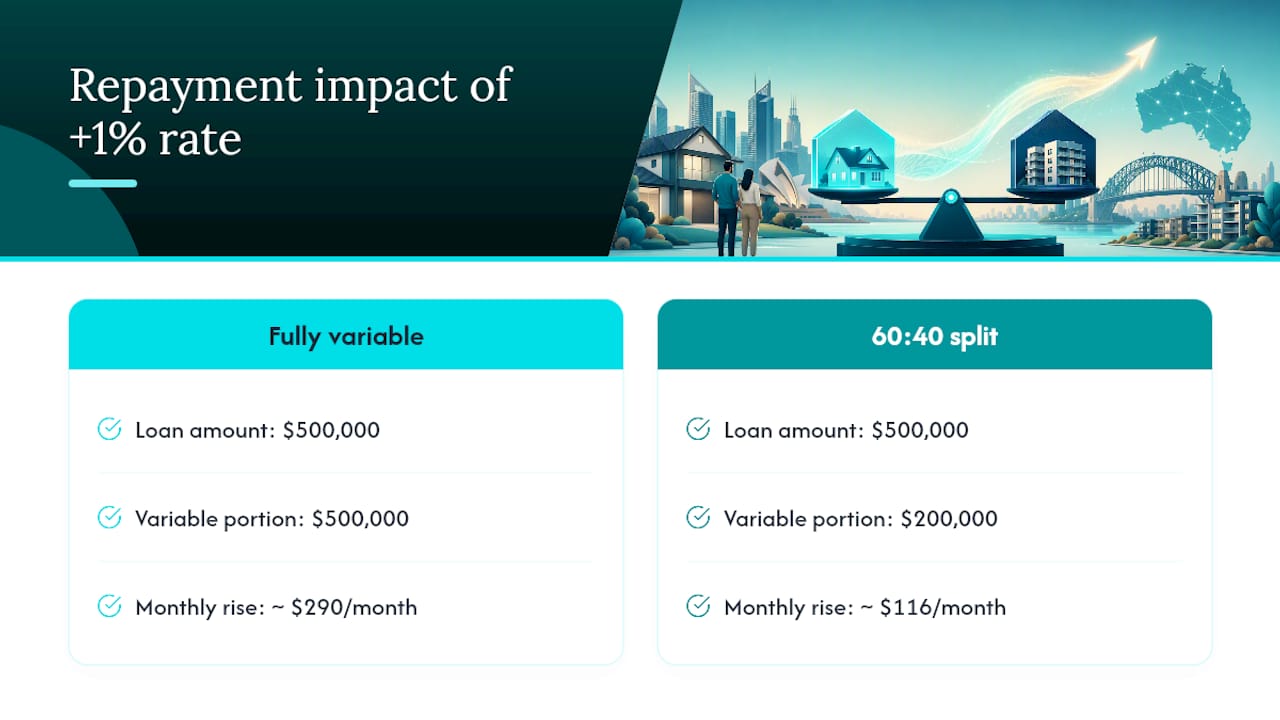
The other variable worth stress testing is rate movement itself. A one percentage point rise on a fully variable $500,000 loan adds roughly $290 a month to repayments. Split that loan 60:40 and only the $200,000 variable slice feels that increase, cutting the monthly hit to around $116.
Pros, Cons, and Where Split Loans Can Actually Hurt You
The case for splitting rests on three real benefits:
- Partial protection from rate rises. Your fixed portion stays put no matter what the RBA or swap markets do, giving you a floor under your budget.
- Genuine budget certainty. Knowing exactly what a chunk of your repayment will cost for the next one to five years makes cash flow planning far easier, particularly for households running tight margins.
- Retained upside on the variable side. If rates fall, your variable portion benefits immediately, and you keep offset and redraw flexibility on that slice.
The drawbacks are just as real, and they’re the reason a split isn’t automatically the right call for everyone. Break costs can turn into a five-figure surprise if your circumstances change mid-term and you need to refinance or sell. Offset effectiveness is capped on the fixed portion, so parking a large cash buffer against a heavily fixed loan wastes its interest-saving power. And running two rate structures adds a layer of complexity that some borrowers simply don’t want to manage, especially when adjusting the ratio later means fresh paperwork and sometimes fresh fees.
The risk scenario that catches people out most often: you fix 70% of your loan for three years, then twelve months in you get a job offer interstate and need to sell. The break cost on that fixed portion, calculated against how swap rates have moved since you locked in, can be substantial enough to wipe out any interest savings you’d banked. The same trap applies if you inherit money or get a bonus and want to dump it against the loan. A heavily fixed split can leave that cash sitting in an offset account earning nothing against the portion it can’t touch.
Pro Tip: Before you fix any portion, ask yourself honestly whether you’d sell or refinance within the fixed term if life forced your hand. If the answer is “maybe,” size your variable portion larger than the standard heuristic suggests.
How to Choose Your Split: A Practical Framework
Three questions determine your starting ratio, in this order.
First, how stable is your income? Individuals with stable incomes may prefer more variable portions for flexibility, while those with irregular income might benefit from a heavier fixed split for budgeting certainty., because budget predictability matters more than chasing marginal savings.
Second, how big is your cash buffer, and where does it live? If you’re carrying a substantial offset balance today or expect to build one quickly (a bonus, an inheritance, a second income), size your variable portion to match or exceed that balance. Otherwise you’re paying for offset access you can’t fully use.
Third, what’s your realistic timeline? If you plan to sell or refinance soon, keeping a smaller fixed portion can reduce exposure to break costs. Long-term investors planning to hold for a decade or more can comfortably fix a larger share, since decision frameworks weighting income stability, liquidity, and timeline consistently point toward heavier fixed allocations for buy-and-hold strategies.
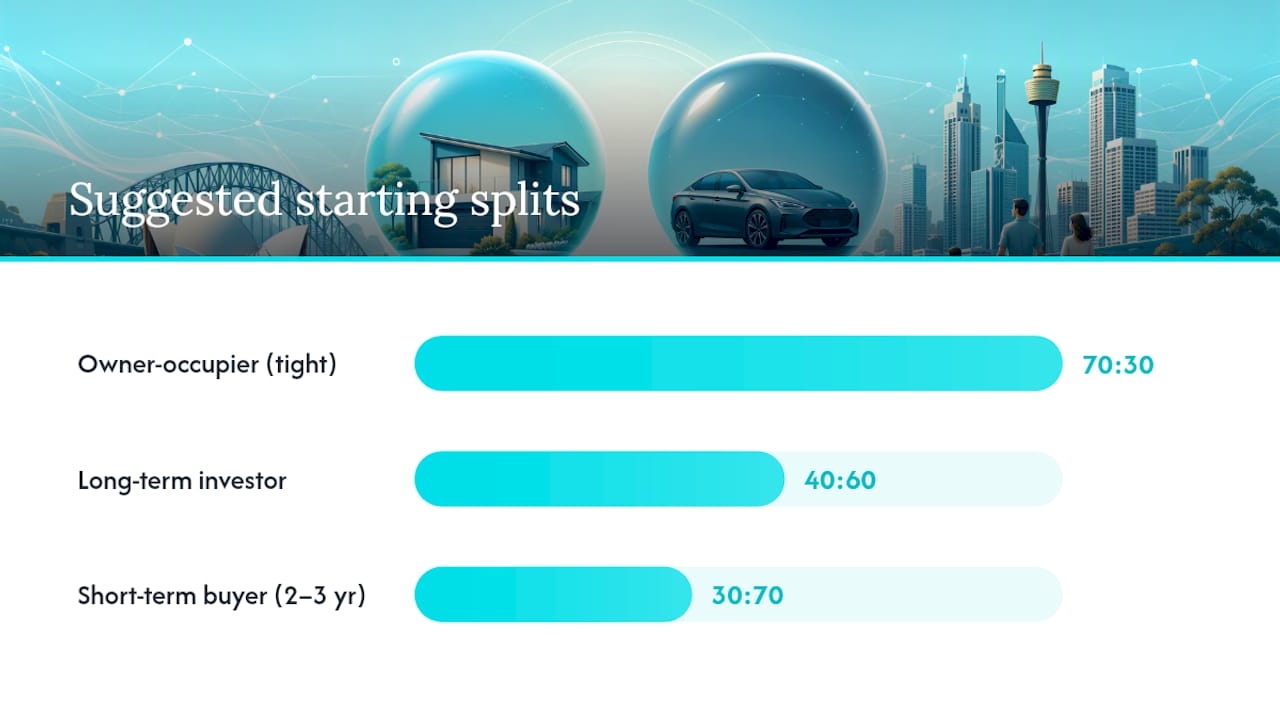
| Borrower profile | Suggested starting split | Why |
|---|---|---|
| Owner-occupier, tight budget | 70:30 fixed-heavy | Prioritizes repayment certainty over flexibility |
| Long-term investor, large offset | 40:60 variable-heavy | Maximizes offset benefit, accepts some rate exposure |
| Short-term buyer (2 to 3 years) | 30:70 variable-heavy | Minimizes break-cost risk if selling or refinancing soon |
Before fixing anything, ask your lender or broker for an indicative break-cost estimate, confirm whether offset and redraw apply to both portions or only one, and check what happens automatically when the fixed term ends. If a broker can’t answer those three questions clearly, that’s a red flag worth pushing on.
Setting Up, Changing, or Exiting a Split Loan
Making the actual change is more procedural than most people expect, and it usually runs through four steps.
- Pull your current loan documents and confirm what features already exist on your loan, including whether offset and redraw are active and on which portion.
- Model the outcome before you call anyone, running the numbers on a few different ratios against your actual income and savings pattern.
- Request the split or fix through your lender or broker, specifying the exact ratio, the fixed term length, and confirming which features carry over to each portion.
- Confirm the fixed-rate paperwork, including the rate lock, before settlement. Most lenders lock your fixed rate for a short window, often around 30 to 90 days, so timing your application against your settlement date matters.
Application fees for splitting or refixing are typically modest, often in the low hundreds of dollars or waived entirely depending on your lender, though it’s worth confirming before you commit. If you’re already partway through a fixed term and considering a change, ask your lender for a written break-cost estimate before you sign anything, and treat that number as a starting point rather than gospel. Swap rates move between the estimate and your actual exit date, so build in a buffer rather than assuming the quoted figure is final. For anything beyond a straightforward split ratio change, particularly if you’re weighing early exit against a full break, a conversation with a mortgage broker or financial adviser is worth the hour it takes.
Model Your Split Before You Lock It In
Every example above uses fixed assumptions: one rate environment, one loan size, one offset balance. Your actual situation has more moving parts, and that’s exactly where scenario modelling earns its keep.
Run two scenarios side by side: a heavy-fixed split (say 70:30) against a heavy-variable split (30:70) using your real loan balance, your actual offset habits, and your genuine timeline to refinance or sell. Users can build multiple scenarios and compare them directly, testing:
- Repayment stability under each split if rates rise or fall by a percentage point or two.
- Long-run interest cost across the full loan term, not just the next 12 months.
- Break-cost exposure if your timeline shifts and you need to exit a fixed portion early.
- Offset drag, meaning how much interest-saving power you’re leaving on the table if your cash buffer outgrows your variable portion.
Because fixed rates track swap-market expectations rather than the RBA cash rate directly, it’s worth stress testing a one to two percentage point adverse swap movement against your likely refinance timing. That single test often reveals whether fixing a portion genuinely reduces your long-term uncertainty or just delays the risk to a less convenient moment.
Pro Tip: Run your offset balance as a variable in the model, not a fixed input. Most borrowers’ cash buffers grow over the life of a loan, and a split that looks efficient today can waste offset benefit five years from now if your variable portion doesn’t grow with it.
Side-by-side comparisons can incorporate superannuation, property, and mortgage assumptions into one projection, so you’re weighing the split decision against your full financial picture rather than the mortgage in isolation.
Our Take: Split Loans Are Risk Management, Not a Bet
Treat a split loan strategy as insurance, not speculation. The goal isn’t to outguess where rates are headed. It’s to make sure a rate shock doesn’t blow up your budget while you still keep some upside if variable rates ease.
The practical discipline that matters most: size your variable portion to match what you actually expect to hold in savings or offset, not what a generic 60:40 rule suggests. And keep enough liquidity outside the loan to absorb a break-cost surprise if your plans change faster than your fixed term allows.
Model it first. Then, if the numbers get complicated or your situation is unusual, talk to a mortgage broker or financial planner before you sign.
— Aerowealth Team
See Your Split Loan Decision Modelled Before You Commit
A broker can quote you a rate. What they usually can’t show you is how that rate choice plays out against your super contributions, your investment property, and your retirement timeline over the next 20 years. That’s the gap AeroWealth closes for Australians weighing a fixed-to-variable split.

Instead of guessing whether a 60:40 or 70:30 split suits your situation, build both scenarios inside AeroWealth and watch how each one affects your repayment stability, long-run interest cost, and break-cost exposure alongside your broader financial plan. The platform’s stress tests let you push through a rate shock or an early refinance and see exactly where a fixed portion helps and where it gets in the way. Modelling doesn’t replace a lender’s formal quote or a chat with a broker, but it puts real numbers behind the decision instead of a rule of thumb. Check the pricing page to see what’s included in the free plan versus the advanced scenario tools, and run your own split comparison before your next rate lock.
Where to Read More
For readers who want to go deeper on any of the mechanics covered here, these sources are worth bookmarking:
- Westpac’s split home loan explainer covers the basics of how splits work and typical fixed-term lengths.
- NAB’s guide to split home loans lays out common ratio recommendations for different borrower types.
- MoneySmart’s offset account guide is the clearest government-backed explanation of how offsets interact with fixed and variable portions.
- CommBank’s split loan overview includes worked scenario examples similar to the ones used above.
This article is general information, not a substitute for advice from a qualified financial advisor. Consult a qualified financial professional about your own circumstances before acting on anything here.
Sources
- What is a split home loan? | Westpac
- Split home loans explained | NAB
- Mortgage offset accounts | MoneySmart
- What is a split home loan? | CommBank
FAQ
Is a Split Loan a Good Idea?
For most borrowers wanting some protection from rate rises without giving up all flexibility, yes, a split loan is a reasonable middle ground. It works best when your variable portion is sized to match your actual offset or savings habits, so you’re not wasting interest-saving potential on a fixed slice.
How Do You Pay Off a $300,000 Mortgage in 5 Years?
Paying off a large mortgage in five years requires substantially higher monthly repayments than standard 30-year schedules, typically needing significant surplus income or lump sums. Most borrowers achieve early payoff gradually through extra repayments and offset balances rather than targeting a fixed short term.
What Salary Do You Need for a $500,000 Loan?
Lenders typically want your total home loan repayments, including a $500,000 mortgage, to sit comfortably within your borrowing capacity assessment, which depends on your household income, other debts, dependents, and the lender’s serviceability buffer. Your broker can run the exact figure against your specific lender’s calculator.
How Much Do You Need to Earn for a $700,000 Mortgage?
A $700,000 mortgage generally requires a household income that varies by lender, existing debts, and how the lender stress tests your repayment capacity against rate rises. Running your numbers through a modelling tool before applying gives you a clearer picture than a rule-of-thumb estimate.
Can You Change Your Split Loan Ratio Later?
Yes, most lenders let you adjust your split ratio after settlement, though changing the fixed portion mid-term may trigger break costs if you’re reducing or exiting a fixed-rate segment early. Ask your lender for a written break-cost estimate before making any change to an existing fixed portion.