Model Your $130,000 Cap: Non-Concessional Contributions for Australians

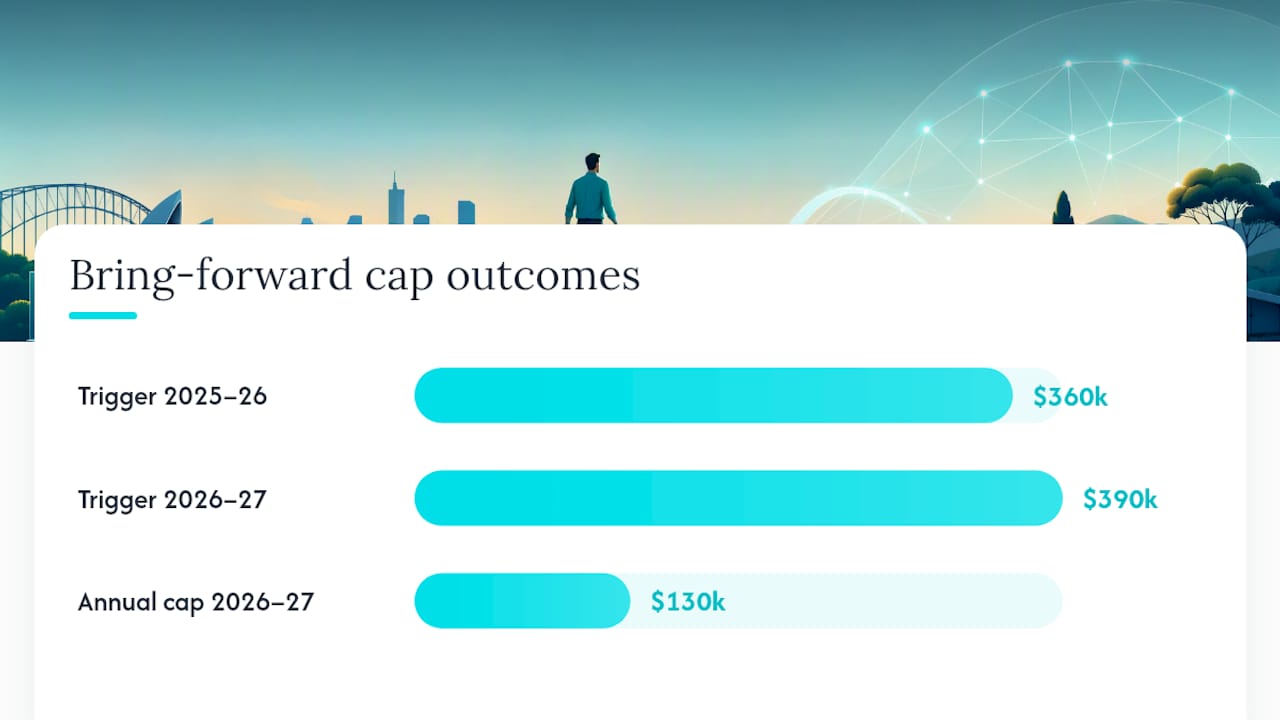
Your non-concessional contributions cap for 2026–27 is $130,000, up from $120,000 the year before. That figure drops to nil if your Total Super Balance sits at $2.1 million or more on June 30, 2026. If your balance is lower, the bring-forward rule can let you contribute up to $390,000 in a single year, spread across three years’ worth of caps.
TL;DR:
- The non-concessional contribution cap increased to $130,000 for 2026–27, but drops to nil if your super balance exceeds $2.1 million on June 30, 2026.
- The bring-forward rule allows eligible individuals to contribute up to $390,000 in three years, but the fixed entitlement is determined at the trigger moment and does not increase with cap indexation.
- Your total super balance on June 30, 2026, limits your ability to maximize contributions, with thresholds affecting whether you can use the full, partial, or no bring-forward options.
- Exceeding the cap results in penalties, but you can resolve it by withdrawing excess contributions or paying tax at your marginal rate; early action and proper documentation are essential.
- Checking the latest TSB and contribution status close to your contribution date is critical, as market movements or large deposits can push your balance over thresholds unexpectedly.
Table of Contents
- What Is the Non-Concessional Contributions Cap and Why Did It Rise in 2026?
- Total Super Balance Thresholds and What They Mean for Your Cap
- How the Bring-Forward Rule Works, and Where the Timing Traps Are
- What Counts Toward the Cap and What You Can Have Excluded
- If You Exceed the Cap: What Happens and How to Fix It
- Checking Your TSB and Tracking Contributions Before You Contribute
- Scenario Modelling: Lump Sum vs. Bring-Forward Contributions
- When Non-Concessional Top-Ups Actually Make Sense
- Model Your Contribution Strategy Before You Commit
- Sources
- FAQ
What Is the Non-Concessional Contributions Cap and Why Did It Rise in 2026?
Non-concessional contributions are the after-tax dollars you tip into super, separate from the concessional contributions your employer pays or that you claim as a tax deduction. Because you’ve already paid income tax on the money, it doesn’t get taxed again going in, provided you stay under the cap. Go over it, and the ATO treats the excess differently.
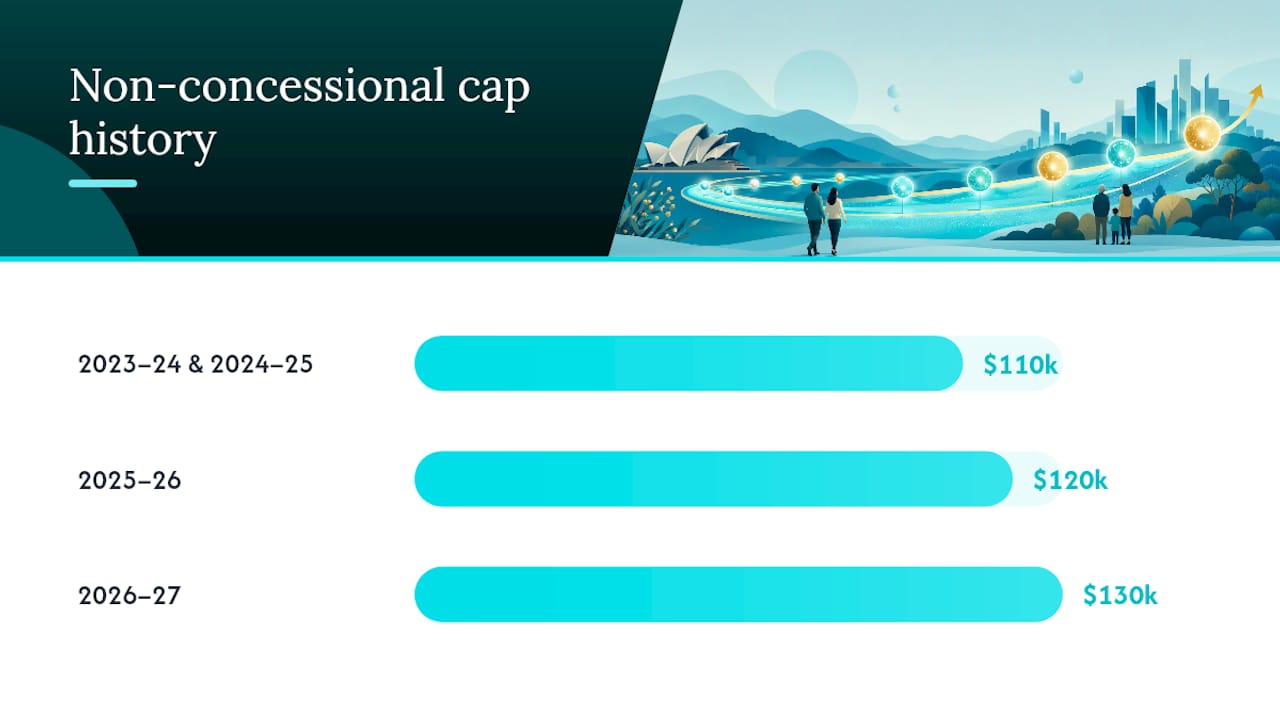
The cap jumped to $130,000 because it’s pegged to Average Weekly Ordinary Time Earnings, or AWOTE, an indexation formula tied to concessional cap increases. The non-concessional cap is set at four times the concessional cap, so when wages growth pushes the concessional figure up, the non-concessional number follows in lockstep.
Recent history shows the pattern:
- 2023–24 and 2024–25: $110,000
- 2025–26: $120,000
- 2026–27: $130,000
Three cap rises in four years is not something readers of older super articles will expect, so double-check any figure you find that predates July 2026.
Total Super Balance Thresholds and What They Mean for Your Cap
Your Total Super Balance (TSB) on June 30, 2026 decides how much of the 2026–27 cap you can actually use, and whether you can trigger the bring-forward rule at all. The ATO calculates TSB by adding up your balances across every super account, including accumulation and pension accounts, as of that date. It’s a snapshot, not a running total, so a large withdrawal or contribution made on July 1 won’t change the number that governs your eligibility.
The bands work like this for 2026–27:
- TSB under $1.84 million: full three-year bring-forward available, up to $390,000
- TSB $1.84 million to under $1.97 million: two-year bring-forward, up to $260,000
- TSB $1.97 million to under $2.1 million: no bring-forward, capped at the standard $130,000 for one year only
- TSB $2.1 million or above: non-concessional cap is nil
That $2.1 million cutoff isn’t arbitrary. It matches the general transfer balance cap, the ceiling on how much you can move into a tax-free retirement pension account. The government’s logic is straightforward: once your balance matches what you could theoretically shift into pension phase, there’s no policy reason to let you keep adding more after-tax money.
This is where a lot of people trip up. They check their TSB months before contributing, see they’re comfortably under $1.84 million, then forget that a strong year of investment returns or an employer contribution surge can push the balance across a threshold by the following June 30. Check your figure close to the date you plan to contribute, not six months out.
How the Bring-Forward Rule Works, and Where the Timing Traps Are
The bring-forward arrangement doesn’t need an application form. It triggers automatically the moment your non-concessional contributions in a single year exceed the standard annual cap, and the ATO’s own systems pick it up through fund reporting.
Two conditions decide whether you’re even eligible:
- You must be under 75 at some point during the financial year you make the contribution.
- Your TSB at the prior June 30 must fall under $2.1 million, since that’s the point where your cap becomes nil.
Here’s the part that catches people out: once triggered, your bring-forward cap is locked in at that year’s figures and won’t move even if the general cap indexes upward during your bring-forward period. Say you trigger a three-year bring-forward in 2025–26 using the $120,000 cap that applied then. Your total entitlement is fixed at $360,000 across 2025–26, 2026–27, and 2027–28, even though the standard annual cap rose to $130,000 in the second year of your arrangement. You don’t get topped up to match the new number.
That fixed-cap quirk means timing matters more than most people assume. Someone who waits one extra year to trigger the bring-forward, deliberately or by circumstance, could end up with a materially higher three-year entitlement simply because they triggered it under the 2026–27 figures rather than the year before.
Pro Tip: If you’re close to a birthday that pushes you past 75, or you expect a large inheritance or property sale settlement in the next 18 months, model the timing of your bring-forward trigger before the money lands in your account, not after.
What Counts Toward the Cap and What You Can Have Excluded
Most personal, after-tax money you put into super counts toward the non-concessional cap. That includes:
- Personal contributions you make from your own bank account without claiming a tax deduction
- Spouse contributions made on behalf of a partner
- Certain foreign super fund transfers once allocated to your Australian account
Some contribution types can be kept out of the cap entirely, but only if you file the right paperwork with your fund at or before the time of contribution. The main exclusions the ATO recognizes are:
- Downsizer contributions from the sale of your home, using the ATO’s downsizer form
- CGT cap election amounts, typically from selling a small business asset
- Personal injury payments, such as structured settlements
- Government co-contributions, which never count against your own cap in the first place
One trap worth flagging: if you make a personal contribution intending it to be non-concessional, then later claim a tax deduction for it, that contribution reclassifies as concessional. It comes out of your non-concessional total and gets counted against your concessional cap instead. Elections need to happen at the right time, not retrofitted after the fact.
If You Exceed the Cap: What Happens and How to Fix It
Breach the cap and the ATO doesn’t leave you guessing. Here’s the sequence:
- The ATO issues an excess non-concessional contributions determination, a formal letter spelling out the excess amount and associated earnings calculated over the period the money sat in your fund.
- You choose how to handle it: release the excess plus 85% of the associated earnings from your fund, or leave it in super and pay excess contributions tax at your top marginal rate on the full excess amount.
- If you choose release, the ATO sends a release authority directly to your super fund, which pays the money out within specified timeframes.
- Associated earnings are taxed at your marginal rate, with an offset for the 15% already paid inside the fund.
While that process plays out, resist the urge to act on your own. Don’t withdraw money from your fund without ATO instruction, don’t assume you can simply amend a past contribution, and don’t ignore the determination letter. Contact your fund early to confirm they’ve received the same figures the ATO has, and keep every contribution statement you can find. Discrepancies between what your fund reported and what actually landed in your account are more common than most people expect, especially when contributions were split across two funds in the same year.
Checking Your TSB and Tracking Contributions Before You Contribute
Your TSB and contribution history both live inside ATO online services, accessible through myGov. Under the super section, you’ll find a running tally of concessional and non-concessional contributions reported by every fund you hold, plus your total super balance as of the last reporting date.
A few practical habits make this easier:
- Check the Total Super Balance screen a few weeks before making a large contribution, not months in advance
- Cross-reference the ATO’s contribution figures against your fund’s own member statement, since reporting lags of a few weeks are common
- If you hold accounts with more than one fund, add the balances yourself. The ATO’s screen aggregates them, but timing differences between funds can cause a temporary mismatch
- Call your fund directly if a contribution you made doesn’t show up within about six weeks. It may be sitting in a suspense account rather than allocated to your balance yet
Coordinating contributions across multiple super funds is one of the more common ways people accidentally trigger the bring-forward rule without meaning to.
Scenario Modelling: Lump Sum vs. Bring-Forward Contributions
Numbers on a cap table only mean so much until you see what they do to an actual retirement projection. Two scenarios show the difference clearly.
Scenario A: A 58-year-old with a TSB of $900,000 contributes $130,000 in 2026–27 as a single, standard non-concessional contribution, perhaps from a redundancy payout. Modelled forward at a standard growth assumption, that single contribution alone can add a meaningful bump to projected retirement income, but it uses only one year of cap space.
Scenario B: The same person instead triggers the three-year bring-forward and contributes the full $390,000 in one year, say from a property sale settlement. Because that entitlement was fixed the moment it was triggered, it won’t rise even if the standard cap indexes again in 2027–28 or 2028–29. Modelled side by side against Scenario A, the larger, earlier contribution generally produces a bigger compounding effect over a 10 to 15 year horizon, since the money starts earning inside super’s concessional tax environment sooner.
Which approach fits depends on things a spreadsheet can’t tell you on its own:
- Do you need that cash for liquidity outside super in the near term?
- Are there estate planning implications to locking money into super rather than a personal name?
- Is this a low marginal tax rate year where a $360,000 to $390,000 concessional carry-forward pairing might also make sense?
Pro Tip: Run both scenarios with your actual numbers before deciding. A tool like Aerowealth can show side-by-side projections of the lump sum versus bring-forward paths, so you’re comparing real numbers instead of guessing which feels bigger.
When Non-Concessional Top-Ups Actually Make Sense
After-tax contributions earn their keep in a few clear situations: a low income year where you don’t need the deduction, or a lump sum from a property sale or inheritance you want compounding inside super’s tax structure sooner rather than later.
They deserve more caution when your TSB sits close to $1.84 million or $2.1 million, where a strong market year could shrink your bring-forward room without warning, or when you genuinely need liquidity outside super for the next few years. Locking money away that you might need for a business opportunity or a health event isn’t a decision to make on cap arithmetic alone.
Complex cases, blended families, business sales, large inheritances, deserve real modelling or a licensed adviser, not a rule of thumb from an article.
— Aerowealth Team
Model Your Contribution Strategy Before You Commit
There are tools available that allow Australians to model different bring-forward scenarios side by side, showing how various contributions impact retirement outcomes based on their super balance, age, and income projections.
Some platforms also help address complex questions that simple cap tables can’t answer, such as how large non-concessional contributions might affect mortgage payoff timelines or investment property sales. If you’re weighing a lump sum contribution against other tax planning options for the year, running the comparison properly matters more than following a general rule. Start with the free tier at Aerowealth and test your own numbers against both the standard cap and a bring-forward trigger before you contribute a dollar.
Sources
Verify these figures directly with the ATO before making a contribution decision, since caps and thresholds can shift with each indexation cycle. For related planning detail, see Aerowealth’s guides on super contribution caps for 2026 and concessional carry-forward rules.
This article is general information, not a substitute for advice from a qualified financial advisor. Consult a qualified financial professional about your own circumstances before acting on anything here.
- Non-concessional contributions cap | Australian Taxation Office
- Implications of the increase in contribution caps from 1 July 2026 | Heffron
- Bring-forward rule and practical guidance | SuperGuide
FAQ
What is the non-concessional contributions cap?
It’s the maximum amount of after-tax money you can add to your super fund each year without triggering extra tax. For 2026–27, that limit is $130,000, though it drops to nil if your Total Super Balance is $2.1 million or more.
What is the non-concessional contribution cap for 2026?
For the 2026–27 financial year, the standard annual cap is $130,000, up from $120,000 in 2025–26. Eligible people under 75 with a lower Total Super Balance can bring forward up to three years of this cap, reaching as much as $390,000 in a single year.
Is it worth making non-concessional contributions to super?
It often makes sense when you have surplus after-tax cash, such as proceeds from a property sale, and want it growing in super’s lower tax environment. It’s worth more caution if your Total Super Balance sits close to a threshold band or if you need that money for liquidity outside super in the next few years.
Can I make non-concessional contributions after 67?
Yes. There’s no upper age limit for standard non-concessional contributions themselves, but to trigger the bring-forward rule you must be under 75 at some point during the financial year you contribute. You’ll also need to meet your fund’s own acceptance rules, which can include work tests in some circumstances.