Tax on Super Withdrawals: What You’ll Actually Pay

For most Australians, tax on super withdrawals disappears completely once you turn 60 and your money comes from a taxed fund. Before that age, what you owe depends on your preservation age, whether the payment is a lump sum or an income stream, and how much of your balance counts as a taxable component. The two bodies worth checking before you touch a dollar of super are the Australian Taxation Office and MoneySmart, both of which set the rules that follow.
A few things swing the final number more than people expect:
- Your age at the time of withdrawal, measured against your preservation age and the age-60 threshold
- Whether the withdrawal is a lump sum or a retirement income stream
- The low-rate cap and the untaxed plan cap, which limit how much receives concessional treatment
- PAYG withholding rules that apply if you don’t quote a tax file number
Key Takeaways
Tax on super withdrawals hinges on age, component mix, and payment type, with age 60 acting as the point where most taxed-fund withdrawals become tax-free.
| Point | Details |
|---|---|
| Age 60 is the trigger | Lump sums and income streams from a taxed fund are generally tax-free from age 60 onward. |
| The low-rate cap matters before 60 | For 2025/26 it sits at $260,000; amounts above it face higher tax rates on the taxable component. |
| Lump sums lose concessional tax on earnings | Money withdrawn as a lump sum is later taxed at your marginal rate, not the fund’s 15% rate. |
| Stopping a pension carries risk | Missing minimum drawdowns can convert future payments back into taxed lump sums. |
| Model before you withdraw | Aerowealth lets you compare lump sum and income stream scenarios side by side before you commit. |
Table of Contents
- How Tax on Super Withdrawals Depends on Your Age
- Lump Sum or Income Stream: The Choice That Follows You for Years
- The Caps and Withholding Rules That Decide Your Rate
- Practical Ways to Manage the Tax Hit
- Tax on Death Benefits: Dependants vs Everyone Else
- A Short Checklist Before You Withdraw
- Voluntary Withdrawals Versus Compulsory Payments
- Super Withdrawal Tax Rules for Temporary Residents
- Why Your Contribution History Shapes Your Tax-Free Component
- Reporting Super Withdrawals on Your Tax Return
- Sources
- FAQ
How Tax on Super Withdrawals Depends on Your Age
Superannuation tax law splits retirees into three age brackets, and each one gets a different deal. Your fund also splits your balance into a tax-free component (built from after-tax contributions) and a taxable component (built from employer contributions, salary sacrifice, and investment earnings). Within the taxable component, there’s a further split between the “taxed element” (already taxed inside the fund) and the “untaxed element” (common in some government and public-sector funds, and taxed more heavily on the way out).
- Under preservation age. Withdrawals are rare outside specific conditions of release, but when they happen, the taxable component is generally taxed at around 22%, including the Medicare levy.
- At or above preservation age, under 60. The taxable component up to the low-rate cap can be tax-free or taxed at a reduced rate; amounts above the cap are taxed at roughly 17% including the Medicare levy.
- Age 60 and over, from a taxed fund. Both lump sums and income streams are normally tax-free for the member, regardless of the component split.
Your own marginal tax rate still matters for anything outside super, so check your notice of assessment or a fund statement before assuming a figure applies to you.
Lump Sum or Income Stream: The Choice That Follows You for Years
The tax bill on the day you withdraw is only half the story. What you do with the money afterward changes how it’s taxed for years to come.
- Pull out a lump sum, and that money leaves the concessional super environment. Any future earnings on it get taxed at your personal marginal rate, not the fund’s 15% concessional rate.
- Keep the money in an account-based pension in retirement phase, and investment earnings inside that pension remain tax-free, while the income paid to you is generally tax-free from age 60.
- Take an income stream before 60, and the taxable portion is assessable, though a tax offset often applies.
- Stop a pension, or fail to meet minimum annual drawdown requirements, and the ATO can treat future payments as lump sums for tax purposes, which strips away the retirement-phase tax-free status you’d otherwise keep.
Pro Tip: Before you commute a pension or take a partial lump sum, model what happens to the earnings on that money outside super versus leaving it in a retirement-phase account. The gap compounds over a decade, not just the first year.
The Caps and Withholding Rules That Decide Your Rate
Two thresholds do most of the heavy lifting once you’re between preservation age and 60. The low-rate cap sets a lifetime limit on how much of your taxable component can get the concessional (nil or low) rate. For the 2025/26 year, that cap sits at $260,000, which is the current indexed figure set by the government.
The untaxed plan cap applies to certain untaxed elements, typically from older public-sector schemes, and amounts above that cap face noticeably higher tax rates.
On the withholding side, ATO Schedule 12 governs PAYG withholding on super lump sums:
- Not providing your TFN triggers the top marginal rate as withholding, regardless of your actual liability.
- Withholding rates vary by your age and by which component (tax-free, taxed, or untaxed) the payment draws from.
- Special rules apply for terminal medical condition payments, very small balances, and payments to dependants, each with its own withholding treatment.
Practical Ways to Manage the Tax Hit
None of this is about avoiding tax you legitimately owe. It’s about sequencing decisions so you don’t pay more than you need to, or lock in a worse outcome than necessary.
- Time it around a birthday when you can. If you’re close to 60, delaying a lump sum withdrawal by a few months can shift the whole taxable component from a reduced rate to fully tax-free.
- Leave money in retirement phase where possible. An account-based pension keeps investment earnings tax-free inside super, something a lump sum sitting in a bank account or brokerage will never match.
- Stagger larger withdrawals. Spreading amounts across financial years or using partial commutations helps you manage how much taxable component you use against the low-rate cap in one go.
- Get your component split in writing. Ask your fund for a statement showing your tax-free versus taxable component before you decide anything, because guessing here is how people overpay.
- Talk to a licensed adviser before recontributing or rolling over. Recontribution strategies can rebuild your tax-free component, but they interact with contribution caps and need professional advice to get right.
Pro Tip: Run the “leave it in versus take it out” comparison on paper, or in a modelling tool, before you sign anything. The tax difference on the withdrawal day is often smaller than the tax difference on the earnings over the next ten years.
If you’re weighing whether to bring forward retirement entirely, bridge years planning becomes part of the same decision, since early access rules and preservation age interact directly with the tax outcomes above.
Tax on Death Benefits: Dependants vs Everyone Else
Death benefits follow a different rulebook entirely, and it’s one that catches families off guard during an already difficult time.
- Payments to a dependant (a spouse, a child under 18, or someone in an interdependent relationship) are usually tax-free, whether paid as a lump sum or an income stream.
- Payments to a non-dependant, such as an independent adult child, are taxed, with the taxed element and untaxed element attracting different rates.
- Trustees generally have discretion over how a benefit is distributed unless a binding nomination is in place, which is why checking your nomination and getting estate advice from a legal specialist matters for blended families or complex estates.
A Short Checklist Before You Withdraw
Before you request a payment, get these answers from your fund in writing:
- Confirm your preservation age and whether your fund holds any untaxed elements.
- Request your tax-free versus taxable component split as a dollar figure, not a percentage estimate.
- Ask how much of your low-rate cap you’ve already used, if any.
- Get a PAYG withholding estimate for the specific amount and payment type you’re planning.
- Confirm minimum pension drawdown requirements and check any binding death benefit nomination on file.
Run the numbers through a scenario model, Aerowealth included, before you call your fund, and bring a licensed adviser into the loop once the balances involved are large or the situation is anything but straightforward.
Voluntary Withdrawals Versus Compulsory Payments
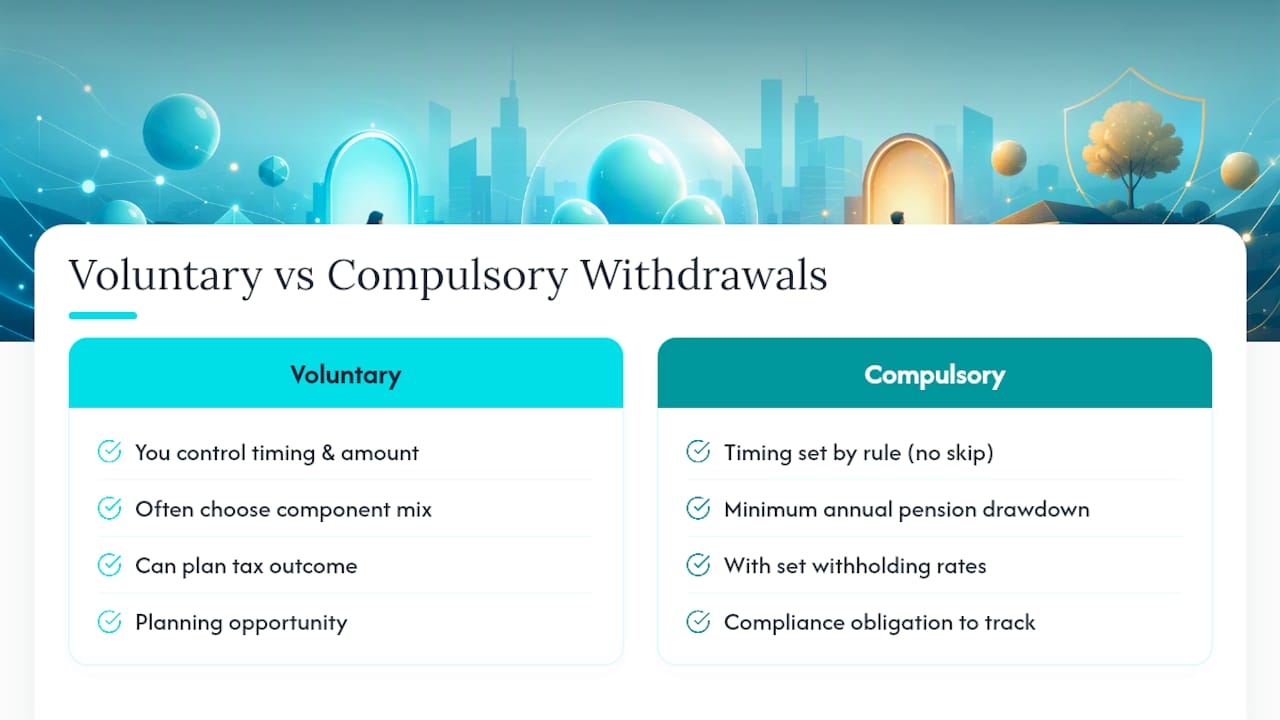
Not every dollar that leaves super does so by choice, and the distinction changes how you should think about tax planning. A voluntary withdrawal, like drawing a lump sum once you’ve met a condition of release, is a decision you control. You choose the timing, the amount, and often the component mix, which means you also control the tax outcome to some degree.
Compulsory payments work differently. The clearest example is the minimum annual pension drawdown, a rule that forces retirees in an account-based pension to withdraw a set percentage of their balance each year based on age. You can’t skip it without consequences. Miss the minimum, and the ATO may treat the entire pension as having stopped for tax purposes, which can convert future payments back into lump sums and undo the tax-free status you’d built up in retirement phase.
Another compulsory scenario shows up with unclaimed super or amounts the ATO releases automatically under specific conditions, such as certain excess contributions determinations. These payments follow set withholding rates regardless of your personal preference, and you often have less room to negotiate timing.
The practical takeaway: treat voluntary withdrawals as a planning opportunity, and treat compulsory ones as a compliance obligation you still need to track for your tax return. Getting the two confused, assuming a compulsory pension payment can be timed like a discretionary lump sum, is one of the more common mistakes retirees make in their first few years of drawing down super.
Super Withdrawal Tax Rules for Temporary Residents
If you worked in Australia on a temporary visa and built up a super balance, the withdrawal rules look nothing like what applies to permanent residents or citizens. Once you leave Australia permanently and your visa has expired or been cancelled, you can apply for a Departing Australia Superannuation Payment, commonly called a DASP.
DASP withholding rates are higher than the standard rates that apply to Australian retirees, and they’re deliberately structured that way because temporary residents didn’t get the same long-term concessional tax treatment on contributions that residents receive. The exact rate depends on the type of component (tax-free, taxed element, or untaxed element) and, in some cases, on whether the working holiday maker visa subclasses (417 or 462) apply, since those carry their own higher withholding schedule under separate rules.
If a temporary resident doesn’t claim their super before leaving, the ATO can eventually transfer unclaimed balances to its own holding account, and different withdrawal and tax rules apply once that happens. Temporary residents also cannot access the low-rate cap treatment the way permanent residents can after reaching preservation age, since DASP operates as its own separate category.
Anyone in this situation should treat the DASP process as entirely distinct from the retirement withdrawal rules covered elsewhere in this guide. Mixing the two frameworks, assuming preservation age or the low-rate cap applies, is a common and costly error.
Why Your Contribution History Shapes Your Tax-Free Component
Your tax-free component isn’t a fixed slice handed to you at retirement. It’s built up over your entire working life from specific contribution types, and the mix matters more than most people realize until they see their fund statement.
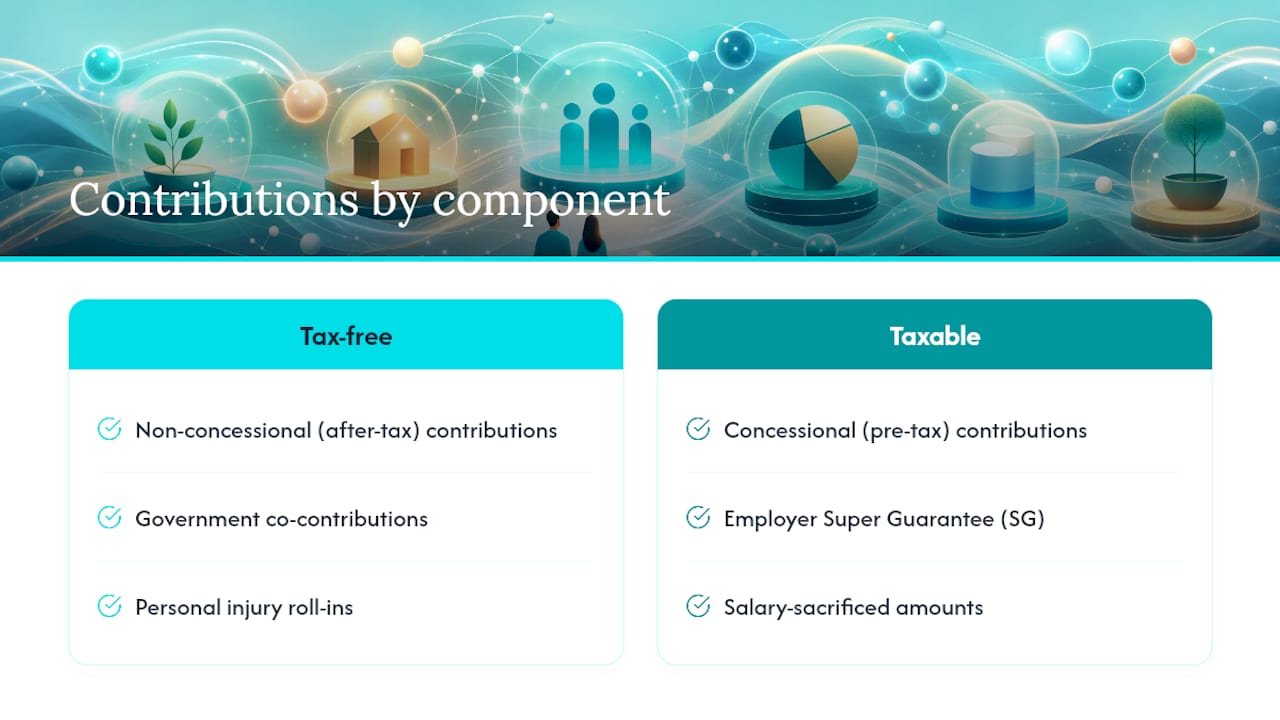
Non-concessional contributions, the after-tax money you or someone else put into your super without claiming a tax deduction, form the backbone of your tax-free component. So do certain government co-contributions and some personal injury payments rolled into super. Concessional contributions, including your employer’s Superannuation Guarantee payments and any salary-sacrificed amounts, build your taxable component instead, since those went in pre-tax.
This is why two people with identical super balances at retirement can face very different tax outcomes on a withdrawal made before age 60. Someone who spent years making voluntary after-tax contributions, perhaps from an inheritance or the sale of an investment property, will have a proportionally larger tax-free component than someone whose balance came almost entirely from employer contributions over a long career.
Recontribution strategies exist specifically to exploit this structure: withdraw an amount (once eligible), then recontribute it as a non-concessional contribution, effectively converting taxable balance into tax-free balance for future withdrawals or death benefit purposes. It’s a legitimate and widely used strategy, but it interacts with annual and lifetime contribution caps, so get it checked by a licensed adviser before acting. Reviewing your super preservation age and contribution history together gives you a clearer read on what your actual tax-free percentage looks like right now.
Reporting Super Withdrawals on Your Tax Return
Whether a super withdrawal even needs to appear on your tax return depends almost entirely on your age and the payment type. If you’re 60 or over and the payment came from a taxed fund, most lump sums and income stream payments don’t need to be declared as assessable income at all, since they’re already tax-free.
Below 60, it’s a different story. Taxable component amounts, along with any tax offset you’re entitled to claim, generally need to be reported using the income statement or payment summary your fund provides. Your fund is required to report these payments to the ATO directly, and that information usually pre-fills into your return through myGov, but you should still check it against your own fund statement rather than assuming it’s correct.
Income stream payments received before 60 typically show up as assessable income with an accompanying tax offset amount, both of which need to be entered correctly to avoid overpaying. If PAYG withholding was deducted at the time of payment, as governed by Schedule 12, that amount should already be reflected as tax withheld, similar to how wage income works.
Death benefit payments to non-dependants, DASP payments, and any withdrawal involving untaxed elements come with their own reporting quirks, and getting the labels wrong on your return is a common source of amended assessments. When in doubt, a fund-issued payment summary is the document to work from, not a rough estimate from memory.
Author perspective: how Aerowealth approaches modelling tax on withdrawals
The mistake we see most often isn’t a wrong tax rate. It’s people modelling the withdrawal day and stopping there, ignoring what happens to that money for the next twenty years. Aerowealth builds scenarios that compare a lump sum against an income stream side by side, factoring in low-rate cap exposure and the investment tax drag that follows once money leaves super. Stress-testing those paths before you act shows the real cost of a decision that looked fine on paper.
— Aerowealth Team
See what your withdrawal actually costs over time
Most retirees can estimate their tax on withdrawal day. Almost none can tell you what that same decision costs them in lost tax-free earnings by year ten, because that math requires comparing scenarios side by side, not just checking a rate table.

Aerowealth was built for exactly that gap. It models super withdrawal scenarios against income streams, tracks how much of your low-rate cap a given lump sum would use, and projects post-withdrawal net income alongside the investment tax drag that kicks in once money leaves the concessional super environment. Run your numbers first, compare a few paths side by side, then take those projections to a licensed financial adviser for a decision tailored to your balance and family situation. Start modelling your withdrawal scenarios and see the ten-year picture before you make a call you can’t easily undo.
Sources
Check the ATO’s retirement withdrawal guidance for component rules and pension commutation risks, and Schedule 12 for PAYG withholding tables. MoneySmart’s tax and super overview covers the low-rate cap and age-based rules in plain language. For deeper planning, see Aerowealth’s guides on super preservation age, super choices, and broader retirement planning.
This article is general information, not a substitute for advice from a qualified financial advisor. Consult a qualified financial professional about your own circumstances before acting on anything here.
- Tax and super - MoneySmart
- Retirement withdrawal – lump sum or income stream | Australian Taxation Office
FAQ
Is Super Tax-Free After Age 60?
For most people, yes. Withdrawals, whether lump sum or income stream, from a taxed super fund are generally tax-free once you turn 60.
What Is the Low-Rate Cap for 2025/26?
The low-rate cap sits at $260,000 for 2025/26, and it limits how much taxable component gets concessional treatment before you turn 60.
Does Withdrawing Super Before 60 Always Attract Tax?
Not always. It depends on your preservation age, whether you’re above or below it, and how much of your taxable component falls within the low-rate cap.
What Happens if I Withdraw Super Without Providing My TFN?
Withholding jumps to the top marginal rate under ATO Schedule 12 if you don’t quote a tax file number to your fund.
Are Death Benefits From Super Taxed?
Payments to dependants are usually tax-free, while payments to non-dependants are taxed at rates depending on the taxed and untaxed elements involved.
Can Modelling Tools Help Me Decide Between a Lump Sum and an Income Stream?
Yes. Tools like Aerowealth compare both paths side by side, showing after-tax income and future investment tax drag, though a licensed adviser should confirm the final decision for your circumstances.