Below 80% on Your Retirement Stress Test? 4 Fixes for Australians

Run a Monte Carlo stress test on your retirement plan now, using realistic return and inflation assumptions, not optimistic averages. If the result shows a success probability below your comfort zone, commonly in the range often recommended by financial planners, don’t panic and don’t ignore it either. Start with the cheapest fix first: build a cash buffer covering about a year of spending or push your retirement date back a year, then re-run the numbers.
TL;DR:
- Running a Monte Carlo stress test with realistic return and inflation assumptions can reveal weaknesses in your retirement plan, especially if success probability falls below 80%.
- Critical factors influencing outcomes include early market drops, prolonged low returns, inflation shocks, unexpected expenses, and liquidity shortages, which should be tested individually.
- Addressing liquidity issues first and reducing planned spending are the fastest ways to improve a weak plan, while increasing savings or delaying retirement take longer to show effect.
- Regular annual re-testing or after major life changes helps detect shifts that could threaten your success, allowing timely adjustments to your strategy.
- Using tailored Australian-specific planning tools enhances scenario comparison accuracy and guides actionable steps based on stress test outcomes.
Table of Contents
- What Is a Retirement Plan Stress Test, and Why Run One?
- How Do You Run a Credible Stress Test?
- What Does Your Success Probability Actually Mean?
- Which Levers Actually Fix a Weak Plan?
- How Do You Stress-Test Life Events, Not Just Markets?
- Example: How a Planning Tool Shows Stress Test Results
- Why Regular Testing Beats a One-Time Check
- See Your Retirement Plan’s Real Numbers, Not Just a Guess
- Sources
- FAQ
What Is a Retirement Plan Stress Test, and Why Run One?
A retirement plan stress test runs your numbers through hundreds or thousands of possible market and life outcomes instead of one tidy average scenario. The output isn’t a single dollar figure. It’s a probability. Something like “your plan succeeds in 84% of simulated futures” tells you far more than a spreadsheet that assumes 7% annual returns forever.
Before you can trust that number, you need to feed the test honest inputs. Garbage assumptions produce a garbage probability, no matter how sophisticated the simulation engine behind it is.
Here’s what belongs in your inputs before you hit run:
- Current account balances across super, investments, and cash, not rounded estimates from memory.
- Expected contributions, including employer super and any voluntary top-ups, mapped to your actual pay cycle.
- A spending profile that changes by life stage, most retirees spend more in the active early years and less later, then more again if aged-care enters the picture.
- A realistic planned retirement age, and a bridge income plan if that age falls before your super preservation age.
- Other income sources: part-time work, rental income, or eligibility for the Age Pension.
- Your asset allocation and the fees attached to it, since a 1% fee difference compounds into a meaningfully different outcome over 30 years.
- Tax assumptions relevant to your account structure and withdrawal stage.
- A life expectancy assumption that’s deliberately conservative. Planning to 90 is safer than planning to 85.
Small changes to any of these move the outcome more than most people expect. Shift your assumed inflation rate from 2.5% to 3.5%, and a plan that looked comfortable can slide into deficit territory over a 30-year retirement. The same is true of spending. Moneysmart’s retirement planning guidance recommends treating retirement as staged rather than static, reviewing your living costs and government support eligibility at each stage rather than locking in one number for three decades. Fees deserve the same scrutiny, especially given regulatory findings that fee monitoring and platform switching have quietly eroded retirement balances for many Australians.
How Do You Run a Credible Stress Test?
Monte Carlo simulation is widely used. Rather than assuming one smooth average return every year, it runs your plan through many randomized market sequences, drawing from historical volatility and correlation patterns, then reports the share of those sequences where you end with money. The Actuaries Institute’s good practice principles describe this Investment Simulation Model approach as the accepted technical basis for retirement stress testing, precisely because it captures the messy, non-linear way markets actually behave.
Compare that to the old 4% rule, which assumes a fixed safe withdrawal rate and calls it done. It’s a useful gut check, but it ignores sequencing entirely. A comparison of the two methods found Monte Carlo handles sequence-of-returns risk far better, which matters most if you’re retiring early or your balance is tight.
Beyond the full simulation, run these five manual scenario checks:
- Severe market drop at retirement. Model a 30–40% equity fall in your first year drawing down.
- Prolonged low returns. Test a decade of below-average growth, not just one bad year.
- Inflation shock. Bump your assumed inflation rate by two or three percentage points and watch what happens to purchasing power.
- A single large unexpected expense. Health costs, a home repair, supporting an adult child.
- Liquidity stress. Check whether you’d be forced to sell growth assets at a loss to cover near-term spending.
Pro Tip: Run the market-drop scenario assuming it happens in your first year of retirement, not year ten. Losses early in drawdown do far more damage than the same losses a decade in, because there’s less time for the portfolio to recover before you need to withdraw from it.
You’ve got three practical routes to actually run these tests: free online retirement calculators for a rough first pass, an adviser-run Monte Carlo analysis for a fuller professional review, or a dedicated planning tool that lets you build and compare scenarios side by side without rebuilding a spreadsheet every time your assumptions change.
What Does Your Success Probability Actually Mean?
A Monte Carlo result in the 80–90% range is generally where planners feel comfortable, according to figures cited by retirement simulator research. Below that band, more than one in five, or one in four, of the simulated futures ran your plan out of money before you did. That’s not a guaranteed failure. It’s a warning that your current settings leave too little room for a bad decade.

A lower success probability may warrant prompt review, while a very high result could indicate potential to retire earlier or spend more comfortably. Neither extreme is something you’d catch from a single average-return projection.
When a stress test flags a weak plan, the failure usually traces back to a handful of repeat offenders:
- Sequence-of-returns risk. Poor market performance hits hardest in the first five years of retirement, when your balance is largest and withdrawals are steady.
- Liquidity shortfall early on. Not enough accessible cash to cover the first two or three years, forcing asset sales at the worst possible time.
- Concentrated holdings. Too much exposure to one sector, one property, or one employer’s stock, which turns a market dip into a portfolio crisis.
- Underestimated fees or taxes. A small annual drag that compounds into a large gap over 25 or 30 years.
Fix these in order of urgency. Liquidity comes first, because a cash shortfall forces bad decisions under pressure. Spending flexibility comes second, since it’s the fastest lever to pull without touching your investment mix. Return-seeking changes, shifting your asset allocation to chase higher growth, come last, because they add risk exactly where your plan just showed it can’t absorb more. It’s also worth checking whether the platforms and funds holding your money are themselves sound. Regulatory reviews have flagged monitoring gaps around fees and fund switching that quietly undermine otherwise solid plans.
Which Levers Actually Fix a Weak Plan?
Four levers move a failing stress test result, and they don’t all cost the same in comfort or time.
- Increase savings. The most direct fix, but also the slowest to show up in your probability score if you’re within a decade of retiring.
- Postpone retirement. Working even one or two extra years does double duty: more contributions in, fewer years of drawdown to fund.
- Reduce planned spending. Trimming your assumed retirement budget by 10–15% often moves the success probability more than a modest allocation change would.
- Adjust asset allocation. Shifting toward growth assets can lift long-run projections, but it raises short-term volatility exactly when sequence risk is most dangerous.
Beyond the big four, several tactical moves reinforce a shaky plan without requiring a full rebuild. A cash buffer covering one to two years of spending removes the need to sell growth assets during a downturn. Laddering fixed income so bonds mature on a schedule matching your withdrawal needs smooths out interest rate surprises. Some retirees look at partial guaranteed income products to cover essential baseline spending, leaving the rest of the portfolio free to chase growth. Reviewing your super fund’s fees and options, and sequencing withdrawals in a tax-aware order, both add up over a multi-decade retirement.
Don’t assume last year’s result still holds.*
If your result sits well below your target band even after applying these levers, or your situation includes something genuinely complex like a business sale, an inheritance, or a blended-family estate question, that’s the point to bring in a licensed financial adviser rather than keep adjusting the model solo.
How Do You Stress-Test Life Events, Not Just Markets?
Money isn’t the only thing that can break a retirement plan. Health, family, and housing shocks hit just as hard, and they’re easy to skip because they don’t show up naturally in a spreadsheet.
Convert these into dollar figures and timing assumptions the same way you would a market drop:
- Major health costs, including the jump in expenses if aged care becomes necessary sooner than planned.
- Caregiving responsibilities, for a partner, parent, or grandchild, which can pull income or savings away from your own plan.
- Housing moves, downsizing, relocating closer to family, or adapting a home for accessibility.
- Changed roles, like a spouse’s health forcing an earlier-than-planned exit from paid work.
A few simple contingency steps go a long way here: agree on aged-care planning triggers before you need them, name an emergency decision-maker for financial matters, and set aside a basic contingency budget separate from your everyday retirement spending. Superannuation death benefits also interact with your estate plan in ways worth checking before, not after, a health crisis. Modeling these scenarios in advance means a real event triggers a plan you’ve already thought through, not a panicked reshuffle of your entire portfolio.
Example: How a Planning Tool Shows Stress Test Results
A useful planning tool doesn’t just spit out a pass or fail. It shows you success probability alongside the range of outcomes behind that number, a year-by-year cashflow projection, and how thin your liquidity gets in the toughest simulated years. That combination is what turns an abstract percentage into a decision you can actually act on.
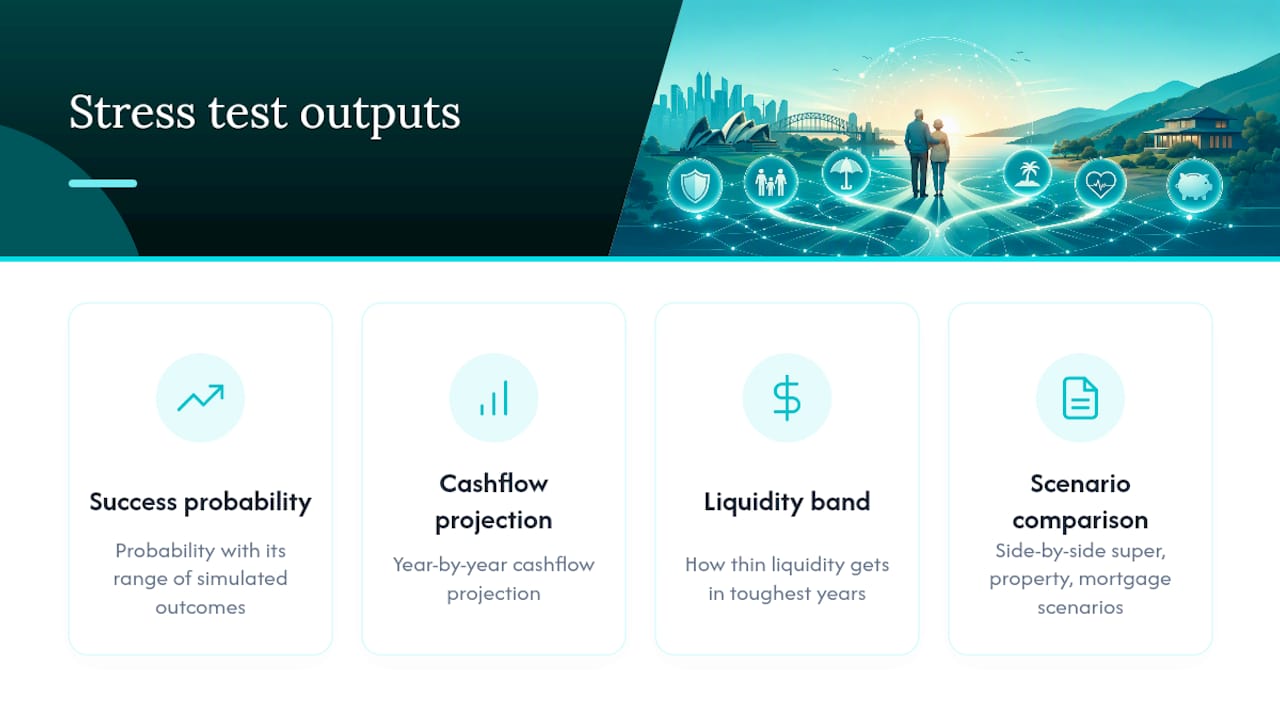
A useful planning tool builds its stress testing around that same logic, tailored to Australian retirement variables. Such a tool lets you run side-by-side scenario comparisons covering superannuation, investment property, and mortgage positions in one view, model bridge years for early retirement before you reach your super preservation age, and adjust asset allocation or spending to see the probability shift in real time.
The point of any of these outputs is what you do next. A weak liquidity band in years one through three points straight at building a cash buffer. A probability that only recovers once you push retirement out two years tells you exactly which lever to consider first. Run the test, read the weak spot, apply the matching lever from the sections above, and re-run it.
Why Regular Testing Beats a One-Time Check
Retirement plans decay the moment you stop checking them. Markets move, spending habits shift, health changes. People who skip testing for years often experience the biggest damage during a downturn and may panic-sell at exactly the wrong moment. Re-test annually, and immediately after any major life change. Use the tools to run the numbers, then bring an adviser in when the decision gets genuinely complex.
— Aerowealth Team
See Your Retirement Plan’s Real Numbers, Not Just a Guess
Most people never actually see how their plan holds up against a bad decade until they’re living through one. Some planning tools change that by running side-by-side scenario comparisons and Monte Carlo stress tests before you commit to anything, so you can see the probability shift as you adjust super contributions, mortgage strategy, or your retirement date.

It’s built specifically for Australians juggling superannuation alongside investment property or a mortgage, and for anyone weighing early retirement through bridge years before their super preservation age unlocks. Instead of guessing whether a 15% spending cut or an extra two years of work moves your success probability where it needs to be, you model both and compare them directly. If you haven’t run a baseline stress test on your own numbers yet, start with AeroWealth’s free plan and see where your plan currently stands.
Sources
For deeper background, see Moneysmart’s retirement planning steps, the Actuaries Institute’s modelling principles, and Aerowealth’s guide to sequence-of-returns risk.
This article is general information, not a substitute for advice from a qualified financial advisor. Consult a qualified financial professional about your own circumstances before acting on anything here.
FAQ
How do I stress test my retirement plan?
Run a Monte Carlo simulation using your actual balances, contributions, and spending, then test specific shocks like a market crash at retirement, an inflation spike, or prolonged low returns to see how each affects your success probability.
What percentage of retirees have $1,000,000 saved?
Reaching a very high balance in super or savings by retirement is uncommon; most retirees have considerably less, which is exactly why stress testing your specific balance against realistic spending matters more than comparing yourself to a round-number benchmark.
What are some practical ways to cut retirement spending if a stress test shows a shortfall?
Common cuts include reducing discretionary travel, downsizing housing, renegotiating insurance and utility contracts, delaying large one-off purchases, and shifting non-essential spending into the more flexible parts of your budget so it can flex down in a weak market year.
How often should I re-run my retirement stress test?
Re-run it at least once a year, and immediately after any major change, a new job, a health event, a property purchase, or a market move large enough to shift your balance meaningfully.