Model Your Retirement Impact When Tax Loss Harvesting in Australia

Tax loss harvesting works by selling investments at a loss to offset capital gains elsewhere in your portfolio, cutting the capital gains tax you owe for the year. It never reduces your salary or other ordinary income, only capital gains, and any leftover loss carries forward indefinitely. The catch: the ATO can void the benefit entirely under Part IVA if it decides the trade’s only real purpose was dodging tax, so timing and intent both matter.
TL;DR:
- Timing of the trade is crucial because settlement delays can push losses into the wrong financial year, especially with T+2 settlement on ASX shares.
- Rebuying the same or similar assets within 30 days risks scrutiny under Part IVA, potentially voiding the loss deduction for tax avoidance.
- Offsets are limited to capital gains only, with unused losses carried forward indefinitely, and the order of applying losses affects tax benefits.
- Crypto transactions settle instantly but require thorough recordkeeping to verify disposal dates and avoid mismatched reporting.
- Prioritize losses against non-discounted gains first, and always keep detailed records to substantiate disposal and cost base for at least six years.
Table of Contents
- What Tax Loss Harvesting Means Under Australian Tax Rules
- Applying Capital Losses and the CGT Discount Order
- EOFY Timing, T+2 Settlement, and Crypto Differences
- Wash Sales and Part IVA: Where the ATO Draws the Line
- Your Step-by-Step Tax Loss Harvesting Checklist
- Records the ATO Expects and Crypto-Specific Traps
- Common Mistakes That Cost Investors Real Money
- Testing Harvesting Decisions Before You Commit
- Why Harvesting Should Be a Year-Round Habit, Not a June Scramble
- See How Harvesting Decisions Play Out in Your Retirement Plan
- FAQ
What Tax Loss Harvesting Means Under Australian Tax Rules
Tax loss harvesting, sometimes called tax loss selling, means realizing a capital loss on purpose so it can offset a capital gain you’ve already made or expect to make. It’s not a deduction against your income. It only exists inside the capital gains tax system, and it only exists once you actually sell.
That last point trips up a lot of investors. Watching an ETF sit 20% underwater doesn’t create a claimable loss. The ATO requires disposal before a loss becomes real for tax purposes, no matter how confident you are the position will keep falling.
Most listed assets qualify:
- ASX shares and ETFs held in a personal or company name
- Cryptocurrency, treated by the ATO as a CGT asset
- Investment property, though settlement timing and stamp duty change the math
Collectables and personal use assets sit in their own bracket. A loss on a collectable can only offset a gain on another collectable, never a gain on your share portfolio. If you’re a trader rather than an investor, your gains and losses may fall under income tax rules instead of CGT, which changes the entire strategy.
Applying Capital Losses and the CGT Discount Order
The mechanics are stricter than most people assume. Capital losses can only reduce capital gains, never your wage or business income, and the ATO confirms that any unused net capital loss carries forward indefinitely until you have gains to absorb it.
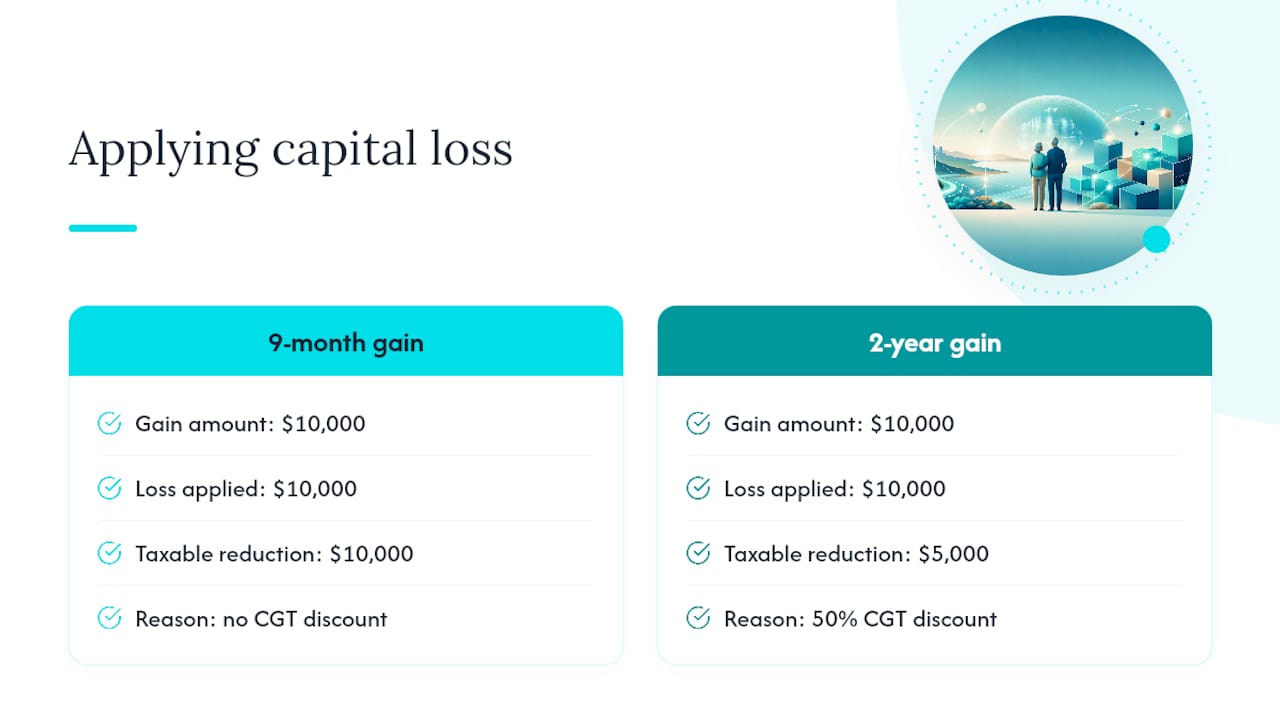
A capital loss applied against a discounted gain effectively saves you only half its face value in tax, because the discount would have halved that gain anyway.
Order matters here. You apply losses first, then calculate the 50% CGT discount on whatever gain remains, assuming you’ve held the asset at least 12 months. That sequencing means a $10,000 loss is worth far more offsetting a short-term gain with no discount attached than offsetting a gain that already qualifies for the 50% reduction. Say you hold a $10,000 gain on shares owned nine months and a $10,000 gain on shares owned two years. Applying your loss to the first gain wipes out $10,000 of taxable income. Applying it to the second only saves you the equivalent of $5,000 after the discount kicks in on the remainder. Prioritize non-discounted gains every time you have a choice.
EOFY Timing, T+2 Settlement, and Crypto Differences
Trade date and settlement date are not the same thing, and the gap between them can push your loss into the wrong financial year. ASX trades settle T+2, meaning a trade executed today doesn’t finalize for two business days.
- Place sell orders for ASX-listed shares or ETFs no later than the second-to-last business day before June 30, giving settlement room so it lands inside the current tax year.
- Confirm your broker’s own cutoff times, since some platforms process late-day orders the following morning.
- Keep every contract note the moment a trade executes. You’ll need it to substantiate the disposal date and cost base.
- For crypto, settlement is effectively instant on most exchanges, but reporting windows and data exports vary by platform, so pull your transaction history well before June 30 rather than scrambling on the day.
- Cross-check your exchange’s tax report against your own records. Discrepancies here are one of the most common causes of amended returns.
Practitioners generally treat that penultimate trading day as the safe cutoff for EOFY loss harvesting, since anything later risks the disposal settling in July.
Wash Sales and Part IVA: Where the ATO Draws the Line
The ATO has a specific target in mind here: selling an asset purely to crystallize a loss, then buying back the same or a substantially identical position almost immediately, with no real change in economic exposure. That’s a wash sale, and the ATO’s Taxpayer Alert on these arrangements makes clear the Commissioner can apply Part IVA and cancel the tax benefit entirely if a scheme’s dominant purpose was avoiding tax.
Risky patterns include:
- Selling a stock on June 29 and repurchasing the identical parcel on July 2
- Selling an ETF and buying back a fund tracking the same index within days
- Selling crypto and immediately swapping back into the same coin on another exchange
None of these are automatically illegal, but they invite scrutiny, and the penalty for getting caught is losing the deduction plus potential interest and penalties on top.
Pro Tip: If you genuinely want to stay invested in a sector, swap into a materially different fund rather than an identical one, an active ETF instead of the index tracker you sold, for example. That preserves your market exposure without mirroring the position you just sold.
The safer path is a commercially meaningful gap, commonly 30 days or more, before rebuying anything close to the original holding, or permanently reallocating that capital elsewhere.
Your Step-by-Step Tax Loss Harvesting Checklist
Work through this in order, ideally starting weeks before June 30 rather than the final week.
- List every realized capital gain for the year across shares, ETFs, crypto, and property, then estimate your net position before touching anything else.
- Identify underwater parcels and calculate the true cost base, including brokerage, transfer fees, and any prior reinvested distributions.
- Prioritize losses against non-discounted gains first, preserving the 50% discount on longer-held positions wherever the math favors it.
- Schedule trades around settlement windows, factoring in T+2 for ASX trades, and save every contract note as it’s generated.
- Report everything through myTax or hand your documentation to your accountant, then carry forward any loss you couldn’t use this year.
| Step | Action | Why it matters |
|---|---|---|
| 1 | Tally gains and losses | Sets your real net position |
| 2 | Calculate accurate cost base | Determines true loss size |
| 3 | Offset non-discounted gains first | Maximizes tax saved per dollar of loss |
| 4 | Trade within settlement windows | Keeps the CGT event in the right year |
| 5 | Report and carry forward unused losses | Avoids losing value permanently |
Records the ATO Expects and Crypto-Specific Traps
Keep your paperwork tight, because the ATO can and does ask for it years later. You’ll need:
- Contract notes for every buy and sell, showing trade date, settlement date, and brokerage
- Broker and platform statements covering the full holding period
- Distribution and dividend reinvestment statements, since these adjust your cost base
- Full exchange transaction histories for crypto, including transfers between wallets
- A running log of any cost base adjustments from corporate actions or splits
In myTax, capital losses get applied against gains in the CGT section, with any excess automatically tracked as a carry-forward for future years, though you should still keep your own running total. Crypto deserves extra care. Exchanges participate in ATO data-matching programs, so every disposal needs reporting, even the ones that produced a loss. Skipping a loss-making crypto sale because “it’s not a gain anyway” is a common and avoidable filing error.
Common Mistakes That Cost Investors Real Money
A few errors show up again and again in EOFY reviews:
- Harvesting a loss with no gain to offset it and no near-term plan to use the carry-forward
- Rebuying the identical asset within days, triggering Part IVA scrutiny
- Forgetting brokerage, transfer fees, or reinvested distributions in the cost base calculation
- Treating a collectable or personal use asset like a general investment when applying losses
Each of these is fixable with basic planning. None of them require complicated tax structures to avoid.
Testing Harvesting Decisions Before You Commit
Selling now for a tax saving isn’t automatically the right call if the asset is likely to rebound and you needed that exposure for retirement. Scenario tools that model side-by-side outcomes let you compare harvesting this year against holding into next, weighing the immediate tax offset against projected portfolio growth. Running both paths through a stress test, rather than guessing, is the difference between a tactical trade and an accidental hit to your long-term retirement number.

Why Harvesting Should Be a Year-Round Habit, Not a June Scramble
Most investors only think about capital losses in the last two weeks of the financial year, which is exactly when settlement timing and broker cutoffs turn a simple decision into a rushed one. We’d rather see harvesting treated as ongoing portfolio maintenance: check unrealized positions quarterly, know your cost base at all times, and only pull the trigger when the math and the timing both line up.
Complex situations, SMSFs, large property portfolios, mixed crypto holdings, still need a qualified tax adviser. Modelling tools sharpen the decision; they don’t replace one. Track parcels individually rather than in aggregate, since parcel-level records are what save you when the ATO asks for substantiation years down the line.
— Aerowealth Team
See How Harvesting Decisions Play Out in Your Retirement Plan
Selling at a loss to save tax this year only makes sense if it doesn’t quietly derail the plan you’re actually working toward. AeroWealth lets you run that comparison properly: model a harvesting scenario against a hold scenario side by side, see the projected CGT impact, and stress-test both against your retirement timeline rather than guessing which one wins.

The platform handles the scenario modelling, comparing projected net worth and retirement age under each path, while your accountant and your own parcel-level records handle the actual tax filing. Think of it as the layer between “I sold for a tax reason” and “I know what that decision does to my retirement date.” If you want to see your own numbers before EOFY forces a rushed decision, start modelling your scenarios on AeroWealth and compare the outcomes for yourself.
This article is general information, not a substitute for advice from a qualified financial advisor. Consult a qualified financial professional about your own circumstances before acting on anything here.
FAQ
What Is the ATO’s 6 Year Rule?
The rule lets you treat a former home as your main residence for CGT purposes for a limited time after you move out and start renting it, as long as you don’t claim another property as your main residence in that period.
What Is the Most Overlooked Tax Break for Investors?
Carrying forward net capital losses indefinitely is one of the most underused benefits in the system. Many investors let a loss sit unused for a year or two instead of tracking it forward to offset a future gain, effectively forfeiting real tax savings.
How Much Can You Write Off With Tax Loss Harvesting?
There’s no fixed cap. You can offset capital losses against capital gains dollar for dollar in the year they occur, and any leftover loss carries forward to offset gains in future years, though losses never reduce your salary or wage income.
Does the 50% CGT Discount Apply to Capital Losses?
No. The discount only applies to capital gains held over 12 months, and it’s calculated after losses have already been applied against those gains, not the other way around.
Can the ATO Deny a Loss From a Wash Sale?
Yes. Under Part IVA, the ATO can cancel the tax benefit from a scheme where the dominant purpose was avoiding tax, including arrangements that sell and quickly repurchase substantially the same asset.