Model 3 Transition to Retirement Scenarios in Australia

A transition to retirement strategy can work well if you’ve hit preservation age and want either extra income while cutting your hours or a tax-efficient way to boost super through salary sacrifice while still working full-time. It won’t work if you need a lump sum, have a small super balance, or have many years left before retirement. The trade-off to weigh: every dollar you draw down early is a dollar that stops compounding for your future.
TL;DR:
- A transition to retirement strategy is best suited for those within two to seven years of stopping work to avoid eroding decades of super growth through early drawdowns.
- Earnings on the assets inside the super account before entering retirement phase are taxed at up to 15%, which can diminish the tax benefits of a TTR.
- Drawing a TTR reduces your super balance over time, and most Australians retire with less than one million dollars in super, making early drawdowns risky.
- TTR is effective mainly for high-income earners using salary sacrifice or those seeking to supplement part-time work income, but not for those needing a lump sum.
- Proper modeling of scenarios involving different drawdown rates, fees, and investment returns before starting is crucial to determine if a TTR strategy suits your long-term goals.
Table of Contents
- How a Transition to Retirement Income Stream Works
- Who Actually Benefits From TTR
- Tax Treatment You Need to Understand Before Starting
- Pros and Cons With Two Worked Examples
- Steps to Test and Start a TTR Strategy
- Risks and Age Pension Effects to Check First
- Modelling Your TTR Scenario Before You Commit
- The Real Judgment Call on TTR
- Model Your TTR Scenarios With Aerowealth
- Sources
- FAQ
How a Transition to Retirement Income Stream Works
A transition to retirement income stream, known as a TRIS or TTR, lets you draw a regular payment from part of your super without meeting a full condition of release. It’s non-commutable while you’re still working, meaning you can’t take it as a lump sum. You keep your existing accumulation account running (often still receiving employer contributions) while a separate pension account pays you an income.
The Australian Taxation Office confirms preservation age is effectively 60 for everyone born after June 1964, following the phased increase that finished on July 1, 2024. You need to still be working to open a TTR, since it’s designed as a bridge, not an exit.
Drawdowns are bound by rules set out on MoneySmart:
- Minimum annual drawdown: 4% of your account balance
- Maximum annual drawdown: 10% of your account balance
- The TRIS stays “non-commutable” (you can’t cash it out) until you either turn 65 or meet another condition of release, such as retiring
Once you hit 65, or notify your fund you’ve fully retired, the account automatically shifts into retirement phase. The 10% cap disappears, and different tax treatment kicks in.
Who Actually Benefits From TTR
TTR isn’t a universal fix. It suits a fairly specific set of circumstances, and knowing which camp you fall into saves a lot of wasted modelling time.
- You’re within roughly 2 to 7 years of stopping work. Advisers commonly flag this window because it’s long enough to matter but short enough that the drawdown doesn’t erode decades of growth.
- You want to cut hours without cutting income to zero. A TTR payment can top up the gap left by a shorter working week.
- You’re a high income earner using salary sacrifice. Redirecting extra pre-tax salary into super while drawing a TTR payment to replace that income can be genuinely tax-effective.
- You have a solid super balance already. If your balance is thin, drawing it down now just accelerates a shortfall later.
If you’re more than a decade from retiring, or you need a one-off lump sum for something like a medical bill or debt payoff, a TTR won’t help. The non-commutable structure blocks lump sum access outright.
Tax Treatment You Need to Understand Before Starting
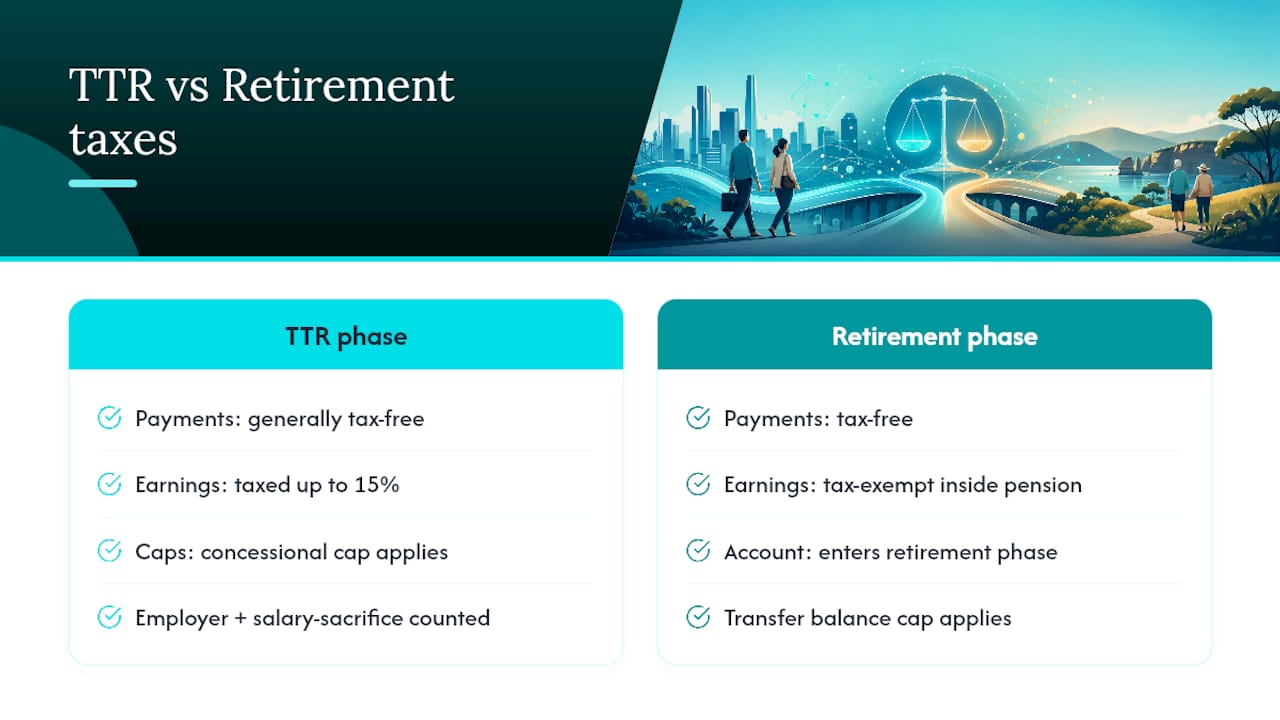
The tax rules are where TTR either earns its keep or quietly costs you money. Once you’re 60 or older, payments from a TTR income stream drawn from a taxed super fund are generally tax-free in your hands. That’s the headline benefit most people chase.
Here’s the catch: earnings on the assets inside your TRIS account are taxed at up to 15% until the account converts to retirement phase. Your accumulation account, by contrast, is taxed the same way regardless of TTR. So the earnings tax difference only shows up on the portion you’ve moved into the pension account, and it’s a real ongoing cost, not a one-time fee.
If you’re using salary sacrifice as part of your TTR approach, remember concessional contribution caps still apply, and both your employer’s super guarantee payments and your salary sacrifice amounts count toward that cap. Very high earners should also check Division 293 exposure, since it adds extra tax on concessional contributions above a certain income threshold.
Everything changes once you turn 65 or formally retire. The account enters retirement phase, the transfer balance cap governs how much you can hold tax-free, the 10% withdrawal ceiling vanishes, and earnings inside the pension account become tax-exempt.
Pros and Cons With Two Worked Examples
Weighing this honestly means putting the upside next to the downside rather than just chasing the tax-free payment headline.
What works in TTR’s favor: you can ease into retirement without a sudden income cliff, salary sacrifice becomes more tax-effective while you draw a replacement income, and you keep flexibility to adjust hours or drawdowns as circumstances change.

What works against it: your total retirement balance ends up smaller than if you’d left everything invested, earnings inside the TRIS are taxed until retirement phase, fees may apply to running two accounts, and insurance held through super can be affected. It’s also worth remembering most people retire with less than a million in super, and comfortable retirement benchmarks sit below that figure, so drawing down early against an already modest balance deserves real scrutiny.
Two quick scenarios:
- Reduce hours, top up with TTR. You cut from five days to three, lose $20,000 a year in salary, and draw roughly that amount from a TRIS to fill the gap.
- Stay full-time, salary sacrifice, draw the minimum. You redirect extra pre-tax salary into super while drawing 4% to 10% from your TRIS to replace the take-home pay you sacrificed.
Steps to Test and Start a TTR Strategy
Getting from “this sounds useful” to actually implementing it takes a handful of concrete steps, in roughly this order.
- Model your numbers first. Estimate drawdown amounts at both the 4% floor and 10% ceiling, project the tax outcome, and see what your balance looks like at 65 versus leaving the account untouched. A retirement planner or dedicated modelling tool does this far more reliably than a spreadsheet guess.
- Check your fund’s TTR rules. Ask how the split between accumulation and pension accounts works, and confirm what happens to any life or income protection insurance when you move money.
- Sort out salary sacrifice arrangements with your employer, if that’s part of the plan, before you touch the pension side.
- Contact your fund or a licensed adviser to formally set up the split and confirm your payment schedule.
Seeing the gap between those two outcomes tells you more about your real risk than any single projection.*
Risks and Age Pension Effects to Check First
TTR income streams count toward both the income and assets tests Centrelink uses for Age Pension eligibility, and consulting Age Pension strategies professionals is recommended before starting one, since the effect varies by account balance and total assets.
- Moving money out of accumulation and into a pension account can inadvertently cancel insurance cover tied to that account.
- Drawing near the 10% ceiling for several years running increases sequence-of-returns risk, where a market downturn early in the drawdown period does outsized damage to your balance.
- Advisers caution that a common mistake is underestimating fees and the ongoing 15% earnings tax, which quietly narrows the benefit over several years.
- Legislative settings around contribution caps and preservation age can shift, so a strategy that works today needs periodic rechecking.
Modelling Your TTR Scenario Before You Commit
The honest answer to “should I start a TTR” almost never comes from a single calculation. It comes from comparing at least three paths side by side: staying full-time with no TTR, reducing hours and topping up with a TRIS, and staying full-time while salary sacrificing against TTR drawdowns.
- Ending super balance at your target retirement age under each scenario
- Projected annual net income while the TTR is running
- Age Pension eligibility signals based on projected assets and income
- Sensitivity to fees and investment returns, since a 1% difference compounds heavily over a decade
Running side-by-side scenarios and stress-testing your assumptions against different fee and return combinations shows you the range of realistic outcomes, not just a single optimistic number.
Aerowealth is built for exactly this kind of comparison, letting you stress-test a TTR decision against your actual super balance, mortgage, and investment plans before you sign anything with your fund.
The Real Judgment Call on TTR
Most TTR content treats it like a tax trick: draw down, salary sacrifice, pocket the difference. That framing undersells what’s actually going on. A TTR is a redistribution of your own money across time, and the tax-free payment above 60 is real, but it sits next to a genuine cost in reduced compounding and earnings tax on the TRIS portion that most explainers skip past.
The conventional advice to “just set it up near preservation age” ignores how much the outcome depends on your specific balance, fee structure, and how many years you actually run the strategy. Two people with identical incomes can get very different results depending on whether they draw 4% or 10%, and whether returns run hot or cold during those years.
What should come first isn’t the paperwork with your fund. It’s an honest projection of your balance under a few different drawdown rates and time horizons. Once you’ve seen the numbers side by side, the decision usually makes itself, and it’s rarely the decision the generic “reduce your hours” articles push you toward.
— Aerowealth Team
Model Your TTR Scenarios With Aerowealth
Aerowealth gives you side-by-side scenario comparisons built for exactly this decision: reduce hours and draw a TRIS, keep working and salary sacrifice, or leave everything as is, each with projected super balances, income, and Age Pension indicators under Australian rules.

If you’re weighing preservation age options for your super against a mortgage, investment property, or ongoing salary sacrifice plan, run the numbers before you talk to your fund. Start with a free plan at Aerowealth and model your own TTR scenario today.
This article is general information, not a substitute for advice from a qualified financial advisor. Consult a qualified financial professional about your own circumstances before acting on anything here.
Sources
FAQ
Is a Transition to Retirement Strategy a Good Idea in Australia?
It depends on your balance and timeline. TTR works well for people within a few years of retirement who want to reduce hours or use salary sacrifice, but it can shrink your long-term balance if drawn too aggressively or held for too long, as noted in ATO guidance.
What Is the $1,000 a Month Rule for Retirees?
Australian retirement planning relies instead on tools like the MoneySmart retirement planner and comfortable retirement benchmarks tailored to local super and pension rules.
What Percentage of People Retire With $1,000,000 in Australia?
Most Australians retire with considerably less than $1 million in super, and comfortable retirement benchmarks from industry bodies sit well below that figure for both singles and couples, according to MoneySmart.
Is TTR Tax-Free Over 60?
The payments themselves are generally tax-free once you’re 60 or older and drawing from a taxed super fund, but earnings on the assets supporting the TRIS are still taxed at up to 15% until the account moves into retirement phase, per MoneySmart.