Turn 67? Model Your Age Pension Eligibility in Australia 2026

You qualify for the Age Pension once you turn 67, meet Australia’s residency rules, and clear the income and assets tests; whichever gives the lower payment applies. That last part trips up more people than the age rule itself. Always confirm current thresholds on Services Australia before you apply, since limits shift several times a year.
TL;DR:
- Asset and income thresholds are reviewed three times annually, so eligibility depends on up-to-date figures rather than fixed limits.
- Deeming applies to investments, meaning Centrelink assumes a set return regardless of actual earnings, which can affect income assessments.
- Being legally blind grants exemption from income and assets tests, and special circumstances like DVA payments or a supporting partner may alter your assessment.
- Proper documentation of overseas residence history is crucial for applicants with gaps in residency, and timing social security claims can influence eligibility outcomes.
- Using scenario modeling tools before applying can help optimize your timing and asset management to maximize pension entitlements.
Table of Contents
- Age Pension Eligibility Checklist: Are You Likely to Qualify?
- What Are the Age and Residency Rules for the Age Pension?
- How Does the Income Test Work for the Age Pension?
- What Assets Count Toward the Age Pension Limit?
- Which Test Determines Your Actual Payment?
- How Do You Apply for the Age Pension?
- How Can Scenario Modelling Clarify Your Eligibility Timing?
- Should You Apply Now or Wait?
- Model Your Age Pension Outcome Before You Apply
- Where to Confirm Current Age Pension Thresholds
- Sources
- FAQ
Age Pension Eligibility Checklist: Are You Likely to Qualify?
Before digging into the fine print, run through this quick self-check. If you tick most of these boxes, you’re probably in range for at least a part pension.
- You’re 67 or older, or turning 67 within the next few months.
- You’ve lived in Australia for at least 10 years total, with at least 5 of those years unbroken.
- You hold Australian citizenship, permanent residency, or a protected Special Category Visa.
- Your income and assets sit near or under the thresholds for your situation (single, couple, homeowner, non-homeowner).
- You have any special circumstances worth flagging, such as being legally blind, receiving a Department of Veterans’ Affairs payment, or having a partner who is already on a pension.
Legally blind pensioners are exempt from the income and assets tests entirely, one of the more overlooked rules in the whole system. If your situation involves a DVA payment or a partner already receiving support, your assessment often runs differently, so it pays to check your specific case rather than assume the general rules apply unchanged.
What Are the Age and Residency Rules for the Age Pension?
The Age Pension age has sat at 67 for several years now, and there’s no scheduled increase beyond that under current policy. If you were born after January 1, 1957, 67 is your number.
Residency is where things get more complicated for people who’ve spent time overseas. You generally need to have been an Australian resident for a total of 10 years, and at least 5 of those years need to be continuous with no long gaps.
Who typically qualifies on residency grounds:
- Australian citizens who’ve lived here long-term.
- Permanent residents who’ve built up the required years since their visa was granted.
- Protected Special Category Visa holders, mostly New Zealand citizens who arrived before February 2001.
If you spent a decade working in the UK or the Middle East and came home at 55, that gap doesn’t necessarily disqualify you, but you’ll need records (passport stamps, visa grants, tax returns) to prove your residency history when you apply.
How Does the Income Test Work for the Age Pension?
Centrelink counts more than just your paycheck. The income test assesses employment income, business income, reportable super contributions, and deemed income from financial assets like bank accounts, shares, and account-based pensions.
Deeming is the part most people don’t expect. Instead of asking what your investments actually earned this year, Centrelink assumes a set rate of return regardless of your real performance. This is a common source of confusion, since a term deposit paying less than the deeming rate still gets assessed as if it earned the assumed amount.
If you’re still working, the Work Bonus lets you earn up to $300 a fortnight from employment without it touching your pension. Unused amounts roll into an income bank you can draw on later, up to a cap, which rewards pensioners who work irregular hours or seasonal jobs.
Pro Tip: If your income sits right at the edge of a threshold, timing a pay rise or a lump-sum bonus for a different fortnight can keep you under the cut-off for that assessment period.
| Situation | Full pension income limit (per fortnight) | Part pension cuts off at |
|---|---|---|
| Single | Up to the applicable income limit | Around the part pension income cut-off |
| Couple (combined) | Up to the applicable income limit | Around the part pension income cut-off |
These figures reflect the review cycle Services Australia runs in March, July, and September each year, so treat them as a snapshot rather than a permanent number. AeroWealth’s income test breakdown walks through how different income sources get assessed if you want the mechanics in more depth.
What Assets Count Toward the Age Pension Limit?
The assets test looks at financial investments, superannuation and account-based pensions, investment properties, vehicles, boats, and personal effects like furniture and jewelry. Private trusts and company structures get counted too, which surprises people who assumed those were shielded.
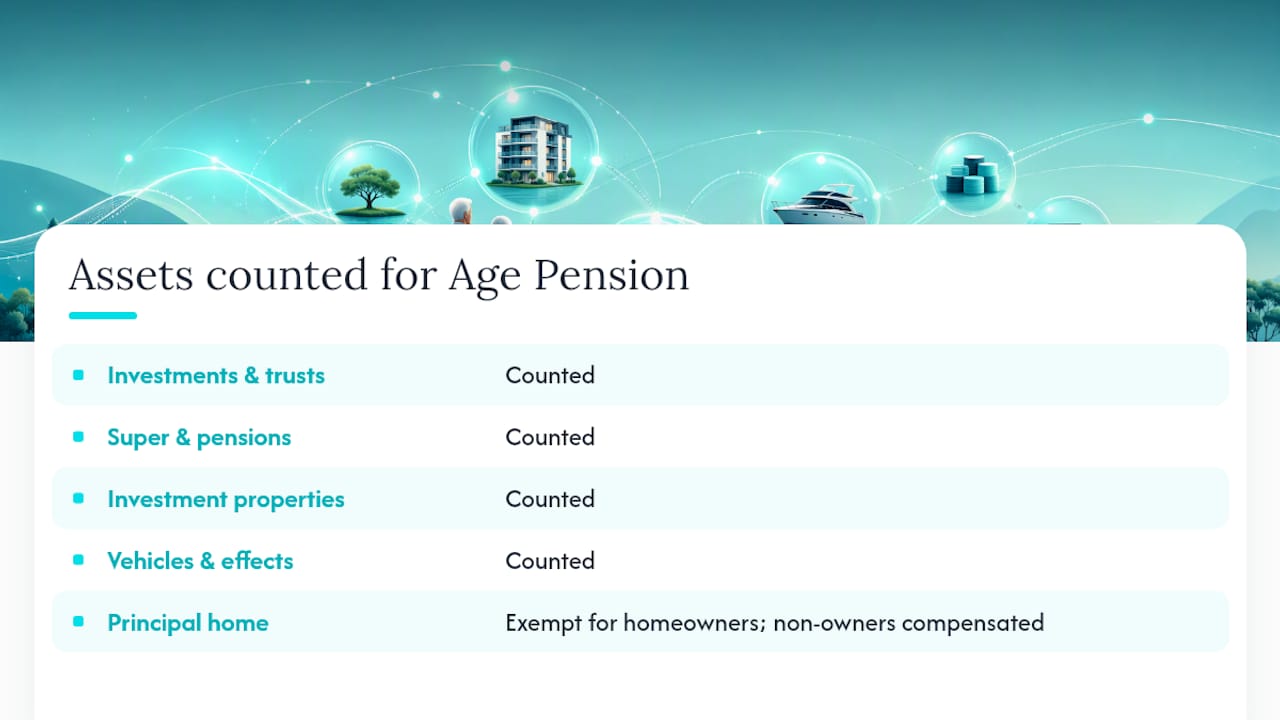
Your principal home is exempt, but that exemption is precisely why homeowners and non-homeowners face different thresholds. Someone who owns their home outright can hold fewer other assets and still get a full pension, because the home itself isn’t in the count. Non-homeowners get a higher asset allowance to compensate for the fact they’re still paying rent or a mortgage.
These limits get reviewed three times a year, in March, July, and September, and small changes to transitional rates have flowed through as recently as March 2026. If your assets sit above the part-pension cut-off but you’re in genuine financial hardship, Asset Hardship provisions exist, and the Home Equity Access Scheme lets asset-rich, cash-poor retirees draw against home equity instead. Both are assessed case by case. AeroWealth’s assets test guide runs through worked examples for both homeowner and non-homeowner scenarios.
Which Test Determines Your Actual Payment?
Centrelink runs both the income test and the assets test on every application, then pays whichever result gives you the lower amount. That’s the part people miss: passing one test doesn’t guarantee your pension rate, because the other test might bind harder.
A retired couple with a modest super balance but a part-time job might find the income test caps their payment, even though their assets sit comfortably under the limit. Flip that around, a couple who owns an investment property outright but has no other income might get capped by the assets test instead.
Common pitfalls worth watching:
- Assuming a low bank balance means you’ll clear the assets test, when deeming still applies to those funds.
- Not reporting reportable super contributions, which count as income even if you never touch the money.
- Gifting large sums to family right before applying. Centrelink applies gifting rules that can still count the money as yours for years afterward.
- Withdrawing a lump sum from super at the wrong time, pushing your assessable assets over a threshold for that quarter.
Pro Tip: If your numbers are close to a cut-off in either test, model the scenario before you act. A drawdown timed for next quarter instead of this one can be the difference between a part pension and none at all.
How Do You Apply for the Age Pension?
You apply through myGov linked to Services Australia, and if you have a partner who’s also Age Pension age, you can lodge a joint claim on one application. Applying online tends to move faster than a paper claim, provided your documents are ready.
- Confirm your Customer Reference Number or create a myGov account linked to Centrelink.
- Gather proof of identity (passport, birth certificate, or citizenship papers).
- Collect residency evidence if you’ve lived overseas (visa records, travel history).
- Pull together bank statements, super statements, and details of any property you own.
- Submit your claim up to 13 weeks before you turn 67, so processing lines up with your birthday.
If you’re overseas when you turn 67, or missing a document like an old visa record, contact Services Australia directly rather than delaying your claim. Partial applications can sometimes be lodged with supporting evidence to follow.
How Can Scenario Modelling Clarify Your Eligibility Timing?
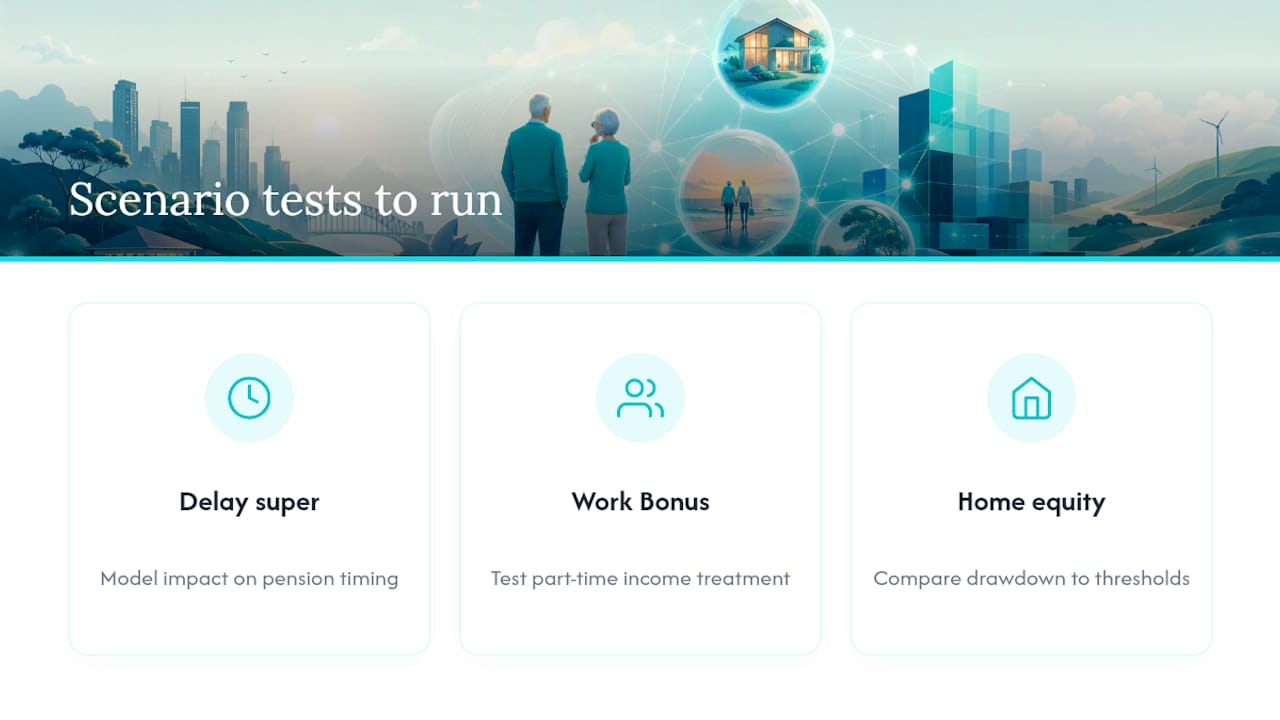
Eligibility rules are static, but your income and assets aren’t. Some modelling tools let you test what happens if you delay a super drawdown, pick up part-time work under the Work Bonus, or explore a Home Equity Access Scheme drawdown against current thresholds.
Running these scenarios before you act, rather than after, is often what separates a full pension from a reduced one. The AeroWealth Team’s income test explainer covers the mechanics in more depth if you want to model your own numbers.
Should You Apply Now or Wait?
If you meet the age and residency basics, apply. Don’t sit on eligibility waiting for a better time that may never come. But if your income or assets sit close to a threshold, model the scenario first, and get professional advice if your situation involves trusts, overseas assets, or a recent inheritance. Always check Services Australia for the live numbers before you commit to anything.
Model Your Age Pension Outcome Before You Apply
Reading thresholds off a table only gets you so far when your real situation involves a super balance, an investment property, and a part-time income that fluctuates. Some software is built for exactly that gap. It lets you run your actual numbers against income and assets test scenarios side by side, so you can see whether delaying a drawdown, banking your Work Bonus, or adjusting your asset mix changes which test binds your payment.

Instead of guessing at where you land relative to the cut-offs, you can build a free scenario in AeroWealth using your own super balance, property value, and expected income, and watch how the projection shifts before you lodge anything with Centrelink. It’s not a replacement for confirming figures with Services Australia, but it’s a faster way to spot whether you’re close to a threshold worth timing carefully. Start a free scenario and see where your numbers actually sit.
Where to Confirm Current Age Pension Thresholds
Check Services Australia’s Age Pension pages for live thresholds, and MoneySmart for plain-language calculators before applying.
This article is general information, not a substitute for advice from a qualified financial advisor. Consult a qualified financial professional about your own circumstances before acting on anything here.
Sources
FAQ
How Much Money Can You Have and Still Get the Age Pension?
It depends on homeowner status: asset limits differ for single homeowners, couples who own their home, and non-homeowners, with specific thresholds reviewed regularly.
What Is the Age Pension Age in Australia in 2026?
The Age Pension age is 67, and it applies to anyone born on or after January 1, 1957, with no further scheduled increase under current policy.
What Are the Current Rules for Centrelink Age Pensioners?
You need to be 67 or older, meet the residency requirement of 10 years total with 5 continuous, and pass whichever of the income or assets tests gives the lower payment result.
How Much Is the Full Age Pension Payment?
Exact fortnightly rates change with indexation, so confirm the current full pension rate directly on Services Australia rather than relying on a figure that may already be outdated.
Can You Use a Calculator to Check Age Pension Eligibility?
Yes. MoneySmart offers plain-language calculators for a quick check, and Some financial tools let you model income and assets scenarios against your specific super and property situation for a more detailed picture.