4%–10% Drawdown: Model Your Bridge to Retirement in Australia

A transition-to-retirement income stream can work as a genuine bridge for many Australians at or above preservation age, but it isn’t automatic. You need to sit above preservation age, respect the 4% to 10% annual drawdown band, and check what a smaller super balance later does to both your retirement income and your Age Pension eligibility. Model it before you touch anything.
TL;DR:
- A transition-to-retirement income stream requires maintaining a balance above your preservation age and adhering to drawdown limits of 4% to 10% annually.
- Earnings supporting a TTR are taxed at up to 15%, but pension payments after age 60 are generally tax-free, which benefits those in higher tax brackets.
- TTR works best for Australians aged 60 to 64 who are still working and want to reduce hours without significantly impacting their super balance or Age Pension eligibility.
- Small super balances may suffer faster erosion from mandatory minimum drawdowns, making high fees and costs more impactful over time.
- Accurate scenario modeling of drawdowns, investment returns, and longevity is essential to avoid compromising long-term retirement income or Age Pension access.
Table of Contents
- What Is a TTR Income Stream in a Bridge to Retirement Strategy?
- Who Can Use a TTR? Preservation Age and Eligibility in Australia
- TTR Rules and Tax: Drawdown Limits and the 15% Question
- When a TTR Actually Helps, and When It Doesn’t
- Other Ways to Bridge the Gap Before Full Retirement
- Setting Up a TTR: Steps and Questions to Ask Your Fund
- Model It First: Why Scenario Testing Beats Guesswork
- The Bridge Timeline: From First TTR Payment to Full Retirement
- What a TTR Actually Costs: Fees, Tax, and What You Give Up
- Our Perspective on Bridging Into Retirement
- Model Your Bridge Years Before You Commit to a TTR
- Sources
- FAQ
What Is a TTR Income Stream in a Bridge to Retirement Strategy?
A transition to retirement income stream, usually called a TTR or TRIS, lets you draw a regular income from part of your super while you’re still working. It’s a non-commutable pension, meaning you generally can’t take lump sums from it until you meet a condition that removes that restriction, such as turning 65 or fully retiring.
You set it up by rolling part of your super balance into an account-based pension. Most people leave the rest sitting in their accumulation account, still growing, still receiving contributions from work. That’s the core of a transition to retirement income stream: reduce your hours, keep some income coming through your job, and top up the gap with regular payments from the TTR side.
The immediate effect is cash flow, not a windfall. You get scheduled payments, not access to a lump sum you can spend however you like. That distinction trips up many people who think TTR means early access to their full balance.
Who Can Use a TTR? Preservation Age and Eligibility in Australia
Preservation age currently sits at 60 for anyone born after June 1964, which now covers everyone newly reaching that milestone. You don’t need to have stopped working. In fact, TTR is specifically built for people who are still employed and want to dial back hours without a full pay cut.
Before you assume you qualify, ring your fund. Some funds don’t offer a TTR product at all, some set a minimum balance before they’ll open one, and moving money into a TTR pension can change or cancel insurance cover attached to your accumulation account. If you were born earlier than 1964, double check your specific preservation age. It may differ from the current default.
TTR Rules and Tax: Drawdown Limits and the 15% Question
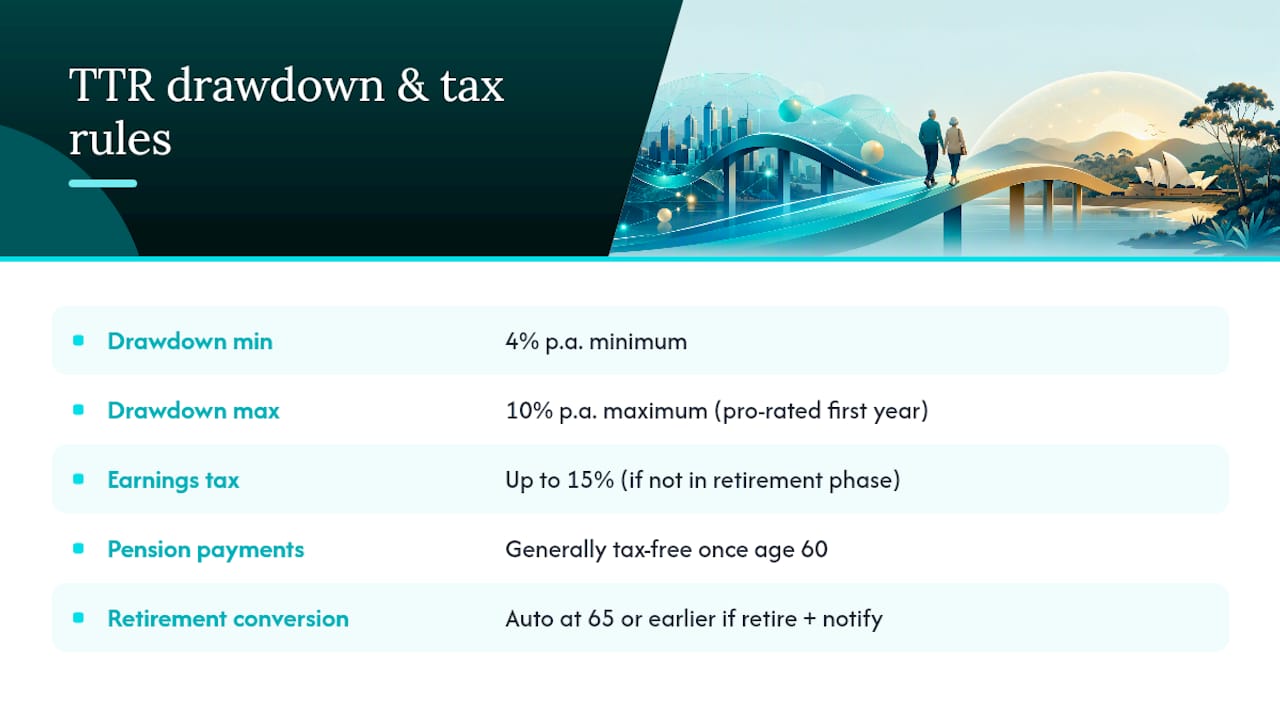
The numbers matter more than the marketing here. A TTR pension requires a minimum annual drawdown of 4% of your account balance and caps you at a maximum of 10%, pro-rated in the first year depending on when you start. MoneySmart’s TTR guide sets out these limits clearly, and they apply every single year you hold the pension.
Since July 2017, earnings on the assets supporting a TTR that hasn’t yet reached retirement phase are taxed at up to 15%, the same as accumulation earnings. That 2017 change removed what used to be a genuine tax exemption, and it’s worth knowing because older explainers still repeat the outdated tax-free framing. What’s still true: pension payments themselves are generally tax-free once you’re 60 or older.
Your TTR automatically shifts into retirement phase when you turn 65, or earlier if you retire and notify your fund that you’ve met a nil cashing restriction condition. That conversion matters because retirement-phase pensions count toward your transfer balance cap, and earnings inside that phase become tax-free. Pairing a TTR with salary sacrifice can still work in your favor: you sacrifice pre-tax income into super at 15% contributions tax while drawing a tax-free pension payment to cover the shortfall in take-home pay.
When a TTR Actually Helps, and When It Doesn’t
TTR isn’t a universal fix. It suits some financial situations far better than others.
Where it tends to help:
- You’re between 60 and 64, still earning a decent income, and want to cut hours without a proportional pay cut.
- You’re in a higher tax bracket, so salary sacrifice paired with tax-free TTR payments creates a real net benefit.
- Your super balance is large enough that mandatory drawdowns don’t meaningfully dent your long-term retirement position.
Where it tends to backfire:
- Your balance is small, and forced minimum draws erode it faster than it can grow.
- Your income is already modest, leaving little tax advantage to capture.
- You’re close to Age Pension eligibility and don’t want an income stream complicating the means test.
Other Ways to Bridge the Gap Before Full Retirement
TTR is one tool, not the only one. Several alternatives can achieve the same cash-flow bridge without touching super at all.
- A cash buffer or non-super savings covers the income gap directly, leaving your super balance untouched and still compounding.
- Reduced hours or consulting work lets you scale back without drawing on retirement savings at all, which keeps your super balance growing longer.
- Investment income, such as rental returns or dividends, can fund the gap, though you need to account for its own tax treatment and how reliable that income actually is year to year.
- A blended approach, using small, short-term TTR draws alongside part-time income, often outperforms an all-or-nothing decision.
The right mix depends entirely on your numbers, which is exactly why scenario modelling beats guesswork here.
Setting Up a TTR: Steps and Questions to Ask Your Fund
- Model a few scenarios first. Test different drawdown rates, salary sacrifice levels, and how each affects your projected balance at full retirement.
- Call your fund to confirm they offer a TTR product, what fees apply, and whether your balance meets any minimum they require.
- Ask directly: does my accumulation account stay open? What happens to my insurance? How is TTR income taxed at my age? What’s the process to notify you when I’ve met a retirement condition?
- Set your drawdown rate within the 4% to 10% band and lock in a payment schedule that matches your actual income gap, not the maximum allowed.
Watch for warning signs: forced high minimum draws that outpace a small balance, unusually high TTR account fees, or an income stream that quietly pushes a partner’s Age Pension below the threshold. ASIC has flagged pushy sales tactics urging people into quick super switches, so treat any unsolicited advice with skepticism.
Pro Tip: Ask your fund for the exact dollar impact of your chosen drawdown rate over five and ten years, not just the percentage. A 6% draw sounds modest until you see what it actually removes from a balance that would otherwise keep compounding.
Model It First: Why Scenario Testing Beats Guesswork
They struggle to show you what a market downturn combined with a 20 year retirement does to that same balance a decade from now.
A useful model includes your planned drawdown rate, any salary sacrifice, expected investment returns, inflation, how long you expect to need the income, and whether home equity plays a role in your broader plan. Stress testing pushes those assumptions harder: lower returns than expected, a longer life than planned, or a sharp market shock early in retirement.
- Compare a 4% draw against an 8% draw over the same ten-year window.
- Test what happens if returns run two points below your base case for five straight years.
- Check the Age Pension impact at different balance levels once you hit Age Pension age.
AeroWealth is built for exactly this kind of Australian-specific, side-by-side comparison, letting you stress test a TTR decision against your full financial picture before you commit to it.
The Bridge Timeline: From First TTR Payment to Full Retirement
Most bridge-to-retirement journeys follow a recognizable shape, even though the exact ages and durations shift from person to person.
Stage two, ages 62 to 65: this is usually the fine-tuning period. You reassess your drawdown rate annually, adjust for changed expenses, and watch how your combined balance (TTR plus accumulation) is tracking against your original model. Many people also revisit salary sacrifice levels here, since income often drops as hours reduce.
Stage three, at 65 or on meeting a retirement condition: your TTR converts automatically into a retirement-phase income stream. Earnings inside it become tax-free, and the balance now counts against your transfer balance cap. If you’re still working part-time at this point, your accumulation account can keep running alongside your new retirement-phase pension.
Stage four, full retirement: work stops entirely, all income comes from your retirement-phase pension (and any other bridge income you’ve built), and Age Pension eligibility becomes the main variable left to manage.
The whole arc can span anywhere from three to eight years depending on when you start and how long you keep working in some capacity. Rushing stage one without modelling stage four is the single most common planning mistake.
What a TTR Actually Costs: Fees, Tax, and What You Give Up
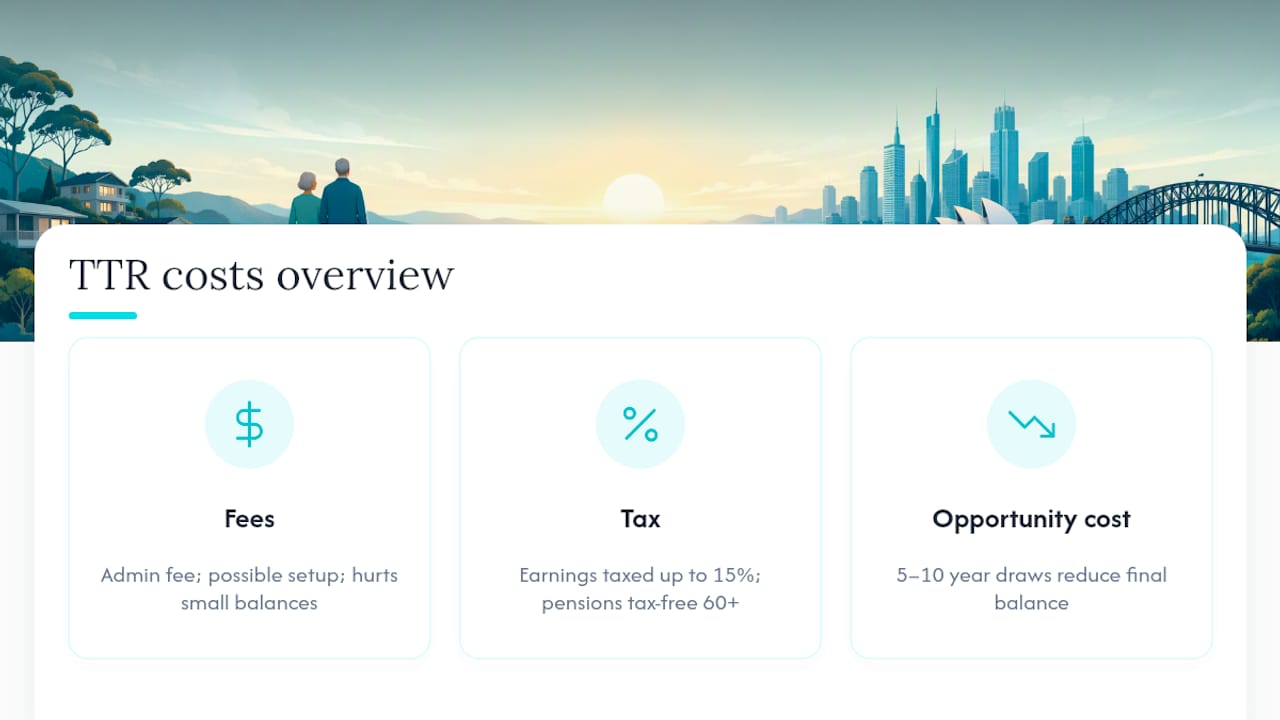
The sticker price of a TTR is rarely the real cost. Three separate cost categories deserve a hard look before you commit.
Fees: most funds charge an administration fee on the TTR account separately from your accumulation account, and some apply a setup fee. On a small balance, a flat annual fee can eat a noticeable slice of your drawdown, which is part of why funds often set minimum balance thresholds before opening one.
Tax: earnings on assets supporting a TTR that hasn’t reached retirement phase are taxed at up to 15%. That’s identical to accumulation-phase tax, so you’re not paying a penalty by opening a TTR, but you’re also not getting the tax break some outdated guides still describe. Pension payments themselves stay tax-free from age 60, which is where the real benefit sits, especially when combined with salary sacrifice reducing your taxable income on the other side of the ledger.
Opportunity cost: this is the one people underweight. Over a five to ten year bridge period, even modest annual draws compound into a meaningfully smaller balance at full retirement, compared with leaving that money untouched and drawing from savings or part-time work instead. Run both versions through a model before deciding which cost you’re actually willing to carry.
Our Perspective on Bridging Into Retirement
Cash flow today matters, but a TTR that quietly erodes your balance for a decade is a bad trade dressed up as a good one. Model conservatively, resist the urge to draw the maximum just because it’s allowed, and if a decision could shift your long-term income or Age Pension position, get proper modelling and, where the numbers are significant, professional advice before you sign anything.
— Aerowealth Team
Model Your Bridge Years Before You Commit to a TTR
Most people decide on a TTR drawdown rate based on a fund brochure and a rough guess about what feels affordable. That’s a thin foundation for a decision that affects your super balance for the next twenty years.

You can start with the Free plan and build your first bridge-years scenario today, or step up to Pro for $7 AUD per month if you want expanded scenario planning and bridge mode built for early retirement modelling. Head to the Aerowealth pricing page and run your own numbers before you touch your super balance.
This article is general information, not a substitute for advice from a qualified financial advisor. Consult a qualified financial professional about your own circumstances before acting on anything here.
Sources
- Transition to retirement | Australian Taxation Office
- Transition to retirement - MoneySmart
- Financial Information Service | Services Australia
FAQ
Can I retire at 60 with $500,000 in super?
It depends heavily on your spending needs and whether you’ll also get any Age Pension, but a moderate super balance often produces a modest income under the standard drawdown rules, so running a full model against your actual expenses matters more than the headline balance.
What retirement rules are changing in Australia in 2026?
Superannuation thresholds, including contribution caps and transfer balance cap figures, are periodically indexed by the ATO, so always check the ATO’s current TRIS rules for the latest figures rather than relying on a fixed number.
How much super do I need to retire on $70,000 a year?
There’s no single figure that fits everyone, since it depends on whether you own your home, expect any Age Pension, and how long your retirement needs to last. That’s the exact kind of question a scenario model, such as one built in Aerowealth, is designed to answer for your specific numbers.
How much money can I have in super and still get the Age Pension?
Age Pension eligibility depends on both an income test and an assets test, and starting a TTR can shift where you sit against either one. Contact Services Australia’s Financial Information Service for guidance tailored to your balance and circumstances.