Two Thirds: Lump Sum Beats DCA. How Investors Should Decide

Lump-sum investing wins more often than not, because money in the market beats money sitting in cash. Dollar-cost averaging (DCA) doesn’t beat that math on average, but it earns its place when the real risk isn’t the market, it’s you panicking and bailing after a bad month. Use the checklist further down to figure out which one fits your temperament and your timeline.
TL;DR:
- Lump-sum investing typically outperforms dollar-cost averaging in about two-thirds of historical periods, mainly because it maintains more time in the market.
- DCA tends to perform better only during market downturns shortly after the initial investment, helping to reduce the impact of bad timing.
- High brokerage fees and complex tax record-keeping may outweigh the behavioral benefits of DCA if transaction costs are significant.
- Your personal risk tolerance and emotional resilience are critical factors; DCA offers psychological protection against panic selling during market drops.
- Running personalized scenario models that include your actual timeline and fee assumptions can reveal whether DCA or lump-sum better aligns with your goals.
Table of Contents
- DCA vs Lump Sum: The Basic Difference
- What the Research Says About DCA vs Lump Sum
- Why Your Emotions Might Matter More Than the Math
- Fees, Tax Lots, and Platform Rules You Need to Check
- How to Decide: DCA, Lump Sum, or a Hybrid
- Building a Hybrid Plan That Fits Your Comfort Level
- Seeing Your Own Numbers Before You Commit
- Aerowealth’s Take: Pick the Plan You’ll Actually Follow
- Model Your Own DCA vs Lump Sum Scenario
- Sources
- FAQ
DCA vs Lump Sum: The Basic Difference
Lump-sum investing means putting all your available cash into the market at once. If you inherit $50,000 today and buy your target portfolio tomorrow, that’s a lump sum. DCA means splitting that same amount into equal chunks deployed on a schedule, say $5,000 a month for ten months, so you’re buying at ten different prices instead of one.
This distinction only matters when you already have the cash sitting there. If you’re investing $2,000 out of every paycheck because that’s when you get paid, you’re technically dollar-cost averaging, but you’re not really facing a choice. There’s no idle lump sum waiting to be deployed differently. The DCA vs lump sum debate only kicks in when you have a windfall, bonus, inheritance, or sale proceeds sitting in cash and you’re deciding how fast to put it to work.
Quick version:
- Lump sum: invest the full amount now, in one transaction.
- DCA: split the amount into equal parts, invested on a fixed schedule.
- The real question: does the cash already exist, or is it just future income?
What the Research Says About DCA vs Lump Sum
The evidence is more one-sided than most people expect. Vanguard’s research found lump-sum investing beat cost averaging in roughly two-thirds of rolling historical periods across the US, UK, and Australia. Morningstar reaches a similar conclusion in its own review of the data.
The core statistic: lump-sum investing outperformed dollar-cost averaging in roughly two-thirds of rolling historical periods studied by Vanguard.
The reason isn’t complicated. Markets rise more often than they fall over any multi-year stretch, so the longer your money sits in cash waiting to be phased in, the more expected return you give up. Vanguard calls this the lost risk premium, and it’s larger the more equity-heavy your target portfolio is. Delay a fully-stocks portfolio and you’re forgoing more upside than if you were easing into a conservative mix.
DCA does have its moment, though. It tends to outperform when the market drops sharply right after you would have invested the lump sum. NABTrade’s analysis of ASX data found staged entry helped in roughly the worst 40% of return deciles, the scenarios where the market tanks shortly after your starting point, but underperformed in the better 60% of outcomes. That’s the trade-off in a single sentence: DCA insures you against bad timing, but you pay for that insurance with lower average returns.
- Lump sum wins in most historical periods, largely due to time in market.
- DCA wins specifically when a downturn follows soon after your starting date.
- The performance gap widens as your target allocation gets more aggressive.
Why Your Emotions Might Matter More Than the Math
Here’s the part the spreadsheets don’t capture: none of this matters if you can’t stick with your plan. Loss aversion is well documented, and it hits hardest right after you’ve invested. Put $50,000 into the market and watch it drop to $44,000 within a month, and a lot of people panic-sell near the bottom, locking in a loss that a lump-sum backtest never accounts for. Morningstar’s take is blunt about this: DCA’s real value is behavioral, not mathematical. It exists to keep you invested, not to beat the market.
DCA reduces that short-term downside exposure. If only a fifth of your cash is exposed on day one, a market drop stings less, and you’re less likely to do something rash with the rest.
- Ask yourself honestly: have you sold investments in a panic before?
- Would a 15% drop in the first month make you want to pull out?
- Do you check your portfolio daily, or monthly?
Pro Tip: If a lump sum drop soon after investing would cause you anxiety, that behavioral cost matters, even if it never shows up in a backtest. Price that in honestly before you choose.
Fees, Tax Lots, and Platform Rules You Need to Check
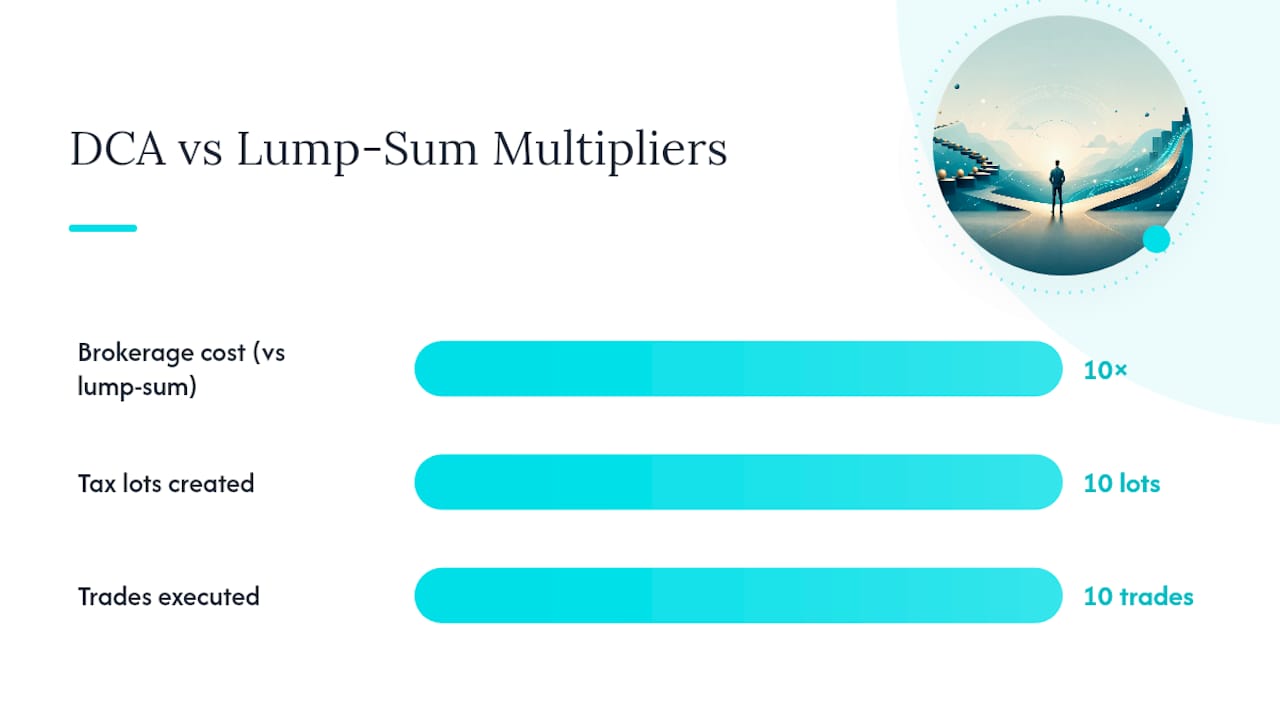
Brokerage fees can quietly wipe out any behavioral benefit DCA offers. If your platform charges a flat fee per trade, splitting $50,000 into ten monthly buys costs you ten times the brokerage of a single lump-sum trade. Run the math before committing. Morningstar’s analysis flags this as one of the more overlooked costs of DCA in practice.
There’s also a paperwork side. Each DCA installment creates a separate parcel with its own cost base, which means more record-keeping for future capital gains calculations. Betashares notes this matters for Australian investors managing CGT events, and contribution caps into super can also affect how fast you can deploy funds. This isn’t tax advice, just a reason to check the rules before you act.
- Compare per-trade versus flat-fee or zero-brokerage platforms before choosing DCA.
- Confirm your platform supports low-minimum auto-invest if you’re splitting a smaller amount.
- Keep a record of each purchase date and price for future CGT reporting.
How to Decide: DCA, Lump Sum, or a Hybrid
Run through this before you touch the money:
- Identify the source. Windfall, inheritance, or bonus sitting in cash now? That’s a real DCA-vs-lump-sum decision. Regular pay going into regular contributions isn’t.
- Check your horizon. Ten-plus years to retirement generally favors lump sum, since time smooths out short-term volatility.
- Run the panic test. Would a 10 to 15% drop in month one make you sell? If yes, lean DCA.
- Check the fee math. If per-trade costs are high relative to your amount, DCA gets expensive fast.
- Check tax timing. Contribution caps or CGT events might dictate pacing regardless of preference.
As a rule of thumb: long horizon plus moderate-to-high risk tolerance points toward lump sum. Loss-averse investors, or those with a shorter runway, do better with a compressed DCA window of three to six months rather than dragging it out over a year or more, which just extends the opportunity cost without adding much protection.
Pro Tip: If you’re torn, model both outcomes with your actual numbers instead of guessing. A quick side-by-side projection often makes the “right” choice obvious once you see the downside range, not just the average.
Building a Hybrid Plan That Fits Your Comfort Level
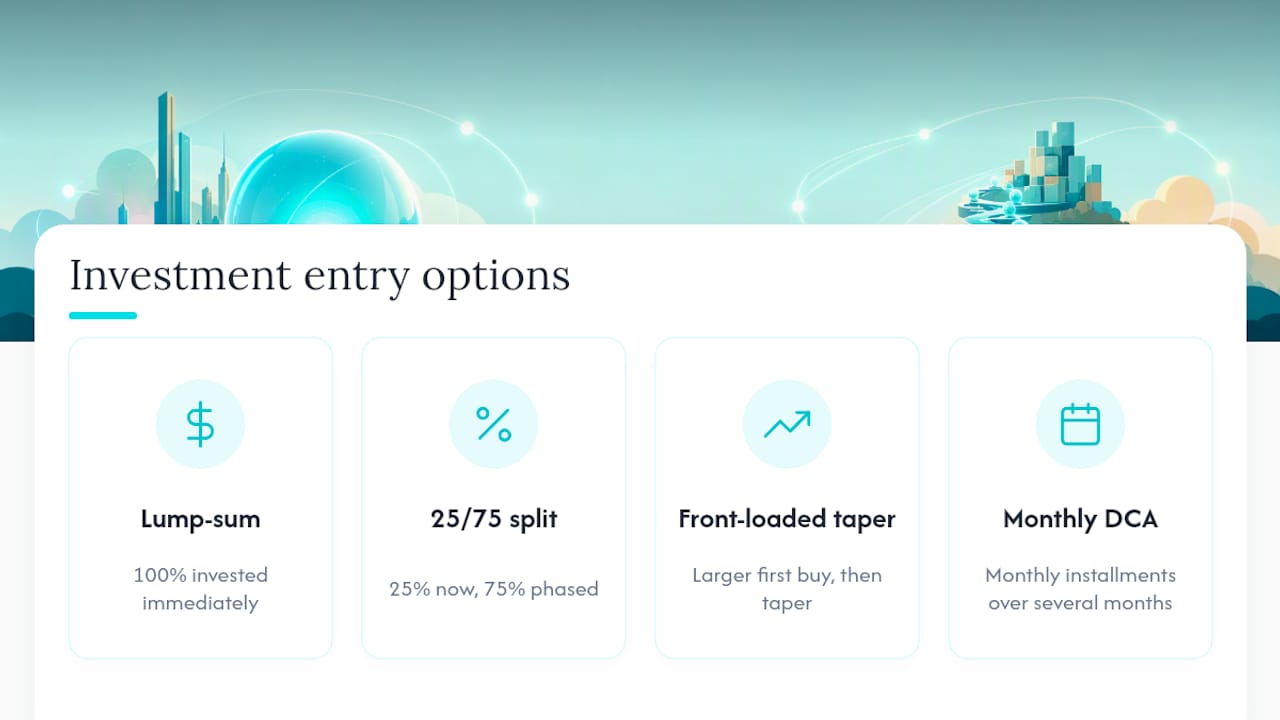
Most investors don’t need a binary choice. A partial immediate investment combined with phased entry can balance upside potential with psychological comfort. A 25/75 split front-loads more caution for the genuinely risk-averse. Some people front-load the first installment larger, then taper the rest, getting more money working sooner without the full lump-sum shock.
On execution: pick a low-fee or flat-fee platform, set up auto-invest so you’re not manually triggering each purchase, and batch trades if your broker charges per transaction. Keep a simple spreadsheet of each buy date and amount for CGT purposes later.
For cadence, monthly installments over a few months is a common recommendation to smooth entry while limiting time spent in cash. If markets look shaky, shortening the window reduces how long you’re exposed to the “wrong side” of the DCA trade-off.
Seeing Your Own Numbers Before You Commit
Averages and deciles are useful, but they’re not your portfolio. The gap between a median outcome and a bad one can be the difference between a comfortable retirement and a stressful one, which is exactly why sequence-of-returns risk deserves attention, not just headline win rates.
A useful scenario model includes your actual time horizon, target allocation, the length of your DCA window, and realistic fee assumptions. Looking at median outcomes alongside 5th and 95th percentile scenarios shows how much downside protection DCA actually buys you, and whether that protection is worth the average return you’re giving up.
- Time horizon and target asset allocation
- DCA window length (weeks vs months)
- Fee assumptions per platform
- Downside percentile, not just the median case
Running your own numbers side by side, rather than trusting a generic average, is the fastest way to see which outcome actually matters to you.
Aerowealth’s Take: Pick the Plan You’ll Actually Follow
But the best strategy is the one you won’t abandon in month two. Model your own numbers, including your risk tolerance, before assuming the “statistically correct” choice is right for you. For deeper context on how timing risk plays out over a full retirement, see our piece on bucket strategy retirement planning.
— Aerowealth Team
Model Your Own DCA vs Lump Sum Scenario
Reading about two-thirds win rates is one thing. Seeing what that actually does to your own retirement number is another. Aerowealth lets you build a lump-sum scenario and a DCA scenario side by side, using your real balance, allocation, and timeline, then compares the median outcome against the downside cases instead of just the average.

You can stress-test both approaches under Australian rules, including contribution and CGT considerations, without opening a spreadsheet. If you want a broader gut-check on how your allocation choices affect risk before you model the DCA decision, Alpha IQ’s diversification guide is a solid companion read. Once you’ve got a feel for your risk tolerance, head to Aerowealth and run a free comparison with your own numbers to see which plan you’d actually stick with.
Sources
- Cost averaging: Invest now or temporarily hold your cash? — Vanguard research paper
- Dollar cost averaging vs lump sum investing — Morningstar Australia
- DCA vs lump sum: which approach should investors use? — Betashares
FAQ
Is lump-sum investing better than DCA?
On average, yes. Vanguard’s research found lump sum outperformed DCA in about two-thirds of historical periods studied, mainly because it spends more time invested in the market.
How much should I dollar-cost average per month?
There’s no fixed dollar figure. It depends on your total lump sum and your chosen window, but a common approach is splitting the amount evenly across a few months rather than stretching it over a year, which limits how long cash sits idle.
Is DCA a good strategy?
DCA is a reasonable strategy when it’s the difference between investing steadily and not investing at all, or when it keeps you from panic-selling after a downturn. It’s not the higher-return choice on average, but its value is behavioral, not mathematical.