Offset vs Redraw: Which One Actually Saves You More?

Both an offset account and a redraw facility cut your home loan interest the same way: they reduce the balance your bank charges daily interest on. Put $60,000 in either one and you save the same amount. The real difference comes down to access, tax risk, and what happens to your money if the bank freezes your account or you sell an investment property.
Here’s the fast version. Offset suits you if you want daily access to your money, get paid a salary, or own an investment property and want to keep the loan “clean” for tax purposes. Redraw suits you if you want forced repayment discipline and don’t mind a short delay to get funds back.
- Interest math is identical for the same balance because both structures reduce the effective loan balance daily.
- Offset avoids loan contamination risk for investors; redraw can trigger ATO apportionment rules.
- Redraw often comes with processing delays and minimum withdrawal amounts; offset gives instant access.
- Plenty of borrowers use both, splitting day-to-day cash from long-term extra repayments.
Key Takeaways
Offset and redraw cut interest by identical amounts for the same balance, but offset wins on access and investor tax safety while redraw wins on repayment discipline.
| Point | Details |
|---|---|
| Interest savings are identical | A $60,000 balance saves the same interest whether parked in offset or redraw, at the same rate. |
| Offset protects investor tax position | Withdrawals don’t create new borrowing, avoiding ATO apportionment rules under TR 2000/2 and TR 95/25. |
| Redraw has access friction | Expect minimums, processing delays of one to two business days, and possible fees. |
| Only offset deposits are protected | Offset balances qualify for Financial Claims Scheme coverage up to $250,000 per ADI; redraw funds don’t. |
| Model both before deciding | Aerowealth lets you compare offset and redraw scenarios against your actual retirement and tax numbers. |
This article is general information, not a substitute for advice from a qualified financial advisor. Consult a qualified financial professional about your own circumstances before acting on anything here.
Table of Contents
- How an Offset Account Works
- How a Redraw Facility Works
- Offset vs Redraw: Comparing What Actually Matters
- Tax, Loan Purpose, and What Happens if Your Bank Collapses
- How to Choose: A Practical Checklist
- Why This Decision Ripples Into Retirement Planning
- See Your Mortgage Strategy’s Real Impact on Retirement
- Sources
- FAQ
How an Offset Account Works
An offset account is a regular transaction account linked to your home loan. Its balance gets subtracted from your loan balance before the bank calculates daily interest. Keep $20,000 sitting in there and you’re only charged interest as if your loan were $20,000 lighter, without actually paying down the loan.
Not all offsets are created equal. A 100% offset subtracts the full balance from your loan for interest purposes. A partial offset (sometimes 40% or 50%) only offsets a fraction of that balance, which quietly cuts your savings even though the account looks identical on the surface. Always confirm which type your loan actually has, since partial offset arrangements can meaningfully shrink your annual savings compared to what you’d expect from the balance alone.
In practice, offset accounts behave like everyday banking:
- Your salary lands in it and starts reducing interest immediately.
- You get a debit card and can withdraw or spend at any time.
- The balance doesn’t earn taxable interest, because it works by reducing loan interest instead of paying you interest income.
Offsets are standard on most variable rate loans but aren’t universal, and packaged loan deals sometimes price the offset feature differently than a plain variable loan.
Pro Tip: Before you sign anything, ask the lender directly whether the offset is 100% or partial. Loan brochures rarely spell this out clearly, and it’s the single detail that determines whether the account earns its keep.
How a Redraw Facility Works
Redraw works inside the loan itself. When you make extra repayments beyond your minimum, that surplus reduces your loan principal, and the bank lets you request access to those extra funds later if you need them. Unlike offset, there’s no separate account sitting alongside the loan. It’s more like a savings buffer buried inside the mortgage structure.
Getting that money back out usually comes with strings attached:
- Many lenders set a minimum redraw amount, so you can’t pull out small sums whenever you like.
- Processing typically takes one to two business days rather than being instant.
- Some lenders charge a redraw fee, and access can be restricted or suspended if your account falls into arrears or hardship.
There’s a technical wrinkle worth knowing about too: redraw availability can shrink as your loan amortizes, since some lenders withhold the equivalent of your next scheduled repayment when you submit a redraw request. Check your loan schedule or product disclosure statement rather than assuming the full extra-repayment balance is always sitting there ready to go.
Pro Tip: If you’re planning to redraw a large amount for a renovation or emergency, call your lender first and ask about processing time and minimums. Finding out three days before you need the cash is the wrong time to discover a restriction.
Offset vs Redraw: Comparing What Actually Matters
Run the numbers and the interest math doesn’t lie: at a 5.9% variable rate, $60,000 sitting in either offset or redraw saves roughly $3,540 a year in interest. Same balance, same rate, same saving. Where the two diverge is everything around that math.
- Access and convenience. Offset gives you a debit card and instant transfers, and you can run multiple offset accounts to bucket savings for different goals. Redraw usually means a request, a wait, and sometimes a minimum withdrawal.
- Fees and product rules. A partial offset quietly reduces your benefit even though the balance looks the same. Redraw fees and minimums do the same thing from a different angle, chipping away at how useful the “extra” money really is when you need it.
- Tax treatment for investors. Offset withdrawals don’t touch the loan structure, so the loan purpose stays intact. Redraw withdrawals used for private purposes can turn a clean investment loan into a mixed-purpose loan requiring interest apportionment.
- Deposit protection. Only one of these structures counts as an actual deposit under Australian banking law, which matters more than most borrowers realize.
For owner-occupiers with no investment property, this often comes down to personal discipline. If seeing extra cash sitting in a spendable account tempts you to dip into it, redraw’s friction is a feature, not a bug.
Tax, Loan Purpose, and What Happens if Your Bank Collapses
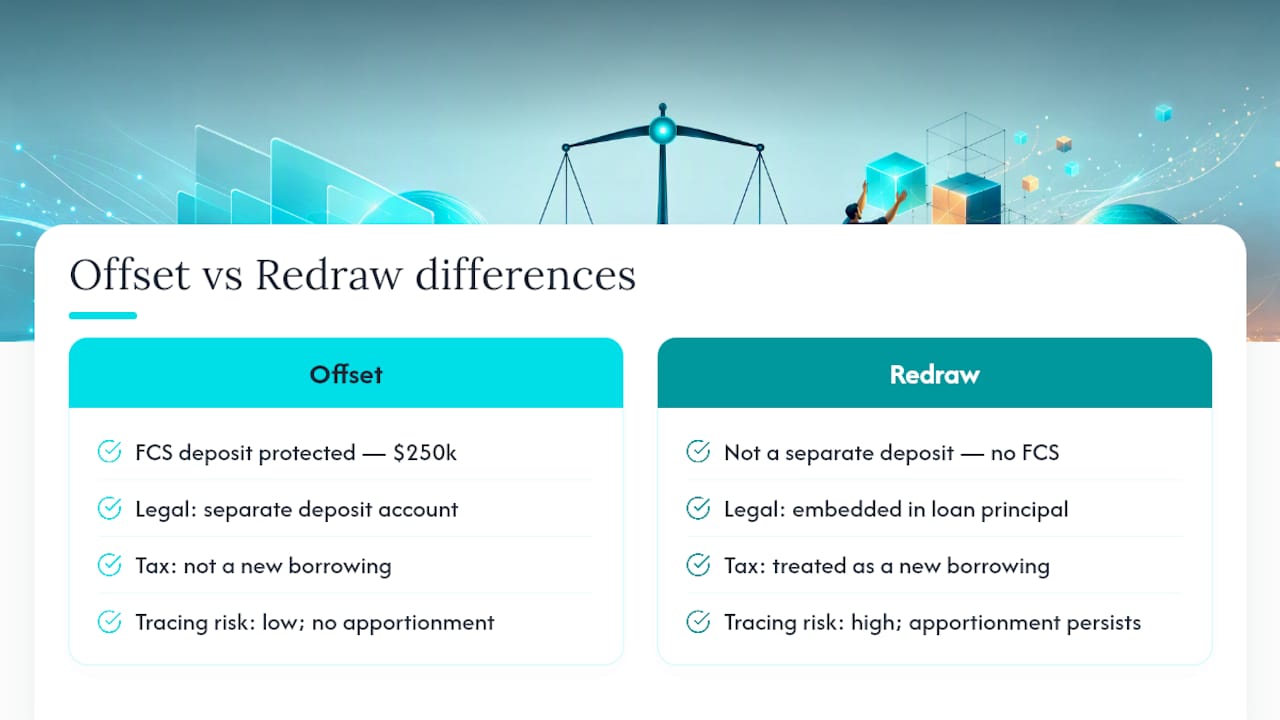
This is where offset and redraw genuinely part ways, and it’s the part investors can’t afford to skip. The Australian Taxation Office treats a redraw withdrawal as a new borrowing event. If you redraw funds from an investment loan and use them for something private, like a holiday or a car, that withdrawal can contaminate the loan and force interest apportionment under Taxation Rulings TR 2000/2 and TR 95/25. Only the portion still tied to income-producing use stays deductible from that point forward.
The Commissioner treats redraw withdrawals as separate borrowings, and tracing rules mean the apportionment can persist for the life of the loan. Simply repaying the private amount later does not automatically clean up a contaminated loan.
Offset accounts sidestep this entirely. Because withdrawing from an offset never changes the loan’s principal or structure, there’s no new borrowing event to trace and nothing to apportion. That’s a big reason accountants and mortgage brokers steer property investors toward offset accounts by default, especially given the ATO’s growing data-matching capability, which makes informal “redraw for a private purchase then pay it back” arrangements riskier than they used to be. For a deeper dive into structuring loans around this, our guide to offset accounts for investment properties walks through common traps.
Deposit protection adds another layer. Funds sitting in an offset account are legally deposits, so they’re covered by the Financial Claims Scheme up to $250,000 per account holder per authorized deposit-taking institution if the bank fails. Redraw funds aren’t a separate deposit; they’re embedded in the loan principal and don’t carry that same standalone protection.
How to Choose: A Practical Checklist
Run through these questions before you decide, or before you accept whatever your lender bundled into your loan by default:
- Are you a property investor? If yes, lean toward offset to avoid loan contamination risk.
- Do you need salary deposits and frequent access to your funds? If yes, offset wins on convenience alone.
- Do you want forced repayment discipline because you know you’ll spend accessible cash? Redraw’s friction can work in your favor here.
- Is your offset actually 100%, or is it partial? Ask the lender directly and get it in writing.
- What are the redraw minimums, fees, and processing times? These vary meaningfully between lenders.
- Can the lender restrict or suspend redraw access? Ask specifically about arrears, hardship, or fixed-rate portion rules.
A few red flags deserve extra attention: lenders that can suspend redraw at their discretion, partial offsets marketed as if they were full offsets, and using redraw on an investment loan for anything private. That last one can permanently alter your loan’s tax treatment even after you repay the amount, so it’s not a mistake you get to quietly undo.
Pro Tip: Many lenders let you run offset and redraw side by side on the same loan. Keep everyday cash and salary in the offset for flexibility, and direct lump-sum extra repayments into redraw as a long-term buffer you’re less tempted to touch.
Why This Decision Ripples Into Retirement Planning
The offset versus redraw choice isn’t just a mortgage detail. It shapes how much interest you pay over decades, how clean your tax position stays if you become an investor, and how much cash flexibility you retain heading into retirement. Running both scenarios side by side, rather than guessing, is the only way to see which structure actually moves your numbers.

See Your Mortgage Strategy’s Real Impact on Retirement
Reading about offset versus redraw is one thing. Seeing exactly how each choice changes your retirement age, net worth, and tax position over the next 20 years is another.

Aerowealth models both paths side by side using your actual numbers: your loan balance, your rate, your investment property (if you have one), and your super. Instead of guessing whether an offset’s flexibility or redraw’s discipline serves your retirement goals better, you can run a stress test and watch the projected outcomes diverge in real time. If you’re weighing whether to redirect extra repayments into redraw or build up an offset balance instead, our mortgage offset calculator shows the dollar difference before you commit either way. For broader strategy conversations about combining the two, a mortgage adviser like Haven Mark Advisers can also help you think through the structural side.
Start with Aerowealth’s free plan and build your own offset versus redraw scenario before your next loan review.
Sources
- Differences between home loan redraw and an offset account - NAB
- Interest expenses — ATO guidance on rental property interest deductibility
- Redraw vs offset explained — CommBank
FAQ
Is It Better to Put Money in Redraw or Offset?
For most owner-occupiers, offset is better because of instant access and full flexibility; for investors, offset is usually preferred to avoid contaminating a deductible loan with private redraw withdrawals.
When Should I Use Offset Instead of Redraw?
Use offset when you need salary deposits, everyday spending access, or own an investment property where loan-purpose tracing under ATO rules matters.
What Are the Cons of Using Redraw?
Redraw often has minimum withdrawal amounts, processing delays of one to two business days, possible fees, and access can be restricted during arrears or hardship, plus it risks loan contamination if used privately on an investment property.
Can I Have Both Offset and Redraw?
Yes, many Australian lenders allow both on the same loan, and a common approach keeps everyday cash in offset while directing lump-sum extra repayments into redraw.