Equity Release to Invest: How Australians Do It Safely

Using equity release to invest means borrowing against the value you have built in your home and putting that money into shares or an investment property. It does not create new money. It is extra debt secured against your home, and your home is the asset at risk. Lenders usually let you borrow up to 80% of your home’s value, less what you still owe. Whether that is wise depends on what you can afford to repay if markets fall or rates rise.
This guide covers the usable equity maths, the ways to access it, how tax works on the interest and the risks to plan around. It also shows how to model the decision before you sign anything.
TL;DR
- Usable equity is generally 80% of your home’s value minus your current loan, and a lender’s valuation and your income decide how much you can actually borrow.
- “Equity release” for retirees (reverse mortgages, the Home Equity Access Scheme) is a different thing from borrowing against your home to gear into shares or property.
- Interest is generally deductible only where the borrowed money is used to produce assessable income, so keep investment and private borrowing in separate loan accounts.
- Gearing magnifies losses as well as gains, and you still owe the loan if the investment falls, so stress-test repayments at rates 2% and 4% higher.
- Model the plan side by side with the do-nothing option before you speak to a lender, broker, licensed adviser or tax professional.
Table of Contents
- What it means to use home equity to invest
- How much equity can you actually use?
- Ways to access the equity
- What you can invest the money in
- Tax: when the interest is deductible
- The risks, and how to plan around them
- Perspective
- Model it before you borrow
- A practical checklist before you apply
- FAQ
- Sources
What it means to use home equity to invest
Equity is the value of your home less any money you owe on it. Moneysmart explains that home equity release lets you access some of that equity while you keep living in the home. Its listed options are a reverse mortgage, home sale proceeds sharing, an equity release agreement and the Government’s Home Equity Access Scheme, formerly the Pension Loans Scheme.
That is where the phrase gets confusing. The products above are designed mostly for people aged 60 and over, who use them for things like home modifications, medical costs and living expenses. Using equity to invest is a separate strategy. A property finance blog draws the same line: retiree equity release products sit on one side, and tapping equity to build wealth while still working sits on the other.
In practice, investing with equity usually looks like this:
- You get a new loan, or a top-up on your existing one, secured by your home.
- You use the money as a deposit and costs for an investment property, or to buy shares, ETFs or a managed fund.
- You service the extra loan from your income, and from any dividends or rent the investment produces.
The lender calls this a home equity loan, a top-up or a split. A financial planner may call it home gearing. BT Professional defines home gearing as using home equity as security for an investment loan, typically to invest in a share portfolio as an alternative to margin loans.
How much equity can you actually use?

The simple formula is: (property value × 80%) − existing loan = usable equity. A major bank’s home loan guide says lenders usually let you borrow up to 80% of your home’s value less your current loan, and that going above 80% may trigger lenders mortgage insurance (LMI). Its example is a $400,000 home with a $220,000 loan, which gives $100,000 of usable equity.
Here is an illustrative example with round numbers:
| Item | Amount |
|---|---|
| Home value (lender’s valuation) | $900,000 |
| 80% of value | $720,000 |
| Current mortgage | $400,000 |
| Usable equity | $320,000 |
Usable equity is a ceiling, not a promise. Model Mortgages notes that the lender orders its own independent valuation, not your estimate or an agent’s appraisal. It also notes that you must show your income can service the new total debt at the APRA stress buffer rate. If you have $400,000 of usable equity but income that supports only $200,000 of extra borrowing, you can release $200,000.
The lender will look at:
- Your income and how stable it is
- Existing debts and living expenses
- Credit history
- Your age and the loan term
- Any other properties you hold
One recent rule matters if you already carry a lot of debt. According to Mozo, APRA’s debt-to-income cap, active from 1 February 2026, limits banks from directing more than 20% of new residential mortgage approvals to borrowers whose total debt is six or more times their gross annual income. Adding an investment loan can push you over that line and affect approval.
Ways to access the equity
There are three common routes, according to the same bank guide: a loan top-up, a refinance with a new split, or a bridging loan.
Top-up or separate split
A top-up adds to your existing loan. A separate loan split, or a supplementary loan account, creates a new loan account against the same home. For investing, the split usually keeps the paper trail cleaner, which matters at tax time (more on that below). If you are weighing fixed against variable parts, our guide to 60:40 split loans shows how to model the break-cost side of that decision.
Refinance
Refinancing moves the whole loan to a new lender, often with a new structure. It can make sense if you want a better rate and extra funds in one step. It can also trigger exit fees or fixed-rate break costs on your current loan, so price it before you commit.
Offset and redraw
Money sitting in an offset account reduces the interest on your home loan, and you can access it later. Using redraw funds for investing raises tax questions, covered below. If an offset is part of your plan, our offset strategy guide walks through how to make it work harder.
Reverse mortgages and the Home Equity Access Scheme
These are built for retirees and for living costs, not for gearing. Moneysmart says that at age 60 the most you can borrow on a reverse mortgage is likely 15% to 20% of your home’s value, rising by about 1% for each year over 60. The loan, with interest and fees, is repaid when you sell, move out or your estate sells. ASIC’s review of reverse mortgage lending describes the interest as compounding and typically 1% to 2% above a standard home loan rate.
If you are considering that route, see our reverse mortgage modelling example and how to build equity before the Home Equity Access Scheme.
What you can invest the money in
Shares, ETFs and managed funds
ANZ notes that you could use home equity to invest in shares, bonds or a managed fund, and that borrowing to invest increases risk, so you should get financial and tax advice first. BT Professional lists benefits such as a lower cost of finance than unsecured borrowing, no margin call risk, diversification beyond property, and franking credits on Australian shares. The same page warns that the home may have to be sold if investments do not perform well enough to service the loan.
An investment property
Equity can fund the deposit and costs for another property. ING lists the costs to plan for: stamp duty, legal and conveyancing fees, accountant fees, pest and building inspections, mortgage insurance and land tax. Its rule of thumb is that you may be able to borrow up to five times your usable equity for an investment property, with the usable equity acting as your deposit. Treat that as a starting point only, because your income and the lender’s serviceability test set the real limit.
If an offset account will sit alongside the new loan, read our offset account investment property guide. If you wonder whether you could later move into the property, there is a separate guide on living in your investment property.

Tax: when the interest is deductible
The ATO looks at what the borrowed money is used for, not at what secures the loan. A home is the security, but a share portfolio or rental property is the purpose.
The ATO’s Tax Ruling TR 2000/2 says that for further borrowings under a redraw facility, deductibility depends on how the redrawn funds are used. Interest attributable to funds used for an income-producing purpose is deductible. Where one loan is used partly for income-producing and partly for private purposes, the interest must be apportioned on a fair and reasonable basis. A debt recycling guide from a financial planning firm adds that the investment must produce assessable income such as dividends, distributions or rent, and that mixing investment borrowings with personal spending can taint the deductibility.
Practical ways to keep this clean:
- Put the investment borrowing in its own loan account, not in the same account you use for private spending.
- Never run private expenses through the investment loan.
- Keep statements showing where every borrowed dollar went.
- Ask a registered tax agent to confirm your set-up before you draw down the money.
This is also the idea behind debt recycling, where investments are bought with a deductible loan while the private mortgage is paid down. One advice firm stresses that the risk lies in execution rather than in the strategy.
There is a second tax layer at the sale end. Capital gains tax applies when you sell shares or a property for a gain, so a plan that ignores it overstates your result. Run CGT through your projections instead of leaving it for later.
The risks, and how to plan around them
Moneysmart is blunt that borrowing to invest brings bigger returns when markets rise and larger losses when they fall, and that you still repay the loan and interest if the investment loses value. It names four major risks: bigger losses, capital risk, investment income risk and interest rate risk. It also says borrowing to invest is a medium to long term strategy, at least five to ten years. Because the loan is secured by your home, the exposure reaches your home, not only the amount you invested.
Stress-test the repayments
Moneysmart asks whether you could still afford repayments if rates rose by 2% or 4%. Here is a simple illustration using made-up numbers, not a forecast:
| Scenario | Loan | Illustrative rate | Annual interest |
|---|---|---|---|
| Base case | $100,000 | 6.0% | $6,000 |
| Rates +2% | $100,000 | 8.0% | $8,000 |
| Rates +4% | $100,000 | 10.0% | $10,000 |
Now ask the harder questions. Could your wage cover the extra $4,000 a year if dividends or rent also fell? What if you lost income for six months? If you want to understand how loan repayments behave when the rate moves, this explainer on how personal loan repayments work shows the mechanics of rates, terms and repayments.
Check your position against ASIC’s profile
ASIC’s guidance says gearing suits people with enough income from other sources or a reserve of funds, those in the highest tax brackets where deductibility is worth most, and experienced investors who understand volatility. It advises seeing a licensed adviser if you are unsure. Negative gearing, where borrowing costs exceed investment income, means you fund the shortfall from your own pocket each year.
Also, borrowing only makes sense if the after-tax return beats all the costs of the investment and the loan, as Moneysmart points out.
Retirees and people close to retirement
If you are 55 or older, the clock matters more than for a 30-year-old. A bad market stretch near retirement leaves you less time to recover, and a lender will also weigh your age and how long the loan can run. Think carefully about whether you will carry this debt into retirement and what income will repay it. Our mortgage in retirement guide models three paths, and the interest-only guide covers loans, offsets and income. For anyone planning to stop work before preservation age, the loan also has to be serviced during the years before super is accessible.
Perspective
Most people ask whether home equity is a good way to invest. We think the better question is what happens to your whole plan under each choice, because the answer changes with your age, income, super balance and how long you can hold the investment.
A single projection hides this. A geared share portfolio, extra super contributions, paying down the mortgage into an offset and doing nothing can all look fine in isolation. Put them side by side and the differences show up in retirement age, retirement income and net worth.
That is why we built AeroWealth around side-by-side scenario comparisons and stress tests. You can put superannuation, an investment property, ETFs, your mortgage and your contributions in one plan, include CGT and tax effects, and see how a rate rise or a market fall changes the outcome. For early retirement, bridge years modelling shows whether you can fund the years before preservation age.
We think a deliberate decision beats a hopeful one. See the numbers first, then take them to your lender, broker, licensed adviser or accountant.
Aerowealth Team
Model it before you borrow
We built AeroWealth for Australians who want to compare decisions like this one before committing. You can model a home equity loan against alternatives such as extra super contributions or an offset strategy, test how your plan holds up when assumptions get worse, and see your projected retirement age, income and net worth change. Our AI assistant explains projections under Australian rules.
There is a free plan to get started. Pro costs $7 per month (AUD) and adds expanded scenario planning, bridge mode for early retirement, advanced mortgage features and a higher AI assistant quota. See the plans and pricing, or start at the AeroWealth home page.
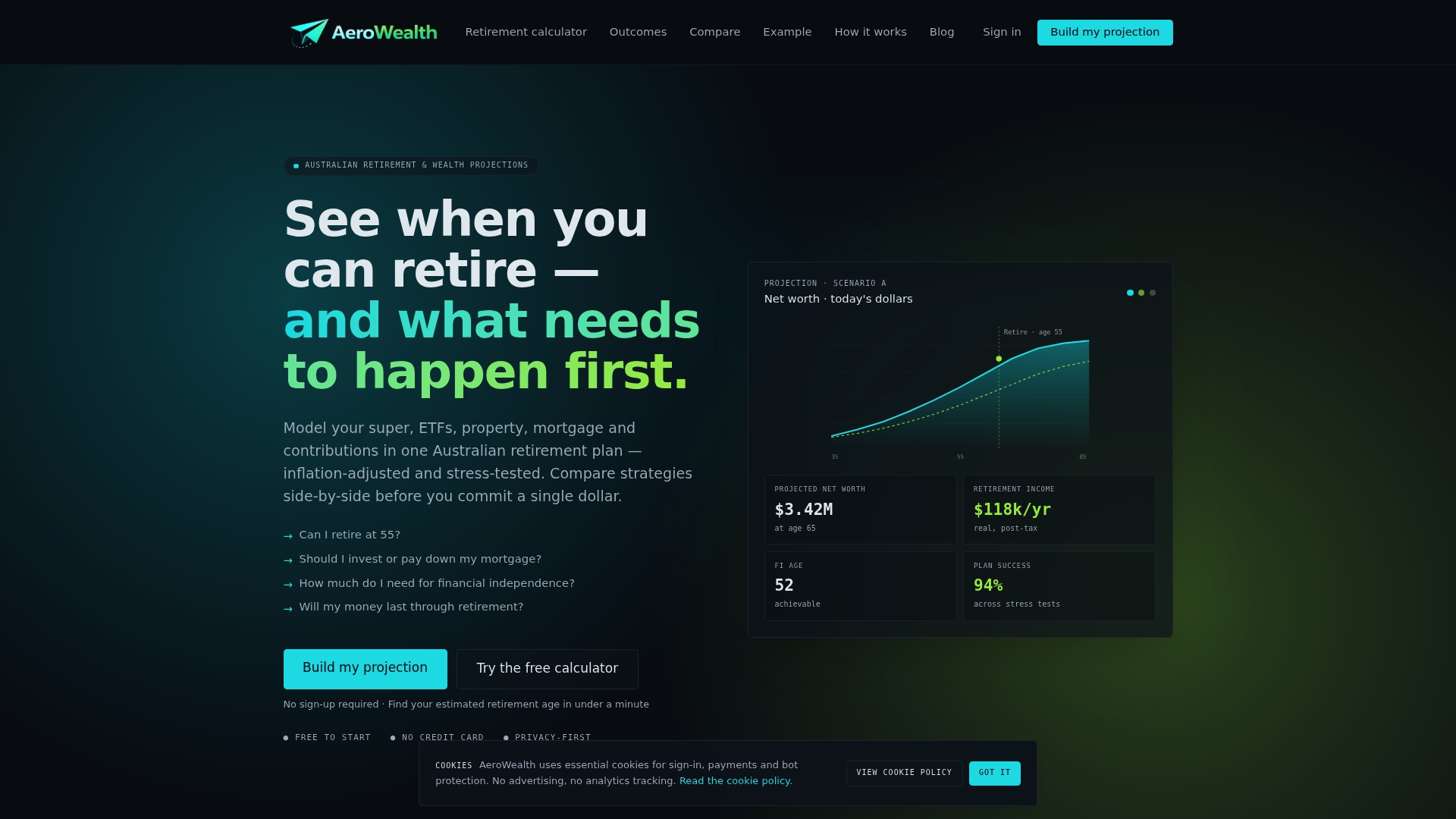
AeroWealth is a modelling tool, not a lender, and it does not replace personal advice. Use its output to prepare better questions for a licensed financial adviser and a registered tax agent.
A practical checklist before you apply
- Value your home realistically. Expect the lender to use its own valuation, and use that figure in your model.
- Calculate usable equity. Apply the 80% limit, then subtract your current loan.
- Work out borrowing capacity. Income, debts, living expenses and the APRA stress buffer set the real number, not the equity alone.
- Decide the purpose and structure. Use a separate loan account for investment borrowing and keep private spending out of it.
- Stress-test. Run rates +2% and +4%, a market fall and a period of lower income.
- Price the exits. Include CGT, selling costs and any loan break costs.
- Get advice. A licensed adviser can assess suitability, and a registered tax agent can confirm deductibility for your situation.
FAQ
Can I use home equity to invest in shares?
Yes, many lenders allow a top-up or separate loan to be used for shares, bonds or managed funds. Borrowing to invest increases risk, so ANZ suggests getting financial and tax advice before you commit. Your home remains the security, so a falling market does not cancel the debt.
Is equity release the same as a reverse mortgage?
No. A reverse mortgage is one kind of equity release product for people aged 60 and over, and it needs no regular repayments while you live in the home. Borrowing against your home to invest is a standard loan strategy with repayments you must service. The two have different costs, rules and risks.
Is the interest on an equity loan tax-deductible?
Only where the borrowed money is used to produce assessable income, such as dividends or rent. The ATO looks at the use of the funds, and mixed-purpose borrowing must be apportioned under TR 2000/2. Speak to a registered tax agent about your own loan structure.
How much can I borrow against my home?
Lenders usually allow up to 80% of your home’s value, less your current loan, without LMI. Your income, debts and age then decide how much of that usable equity you can actually borrow. Use the lender’s valuation and the APRA stress buffer when you model it.
Sources
- Reverse mortgage and home equity release, Moneysmart
- Borrowing to invest, Moneysmart
- Should I borrow money to invest? ASIC
- REP 586, Review of reverse mortgage lending in Australia, ASIC
- TR 2000/2, ATO legal database
- Using equity to invest or buy another home, home loan guide
- Using the equity in your home, ANZ
- Home gearing: process, benefits and risks, BT Professional
- Usable equity vs theoretical equity, Model Mortgages
- How to use home equity in 2026, Mozo
- Using equity to buy investment property, ING
- How to use home equity to invest in property, Stryve
- Debt recycling guide, Hudson Financial Planning