Fast ATO Steps to Claim Franking Credits for Australians for Retirement

You are likely eligible for a franking credits refund if your total tax offset from franked dividends exceeds your basic income tax and Medicare levy for the year. If you meet the ATO’s automatic-refund criteria, expect the payment from mid-July without lifting a finger. If not, the fastest fix is phone lodgment on 13 28 65 or the myGov refund form, both faster than mailing the paper application.
TL;DR:
- Most eligible individuals will receive automatic franked dividend refunds starting mid-July if their registry data aligns with the ATO’s criteria, with many processed by August.
- Refunds are triggered when your franking credit offset exceeds your combined income tax and Medicare levy, especially for low-income retirees with modest portfolios.
- Claiming the refund via phone or myGov is faster than paper applications, which can take up to 50 business days to process, particularly if no prefilled data exists.
- Holding period rules require investors to keep shares “at risk” for 45 days, but small shareholders under a specified threshold are exempt from this requirement.
- Accurate records, including dividend statements and current bank details, are essential to prevent delays or forfeiting automatic refunds.
Table of Contents
- What Qualifies You for a Franking Credits Refund?
- What Are the Holding Period and Related Payments Rules?
- How Do You Claim a Franking Credits Refund?
- Franking Credits From Trusts or Managed Funds
- What Records Do You Need Before You Apply?
- Do You Get an Automatic Refund, or Do You Need to Apply?
- Aerowealth Perspective: How Franking Credit Refunds Fit Retirement Planning
- See How Franking Credits Affect Your Retirement Numbers
- Sources
- FAQ
What Qualifies You for a Franking Credits Refund?
You qualify when your franking credit tax offset for the year is bigger than what you owe in income tax and Medicare levy combined. That surplus becomes a cash refund rather than sitting unused. The ATO’s rules on refunding excess franking credits confirm this applies to Australian resident individuals, and it only covers dividends received on or after July 1, 2000.
A few specifics trip people up:
- You must be an Australian tax resident for the relevant part of the income year.
- Dividends from New Zealand companies only count if they carry Australian franking credits attached, not just NZ imputation credits.
- If you’re otherwise required to lodge a tax return (because you have other income), you claim the franking tax offset through your return, and any excess is refunded on assessment rather than through a standalone application.
- If lodging a return isn’t otherwise required, you use the dedicated refund application instead.
The franking tax offset works by grossing up your assessable income to include the credit, then subtracting that same credit from your tax bill. When the offset outweighs what you owe, the difference comes back to you in cash rather than carrying forward. This is the mechanical heart of dividend imputation in Australia, and it’s the reason retirees on low taxable incomes often see meaningful refunds even when they owe little or no tax elsewhere.
What Are the Holding Period and Related Payments Rules?
Two integrity rules can knock out a claim even when the eligibility test above is satisfied.
- The holding period rule. For shares bought on or after July 1, 1997, you generally need to hold them “at risk” for 45 days (90 days for preference shares) to claim the attached franking credits.
- The related payments rule. If you or someone connected to you made or agreed to make a “related payment” tied to the dividend, such as passing the economic benefit to another party, the credits can be denied even if you technically held the shares long enough.
- Dividend washing. Selling a parcel just after the dividend is declared and buying an equivalent parcel to claim credits twice on the same underlying economic interest is specifically targeted by the ATO.
The small shareholder exemption removes most of this hassle for smaller investors: if your total franking credit entitlement for the year is within a small threshold, you’re generally exempt from the holding period test. Most retirees with a modest share portfolio never need to think about parcel-by-parcel timing at all.
Pro Tip: Even under the $5,000 exemption, the ATO can still invoke general anti-avoidance provisions if a scheme looks designed purely to generate franking credits. The exemption simplifies the paperwork, not the underlying intent test.

How Do You Claim a Franking Credits Refund?
Three lodgment paths exist, and picking the right one saves weeks of waiting.
- myGov / ATO Online. If you’re not required to lodge a tax return, log into myGov linked to your ATO account and use the prefilled refund of franking credits form. Many fields populate automatically from data your fund managers and share registries have already reported.
- Phone (13 28 65). Have your Tax File Number and total dividend and franking credit amounts ready. The ATO’s own guidance notes phone lodgment takes under 7 minutes and is generally processed within about 10 to 12 business days. The line runs 24 hours a day, so you can avoid peak call times entirely.
- Paper application (NAT 4105). Necessary if you’re claiming for a prior year or your dividend data hasn’t been prefilled anywhere. Processing here can take up to 50 business days, several times longer than phone.
If you’re required to lodge a full tax return for other income (a part-time job, rental property, or capital gains), you claim the franking tax offset within that return instead of using the standalone application. Filing a return you didn’t actually need to file, or applying manually when you were otherwise due to an automatic refund, can also forfeit that automatic processing for the year. Check which category you fall into before you touch any form.
Franking Credits From Trusts or Managed Funds
Dividends often reach individuals indirectly, through a managed fund, family trust, or partnership rather than direct share ownership. The rules still hinge on the same basic test: you need a present entitlement to the distribution, and the franking credits attached must match what the trust or partnership actually received.
- Trustees and partnerships must show the franked amount and the franking credit separately on the distribution statement issued to each beneficiary or partner.
- Your share of the credits has to line up with your share of the distribution. You can’t claim more than your proportional entitlement.
- Ask your fund manager or trustee for the annual tax statement or distribution summary before you apply. That document supplies the exact figures the ATO expects on your application, whether you’re claiming through myGov, phone, or paper.
Managed fund statements sometimes bundle franked and unfranked components together in a way that’s easy to misread, so check the individual line items rather than assuming the total distribution is fully franked.
What Records Do You Need Before You Apply?
Gather these before you pick up the phone or open the myGov form, because missing figures are the single biggest cause of delay.
- Dividend and distribution statements from every company or fund, showing the franked amount, the franking credit (sometimes labeled the imputation credit), and any TFN amounts withheld.
- Your running totals for the income year: add up every franked amount to get total dividend income, then separately add up every franking credit figure.
- Bank (EFT) details and identity information current on your ATO Online profile. The ATO’s application instructions specify these fields precisely, and getting the account details wrong is a common cause of stalled payments.
Keep the underlying statements for at least five years in case the ATO asks you to substantiate a claim later.
Do You Get an Automatic Refund, or Do You Need to Apply?
Some taxpayers never need to lift a finger. The ATO issues automatic refunds to individuals it can identify from share-registry data, generally starting from mid-July, with most of these finalized by August.
- Common criteria include being over 60 as of June 30, having dividend income under a set cap, being an Australian resident, not using a registered tax agent, and having consistent registry reporting under your correct TFN and address.
- If your details on file are outdated (a recent move, a name change, a new bank account), the registry match can fail and you’ll need to apply manually instead.
- Lodging a tax return you weren’t otherwise required to file can forfeit automatic processing for that year, since the ATO assumes you’re claiming through the return process instead.
Before the automatic run each year, log into ATO Online and confirm your contact and bank details are current. A mismatch is the most common reason an eligible retiree misses out on an automatic payment entirely.
Aerowealth Perspective: How Franking Credit Refunds Fit Retirement Planning
Retirees frequently build income projections assuming every franking credit converts cleanly to cash, then get blindsided when a holding-period slip or a registry mismatch delays or shrinks the refund. Reliable dividend income modeling matters more than most spreadsheets account for. Running a franked dividend retirement scenario alongside a reduced or delayed version of the same year exposes exactly how much cushion your plan actually has.
— Aerowealth Team
See How Franking Credits Affect Your Retirement Numbers
Knowing you qualify for a refund is one thing. Knowing what that refund actually does to your retirement income over the next 20 years is another problem entirely, and it’s one most spreadsheets handle badly. Financial modelling tools can show franked dividend income, superannuation drawdowns, and the tax impact of your investment mix side by side, so you can see how a delayed or reduced refund year actually changes your numbers instead of guessing.
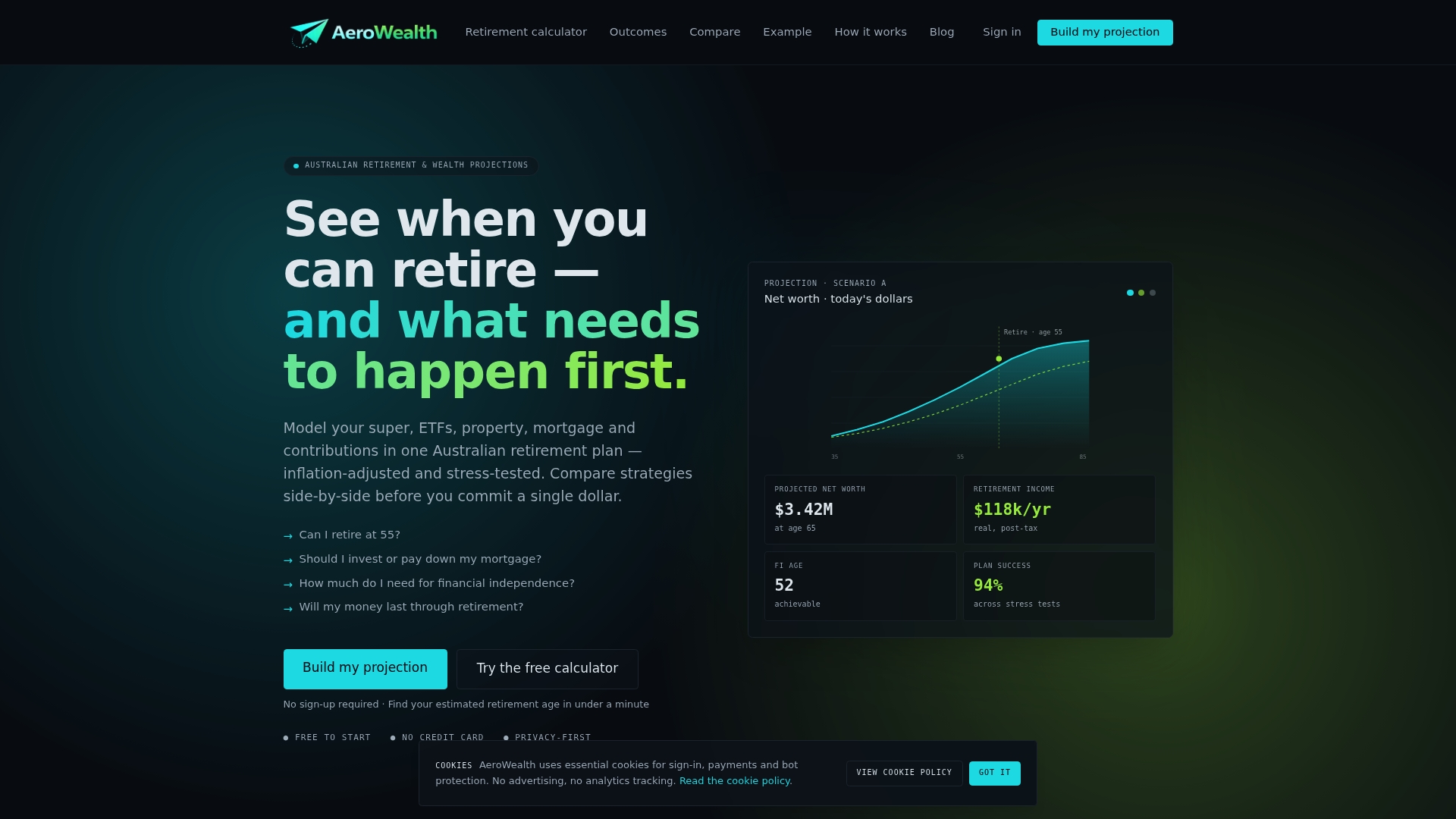
Run a free scenario with your own dividend and franking credit figures and compare it against a version where a refund arrives late or gets knocked back under the holding period rule. If you also hold ASX shares across several companies, it’s worth checking each statement individually before you plug in totals. Start a projection on the Aerowealth platform and see exactly where franked income fits into your retirement timeline.
This article is general information, not a substitute for advice from a qualified financial advisor. Consult a qualified financial professional about your own circumstances before acting on anything here.
FAQ
When Can I Apply for a Refund of Franking Credits in 2026?
You can apply as soon as you have your dividend statements for the relevant income year, typically from July onward once your fund managers and share registries have issued annual tax statements.
How Can I Claim a Refund of Franking Credits From the ATO?
Use the prefilled form through myGov linked to ATO Online, call 13 28 65 for phone lodgment, or mail the paper NAT 4105 form if your data isn’t prefilled or you’re claiming for a prior year.
How Long Does It Take to Get My ATO Franking Credits Refunded?
Phone lodgments are typically processed within about 10 to 12 business days, while paper applications can take up to 50 business days.
How Do Individuals Apply for a Refund of Franking Credits Without Lodging a Tax Return?
If you’re not otherwise required to lodge a return, you use the standalone refund of franking credits application through myGov, phone, or paper instead of filing a full return.
Do I Need to Apply If I Already Get Automatic Refunds?
No. If you meet the ATO’s automatic-refund criteria, such as being over 60 with consistent registry data on file, the refund is issued from mid-July without a separate application, though you should confirm your bank and contact details are current beforehand.