From $700,000 to $3.3 million: Living on Franked Dividends in Australia

Yes, for many Australians, living primarily off dividends is genuinely achievable, but only if you get the arithmetic right. Feasibility hinges on your grossed-up yield once franking credits are counted, your tax status (personal, super accumulation, or SMSF pension phase), the size of your portfolio, and whether you’ve built a buffer for the years dividends fall short. The next step isn’t optimism. It’s running the actual numbers against your own scenario.
TL;DR:
- Achieving a grossed-up dividend yield of 5% to 5.5% across a diversified portfolio is essential, with a conservative withdrawal rate closer to 4%.
- Changes in dividend yields, such as a 0.5% drop, can increase capital requirements by roughly 10%, and dividend cuts could force portfolio rebalancing or capital drawdown.
- Holding assets in superannuation pension phase or SMSFs leverages franking credits, reducing required capital by 30% to 50% compared to personal holdings.
- Stress-testing your plan against worst-case dividend scenarios and accounting for inflation helps ensure sustainable income over time.
Table of Contents
- Can You Retire on Dividends in Australia?
- How Much Capital Do You Actually Need?
- Franking Credits, Tax Mechanics, and the 2027 CGT Changes
- The Real Risks: Dividend Volatility and Concentration
- Building the Portfolio: ETFs, LICs, Direct Shares, and Account Location
- Your Implementation Checklist and Monitoring Plan
- Modelling Scenarios With Aerowealth: Why Stress-Testing Matters
- Does Inflation Erode Dividend Income Over Time?
- Dividends vs. Other Income Strategies in Retirement
- Choosing Australian Shares With a Stable Dividend History
- Australian Economic Risks That Threaten Dividend Income
- Who Should Actually Try to Live Off Dividends?
- See How This Plays Out for Your Own Numbers
- Sources
- FAQ
Can You Retire on Dividends in Australia?
Living off dividends means covering your living costs from the income your shares pay out, without regularly selling down the underlying portfolio. That’s the key distinction from a total-return or drawdown strategy, where you sell units each year regardless of whether the market paid you a dividend or not. Both approaches can work. They just behave very differently when markets fall, because a dividend-focused retiree who never sells at depressed prices avoids locking in losses, while a drawdown retiree who sells during a downturn does.
The headline yield on the ASX is not the number that matters most. Morningstar points out that Australian cash dividend yields typically sit around 3.3%, but Australian companies attach franking credits to many payouts, and once you gross those up, the effective yield climbs meaningfully higher for eligible taxpayers.
Rules of thumb help you sanity-check a plan before you build the full model:
- Target a grossed-up yield in the 5% to 5.5% range across a diversified portfolio, a level Kalkine’s analysis treats as a realistic ceiling for income-focused Australian investors.
- Keep your effective withdrawal rate conservative, closer to 4% of total capital than 6%, even when your dividend yield technically covers more.
- Assume dividend cuts can occur occasionally somewhere in your portfolio, and plan your spending around that possibility rather than a best-case average.
None of these numbers are guarantees. They’re starting points for a model you then stress against your own tax situation and portfolio mix.
How Much Capital Do You Actually Need?
The formula is simple: capital required equals your annual income need divided by your net-of-tax dividend yield. The complexity is entirely in that second number, because your net yield changes dramatically depending on where your money sits.
Statistic: The Parliamentary Budget Office notes that franking credit refunds disproportionately flow to SMSFs and pension-phase funds, and practitioners commonly show that pension-phase tax treatment can cut the capital required for a given income target by 30% to 50% compared to a top-marginal-rate personal holding.
Here’s how that plays out across three common income targets and three tax situations.
- A$40,000 a year, SMSF pension phase (0% tax). The fund keeps the full grossed-up yield, and franking credits beyond the (nil) tax liability are refunded in cash, substantially lowering capital required.
- A$60,000 a year, mid-marginal tax rate (34.5% including Medicare levy). After tax on the grossed-up amount, net yield falls, increasing capital required.
- A$100,000 a year, top marginal rate (47%). Net yield drops further, meaning even more capital is needed. The difference between tax scenarios significantly affects capital required for the same income target.
The gap between the first and third examples isn’t really about lifestyle ambition. It’s almost entirely a tax-structure effect, which is why so many retirement plans built around dividends lean heavily on getting money into pension-phase super before relying on the income.
A few sensitivity notes worth building into any model:
- A 0.5 percentage point fall in average yield (say, from a market re-rating or a sector-wide dividend cut) pushes the capital requirement up by roughly 10% for the same income target.
- A one-year 20% cut to dividends across your portfolio, the kind Morningstar’s data on historical swings shows has happened to major ASX names before, means either drawing down capital, tapping a cash buffer, or cutting spending for that year.
- If you’re also eligible for the Age Pension, dividend income and account balances both count in the means test, so a large dividend-focused portfolio can reduce or eliminate pension eligibility even while franking credits are boosting your effective yield.
Franking Credits, Tax Mechanics, and the 2027 CGT Changes
Australia’s dividend imputation system exists to stop company profits from being taxed twice, once at the corporate level and again in the shareholder’s hands. You gross up the dividend to include that credit as income, then claim the credit as an offset against your own tax bill.
The mechanics matter most at the extremes. The ATO’s guidance on franking credit refunds confirms that Australian tax residents receive a refund when their franking credits exceed their tax liability for the year.
Statistic: A $70 cash dividend fully franked grosses up to $100 of taxable income, with $30 of franking credit attached. In pension-phase SMSF, that fund owes no tax on the $100, so the full $30 credit is refunded, lifting the effective cash return from $70 to $100, a 43% uplift over the cash dividend alone, a mechanic Vanguard’s franking credit explainer walks through in more detail.
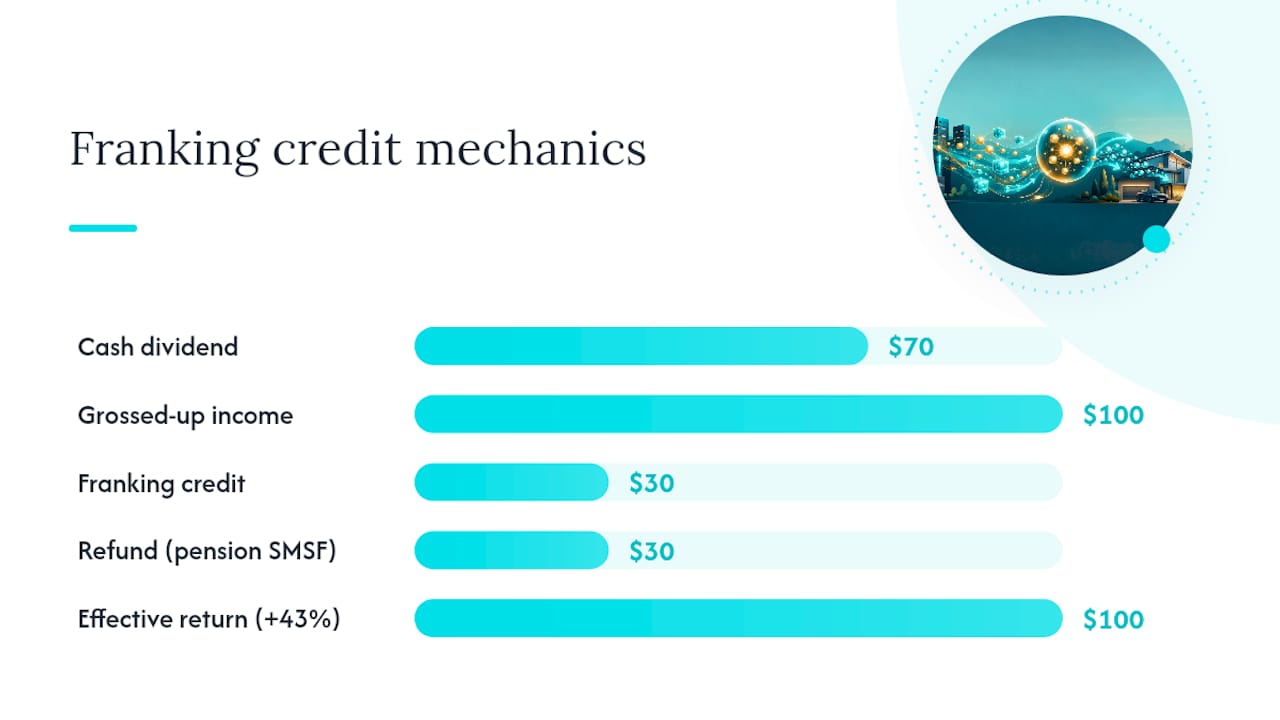
That single mechanic explains why so much Australian retirement planning revolves around getting assets into pension phase before drawing income from them. Inside pension-phase super, it’s pure upside.
The 2026 to 2027 tax reforms change the calculus further. The Parliamentary Budget Office’s analysis confirms that changes effective July 1, 2027 replace the 50% CGT discount for individuals with cost-base indexation and introduce a minimum 30% tax on net capital gains. Practically, that means:
- Capital gains on shares held for growth become relatively less tax-efficient for many individual investors once the new rules apply.
- Fully franked dividend income, especially inside pension-phase super where it’s tax-free and refundable, becomes comparatively more attractive as a retirement income source.
- Investors who had been leaning on a total-return, sell-down strategy outside super have a real reason to revisit that plan before mid-2027, not after.
This is exactly the kind of policy shift where a static rule of thumb stops being useful. Re-run your numbers whenever the tax law under you moves, rather than assuming your original model still holds.
The Real Risks: Dividend Volatility and Concentration
Dividends feel steady until the year they aren’t. Large ASX companies have cut payouts by more than half in a single year during commodity downturns and banking stress, and Morningstar’s own analysis of dividend volatility treats this as a structural feature of the Australian market, not an anomaly.
Part of the reason is concentration. The ASX 200’s dividend income is heavily weighted toward banks and miners, two sectors that move on very different but equally powerful cycles: interest rates and credit quality for banks, commodity prices for miners. When one of those cycles turns, a portfolio built mostly from big-four bank shares and diversified miners can see its total dividend income fall sharply in the same year, because the concentration that made the yield look attractive also removes the diversification that would have cushioned the blow.
Global diversification and equal-weighting strategies reduce that single-sector exposure, though often at the cost of a lower headline yield, since Morningstar’s research notes that Australian dividend growth has historically trailed dividend growth in markets like the United States. A blended portfolio, some Australian shares for franking, some global exposure for dividend growth and diversification, tends to hold up better across a full economic cycle than an all-Australian, all-yield approach.
There are practical ways to blunt the impact of a bad dividend year without abandoning the strategy entirely:
- Hold one to three years of planned spending in cash or short-term deposits, so a dividend cut doesn’t force you to sell shares at a bad price to cover bills.
- Favor a mix that includes some dividend growers alongside high-yield names, since growers tend to cut less often and recover faster.
- Set a rebalancing rule in advance (for example, once a sector exceeds 35% of income) rather than reacting emotionally when one part of the portfolio outruns the rest.
- Build a written contingency plan for a 20% income cut: which spending gets trimmed first, and for how long, before you touch capital.
Deep modelling work on retirement sequencing shows that a cash buffer combined with a conservative initial withdrawal rate materially raises the odds a dividend-based plan survives a bad early stretch, which is exactly when a portfolio is most vulnerable to a market fall landing at the same time as a dividend cut.
Pro Tip: Stress-test your plan against the worst dividend year in the last 20, not the average one. If your buffer and spending plan survive that scenario, an average year is easy.
Building the Portfolio: ETFs, LICs, Direct Shares, and Account Location
There’s no single right structure, but the trade-offs are consistent enough to map out clearly. High-yield income ETFs and Listed Investment Companies (LICs) give you instant diversification across dozens of dividend-paying names in one trade, with a fund manager handling rebalancing. Direct shares give you full control over which companies you hold and let you manage franking credits and capital gains timing yourself, but they demand more ongoing attention and carry higher single-stock risk if you concentrate too heavily.
A reasonable starting framework:
- Core Australian income exposure, through a mix of direct blue-chip shares or an income-focused ETF, targeting that 5% to 5.5% grossed-up yield range.
- Global equities allocation, accepting a lower headline yield in exchange for stronger long-term dividend growth and currency diversification, since Australian dollar movements affect the local-currency value of overseas dividends.
- LICs for selective active management, where a manager’s stock-picking track record on dividend sustainability adds value over a passive index approach, though fees and any share price discount to net asset value need checking.
Global holdings introduce a currency variable Australian-only portfolios don’t have. When the Australian dollar weakens, dividends from US or European holdings convert to more Australian dollars, and vice versa when it strengthens. That cuts both ways as a diversifier, smoothing some risks while adding a new one, so it’s worth sizing global exposure deliberately rather than treating it as a rounding error.
Account location is where the biggest lever sits. The same portfolio, held in three different structures, produces three very different net incomes:
- Personal name, top marginal rate. You get the full cash dividend but pay tax on the grossed-up amount at up to 47%, clawing back much of the franking credit’s value.
- Superannuation accumulation phase. Earnings taxed at 15%, with franking credits offsetting most or all of that liability, meaningfully better than holding the same shares personally at a high marginal rate.
- SMSF or super fund pension phase. Earnings taxed at 0%, and franking credits are refunded in cash, which is the single most powerful yield boost available to Australian retirees inside the rules.
This is why so much of the practical work in “living off dividends” planning isn’t stock-picking. It’s making sure your capital is sitting in the right structure before you start drawing on it, a topic covered in more depth in Aerowealth’s guide to retirement income streams and its breakdown of individual retirement accounts in Australia. Portfolio construction that ignores diversification basics, wherever it’s held, tends to concentrate risk the same way a bank-and-miner-heavy ASX portfolio does, a pattern also explored in general terms in Marmot Finance’s piece on reducing risk through diversification.
Your Implementation Checklist and Monitoring Plan
Getting from “this sounds achievable” to an actual dividend-funded retirement takes a sequence of concrete steps, not a single decision.
- Estimate your real annual income need, using actual spending data rather than a guess, and check it against ABS average weekly earnings figures as a sanity check on whether your target is modest or ambitious relative to typical Australian household income.
- Run the capital-required formula across your actual tax situation, not a generic example, since the gap between personal and pension-phase treatment can be hundreds of thousands of dollars for the same income target.
- Set your cash buffer size, a minimum of one year of spending, ideally closer to two or three if you’re retiring early and won’t have Age Pension or super access to fall back on.
- Choose your vehicles, deciding on the mix of direct shares, ETFs, and LICs, and where each sits across personal, super, and SMSF accounts.
- Confirm account setup and payout timing, checking dividend payment dates against your spending calendar so cash arrives when you need it, not months before or after.
- Set a rebalancing cadence, commonly annual, with a trigger rule (for example, any sector exceeding a set percentage of total income gets trimmed back).
- Schedule an annual stress test, rerunning your numbers against a bad-case dividend cut scenario and adjusting spending guardrails if the buffer looks thin.
The monitoring side matters as much as the setup. A plan built once and never revisited is a plan built for conditions that no longer exist by year three. If it’s tracking well above plan, decide in advance whether that surplus builds your buffer further or funds a lifestyle upgrade.
Pro Tip: Put your annual stress test on the same calendar date every year, tied to when your fund statements arrive. Reviews that don’t have a fixed date get skipped the year you need them most.
Modelling Scenarios With Aerowealth: Why Stress-Testing Matters
The examples above use fixed assumptions because that’s what a worked example needs to stay readable. Real portfolios don’t behave that neatly, which is exactly why scenario modelling matters more than a single spreadsheet calculation.
Good scenario modelling shows you three things a static formula can’t: the probability your income target is met across a range of market outcomes, how long your cash buffer lasts if dividends fall for two or three years running, and how sensitive your entire plan is to the account structure you’ve chosen. Side-by-side comparisons matter here, because the difference between “SMSF pension phase” and “personal ownership at top marginal rate” isn’t a rounding error. It’s the difference between needing $700,000 and needing $3.3 million for the same income, as the worked examples above show.
Scenario modelling tools let you compare conservative, baseline, and optimistic dividend scenarios side by side to see how each affects projected retirement age, income sustainability, and net worth trajectory under Australian tax rules.
A few things worth checking in the output whenever you run a model like this:
- Probability bands, showing the range of outcomes rather than a single projected number, since a plan that only “works” in the average case is a plan that fails half the time.
- Drawdown risk, meaning how much of your capital you’d need to touch if dividends cut for a sustained period, not just a single bad year.
- Sensitivity to account location, testing what happens to your required capital and timeline if some assets sit outside super versus inside pension phase.
The most useful exercise is running three versions of the same plan: a conservative case (yield down half a point, one bad dividend year every four), a baseline case matching your current expectations, and an optimistic case (dividend growth continues, no major cuts). Seeing how far the retirement age or required capital shifts between those three tells you far more than any single “you need $X” answer ever could.
Does Inflation Erode Dividend Income Over Time?
Inflation is the quiet threat to a dividend-funded retirement, because a fixed dollar amount of dividend income buys progressively less every year prices rise.
This is where the choice between high-yield and dividend-growth holdings really shows its cost. Australian dividend growth has historically lagged behind markets like the United States, meaning a portfolio built purely for maximum current yield may deliver flat or slow-growing income even while inflation keeps climbing. A blended approach, some high-yield Australian holdings for franking benefits and some global dividend growers for income that rises over time, helps offset that gap.
Practically, this means building an assumed inflation adjustment into your spending plan from day one rather than treating it as a future problem. If your dividend income isn’t growing at roughly the rate of inflation, your real spending power shrinks even while the dollar figure on your statement looks unchanged. Reviewing that gap during your annual stress test, alongside the dividend-cut scenario, catches the erosion early enough to adjust your allocation rather than your lifestyle.
Dividends vs. Other Income Strategies in Retirement
Dividend investing is one of several ways Australians fund retirement, and it’s worth being honest about where it sits against the alternatives rather than treating it as automatically superior.
A total-return drawdown strategy, selling a set percentage of the portfolio each year regardless of dividend payouts, generally offers more flexibility and can produce a smoother income stream, but it forces selling during downturns unless it’s paired with its own cash buffer. Account-based pensions and annuities offer more certainty of income, particularly annuities, but usually at the cost of some upside and, in the case of annuities, reduced access to capital.
The Age Pension remains part of the picture for many retirees regardless of which income strategy they choose, and it interacts with both approaches through the same means test. A dividend-heavy portfolio held personally can reduce Age Pension eligibility just as much as an equivalent-sized portfolio drawn down for income, since it’s the asset value and income that matter to Centrelink, not the mechanism generating it.
In practice, most sustainable retirement plans in Australia blend these approaches rather than picking one exclusively: dividend income and franking credits from a super or SMSF core, a cash buffer for flexibility, and sometimes a partial annuity or account-based pension for a guaranteed income floor. Aerowealth’s guide to alternative retirement plans covers how these blended structures typically get built.
Choosing Australian Shares With a Stable Dividend History
Stable dividend payers share a few identifiable traits, and screening for them cuts a lot of risk out of a dividend portfolio before it’s even built.
Look first at payout consistency over a full economic cycle, not just the last two or three good years. A company that maintained or grew its dividend through the 2020 downturn and previous commodity or credit cycles has demonstrated something a five-year growth chart alone can’t show.
Franking history is worth checking specifically for Australian holdings, since not every dividend is fully franked, and a partially franked or unfranked payout delivers a meaningfully lower grossed-up yield than the headline number suggests. Balance sheet strength, low debt relative to earnings, matters too, because companies under financial pressure cut dividends before they cut anything else. Finally, sector diversification within your dividend holdings guards against the concentration risk that hits Australian portfolios hardest when banks or miners move together.
Australian Economic Risks That Threaten Dividend Income
A few conditions specific to the Australian economy deserve direct attention, because they don’t always show up in generic dividend-investing advice written for other markets.
Interest rate cycles hit Australian bank dividends particularly hard, since the big four banks make up a large share of ASX dividend income and their profitability is tightly linked to net interest margins and credit quality. A rising-rate environment that triggers mortgage stress can pressure bank earnings and dividends simultaneously, right as the broader economy is also under strain.
Commodity price swings do the same to mining dividends. Iron ore, coal, and lithium prices move on global demand, particularly from China, and a downturn there can cut mining dividend income sharply within a single reporting period, with little warning built into the share price beforehand. Currency movements add another layer: a stronger Australian dollar can reduce the local-currency value of export earnings for resource companies, indirectly pressuring the dividends those earnings fund.
Regulatory and tax policy risk sits alongside all of this. The shift in CGT treatment effective July 2027 is a clear example of how a single policy change can alter the relative attractiveness of dividend income overnight, and future changes to franking credit rules are always a live possibility given how often the policy has been debated in Canberra.
Who Should Actually Try to Live Off Dividends?
Dividend income works best for people already close to pension-phase super access, or those with a large enough personal portfolio that the tax drag doesn’t gut the yield. Retirees with sizeable ASX holdings and access to SMSF pension phase get the biggest structural advantage available, because the refundable franking credit mechanic does most of the heavy lifting for them.
For everyone else, the trade-off is psychological as much as financial. Watching your income fluctuate with the market, rather than drawing a fixed amount regardless of what shares are paying, requires a tolerance for variability that not every retiree has. That’s precisely why a cash buffer and a stress-tested model aren’t optional extras. They’re what keeps a bad dividend year from becoming a crisis.
If there’s one thing worth pushing back on, it’s the idea that a single grossed-up yield target makes a plan safe. It doesn’t. Diversify across sectors and geographies, model more than one scenario before committing capital, and stay conservative on withdrawal assumptions in the first few years, when a bad sequence does the most lasting damage. Get those three things right and dividend income becomes a durable retirement strategy rather than a hopeful spreadsheet.
— Aerowealth Team
See How This Plays Out for Your Own Numbers
Every example in this article uses fixed assumptions to keep the math readable, but your actual capital, tax structure, and spending needs won’t match any of them exactly. That gap is exactly what a proper model closes.
Aerowealth lets you build side-by-side scenarios for exactly this situation, comparing a conservative dividend-cut case against your baseline plan, testing what changes if assets move from personal ownership into SMSF pension phase, and seeing how the 2027 CGT changes might shift your optimal allocation. Instead of guessing whether your buffer is big enough, you can see a projection of your retirement age, income sustainability, and net worth under each scenario before committing a dollar. For readers earlier in the planning process, Aerowealth’s guide to retirement income strategies and its broader retirement planning guide cover the groundwork this article builds on.
This article is general information, not a substitute for advice from a qualified financial advisor. Consult a qualified financial professional about your own circumstances before acting on anything here.
Sources
- ATO — Refund of franking credits for individuals
- Parliamentary Budget Office — Budget background and analysis
- Morningstar Australia — Can you retire on dividends?
- Parliamentary Budget Office — Dividend imputation and franking credits
FAQ
How much money do I need to make $10,000 a month in dividends?
That depends on your income target and tax situation.
How rich do you have to be to live off dividends?
There’s no fixed wealth threshold. It depends entirely on your income target and tax structure. Someone needing $40,000 a year in SMSF pension phase can get there with roughly $700,000, while someone needing $100,000 a year at the top marginal rate outside super may need over $3 million for the same lifestyle.
At what point can you live off dividends?
You can start once your grossed-up dividend income, after tax, reliably covers your annual spending with a buffer for bad years. That usually means having your capital-required calculation, tax structure, and at least a one-year cash buffer confirmed before you stop other income.
How much do I need to make $1,000 a month in dividends?
That depends on your income target and tax situation.