3.0%–3.9% Safe Withdrawal Rate for Australians — Model It vs APRA’s 4%

Research on Australian retirement portfolios points to a starting withdrawal rate of roughly 3.0% to 3.9%, depending on how much flexibility you’re willing to build into your spending. That sits below the government’s minimum drawdown rules, which force retirees under 65 to withdraw at least 4% from an account-based pension, rising with age. The gap between “safe” and “mandatory” is the whole story here, and understanding it changes how you should think about your super balance. Keep reading to see how to calculate your own number.
TL;DR:
- The safe withdrawal rate for Australian retirees is around 3.0% to 3.9%, lower than the traditional 4% rule used in the US, due to local market and cost factors.
- The minimum pension drawdown rates are legally required to be higher than the safe withdrawal estimates, starting at about 4% for those under 65 and increasing with age.
- Factors such as portfolio composition, retirement age, pension eligibility, taxes, and fees significantly influence the sustainable withdrawal percentage.
- Flexible spending strategies and guardrails help manage market risks and unexpected expenses better than fixed-percentage withdrawals.
- Proper scenario modeling, including tax and fees, is crucial for accurately estimating a personally safe withdrawal rate before retirement.
Table of Contents
- Safe Withdrawal Rate vs. APRA Minimum Drawdown: What’s the Difference?
- What Australian Research Actually Says About Safe Withdrawal Rates
- What Actually Moves Your Personal Number Up or Down
- Withdrawal Strategies That Actually Work in Retirement
- How to Calculate Your Own Starting Withdrawal Rate
- Testing Your Withdrawal Rate Before You Commit to It
- Why Inflation Changes the Math More Than People Expect
- How Super Withdrawals Are Actually Taxed
- Planning for Healthcare Costs You Can’t Predict
- What Retirees Get Wrong About Picking a Number
- Try Modeling Your Own Withdrawal Scenarios
- Sources
- FAQ
Safe Withdrawal Rate vs. APRA Minimum Drawdown: What’s the Difference?
A safe withdrawal rate (SWR) is a planning estimate: the percentage of your retirement savings you can spend each year with a reasonable chance the money lasts your whole retirement. It comes from modeling historical and simulated market returns against spending patterns. The APRA/ATO minimum drawdown rate is something else entirely. It’s a legal requirement tied to account-based pensions, designed to make sure super savings get spent down over a person’s lifetime rather than left untouched for estate planning.
The two numbers often point in different directions. As of 2026, the minimum pension drawdown percentages look like this:
- Under 65: a minimum drawdown starting around the low single digits
- 65 to 74: a minimum drawdown increasing with age
- 75 to 79: continuing age-based incremental increases
- 80 to 84: further rises in the minimum drawdown percentage
- 85 to 89: higher mandatory withdrawal rates
- 90 to 94: substantially higher percentages required
- 95 and over: the highest mandated drawdown percentages
These percentages apply to your account balance as of 1 July each year, and the payment must be made by 30 June to keep the pension’s tax-free earnings status intact, according to the ATO’s income stream rules. Miss it, and the pension can be treated as ceasing for tax purposes, which triggers unwanted tax consequences on fund earnings. The minimum isn’t a suggestion. It’s a floor you must clear, even when research says a lower number would serve your portfolio’s longevity better.
What Australian Research Actually Says About Safe Withdrawal Rates
The number most Australians have heard is the 4% rule, borrowed from decades-old US research. It doesn’t translate cleanly here. Morningstar’s Australian analysis puts a flexible starting rate at about 3.9%, while a more conservative approach aimed at higher certainty over a 30-year retirement sits closer to 3.0% to 3.5%.
The gap matters in dollar terms: on a $700,000 balance, the difference between the lower and higher suggested withdrawal rates can amount to several thousand dollars a year, representing a significant monthly spending difference.
Why the lower number for Australia? A few reasons keep showing up in the research:
- Australian equity and bond return history differs from the US dataset that produced the original 4% rule.
- Superannuation fees, even modest ones, compound against you over a 30-year drawdown.
- Conservative studies test for a high probability of success, often 80% to 90%, meaning the portfolio should survive in that share of simulated market scenarios, not just the average one.
The Portfolio Construction Forum’s Australian perspective backs this up, showing that portfolio composition and conservative assumptions routinely push local safe rates below the US benchmark. “Success” in this context doesn’t mean your balance grows. It means it doesn’t hit zero before you do, based on historical or simulated market paths stretched across three decades.
What Actually Moves Your Personal Number Up or Down
Two retirees with identical super balances can have very different safe withdrawal rates. The variables that separate them are worth understanding individually.
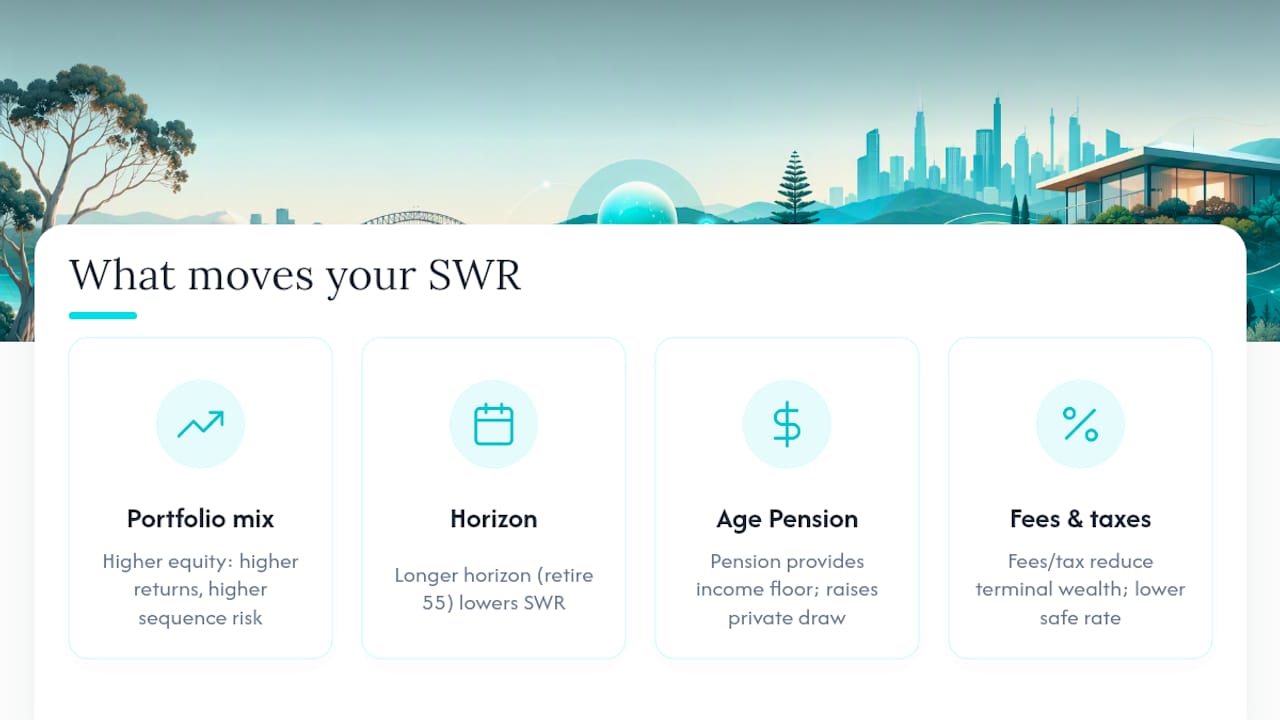
Portfolio mix. A higher equity allocation raises expected long-term returns but increases exposure to sequence-of-returns risk, the danger of a market downturn hitting in your first few retirement years. A more conservative mix trades some growth for smoother year-to-year outcomes.
Retirement horizon. Retiring at 55 means planning for a longer payout period than retiring at 67, which pushes your safe withdrawal percentage down, not up, because the money has to stretch further.
Age Pension eligibility. If you qualify for a full or part Age Pension, it acts as a floor under your income, which means your private savings don’t need to cover 100% of your living costs. That extra cushion often lets retirees safely draw a higher percentage from their own portfolio, because the pension backstops the downside.
Fees and taxes. This is the factor most retirees underestimate. Research on Australian default super plans found that tax and fees materially reduce post-tax terminal wealth, and modeling that ignores them overstates how much you can actually spend. A 1% difference in ongoing fees, compounded over 25 to 30 years, can be the difference between a sustainable plan and one that runs dry early.
Pro Tip: Run your numbers after fees and after tax, not before. A withdrawal rate that looks safe on a gross balance can be materially riskier once real costs are subtracted every year.
Withdrawal Strategies That Actually Work in Retirement
A fixed percentage withdrawn every year regardless of market performance is the simplest approach, and often the worst one. Real retirees tend to use one of a few adjustable strategies instead.
- Flexible spending. Increase your withdrawal with inflation in good years, but hold spending flat or trim it after a year of poor investment returns. This is the approach behind Morningstar’s higher 3.9% starting figure, because it shifts risk back onto the retiree’s spending rather than the portfolio’s survival.
- Floor-and-ceiling with guardrails. Set a minimum income floor you won’t drop below and a ceiling you won’t exceed, then adjust spending within that band based on portfolio performance. Guardrails trigger a spending cut or raise when the balance crosses a set threshold, which keeps decisions systematic instead of emotional.
- Partial longevity protection. Some retirees allocate a portion of savings toward a lifetime income product, effectively insuring against outliving their money, while keeping the rest invested for flexibility and growth.
Each comes with trade-offs:
- Flexible spending suits retirees comfortable with variable income and annual portfolio check-ins.
- Guardrails suit those who want structure and fewer ad hoc decisions.
- Longevity protection suits retirees more worried about outliving savings than about maximizing growth.
For a deeper look at how these approaches interact with pension eligibility and asset allocation, Aerowealth’s guide to retirement income strategies walks through the mechanics in more detail. If you want to read further on lifetime income concepts generally, East Two West’s coverage of annuities is a useful primer on how longevity products function.
How to Calculate Your Own Starting Withdrawal Rate
Work through this in order:
- Total your investable assets. Add super balances, plus any outside investments you’ll draw from in retirement. Exclude the family home.
- Estimate Age Pension entitlement. If you’ll qualify for part or full pension, that income reduces how much your private savings need to cover.
- Set your horizon. Plan for 25 to 35 years depending on your retirement age and health expectations.
- Choose a probability target. A higher target, 90% success, means a lower starting percentage. An 80% target allows a slightly higher one but carries more risk of adjustment later.
- Apply the range. Multiply your investable assets by 3.0% to 3.9%, adjusting toward the low end if you’re conservative or retiring early.
On $1,000,000, that same range spans $30,000 to $39,000.
A simple stress test: model a bad first five years of returns and see how quickly that changes your exhaustion risk. If a rough early sequence sharply raises the odds of running out, the fix is a lower starting rate or built-in guardrails.
Testing Your Withdrawal Rate Before You Commit to It
Running these numbers by hand only gets you so far, because a single percentage doesn’t capture how your specific mix of super, Age Pension timing, and any property or mortgage decisions interact over 30 years. Look for modeling that accounts for Australian super rules, integrates Age Pension means testing, applies tax on withdrawals correctly, and lets you stress-test a bad sequence of early returns against your actual balance.
Side-by-side scenario comparisons are where this gets useful in practice. Some financial planning tools build scenario modeling for Australian retirement planning, letting you test the worked example above against your own balance rather than a generic average.
Why Inflation Changes the Math More Than People Expect
A withdrawal rate isn’t a fixed dollar figure. It’s a percentage that gets adjusted for inflation year over year under most modeling approaches, which means the real risk isn’t spending too much in year one. It’s underestimating how much prices will have moved by year twenty.
A retiree drawing $30,000 a year and indexing that to inflation could see their real withdrawal climb toward $40,000 or more within a decade if inflation runs hot, even though their percentage of the portfolio hasn’t technically changed.
Building in an inflation buffer up front, rather than assuming markets and prices will behave the way they have in the calmest historical periods, reduces the odds of a painful mid-retirement spending cut. Flexible spending strategies partially solve this by tying inflation increases to portfolio performance rather than applying them automatically regardless of how markets have done. A year of poor returns paired with high inflation is the scenario that does the most damage to a fixed, inflation-indexed withdrawal plan, and it’s worth modeling explicitly rather than assuming it won’t happen during your retirement.
How Super Withdrawals Are Actually Taxed
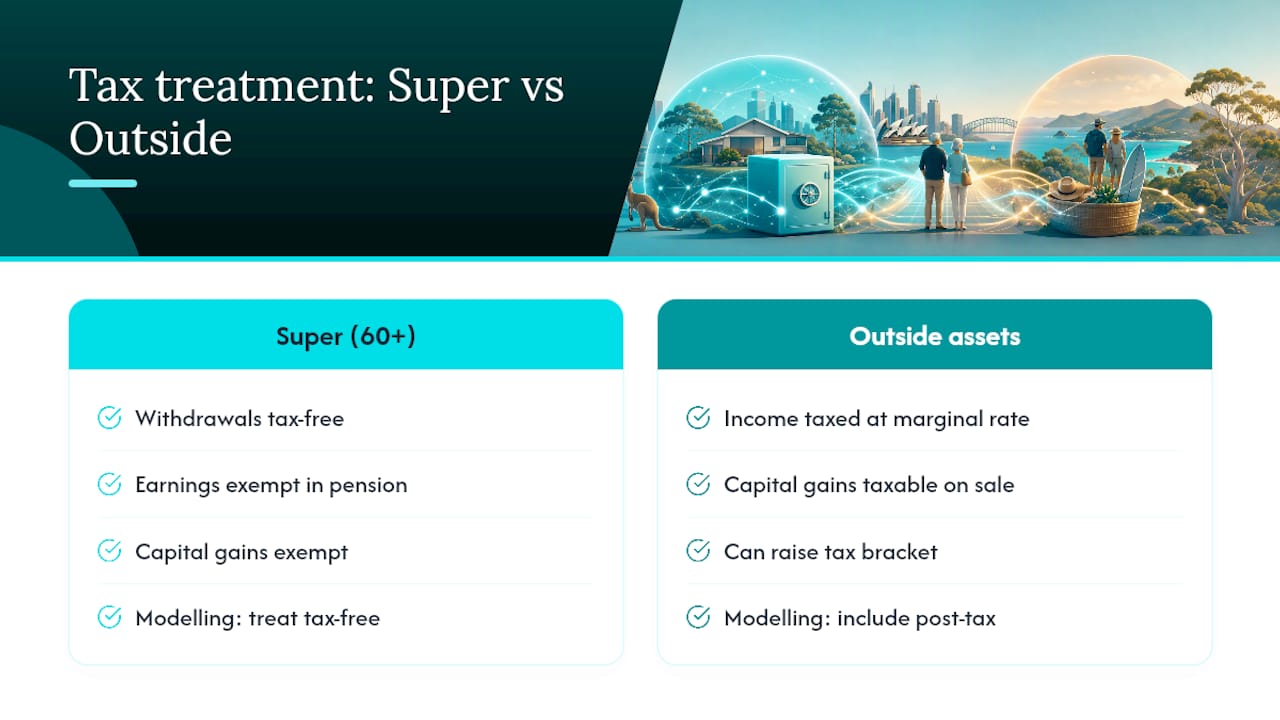
Withdrawals from a taxed superannuation fund are generally tax-free once you’re 60 or older, whether taken as a lump sum or as an account-based pension income stream. That’s a meaningful advantage over other retirement savings vehicles, and it’s part of why super remains the primary retirement vehicle for most Australians. Investment earnings inside a pension phase account are also exempt from tax, which is part of the incentive behind the minimum drawdown rules in the first place.
The tax picture gets more complicated once you look beyond super. Income from outside investments, term deposits, managed funds, or investment properties, is taxed at your marginal rate, and capital gains on non-super assets sold in retirement can create a tax event even if your super income is tax-free. Retirees drawing from a mix of super and outside investments need to sequence their withdrawals carefully to avoid pushing themselves into a higher tax bracket unnecessarily in a given year.
This is where the research on fees and tax gets practical rather than theoretical. Modeling that ignores post-tax outcomes routinely overstates what a retiree can actually spend, because a withdrawal rate calculated on gross super balances doesn’t reflect what happens once outside investment income and capital gains events are added to the picture. If your retirement income comes from several sources, a projection that treats all of it as tax-free will overstate your real spending power, sometimes significantly, depending on how much of your income sits outside super.
Planning for Healthcare Costs You Can’t Predict
Every safe withdrawal rate calculation assumes a relatively smooth spending pattern. Real retirement rarely delivers one. Healthcare costs tend to rise later in retirement, often well after the initial withdrawal rate has been set, and they don’t follow the same predictable inflation curve as everyday living expenses.
Private health insurance premiums, out-of-pocket medical costs, dental work, and aged care fees can all spike sharply in a retiree’s 70s and 80s, right when a portfolio has already been drawing down for a decade or more. A withdrawal strategy that leaves no room for these lumpy, unpredictable costs is fragile by design, even if the underlying percentage looked conservative on paper.
The practical fix isn’t a bigger percentage across the board. It’s building a separate buffer, cash or low-risk assets set aside specifically for unplanned costs, rather than assuming your regular withdrawal rate will stretch to cover a major dental procedure or a home care package. Guardrail-based strategies handle this reasonably well, since they already assume spending will flex year to year. A strict fixed-percentage approach handles it poorly, because any dip below the required minimum drawdown to cover an emergency cost still counts against the following year’s ATO obligation.
What Retirees Get Wrong About Picking a Number
Most people treat the safe withdrawal rate question like it has one correct answer, then get anxious when they can’t find it. It doesn’t have one answer. It has a range, and where you sit in that range depends on how much certainty you need versus how much flexibility you can tolerate. If you’re unsure, err toward the conservative end and build in guardrails rather than committing to a fixed number you can’t easily revise. Test your assumptions before you rely on them, ideally with a scenario tool or a licensed adviser.
— Aerowealth Team
Try Modeling Your Own Withdrawal Scenarios
This kind of tool is built for calculating how a given withdrawal rate plays out against your actual super balance, Age Pension entitlement, and tax position, rather than relying on a generic percentage that ignores your circumstances.

You can model super, investment property, mortgage offset strategies, and contribution changes side by side, then stress-test a bad early sequence of returns the same way this article described. The free plan covers the basics, and Pro unlocks bridge-year modeling for early retirement, advanced mortgage scenarios, and a higher quota on the AI assistant that explains your projections under Australian rules. Head to Aerowealth and run your own balance through the worked example above.
This article is general information, not a substitute for advice from a qualified financial advisor. Consult a qualified financial professional about your own circumstances before acting on anything here.
Sources
- Minimum pension drawdown reminder | ATO
- Higher valuations, lower safe withdrawal rate in retirement | Morningstar Australia
FAQ
Is a 6% Withdrawal Rate Safe?
It might work for a very short retirement or alongside a large Age Pension entitlement, but as a general starting point it carries a meaningfully higher risk of running out of money.
Is $1,000,000 Enough to Retire at 60?
Retiring at 60 means a longer horizon than average, so leaning toward the conservative end of that range, with guardrails, is the safer approach.
What Is a Safe Withdrawal Rate for $500,000?
Retirees relying more heavily on this balance without pension support should lean toward the lower end and reassess annually.
What Is a 4% Safe Withdrawal Rate?
Australian-specific research from Morningstar and others generally puts the locally adjusted safe rate lower, closer to 3.0% to 3.9%, due to differences in market history, fees, and tax treatment.