Australians: Up to $300,000 From Downsizing? Check Your Age Pension

Selling to downsize usually pays off when two boxes are ticked: you qualify for the ATO’s downsizer contribution, and the leftover sale proceeds won’t push you past Services Australia’s Age Pension asset thresholds. If both check out, model your actual net proceeds, not the headline sale price, and talk to the Financial Information Service before you sign anything.
TL;DR:
- Selling a home and downsizing only benefits financially if you qualify for the downsizer contribution and the sale proceeds stay below pension asset thresholds.
- Net proceeds must account for all costs, including agent commissions, stamp duty, transition expenses, and ongoing fees, to accurately plan for retirement finances.
- Aussies aged 55 or older can contribute up to $300,000 from their home sale into super without a work test or age limit, provided the home has been owned for at least 10 years.
- Selling halts the home exemption from the Age Pension asset test, meaning unspent proceeds are subject to deeming and may reduce pension eligibility.
- Carefully model sale scenarios using conservative estimates and consider risks like lower sale prices, prolonged bridging finance, and the impact on pension entitlements before acting.
Table of Contents
- Pros and Cons of Downsizing: What You Gain and What You Might Lose
- How Do You Calculate Net Proceeds From a Home Sale?
- Can You Put Sale Proceeds Into Your Super? The Downsizer Contribution Explained
- Will Selling Your House Affect Your Age Pension?
- Should You Sell First, Buy First, or Consider Other Options?
- What to Do With the Money After You Sell
- Modelling Your Downsizing Decision Before You Commit
- A Personal Note on Leaving the Family Home
- Model Your Downsizing Decision With Aerowealth
- Where to Verify the Rules Before You Sell
- Sources
- FAQ
Pros and Cons of Downsizing: What You Gain and What You Might Lose
Downsizing frees up cash, cuts maintenance, and often puts you closer to family, medical care, or public transport. Many retirees also sleep better without a mortgage or a big block of land to manage. But a smaller home is not automatically a cheaper one.
- Pros: lower utility bills, less upkeep, potential lump sum for super or investments, easier access to services
- Cons: loss of space and storage, emotional cost of leaving a long-time family home, new recurring charges like strata levies or retirement village fees
- Hidden cost trap: apartments and villas often carry strata fees, and retirement villages add entry costs plus deferred management fees that can eat into what you keep when you eventually leave
Compare annual housing costs between your current home and the new one, not just the purchase price. A unit that is significantly cheaper but carries yearly strata fees can cost more over time than staying put.
How Do You Calculate Net Proceeds From a Home Sale?
The number that matters is what lands in your account after every cost clears, not the price on the contract. Skip this step and you’ll plan a retirement around money that never shows up.
- Selling costs: agent commission (typically 1.5–3%), marketing, staging or repairs, and conveyancing fees, which commonly total $20,000 to $40,000 on a median home
- Acquisition costs: stamp duty on the new property, legal fees, building and pest inspections
- Transition costs: bridging finance interest if you buy before you sell, temporary rental, storage, or running two properties at once
Pro Tip: Run at least two scenarios: one where you sell low and buy high, and one where bridging finance drags on three months longer than planned. If both still leave you comfortable, you’ve got a genuine buffer, not just a hopeful spreadsheet.
Mapping out the full flow, sale proceeds minus selling costs, minus acquisition costs, plus transition costs, gives you a realistic figure to work with for super contributions, investments, or a cash reserve.
Can You Put Sale Proceeds Into Your Super? The Downsizer Contribution Explained
Yes, and it’s one of the few super strategies with no work test and no upper age limit. Under current ATO rules, Australians aged 55 or older can contribute a substantial amount each (up to three hundred thousand dollars per person) from the sale of their main residence into super.
- You must have owned the home for at least 10 years and it must qualify as your main residence
- The contribution generally needs to happen within 90 days of receiving the sale proceeds, and it doesn’t count toward your non-concessional contribution caps
- You must submit the approved ATO downsizer contribution form to your super fund before or at the time of the contribution, otherwise the fund may reject it outright
- Check how the contribution interacts with your Transfer Balance Cap and total super balance, since it can push you over pension-phase limits even if you’re under the general cap
Getting the paperwork wrong is a common, avoidable mistake. Aerowealth’s downsizer contribution guide walks through the form and timing in more detail if you want to double check your own situation.
Will Selling Your House Affect Your Age Pension?
While you live in it, your home is exempt from the Age Pension assets test. The moment you sell, that protection disappears for whatever you don’t reinvest in a new principal home.
Under 2026 Services Australia rules, a single homeowner can hold up to $314,000 in assets and still get the full pension, with a cut-off around $697,000; for couples, the full-pension limit sits at $470,000 with a cut-off near $1,047,500.
Sale proceeds not spent on a new home get assessed as financial assets and are subject to deeming, meaning Centrelink assumes a rate of return on that money whether you’re earning it or not. There’s a time-limited exemption for funds you’ve earmarked to buy a replacement home, but once that window closes or the funds sit unallocated, they’re assessed. Before you settle, contact the Financial Information Service for a tailored estimate. It’s a free service and it can save you from a nasty pension surprise a few months after moving day.
Should You Sell First, Buy First, or Consider Other Options?
Selling first gives you certainty on price and cash in hand, but you risk scrambling for temporary housing or overpaying under time pressure. Buying first locks in your new home but exposes you to bridging finance costs and the risk your old home sells for less than expected.
- Reverse mortgage: keeps you in place, but interest compounds and reduces your estate over time
- Renting instead of buying: frees up more capital but removes the security of ownership and exposes you to rent increases
- Staying and renovating: avoids transaction costs entirely but doesn’t solve upkeep or location issues
- Retirement village: often includes lifestyle and care benefits, but entry fees and deferred management fees vary by contract and state, so read the fine print before assuming it’s cheaper
Base your decision on how urgently you need to move, how much cash certainty you need, your pension status, and how comfortable you are carrying bridging finance. Model each path before committing to one.
What to Do With the Money After You Sell
Once settlement clears, lodge your downsizer form promptly if you’re eligible, and set aside a contingency for costs that always run higher than the quote. Talk to a tax adviser about capital gains tax, since your main residence is generally CGT exempt, but edge cases like extended rental periods or a home used partly for business can change that.
Decide what’s short-term (a cash buffer for the move and early retirement years) versus long-term (super contributions or conservative investments), and factor in the timing rules on each. It’s also worth setting aside a portion for possible future aged-care costs and updating your will and estate plan to reflect the new asset mix.
Modelling Your Downsizing Decision Before You Commit
Numbers on a real estate listing don’t tell you what you’ll actually keep. A proper scenario model does, factoring in sale price sensitivity, transaction costs, how proceeds affect pension income, and any downsizer contribution and Transfer Balance Cap implications together.
A practical checklist to run yourself or bring to an adviser: model a conservative and an optimistic sale price, factor in full transaction costs, test the pension impact under current deeming rates, and check how much fits under your downsizer contribution limit without breaching your Transfer Balance Cap.
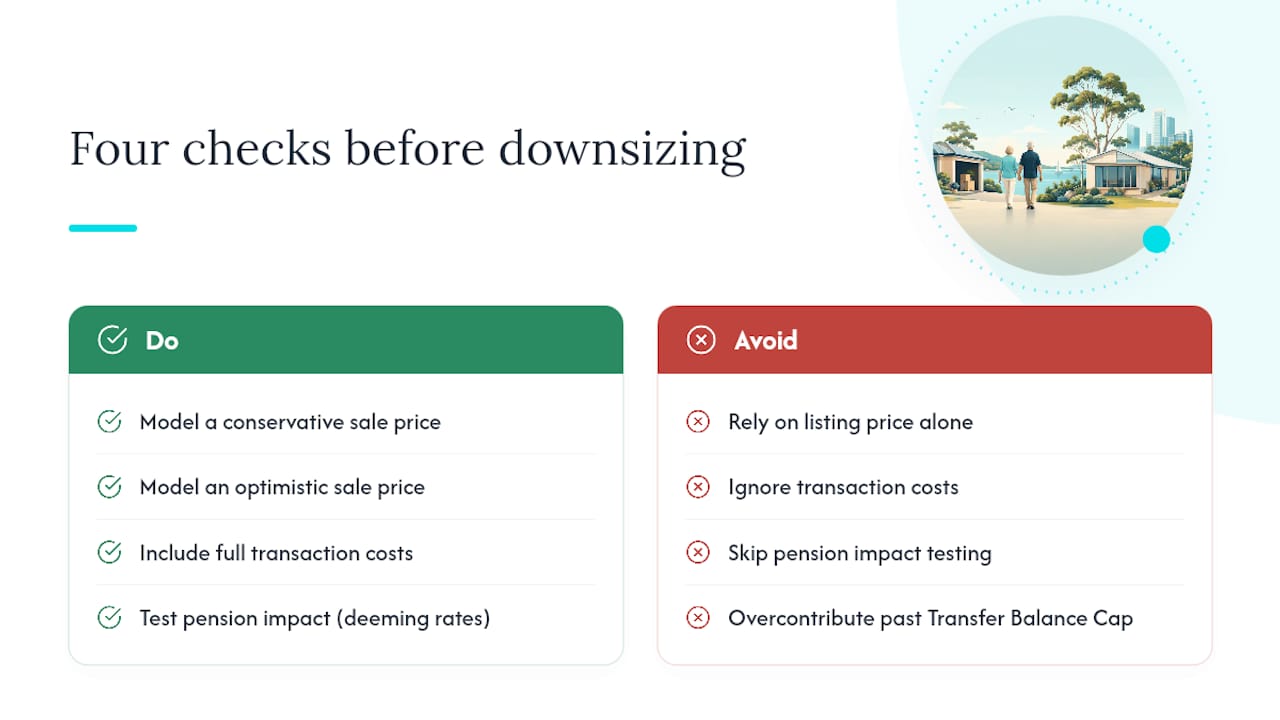
Pro Tip: Some financial planning tools let you build side-by-side scenarios for exactly this, comparing a “sell and downsize” plan against “stay put” using Australian super and pension rules, so you see net outcomes rather than guesswork.
A Personal Note on Leaving the Family Home
Leaving a home you’ve raised a family in isn’t just a financial transaction, and no spreadsheet accounts for that grief properly. What we’d urge is this: let the numbers, not the nostalgia or the sales pitch, decide the timing. Get your net proceeds modelled, get a read from the Financial Information Service, and only then decide if the headline sale price actually means what you think it means.
— Aerowealth Team
Model Your Downsizing Decision With Aerowealth
If you’ve read this far, you already know the real risk isn’t the sale itself, it’s discovering after settlement that your pension dropped more than expected or your downsizer contribution triggered a Transfer Balance Cap issue you didn’t see coming. Aerowealth is built to catch that before it happens, letting you build a “sell and downsize” scenario next to a “stay put” scenario and see the difference in retirement income, super balance, and net worth side by side.

It doesn’t replace your accountant or the Financial Information Service, it gives you a clear picture to bring into those conversations instead of a rough guess on a napkin. You can also stress test assumptions like a lower sale price or a longer bridging period to see how much cushion you actually have. If you’re weighing whether to sell your home to downsize for retirement, try Aerowealth’s scenario modelling and see your numbers before you sign a contract.
Where to Verify the Rules Before You Sell
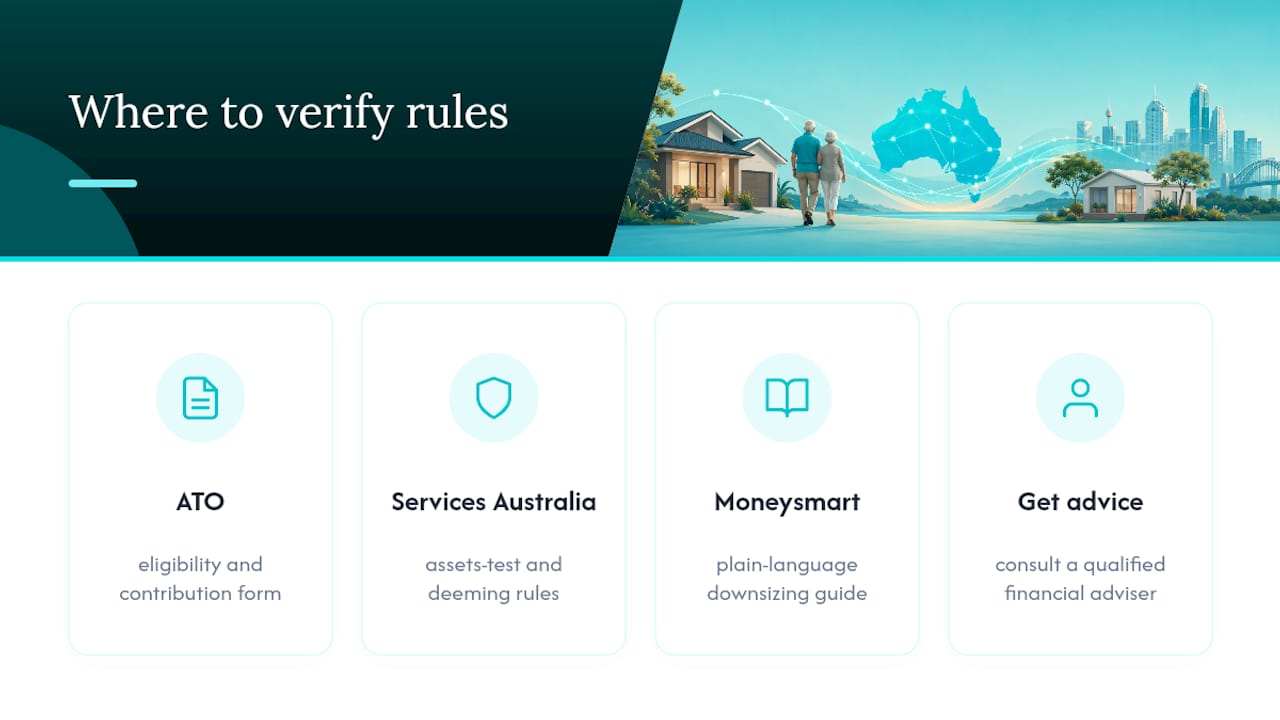
Check the ATO’s downsizer contribution page for eligibility and the current contribution form. Review Services Australia’s assets test guidance and its deeming rules for how sale proceeds get assessed. Moneysmart’s downsizing guide covers the lifestyle side in plain terms. If you’re selling and need practical tips on presenting the property, this guide on selling property in any condition is a useful starting point.
This article is general information, not a substitute for advice from a qualified financial advisor. Consult a qualified financial professional about your own circumstances before acting on anything here.
Sources
- Downsizer contributions — Australian Taxation Office
- Assets test for Age Pension — Services Australia
- Downsizing in retirement — Moneysmart (ASIC)
FAQ
Will I lose my Age Pension if I sell my house?
Not automatically, but any sale proceeds you don’t reinvest in a new principal home become assessable financial assets under deeming rules, which can reduce or eliminate your pension if they push you over the Services Australia asset-test thresholds.
What are the current rules for pensioners downsizing in Australia?
Eligible retirees aged 55 and over can contribute up to $300,000 each ($600,000 per couple) from a home sale into super under the ATO’s downsizer contribution rules, while unspent proceeds are assessed against pension thresholds.
How do I avoid selling my house to pay for aged care?
There’s no guaranteed way to avoid it entirely, but options like a reverse mortgage, renting out the home, or drawing on super and other assets first can delay or reduce the need to sell; speak with the Financial Information Service and an aged-care financial adviser about your specific situation.
What is the best age to downsize your home?
There’s no single ideal age. It depends on your health, mobility, super balance, and whether you meet the downsizer contribution’s 10-year ownership rule, but many retirees choose to act while healthy enough to manage the move themselves, often in their early to mid sixties.