July 1, 2026: $2.1M Transfer Balance Cap Explained for Australians

The transfer balance cap limits how much super you can move into a tax-free retirement-phase pension, and from July 1, 2026, the general cap rises to $2.1 million. Anything above your personal cap stays in accumulation, where earnings are taxed at up to 15%, or gets paid out as a lump sum. For most people approaching retirement, this single number determines how much of their nest egg actually gets to grow tax-free.
TL;DR:
- Your personal transfer balance cap is set when you first start a pension and may be lower than the upcoming $2.1 million general cap increase, depending on when you began.
- Only new credits, such as starting a pension or receiving a death benefit income stream, count toward your transfer balance account; investment growth does not trigger a breach.
- Exceeding your personal cap results in a tax on notional earnings and requires prompt action to commute or withdraw the excess; delays increase tax liabilities.
- The 2026 cap increase to $2.1 million primarily benefits those who have not fully utilized their current unused cap percentage by allowing more future indexation.
- Delaying pension start might reduce future indexation benefits if your unused cap percentage is low, so modeling your timing options is crucial before making decisions.
Table of Contents
- What Is the Transfer Balance Cap and How Does It Work?
- How Has the General Transfer Balance Cap Changed Over Time?
- Why Your Personal Cap Might Be Lower Than $2.1 Million
- What Is the Transfer Balance Account and How Do You Check Yours?
- What Counts Toward the Cap, and What Doesn’t
- What Happens If You Exceed Your Transfer Balance Cap
- Planning Around the 2026 Cap Increase
- Where to Check the Official Rules and Your Own Details
- Our Take: The Cap Increase Matters Less Than Your Timing Decisions
- Sources
- FAQ
What Is the Transfer Balance Cap and How Does It Work?
The transfer balance cap (TBC) sets a ceiling on how much super you can shift from a regular accumulation account into a retirement-phase pension, where investment earnings and pension payments are tax-free. It has applied since July 1, 2017, and it exists because unlimited tax-free pensions would have let wealthy retirees park unlimited millions in a zero-tax structure indefinitely.
The mechanics are simpler than the name suggests. Think of it as a ledger. Every time you start a pension or add to one, the Australian Taxation Office (ATO) credits that amount to your transfer balance account. Every time you commute a pension back to accumulation or take a lump sum, it’s debited. The running total against your personal cap decides whether you have room to move more money into retirement phase.
A few things worth locking in before you go further:
- Accumulation accounts are taxed at up to 15% on earnings; retirement-phase pensions pay zero tax on earnings and pension income.
- The cap applies per person, not per account, so multiple pension accounts across different funds all count against the same limit.
- Breaching the cap doesn’t cancel your pension. It triggers a tax bill and a required correction, which we cover further down.
Once you understand this credit and debit system, the rest of the transfer balance cap explained framework starts to click into place.
How Has the General Transfer Balance Cap Changed Over Time?
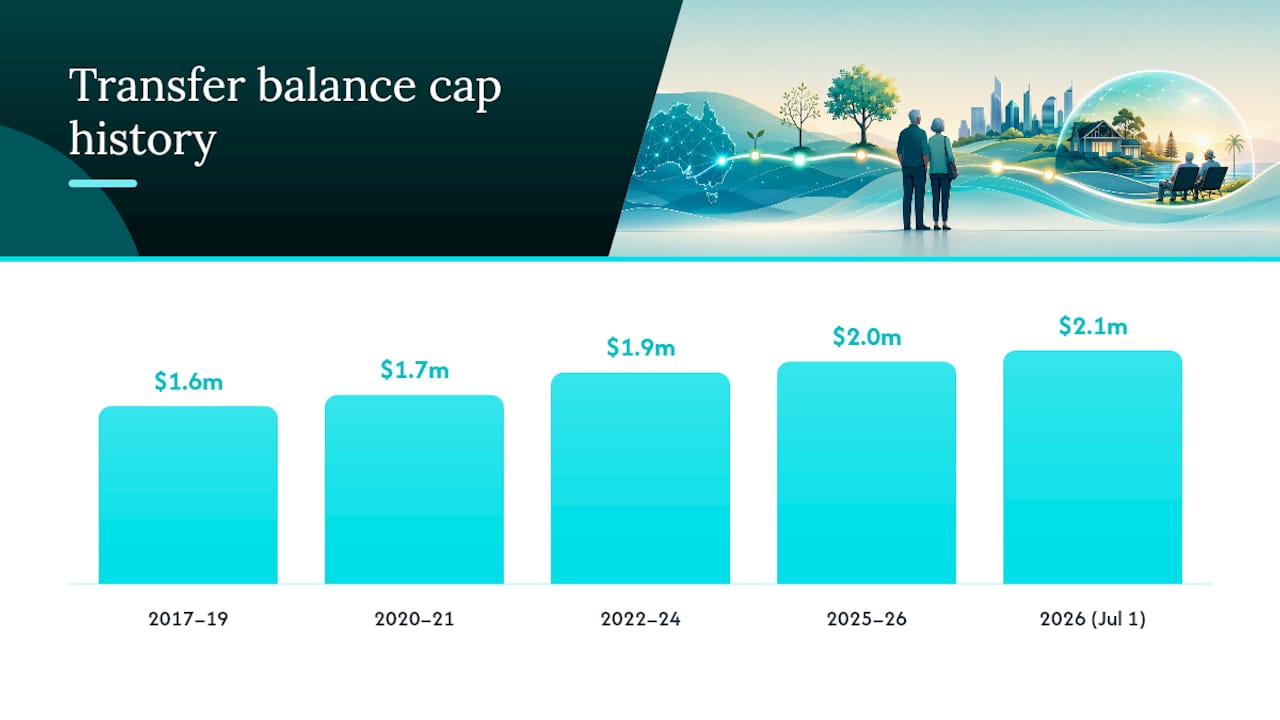
The general cap has climbed steadily since 2017, and the jump due on July 1, 2026, is the largest single increase so far.
| Financial Year | General Transfer Balance Cap |
|---|---|
| 2017 to 2019 | $1.6 million |
| 2020 to 2021 | $1.7 million |
| 2022 to 2023 | $1.9 million |
| 2024 | $1.9 million |
| 2025–26 | $2.0 million |
| 2026 | $2.1 million |
Indexation is tied to CPI and moves in $100,000 increments. The ATO only lifts the cap once inflation has pushed the calculation past a full $100,000 step, which is why some years see no change at all.
The general cap is increasing to $2.1 million on July 1, 2026, up from $2.0 million. That’s the fourth increase since the cap was introduced at $1.6 million in 2017, and it directly reshapes how much room high-balance retirees have to work with.
Why Your Personal Cap Might Be Lower Than $2.1 Million
Here’s where a lot of retirees get caught out: your personal transfer balance cap is not automatically $2.1 million just because that’s the current general cap. It’s set the moment you first start a retirement-phase income stream, and it locks in at whatever the general cap was on that date.
If you started your first pension back in 2020 when the general cap sat at $1.7 million, your personal cap started at $1.7 million too. Whether it ever climbs toward $2.1 million depends entirely on proportional indexation, which hinges on three things:
- Highest-ever balance: the largest amount your transfer balance account has ever recorded, not your current balance.
- Used cap percentage: your highest-ever balance divided by the general cap that applied at the time, expressed as a percentage.
- Unused cap percentage: 100% minus your used cap percentage, rounded down to the nearest whole percent.
Only your unused percentage gets applied to future indexation increases. The ATO’s own calculation method requires that rounding-down step before you multiply by the $100,000 increment.
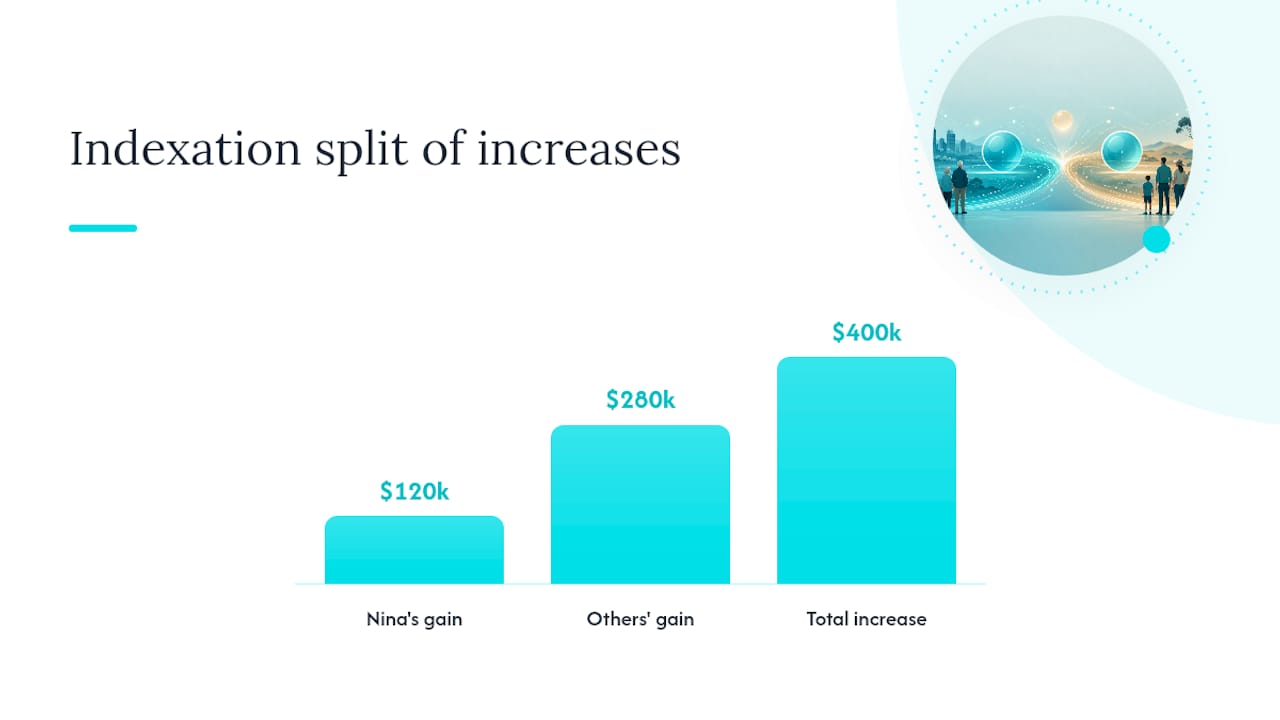
Here’s a worked example. Say Nina started a pension in 2020–21 with $1.19 million, when the general cap was $1.7 million. When the cap later steps up by $400,000 in total across subsequent increases, Nina’s personal cap only grows by 30% of that $400,000, or $120,000, not the full amount.
Pro Tip: If you’ve never fully used your transfer balance cap, delaying your first pension start can actually work against you, not for you, because your personal cap gets locked in at whatever the general cap is on that day. Model the trade-off before assuming “later is better.”
The reverse also matters: once your transfer balance account has ever hit 100% of the general cap that applied at the time, you permanently lose entitlement to any future indexation, regardless of what your balance does afterward.
What Is the Transfer Balance Account and How Do You Check Yours?
Your transfer balance account (TBA) is the running ledger the ATO keeps against your personal cap. You have exactly one, no matter how many super funds or pension accounts you hold, and it tracks every credit and debit that touches your retirement-phase pensions for life.
Common credits include:
- Starting an account-based pension or annuity in retirement phase
- Receiving a death benefit income stream from a deceased spouse or dependant.
- A transition-to-retirement income stream (TRIS) converting to retirement phase, usually once you turn 65 or meet a condition of release.
- Certain repayments related to limited recourse borrowing arrangements (LRBAs) inside self-managed super.
Common debits include commuting a pension back to accumulation, a family law payment split reducing your balance, and structured settlement contributions being removed from the count.
To check your own numbers, log into myGov, link it to the ATO if you haven’t already, then go to ATO online services and select Super followed by Transfer balance cap. That page shows your personal cap, your current transfer balance account total, and any available cap space. If a reported figure looks wrong, contact your super fund directly, since funds report the figures the ATO relies on.
What Counts Toward the Cap, and What Doesn’t
This is where the transfer balance cap explained conversation usually breaks down for people, because the rule sounds straightforward until investment returns get involved.
What counts as a credit:
- The amount you transfer into retirement phase when you start a pension.
- Special values calculated for capped defined benefit income streams, which use a formula rather than a simple account balance.
- Death benefit income streams, generally credited around 12 months after the date of death in many cases, which gives beneficiaries a short window to plan before that credit lands.
What does not count:
- Investment growth your pension earns after the transfer has already happened.
- Pension payments you draw down, since spending from the account doesn’t reduce your recorded transfer balance.
A pension that started at $1.9 million and has since grown to $2.4 million through investment returns has not breached anything, because that growth was never a new credit. Only fresh transfers into retirement phase create credits, confirms the ATO’s transfer balance account guidance. This is the single most misunderstood part of the whole system, and it’s genuinely good news: strong markets don’t punish you here.
Defined benefit special values are trickier. If you’re combining a capped defined benefit pension with an account-based pension, the special value rules can force you to commute part of the account-based pension even when the defined benefit itself creates no commutable cash.
What Happens If You Exceed Your Transfer Balance Cap
Going over your personal cap doesn’t trigger an automatic penalty payment, but it does start a clock. The ATO issues an excess transfer balance determination once it identifies a breach, and from that point, notional earnings on the excess amount accrue and get taxed until you fix it.
The tax rates are fixed: 15% on notional earnings for a first-time breach, rising to 30% for any subsequent breach, according to SuperGuide’s breakdown of the excess transfer balance rules.
You generally have two ways to fix it:
- Commute the excess amount back into accumulation phase.
- Withdraw the excess as a lump sum from your super fund entirely.
If you don’t act within the required timeframe, the ATO can issue a commutation authority directly to your super fund, forcing the fund to release the excess amount on your behalf, whether you’ve made a decision or not.
If you get a determination notice, move fast:
- Contact your super fund immediately to confirm the reported balance and available options.
- Talk to a tax adviser about whether commuting or withdrawing suits your broader tax position.
- Check whether the breach came from a reporting error rather than an actual transfer, since fund reporting mistakes do happen.
Planning Around the 2026 Cap Increase
The $2.1 million general cap arriving on July 1, 2026, is a planning trigger, not just a number to note. A few concrete moves are worth working through before that date.
Start with your own numbers. Check your highest-ever transfer balance account figure through myGov, since that single figure determines your used and unused cap percentages for every future indexation event, or try an online retirement calculator for a quick projection. If you haven’t started a pension yet, timing matters more than most people assume. Starting later can mean a higher personal cap if the general cap has risen since your fund balance grew, but it can also mean missing years of tax-free earnings. There’s no universal right answer here, which is exactly why this needs modelling rather than guessing.
The cap increase also ripples into contribution planning. Non-concessional contribution eligibility and bring-forward thresholds are both measured against your total super balance relative to the general cap on June 30 each year, so the 2026 shift to $2.1 million changes who qualify for larger bring-forward contributions going into the following financial year.
Death benefit timing deserves a look too. If you’re likely to receive a death benefit income stream from a spouse, understand that the roughly 12-month credit window gives you time to restructure your own pensions first, rather than getting caught with two large balances colliding against your cap at once.
This is precisely the kind of decision that’s hard to eyeball on a spreadsheet, because it involves multiple moving variables: your highest-ever balance, projected indexation, contribution timing, and how a commutation would ripple through your income for the next decade. Running the numbers through a transfer balance cap strategy model shows you the actual dollar impact of starting your pension now versus in two years, side by side, instead of leaving it to guesswork.
Pro Tip: Save a screenshot of your super fund’s pension confirmation letter and your myGov transfer balance account page on the day you commence any pension. It’s the cleanest record you’ll have if a reported figure is ever disputed years later.
Where to Check the Official Rules and Your Own Details
For the current cap table and indexation rules, the ATO’s transfer balance cap page is the primary source, alongside its dedicated transfer balance account page for credit and debit definitions.
To see your own personal cap and balance, log in through myGov and navigate to ATO online services. For worked examples that walk through proportional indexation step by step, SuperGuide’s retirement coverage is a reliable plain-English companion to the ATO’s own technical guidance.
Our Take: The Cap Increase Matters Less Than Your Timing Decisions
Most coverage of the 2026 cap increase treats the new $2.1 million figure as the headline. It isn’t, not really. The number that actually shapes your retirement outcome is your own unused cap percentage, and that’s determined by decisions you made years ago, or are about to make now.
Conventional advice tends to tell people to “start your pension as soon as you’re eligible.” That’s often wrong. If the general cap is likely to keep climbing and your balance hasn’t hit your current personal cap, starting later can preserve more future indexation. If you’re sitting on a balance close to your cap already, waiting costs you tax-free growth for no benefit. There’s no single right timing, which is exactly the problem with generic guidance.
What we’d prioritize first: pull your highest-ever balance figure from myGov today, and run the actual numbers, both timing scenarios, before assuming either path is obviously better. A gut call on a six or seven figure decision is a bad habit even smart people fall into.
— Aerowealth Team
This article is general information, not a substitute for advice from a qualified financial advisor. Consult a qualified financial professional about your own circumstances before acting on anything here.
Sources
- Transfer balance cap | Australian Taxation Office
- Transfer balance cap (TBC) for super pensions: How it works | SuperGuide
FAQ
Can I Retire at 60 With $600,000 in Super?
Yes, though your balance sits well under the $2.1 million cap so the transfer balance cap itself won’t restrict you. The real question is whether that balance, combined with the Age Pension and other assets, funds the income you need, which is a cash flow question, not a cap question.
How Many People in Australia Have $1 Million or More in Super?
The ATO doesn’t publish this figure in the transfer balance cap materials, and reliable current counts vary by source, so it’s best treated as a moving target tied to super balance growth over time rather than a fixed number.
What Happens if My Super Balance Is Over $1.9 Million?
Having a total super balance over $1.9 million doesn’t automatically breach anything, since the transfer balance cap only limits how much you move into retirement-phase pensions, not your total accumulation balance. It can, however, affect your non-concessional contribution eligibility for that financial year.
What Is the Transfer Balance Cap for 2026?
The general transfer balance cap is $2.0 million for the 2025–26 financial year, rising to $2.1 million from July 1, 2026. Your personal cap may be lower depending on when you first started a pension and your unused cap percentage.