3% Inflation Halves Retirement Buying Power — Model Australian Scenarios

Yes, inflation will quietly cut your retirement purchasing power, and it does it every single year you’re drawing down. Inflation in retirement planning is not a side variable; it’s the factor that decides whether your savings last 20 years or 30. Start with three moves: check the inflation assumption baked into your current numbers against ABS CPI data, lock in an inflation-protected income floor for essentials, and stress test your plan with a tool like AeroWealth before you settle on a drawdown rate.
TL;DR:
- Most retirement plans default to 2% to 4% inflation assumptions, but small differences in this range can significantly impact the required savings over 30 years.
- Healthcare, housing, and utilities costs tend to rise faster than general inflation, making it essential to account for category-specific price increases when planning.
- Combining inflation-protected assets like CPI-linked annuities and the Age Pension helps create a reliable income floor that adjusts automatically for inflation.
- Regularly stress testing your plan against different inflation scenarios, including shocks and market downturns, is crucial to ensure long-term sustainability.
- Updating your inflation assumptions annually and after significant CPI or rate changes helps maintain an accurate, resilient retirement strategy.
Table of Contents
- How inflation erodes retirement income and why retirees are especially vulnerable
- Common inflation assumptions used in planning and where to source them
- Practical strategies to protect retirement income from inflation
- Adjusting spending and withdrawal strategy to preserve real purchasing power
- Using modelling and scenario tools to test inflation outcomes
- Step-by-step checklist to update your retirement plan for inflation
- Balancing protection and lifestyle in retirement
- Model Your Own Inflation Scenarios With AeroWealth
- Sources
- FAQ
How inflation erodes retirement income and why retirees are especially vulnerable
Inflation doesn’t feel dramatic day to day. It’s a slow leak, not a burst pipe, and that’s exactly what makes it dangerous for people living off a fixed pool of savings.
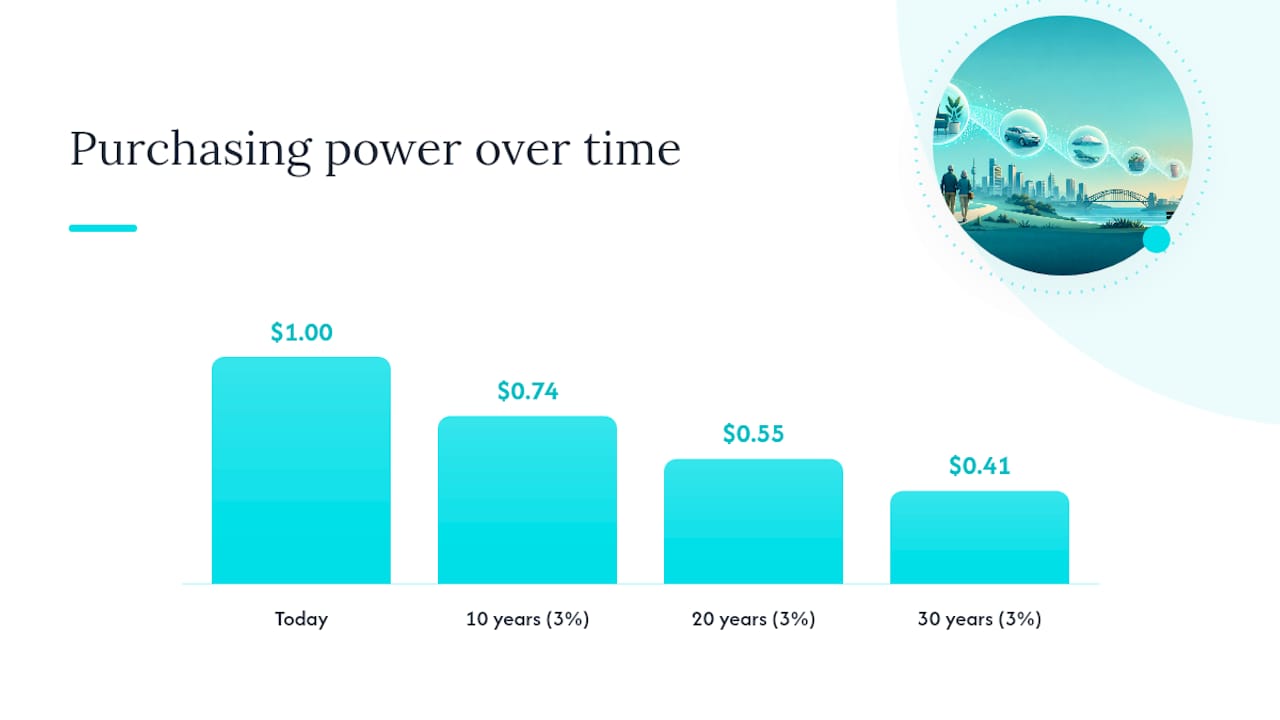
Run the math on even a modest rate. At 3% inflation, a dollar today buys about 74 cents of goods in ten years and roughly 55 cents in twenty. Stretch that to a 30-year retirement (entirely plausible if you retire at 60 and live into your 90s) and that same dollar buys around 41 cents worth. Someone who needs $70,000 a year to live comfortably today will need substantially more in nominal terms by year 30, just to maintain the same lifestyle.
Retirees face a second, nastier problem: sequencing risk. If a market downturn hits early in retirement at the same time inflation spikes, you’re forced to sell more assets at depressed prices just to cover rising costs. That one-two punch did real damage historically. Morningstar’s analysis of past inflation shocks found that retirees relying on equity-linked income saw real income fall around 30.7% during the 1970s inflation surge, and it took roughly nine years to recover. Nine years is a long time to live on less when you’re already retired.
The Age Pension offers a partial buffer here, but it’s not instant protection. Payments are indexed to movements in prices and wages twice a year, in March and September, through Services Australia’s indexation rules. That lag means there’s always a window, sometimes several months, where your pension hasn’t caught up to what things actually cost.
Not every expense inflates at the same pace, either. Some categories move much faster than the headline CPI number suggests:
- Health care and aged care costs tend to rise faster than general inflation, especially as you age and need more services.
- Housing costs (rates, insurance, maintenance, strata fees) climb steadily and rarely drop back.
- Groceries and utilities track close to headline CPI but spike hard during supply shocks.
- Discretionary spending (travel, dining, hobbies) is the one category you actually control and can trim when needed.
That last point matters more than most retirees realize: your essential spending is the piece inflation attacks hardest, and it’s also the piece you have the least flexibility to cut.
Common inflation assumptions used in planning and where to source them
Most retirement calculators default to somewhere between 2% and 4% annual inflation, and that range isn’t cosmetic. It changes your required nest egg by a meaningful margin.
A retiree assuming 2.5% inflation over 30 years will project a very different savings target than one assuming 4%. The gap compounds. On a $70,000 annual spending base, the difference between those two assumptions can mean needing several hundred thousand dollars more saved just to maintain the same real income for three decades.
Where should that assumption actually come from? The ABS monthly CPI indicator is the most current, authoritative read on where prices are actually moving. For a longer-term view of what markets expect inflation to average over coming years, the RBA’s inflation calculator and its breakeven inflation context give a practical way to test purchasing-power impacts rather than guessing.
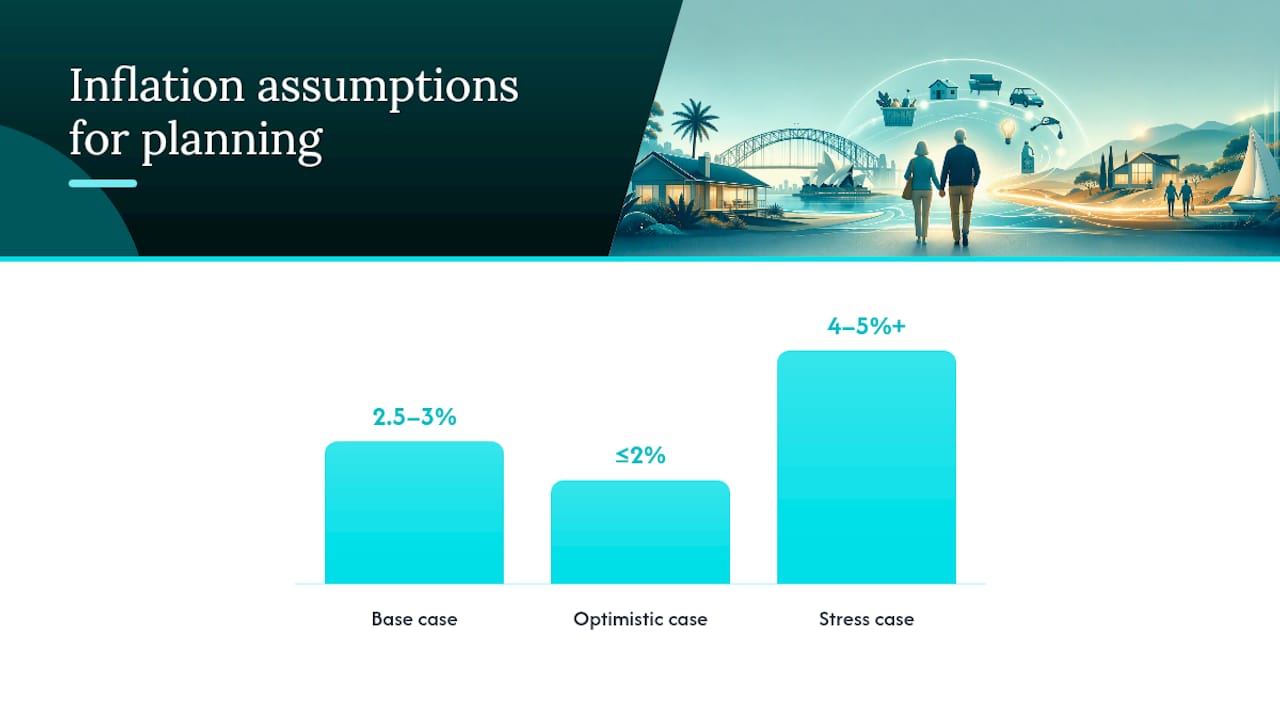
Good modelling doesn’t use one number. It uses three:
| Scenario | Typical inflation assumption | Planning purpose |
|---|---|---|
| Base case | 2.5% to 3% | Reflects the RBA’s long-run target band; used for most-likely projections |
| Optimistic case | 2% or below | Tests upside if inflation stays subdued longer than expected |
| Stress case | 4% to 5%+ | Models a shock scenario similar to recent inflation surges |
Academic work on retirement modelling backs this discipline. A journal analysis published through the Financial Planning Association argues that mismatched nominal and real calculations are one of the most common errors in retirement projections, and that a consistent inflation-adjusted method produces materially different (and more reliable) outcomes.
One more habit worth building: re-run your plan whenever there’s a significant CPI print or an RBA rate move. ASFA’s Retirement Standard itself isn’t fixed; it’s a moving target that Morningstar has flagged as rising with sustained inflation, with the comfortable retirement figure for a single homeowner being updated regularly and recently indicated at around $630,000 in early 2026 terms. If the benchmark moves, your plan should too.
Practical strategies to protect retirement income from inflation
Protecting your income from inflation isn’t one decision. It’s a combination of asset choices, income products, and a few behavioral levers that most retirees overlook.
- Tilt part of your portfolio toward inflation-friendly assets. Infrastructure, commodities, and real estate have historically tracked or outpaced inflation better than cash and fixed-rate bonds, because their underlying revenue (tolls, rents, resource prices) tends to rise with the cost of living.
- Add a dedicated inflation-protected income component. Relying on growth assets alone to cover essential spending is risky. Industry analysis consistently recommends combining the Age Pension, an account-based pension, and a CPI-linked lifetime annuity as a defense mix, since the annuity’s payments rise directly with CPI rather than depending on market performance.
- Treat the Age Pension as your inflation-indexed floor. Even with its timing lags, it’s one of the few income sources in your plan that automatically adjusts to price and wage movements, which makes it worth structuring the rest of your plan around rather than treating as an afterthought.
- Use non-investment levers too. Paying down a mortgage before retirement removes a fixed, inflation-exposed liability from your budget. Deferring retirement by even a year or two lets super balances keep compounding while you delay drawdown. Reallocating discretionary spending during high-inflation years (fewer overseas trips, more local ones) buys breathing room without touching capital.
Pro Tip: Don’t try to inflation-proof your entire portfolio. Focus the protection on the income covering essentials (housing, food, health care) and let growth assets do their job on the discretionary side. Trying to hedge everything usually means giving up long-term returns you didn’t need to sacrifice.
None of these levers work in isolation. A CPI-linked annuity that covers your grocery and utility bills, layered under an Age Pension entitlement, does more for your peace of mind than an extra 1% in expected portfolio return. That combination is also what tends to increase confidence to actually spend the money you’ve saved, rather than hoarding it out of fear.
Adjusting spending and withdrawal strategy to preserve real purchasing power
The inflation rate you assume changes how long your money lasts, sometimes dramatically. Illustrative modelling from SuperGuide shows that a lump sum drawn down at a fixed nominal amount can run out years earlier under a 4% inflation path compared to a 2.5% path, even with identical starting balances and investment returns.
That’s why a fixed withdrawal rate set once at retirement and never revisited is a fragile strategy. A better approach uses guardrails:
- Set a target withdrawal rate, then define an upper and lower band around it (say, 10% either side).
- If your portfolio outperforms and inflation stays mild, you have room to increase spending.
- If inflation runs hot or markets fall, the guardrail signals it’s time to trim discretionary spending before touching the capital base.
- Prioritize cutting travel and leisure spending first; only reduce essential spending as a last resort, since that’s harder to claw back later.
- Hold a cash buffer of one to two years of essential expenses so you’re not forced to sell growth assets during a downturn just to fund monthly bills.
Rebalancing on a regular cadence (annually is common) rather than reactively also matters more than most people assume. It keeps your asset mix aligned with your risk tolerance instead of drifting toward whatever performed best last year. For a deeper look at structuring withdrawals against these pressures, see this guide to retirement income strategies.
Using modelling and scenario tools to test inflation outcomes
Abstract inflation risk becomes manageable the moment you can see it on a chart next to your actual numbers. That’s the entire point of running scenarios rather than relying on a single static projection.
The inputs worth testing are specific:
- Multiple inflation paths (base, optimistic, stress) rather than one flat assumption.
- A range of investment return sequences, including a poor-returns-early scenario.
- A combined shock: inflation spike plus market downturn hitting in the same year.
- Different drawdown rates and how each holds up under each inflation path.
Side-by-side comparison is what turns this from guesswork into a decision. Rather than asking “what if inflation is higher,” you can put a 2.5% path next to a 4% path and watch exactly where and when your projected balance diverges. AeroWealth’s modelling tools build this comparison directly around superannuation balances, property holdings, and mortgages, so the scenario reflects your actual financial structure rather than a generic template.
For anyone considering retiring before their super preservation age, bridge-mode modelling matters even more, since it isolates the years where you’re funding life entirely from outside super, precisely the period where an inflation miscalculation does the most damage. The platform also factors in CGT and tax implications alongside Age Pension interactions, which most spreadsheet-based approaches skip entirely.
Some users who run these stress tests report high planning success rates before finalizing their retirement age and drawdown plan, a reminder that the value isn’t in predicting inflation precisely; it’s in knowing how your plan holds up across the range of paths inflation could actually take.
Step-by-step checklist to update your retirement plan for inflation
Updating an existing plan for inflation risk doesn’t require starting over. It requires working through a short, deliberate sequence.
- Audit your current assumptions. Pull up your existing plan and check what inflation rate and return assumptions it’s actually using; many older plans default to figures set years ago.
- Run three scenarios, not one. Model a base case, an optimistic case, and a stress case, then compare how each affects your projected retirement age and income.
- Secure an inflation-protected income floor. Confirm your essential expenses (housing, health, groceries) are covered by a combination of Age Pension and any CPI-linked income product, independent of market performance.
- Set withdrawal guardrails. Define the spending band you’ll operate within and decide in advance what triggers a cut to discretionary spending.
- Schedule an annual review. Put a date in your calendar to re-check your plan against the latest CPI data, not just when markets move.
Balancing protection and lifestyle in retirement
The biggest inflation-related mistake we see isn’t poor asset allocation. It’s underspending driven by fear.
Retirees who worry about inflation eating their savings often respond by spending less than their plan actually allows, sometimes far less. That instinct is understandable, but it usually produces the opposite of a good outcome: years of unnecessary frugality followed by a large, unused balance at the end of life.
The fix isn’t to ignore inflation risk. It’s to protect the essential layer of your income explicitly, through the Age Pension, CPI-linked products, or both, so the discretionary layer can be spent with actual confidence. Once your essentials are covered regardless of what CPI does next quarter, the psychological permission to spend on the things you retired for tends to follow.
We’d also push back gently on the idea that this is a “set and forget” exercise. Modelling your plan once at retirement and never touching it again defeats the purpose. Revisit the numbers periodically, and loop in a financial adviser for the decisions with tax or Centrelink implications that a model alone shouldn’t make for you. For more on reframing this mindset day to day, this guide to budgeting in retirement is a useful next stop.
— Aerowealth Team
Model Your Own Inflation Scenarios With AeroWealth
Spreadsheets can handle one inflation assumption at a time, badly.

Build a base case, an optimistic case, and a stress case, then compare the projected outcomes without reworking a single formula. The bridge-mode feature is particularly useful if you’re planning to retire before your super preservation age, since that’s the stretch where an inflation miscalculation costs you the most. Start with the free plan to map your first scenario, or move to Pro for $7 AUD per month if you want expanded scenario comparisons and a higher AI assistant quota to help interpret what the numbers actually mean for your retirement date.
Sources
For ongoing inflation tracking, the ABS CPI indicator is updated monthly and remains the primary reference for actual price movements. The RBA’s inflation calculator lets you test purchasing-power scenarios directly. Services Australia publishes the exact indexation rules governing Age Pension adjustments, and ASFA’s Retirement Standard remains the go-to benchmark for what a modest versus comfortable retirement actually costs in current terms.
This article is general information, not a substitute for advice from a qualified financial advisor. Consult a qualified financial professional about your own circumstances before acting on anything here.
- Protecting retirement income from inflation shocks — Morningstar
- ABS — Introducing monthly CPI indicator (Australia)
- Reserve Bank of Australia — Inflation calculator
- Services Australia — Age Pension
FAQ
What Is a Good Inflation Rate to Assume for Retirement Planning?
Relying on a single fixed assumption, rather than a range of scenarios, is one of the more common planning mistakes.
What Is the 7% Rule in Retirement?
If you’ve seen a 7% figure elsewhere, treat it cautiously and test it against your own scenario using a tool like AeroWealth before relying on it.
What Percentage of People Retire With $1,000,000?
Reaching seven figures in retirement savings is uncommon for most Australians; the majority retire with considerably less, which is exactly why the Age Pension and superannuation drawdown strategy matter so much for typical retirees. ASFA’s Retirement Standard puts the comfortable benchmark for a single homeowner at around $630,000, well below the $1 million mark often cited in headlines.
What Is the “$1,000 a Month” Rule for Retirees?
It’s a useful rough starting point, but it ignores inflation entirely, which is why running an actual scenario through a modelling tool gives a far more reliable number for your situation.
How Often Should I Update My Plan for Inflation?
Review your plan at least once a year, and again immediately after any significant CPI print or RBA rate change. Rerunning your drawdown scenarios after these events catches assumption drift before it compounds into a real shortfall.