3 Scenarios: How Rental Income Affects Your Age Pension in Australia

Yes, rent from an investment property affects your Age Pension. Services Australia counts it as assessable income under the income test, and the property itself counts as an asset under the assets test. Centrelink runs both tests and pays whichever result gives you the lower pension. There are exceptions worth knowing: a rental running at a loss is treated as zero income, and property held inside a self-managed super fund is assessed differently again.
TL;DR:
- Rental income is assessed by subtracting allowable costs from gross rent, with losses treated as zero income except for properties inside self-managed super funds.
- Centrelink does not allow depreciation or certain loan costs that the ATO permits, meaning tax-loss properties can still produce assessable income for the pension.
- The property’s current market value minus secured debt determines its contribution to the assets test, with the principal home fully exempt and thresholds updated seasonally.
- Short-term rentals, boarders paying market rent, and properties owned within super funds are all evaluated differently, affecting income and asset assessments.
- Modelling scenarios with tools like Aerowealth helps retirees optimize decisions on keeping, selling, or restructuring rental properties before reporting changes to Centrelink.
Table of Contents
- How Centrelink Assesses Rental Income for the Age Pension
- Which Rental Deductions Centrelink Allows (and Which the ATO Allows Instead)
- How the Assets Test Treats Your Investment Property
- Common Scenarios: Losses, Airbnb, Boarders, SMSF Property, and Selling
- Reporting Rental Income and Assets to Services Australia
- How Scenario Modelling Helps You Decide What to Do With a Rental Property
- What Aerowealth Sees Most Retirees Get Wrong
- Model Your Property and Pension Options With Aerowealth
- Where to Read the Official Rules
- Sources
- FAQ
How Centrelink Assesses Rental Income for the Age Pension
Centrelink does not use deeming for rental income the way it does for bank accounts and shares. It looks at what the property actually earns, then subtracts a specific set of allowed costs to arrive at your assessable figure. Here’s how the calculation runs in practice:
- Add up the gross rent received over the relevant period.
- Subtract Centrelink-allowed deductions, such as agent fees and loan interest.
- The result is your assessable rental income for the income test.
- This figure combines with your other income (super drawdowns, part-time work, dividends) against the relevant income-test threshold.
Services Australia confirms rental income counts alongside other income sources, and the taper rate then reduces your pension once you cross the free area. Thresholds shift periodically, so the exact cutoff for a single person versus a couple is worth checking directly on the Services Australia site rather than relying on last year’s figure.
Which Rental Deductions Centrelink Allows (and Which the ATO Allows Instead)
This is where a lot of retirees get tripped up. The Australian Taxation Office lets you claim a broad set of deductions to reduce your taxable income. Centrelink’s list is narrower, and confusing the two leads to a nasty surprise at reassessment time.
Centrelink typically allows:
- Property agent management fees
- Repairs and maintenance costs
- Council rates and water charges
- Building and landlord insurance
- Interest on a loan used to buy the rental property
Centrelink does not allow, even though the ATO does:
- Depreciation on fittings and capital works
- Loan establishment and ongoing bank fees
- Borrowing costs amortized over the loan term
This gap explains why a property that shows a tax loss on your return can still generate assessable income for the pension. Depreciation might wipe out your taxable profit at the ATO, but Centrelink adds it back before calculating your pension income.
Pro Tip: Keep two separate running totals for each rental property: one using ATO-allowable deductions for your tax return, and one using Centrelink’s narrower list for your pension reporting. It takes ten extra minutes a quarter and saves a lot of confusion at reassessment.
How the Assets Test Treats Your Investment Property
The assets test looks at what the property is worth today, not what you paid for it, and then subtracts any debt secured against that specific property. The net value after mortgage deduction contributes to your assessable assets, not the full value.
A few rules shape how far this actually bites:
- Your principal home is exempt from the assets test entirely, along with the first two hectares of land it sits on.
- Homeowners face a lower assets-test threshold than non-homeowners, since Centrelink assumes homeowners have one major asset already covered.
- Debt only reduces the assessment if it’s secured against that particular property, not against your home or another asset.
- The Department of Social Services reviews asset limits and cutoff points seasonally, typically in March, July, and September.
Because valuations move and thresholds get revised several times a year, a property that sat comfortably under the cutoff in January can push you over it by September, even without you doing anything differently.
Common Scenarios: Losses, Airbnb, Boarders, SMSF Property, and Selling
Real situations rarely match the textbook example, so here’s how Centrelink treats the messier cases that actually come up.
- Rental running at a loss. If allowable deductions exceed the rent received, Centrelink treats the income as zero for that property. You can’t use the loss to offset your other income streams, the way you might on a tax return.
- Short-term letting. Airbnb and similar platforms count as rental income under the same rules as a long-term lease, and Services Australia expects you to report it.
- Boarders and lodgers. An immediate family member paying board is generally not assessed as income. A non-family boarder paying market rent is treated as assessable rental income.
- SMSF-held property. A rental property owned inside your self-managed super fund is assessed as a financial asset within your super balance, and deeming rules apply to it rather than actual-rent assessment.
- Selling the property. The sale proceeds themselves aren’t income for pension purposes, but they change your asset mix, and timing the sale around a threshold update can matter more than people expect.
A vacant property that earns no rent still counts under the assets test even though it contributes nothing to the income test, which catches out a surprising number of owners between tenants.
Reporting Rental Income and Assets to Services Australia
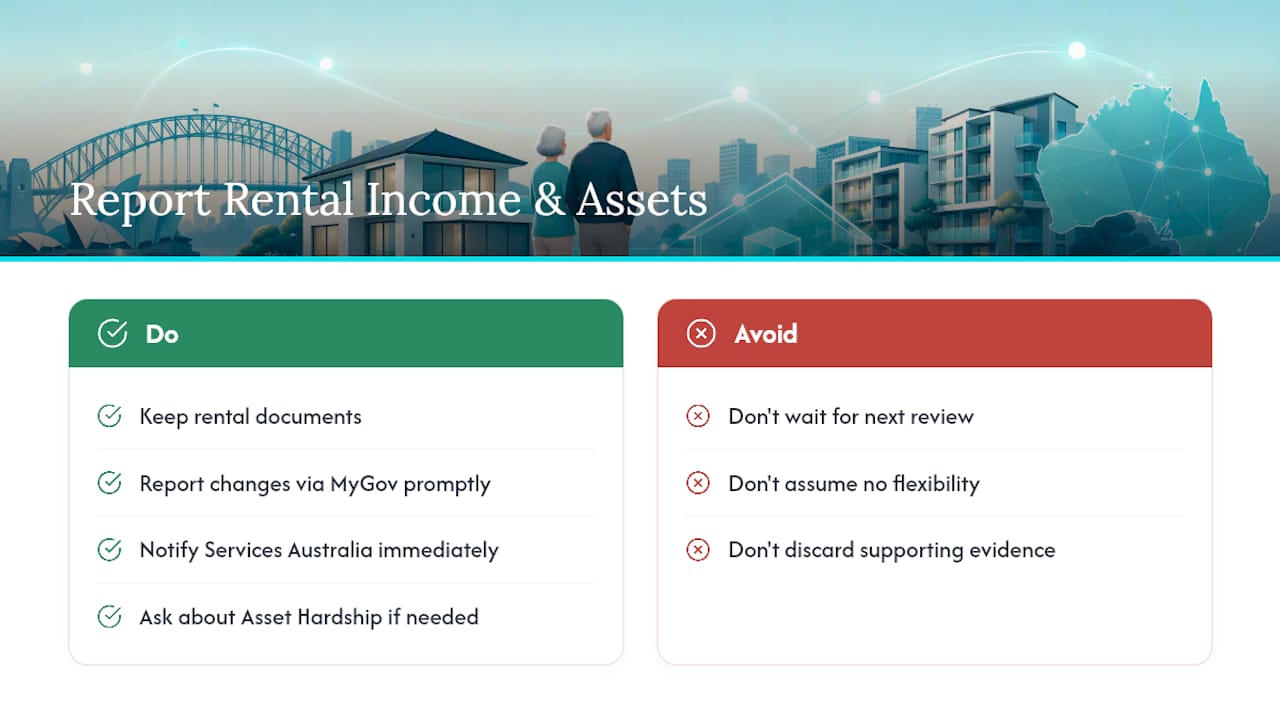
Keep rental statements, loan agreements, tax returns, and agent invoices on hand. Services Australia and the Social Security Guide both point to these as the standard evidence for verifying income and deductions during a review.
Report changes through your MyGov account linked to Centrelink, and notify Services Australia as soon as your rental arrangement changes, not just at your next scheduled review. Because asset limits move seasonally, a reassessment can shift your payment even if nothing in your own finances has changed. If a sudden valuation jump or unexpected expense puts you in genuine difficulty, ask about Asset Hardship provisions rather than assuming there’s no flexibility.
How Scenario Modelling Helps You Decide What to Do With a Rental Property
Rules on paper are one thing. Deciding whether to keep a rental, sell it, or restructure the loan against it is another, because the right call depends on numbers specific to you.
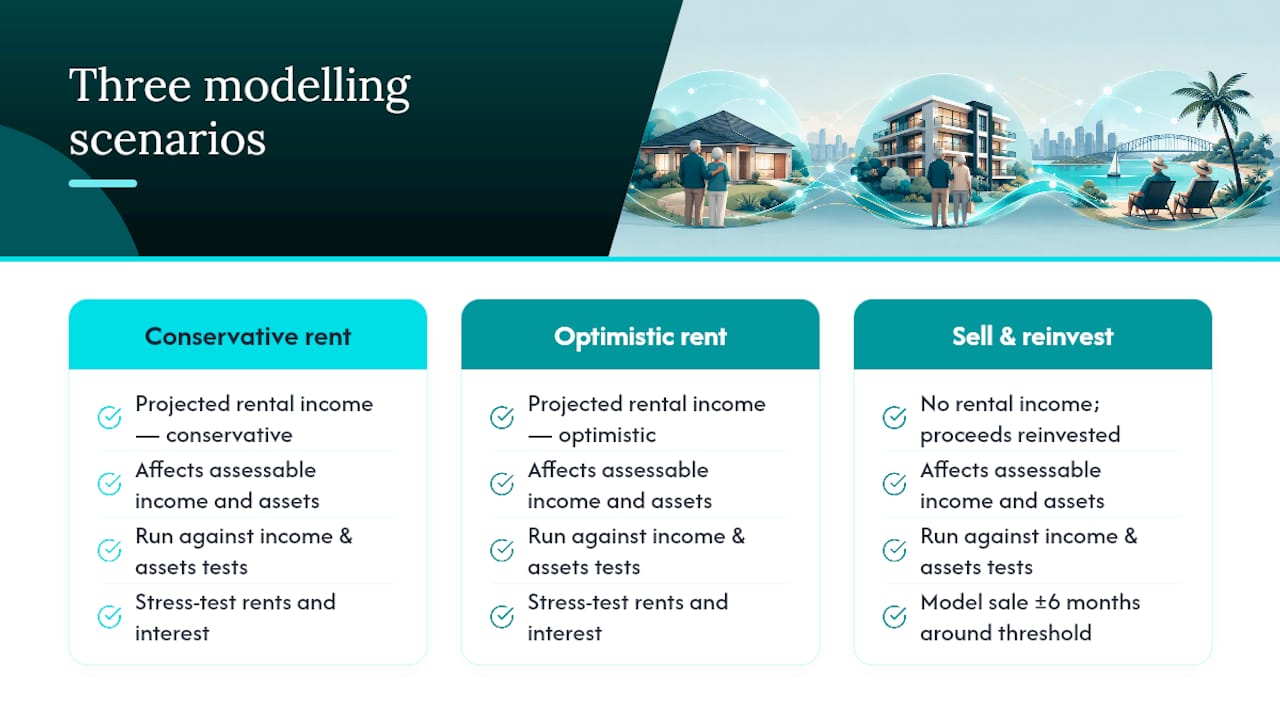
Running the same property through three scenarios, keep and rent at a conservative yield, keep and rent at an optimistic yield, and sell and reinvest the proceeds, shows how differently each path affects your assessable income and assets under the actual thresholds, not rough estimates.
This is the kind of comparison Aerowealth is built for: modelling projected rental income, running it against the income and assets tests, and stress-testing what happens if rents soften or interest rates move. It won’t replace a formal assessment from Services Australia or advice from a licensed adviser, but it narrows down which options are worth taking further.
Pro Tip: Model the sale scenario with a six-month delay either side of a threshold update date. Sometimes waiting a quarter to sell changes your pension outcome more than the sale price does.
What Aerowealth Sees Most Retirees Get Wrong
The biggest mistake is assuming ATO deductions carry over to Centrelink. They don’t, and depreciation is the one that catches people out most often. The second is ignoring what happens once a rental moves into an SMSF, where deeming replaces actual-rent assessment entirely. Our priority list is simple: model accurately, report changes promptly, and talk to a qualified adviser before restructuring anything.
Model Your Property and Pension Options With Aerowealth
This modelling tool helps Australians see the numbers before they act, allowing users to build scenarios comparing keep versus sell options, test different rental yields, and stress-test loan structures under the same income and assets tests Services Australia applies.

It provides side-by-side scenario comparisons rather than a single static projection, helping users understand different rental yields or timing of sales. It is designed around Australian rules for super, mortgages, and property investment.
Try a free scenario on Aerowealth and see how your own rental numbers play out against the current tests before you make a decision.
Where to Read the Official Rules
For the definitive word, check the Social Security Guide on income from real estate, Services Australia’s assets test page, and, for how negative gearing policy debates could shape future rules, this analysis of proposed changes. Thresholds change; always check the live page.
This article is general information, not a substitute for advice from a qualified financial advisor. Consult a qualified financial professional about your own circumstances before acting on anything here.
Sources
FAQ
Can I have a rental property and still get the Age Pension?
Yes. Owning a rental property doesn’t disqualify you from the Age Pension, but the rent counts under the income test and the property’s value counts under the assets test, and Centrelink pays based on whichever test produces the lower payment.
Does rent from an investment property count as income for Centrelink?
Yes, gross rent minus Centrelink’s allowed deductions counts as assessable income, though a property running at a net loss is treated as zero income rather than a negative figure.
Can you get Centrelink payments if you own an investment property?
You can, provided your total assessable income and assets, including the property’s market value less any secured debt, stay within the current thresholds for your homeowner status.
Is it better to sell an investment property after retiring?
It depends on your numbers. Selling changes an asset from real estate into cash or investments, which are assessed differently, and the timing relative to seasonal threshold updates can affect the outcome. Modelling tools like Aerowealth let you compare the keep-versus-sell tradeoff against your own figures, but a decision this size is worth confirming with a financial adviser first.