Retiring Into a Bear Market: An Australian Plan

If you retire into a bear market, the main danger is not the fall itself. It is having to draw an income from a shrunken portfolio while prices are low. The risk is manageable. A one to two year cash buffer, a sensible investment mix, flexible spending and a clear view of your Age Pension safety net all reduce it. You can test each of these before you commit to a retirement date.
TL;DR
- Retiring into a bear market exposes you to sequence-of-returns risk: early losses combined with withdrawals do more lasting damage than the same losses later.
- A cash buffer of one to two years of living expenses lets growth assets recover without forced selling.
- Super pension minimum drawdowns are percentages of your balance, so your required income moves with markets, and the Age Pension assets test can partly offset falls.
- Flexible spending, such as skipping one inflation adjustment, can meaningfully extend how long your money lasts.
- Model your own numbers side by side, with a normal market and a bad start, before choosing when to stop work.
Table of Contents
- What it means to retire into a bear market
- A worked example of why order matters
- Why planning ahead matters in Australia
- Build a buffer so you are not a forced seller
- Review your super investment mix before you retire
- Know the super rules that shape your withdrawals
- Let the Age Pension absorb part of the shock
- Spend flexibly in the early years
- Should a bear market change when you retire?
- Our perspective: test the bad start, not just the average
- Run the bad-start scenario yourself
- FAQ
- Sources
What it means to retire into a bear market
A bear market is a sustained fall in share prices, commonly defined as a drop of 20% or more from a peak. Retiring into one means your first years without a salary coincide with that fall.
The reason this matters more than a fall at age 45 is simple. When you work, you buy shares at lower prices with your contributions. When you retire, you sell. If you sell assets to fund living costs after they have dropped, you hold fewer units when the recovery comes. That is sequence-of-returns risk, and it is why two retirees with identical average returns over 25 years can end up in very different places.
The risk is concentrated early. Research summarised by US financial publisher Morningstar points to the first years of retirement as the period when poor returns do the most harm, and it notes that trimming annual spending, for example by forgoing an inflation adjustment in a downturn, can meaningfully extend a portfolio’s life. A fall many years into retirement, by contrast, often leaves you better placed, because you have already drawn down less of the portfolio at a time of weakness.
We cover the mechanics in more depth in our guide to sequence of returns risk for Australian retirees.
A worked example of why order matters
The figures below are a simple illustration, not a forecast. Imagine two retirees, each with $800,000 in super pension phase, each withdrawing $40,000 a year (5%) at the start of each year, and each earning the same two annual returns, in a different order.
| Retiree A: bad year first | Retiree B: good year first | |
|---|---|---|
| Starting balance | $800,000 | $800,000 |
| After year one withdrawal | $760,000 | $760,000 |
| Year one return | -20% | +10% |
| Balance after year one | $608,000 | $836,000 |
| After year two withdrawal | $568,000 | $796,000 |
| Year two return | +10% | -20% |
| Balance after year two | $624,800 | $636,800 |
After two years the balances look close. The difference is in what happens next. Retiree A has lost more capital while the withdrawals were taking money out, and each later dollar of growth works on a smaller base. Stretch the pattern over a decade of withdrawals and the gap widens, which is why the first three to five years deserve most of your planning attention.
A fall that arrives when you have a plan is uncomfortable. A fall that arrives when you do not is where people make permanent mistakes.
Why planning ahead matters in Australia
Most people do not have that plan. ASIC’s Moneysmart research found that 48% of Australian pre-retirees aged 50 to 66 worry about running out of money in retirement, while only 18% have a clear plan.
Timing matters too. For people within a decade of retirement, financial planner André Small told CNBC that sequence risk should be planned for at least three to five years before retirement. The practical reading for Australians is to stress-test your plan well before your last pay cheque, not after the market turns.
Build a buffer so you are not a forced seller
The most direct defence is a cash buffer: an amount equal to one or two years of living expenses held in cash or liquid investments. SuperGuide describes this as a way to avoid selling assets at low prices during a downturn, and pairs it with a bucket approach that separates money for spending from money for growth.
Here is how that looks in practice:
- Work out your annual spending. Be honest: essentials, travel, gifts, health costs and the occasional large repair.
- Hold one to two years of it in cash. In super pension phase this may sit in a cash option inside your fund. Outside super it might be an offset account or a savings account.
- Keep the rest invested for growth and income. This is the money you leave alone while markets recover.
- Refill the buffer when markets are strong. Top it up from gains or income, and let it run down when they are weak.
If your mortgage is not yet paid off, an offset account can serve as part of the buffer while reducing interest. We explore how this fits with other income sources in our retirement income strategies guide for Australians.
Do not overcorrect into cash
A buffer is not the same as moving everything to cash. SuperGuide’s Barbara Drury makes the point that leaning too heavily on low-risk cash can limit the growth a multi-decade retirement needs. A person who retires at 60 could be funding 30 years or more. Too little growth is its own risk, and it is quieter than a crash.
Review your super investment mix before you retire
Moneysmart, ASIC’s consumer site, advises people nearing retirement to review their super investment mix, fees and performance so they match a lower tolerance for volatility. That is a review, not an instruction to sell down growth assets.
Questions worth asking about your own fund:
- What share is in growth assets such as shares and property, and what share is in defensive assets such as cash and fixed interest?
- Does the fund’s default retirement option suit you, or is a custom mix better?
- What are the total fees on the option you hold?
- If you run a self-managed super fund, do you have enough in cash to meet pension payments without selling shares? SuperGuide notes trustees have more flexibility to set their own mix and cash allocation, which is useful here, and also means the decision is yours.
A mix that holds both growth and defensive assets matters because it lets you draw income from the defensive side while the growth side recovers. Selling shares after they fall locks in the loss and leaves you with less exposure when prices rebound.
For personal advice about your mix, a licensed financial adviser can look at your whole situation.
Know the super rules that shape your withdrawals
Super is not a bank account you can dip into at any time. Moneysmart explains that access generally requires a condition of release, such as reaching preservation age (60) and permanently retiring, or reaching age 65.
That matters if you are thinking of retiring early. Anyone leaving work before 60 needs enough money outside super to cover the gap. A bear market that hits your non-super savings in those bridge years is a double problem, because you cannot top up from super. If that is you, build the bridge with extra care, and test it against a falling market as well as a flat one.
Minimum drawdowns move with your balance
Once you start a super pension, you must withdraw at least a minimum percentage each year. The ATO sets these rates by age: 4% under 65, 5% from 65 to 74, 6% from 75 to 79, 7% from 80 to 84, 9% from 85 to 89, 11% from 90 to 94, and 14% at 95 and over.
Because the percentage applies to your balance, a market fall reduces the dollar minimum in the following year. That works in your favour: you are not forced to take out the same dollars from a smaller pot. It also means that a fall in income from your pension can be part of the picture. If your spending needs sit well above the minimum, you are the one choosing how much extra to withdraw, and the bear market is the time to look hardest at that choice. See our minimum pension drawdown table for the current schedule.
Let the Age Pension absorb part of the shock
For many Australians, the Age Pension acts as a partial shock absorber, because the assets test responds to falling balances. When your super and investments drop, you may become eligible for a higher rate of pension, or for a part pension where you previously had none.
At the September 2026 update, Services Australia lists the following assets test limits for homeowners:
| Homeowner household | Full pension up to | Part pension cut-off |
|---|---|---|
| Single | $333,000 | $745,750 |
| Couple (combined) | $499,000 | $1,121,000 |
These limits are indexed, so check the official page for the current figures. Our explainer on the Age Pension assets test walks through how each dollar over the limit reduces the payment.
The income test also matters, and it works differently. Under deeming rules, financial assets are assumed to earn set rates whatever they actually return: 1.75% on the first $66,800 for a single person (or $110,600 for a couple where at least one receives a pension) and 3.75% above that. A bear market does not reduce deemed income directly, but a lower balance does. Our guides to deeming rates and the income test show how the two tests interact, and the lower of the two results applies.
The Age Pension is not a reason to ignore the risk. Whether you qualify depends on your age, assets, income and residency, and a fall may move you only part of the way. But in a stress test it is a floor worth including.

Spend flexibly in the early years
You do not need to cut your lifestyle drastically. Small, temporary changes carry real weight early on:
- Skip the annual inflation increase to your withdrawals for a year or two.
- Delay a big discretionary purchase, such as a new car or a major trip, until markets recover.
- Draw first from cash and defensive assets, and leave shares to recover.
- Keep part-time or casual work for a short period if it suits you. Even modest earnings reduce the amount you must sell.
Morningstar’s analysis, referred to above, shows how much a modest spending adjustment can add to portfolio longevity. The reason is the same sequence effect, working in your favour: each dollar you do not sell at a low price stays invested for the recovery.
A rule worth writing down in advance is what you will do if your portfolio drops by, say, 15% or 25% from its starting point. A pre-agreed trigger takes emotion out of the decision.
Should a bear market change when you retire?
Sometimes yes, but not always, and not because of a headline. Three questions give you a better answer than the market level does:
- How much of your spending is covered by reliable income? If the Age Pension, a defined benefit pension or rent already covers your essentials, a fall hurts less.
- How many years of spending do you hold in safe assets? Two years is a good starting point. Four or five gives you more room.
- How would an extra year or two of work change the picture? Another year of contributions, a smaller drawdown period and a higher balance together often make a larger difference than people expect.
If you are mid-retirement plan, with a property or two in the mix, remember that a move or a purchase adds its own variables. If part of your plan involves a lifestyle move overseas, planning a retirement move with confidence means including the costs and currency risk in the same scenario as your super and shares, so a falling market does not catch the move half-funded.
None of this means waiting for the perfect moment. Markets rarely announce the bottom. The aim is to make sure that, whichever way the next two years go, you still have a working plan.
Our perspective: test the bad start, not just the average
Most retirement projections show a smooth line: a steady average return, year after year. Real markets do not behave that way, and the first five years of a plan are where the smooth line misleads most.
We built Aerowealth because spreadsheets make this kind of testing slow and opaque. We think a useful plan should let you place two versions of your retirement side by side: one with a normal market and one that opens with a fall. You then see what changes in your retirement age, your income and your net worth, and you can judge whether a cash buffer, a delayed retirement date or a lower spending level closes the gap.
We also think Australian rules should be part of the model from the start. Preservation age, minimum pension drawdowns, Age Pension tests, mortgage offsets and capital gains tax all change what a bear market costs you. A generic calculator that ignores them can give you a number that looks precise and is wrong.
Our advice is plain. Do the stress test while you still have choices, and treat the result as information, not as a verdict.
— Aerowealth Team
Run the bad-start scenario yourself
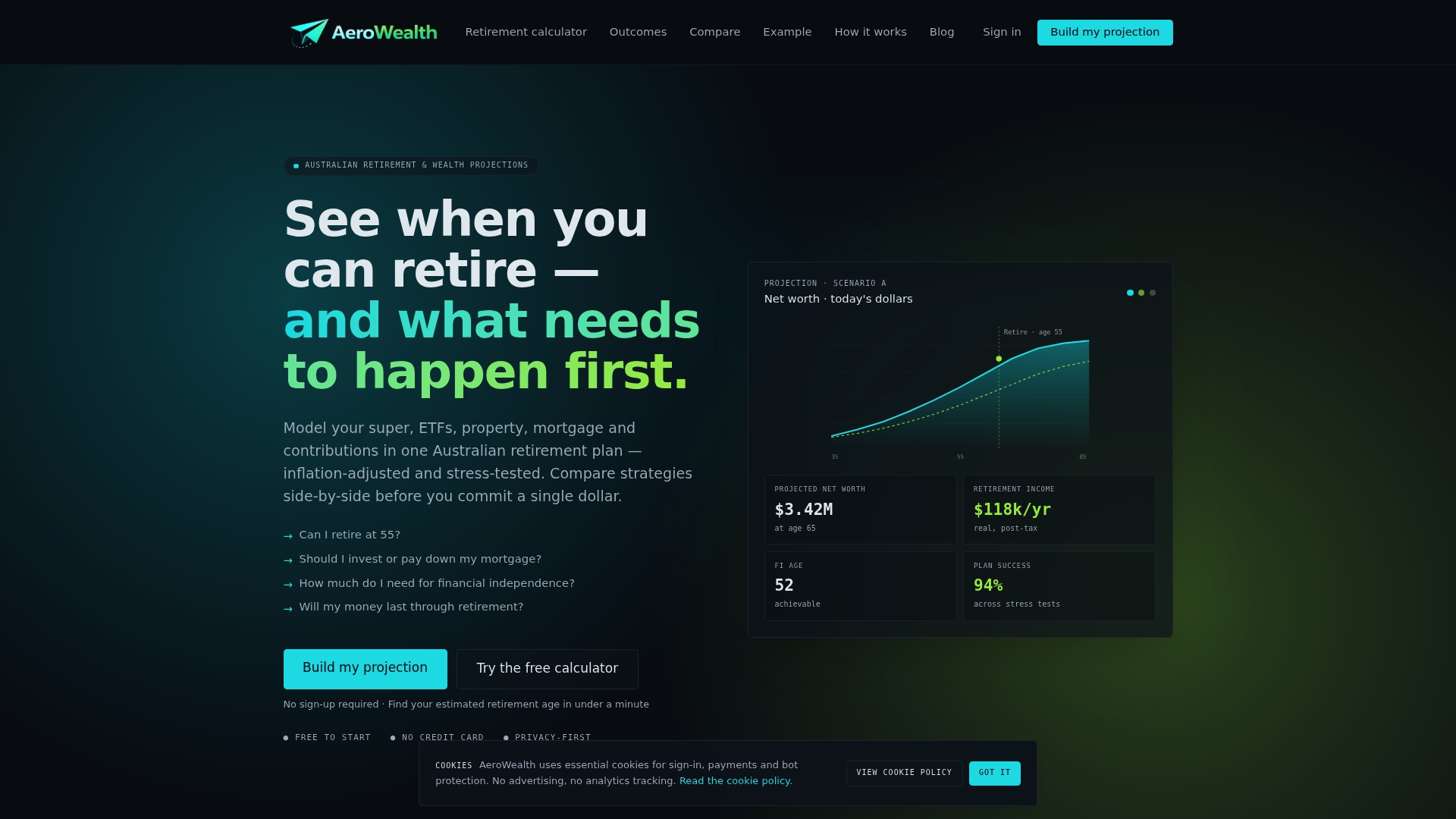
Aerowealth lets you model super, investment property, ETFs, mortgages and contributions in one plan, compare scenarios side by side and stress-test your assumptions under Australian rules. You can build a normal-market version and a bear-market-start version of the same retirement and see the difference in your projected income and net worth.
There is a free plan to get started. Pro is $7 per month and adds expanded scenario planning, bridge mode for retiring before preservation age, advanced mortgage features and a higher AI assistant quota. See the plans and pricing, or start from the Aerowealth home page.
FAQ
Should retirees be in the stock market during a bear market?
Most retirees need some growth assets, because retirement can last decades and cash alone may not keep pace with living costs. The goal is a mix that lets you draw from cash and defensive assets while shares recover. Moneysmart suggests reviewing your super mix as you near retirement, and a licensed adviser can help you set the right balance for your situation.
Should a 70-year-old get out of the stock market?
There is no age at which selling everything is the right answer. A 70-year-old may still be investing for 20 years or more. Selling after a fall locks in the loss, and moving fully to cash can limit the growth you need. A better step is to check that you hold one to two years of spending in cash and that your mix suits your tolerance for volatility.
Can I live off the interest on $100,000?
Not comfortably. At the deeming rate of 1.75% on the first part of a financial asset balance, or at any similar return, $100,000 produces only a few thousand dollars a year. Many retirees combine super drawdowns, savings and the Age Pension. Whether you qualify for a pension depends on the assets and income tests, so run your own figures.
Is it better to delay retirement in a bear market?
A delay can help, because you add contributions and shorten the time you need to fund. It is not the only option. You can also reduce planned spending, build a larger cash buffer or work part-time for a year or two. Modelling each choice side by side shows which one moves your outcome most.
Sources
- Make a retirement plan, Moneysmart
- What happens to your super when you retire, Moneysmart
- Moneysmart key research findings, ASIC
- Income stream (pension) rules and payments, ATO
- Assets test for Age Pension, Services Australia
- Deeming, Services Australia
- What to do if the market tanks and you’re retired, SuperGuide
- You Just Retired (or Are About to). Now What? Morningstar
- Market volatility and retirement: sequence of returns risk, CNBC