Keep Your Age Pension Working Part Time in Australia: $300 Work Bonus

Yes, in most cases you can work part-time and keep the Age Pension. Two mechanisms decide how much you keep: the Work Bonus, which shields part of your pay from assessment, and the Age Pension income test, which reduces payments above a set threshold. The catch is administrative, not legal: you must report all employment and self-employment income to Centrelink every fortnight.
TL;DR:
- The Work Bonus allows you to exclude the first $300 of income each fortnight from the Age Pension income test, protecting your payments with unused amount banking.
- Reporting all income biweekly is mandatory; failing to do so can lead to overpayment debts or pension suspension, which may take time to resolve.
- There is no legal limit on working hours, but sustained high earnings can trigger pension suspension, which can often be reversed once your income drops below the threshold.
- Part-time work can positively impact super contributions and tax, especially for those aged 67 to 75, but planning invoice timing and understanding tax interactions are crucial.
- Using scenario modelling tools helps retirees compare how different hours, wages, and drawdowns affect pension, super longevity, and overall financial health over time.
Table of Contents
- How the Age Pension and Work Bonus affect part-time earnings
- Reporting, compliance, and practical administration
- Earnings, hours, and suspension rules: what practically limits part-time work
- Superannuation, tax and transition-to-retirement considerations when working part-time
- Practical job ideas, finding flexible roles, and balancing lifestyle
- How modelling part-time retirement scenarios helps
- Impact of part-time work on health care card eligibility and other social security benefits
- Strategies for managing tax liabilities on part-time income during retirement
- Options for salary packaging or salary sacrifice when working part-time in retirement
- How part-time income affects eligibility for supplementary government benefits
- Considerations for maintaining or accessing superannuation while working part-time
- Long-term financial planning: balancing part-time work income with pension and savings
- AeroWealth team perspective: balancing purpose and prudence
- Model Your Part-Time Retirement Before You Commit to It
- Sources
- FAQ
How the Age Pension and Work Bonus affect part-time earnings
Here’s the mechanic that trips people up: the Age Pension income test cuts your payment by 50 cents for every dollar you earn above the income free area. Earn $100 over the threshold in a fortnight, and your pension drops $50. That sounds brutal until you factor in the Work Bonus, which exists specifically to soften this for people still working.
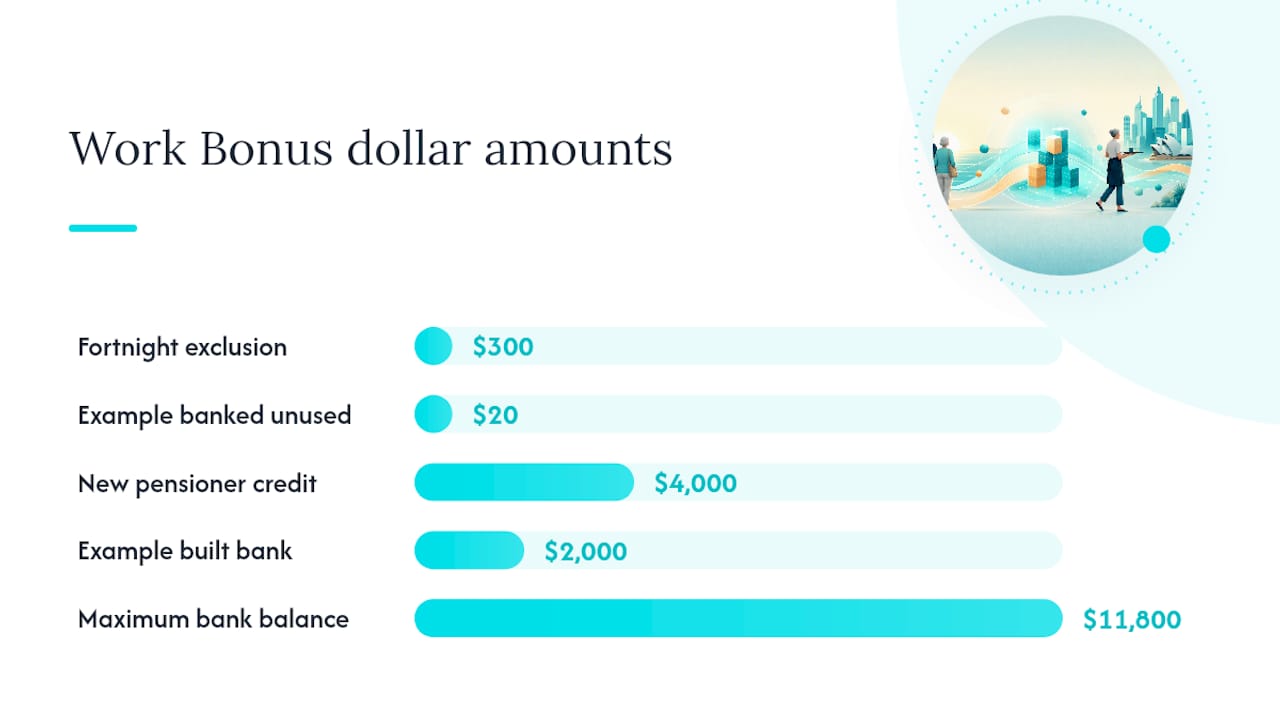
The Work Bonus excludes the first $300 of employment or eligible self-employment income in each 14-day period from the income test entirely. That $300 doesn’t touch your pension calculation at all. Better still, if you earn less than $300 in a given fortnight, the unused portion rolls into an income bank you can draw on later, up to a cap.
Pro Tip: If you know you’ll pick up extra shifts over summer or during a busy retail season, let your Work Bonus bank build up in the quieter months first. That banked amount then offsets the spike when your hours increase.
From January 1, 2024, new pensioners get a $4,000 starting credit automatically added to their Work Bonus income bank, and the maximum balance anyone can hold is $11,800. That’s a meaningful buffer if you’re easing into part-time work rather than diving in at full pace.
Three examples show how this plays out in practice:
- Light hours: You earn $280 a fortnight from casual retail work. The entire amount sits under the $300 Work Bonus exclusion, so your pension is untouched, and you bank $20 in unused concession.
- Moderate hours: You earn $600 a fortnight tutoring. The first $300 is excluded, leaving $300 assessable. If that pushes you above your income free area, the pension reduces by 50 cents for every dollar over that line, not the full $300.
- Heavier hours with a bank balance: You earn $900 in one fortnight from a short consulting project, but you’ve built up $2,000 in your Work Bonus bank from quieter months. That banked amount can offset the excess above $300, potentially keeping your pension fully intact for that period.
Eligibility for the Work Bonus itself is straightforward. You need to have reached Age Pension age and be receiving an eligible payment, and since July 2019 the scheme has covered self-employment income from genuine work, not just wages. It’s not limited to employees clocking in for someone else.
Reporting, compliance, and practical administration
Centrelink expects fortnightly reporting of everything you earn, whether it’s wages, casual shifts, or self-employment income. This isn’t optional paperwork you can catch up on later. Here’s the practical process:
- Report every fortnight through myGov, the Centrelink Express Plus app, or by phone, using the exact figures from your payslip or invoice before tax.
- Declare self-employment income even if it’s irregular. Centrelink wants the gross figure for the reporting period, not an annual average you calculate yourself.
- Notify changes immediately if your hours shift, a job ends, or you start a new role, rather than waiting for your next scheduled report.
Skipping this or reporting late has real consequences. Failing to report income accurately can trigger an overpayment debt that Centrelink will recover from future payments, or it can lead to your pension being suspended altogether. Getting reinstated after a suspension usually means submitting the missing reports and waiting for Centrelink to reassess your file, which can take longer than most people expect.
Pro Tip: Keep every payslip and invoice in one folder, digital or physical, from day one. When Centrelink asks for evidence during a review, having six months of records ready beats scrambling through emails.
Earnings, hours, and suspension rules: what practically limits part-time work
There’s no legal cap on how many hours a pensioner can work. Centrelink doesn’t care if you’re doing five hours a week or thirty. What matters is the dollar figure that lands on your income test, not the timesheet.
That said, sustained high earnings carry a real risk. If your income exceeds the cut-off point for several consecutive fortnights, your pension can be automatically suspended rather than just reduced. The upside is that suspension isn’t permanent exile from the system. Payments can often be restored within two years of suspension if your income drops back under the threshold, without forcing you through a full new application.
Self-employed retirees face a different assessment pattern than employees. Business income is often averaged over a period rather than assessed as a lump sum, which can smooth out the pension impact compared with a single large invoice landing in one fortnight. This creates a genuine planning lever:
- Time large invoices to spread across multiple reporting periods where possible.
- Avoid clustering big contracts in fortnights where you’re already close to the cut-off.
- Keep records that separate gross business income from expenses, since only net gainful work income typically counts.
Superannuation, tax and transition-to-retirement considerations when working part-time
Working part-time in retirement isn’t just a pension question. It reshapes your relationship with super and tax, sometimes in your favor.
If you’re between 67 and 75, you generally need to meet the work test, 40 hours within 30 consecutive days, to make voluntary personal super contributions. A part-time role, even a short-term one, can be structured deliberately to satisfy this test and reopen contribution opportunities that would otherwise be closed to you.
A transition-to-retirement (TTR) pension is worth a look if you’re still below preservation age flexibility limits and want to draw a modest income stream from super while working reduced hours. The trade-off: TTR income is capped and taxed differently depending on your age, so it suits people easing down hours gradually rather than those picking up occasional gig work.
Tax matters more than most retirees expect once wages enter the picture:
- Part-time wages get added to any other assessable income and taxed at your marginal rate, which can be higher than you assume if you’re also drawing a taxable super income stream.
- Concessional contribution caps still apply if you’re topping up super from wages, so check your total contributions before assuming you have unlimited room.
- Extra earnings can occasionally push you into needing to lodge a tax return you’d otherwise skip, so keep that administrative step on your radar.
Working part-time also reduces how much you need to withdraw from super to fund your lifestyle, which helps your balance last longer and gives your investments more time to recover from any market dips.
Practical job ideas, finding flexible roles, and balancing lifestyle
The best part-time roles for retirees aren’t always the obvious ones. Here’s where people actually find sustainable, flexible work:
- Casual retail or hospitality offers predictable short shifts that are easy to report and rarely spike your income unexpectedly.
- Tutoring or mentoring in your former profession pays well per hour and lets you set your own schedule.
- Local council and community roles, often advertised through council websites, include visitor information, library assistance, and event support.
- Aged-care support work, searchable through My Aged Care networks, suits people who want purpose-driven part-time hours.
- Consulting or project work in your old industry can be lucrative but needs careful invoice timing given the self-employment income smoothing rules.
- Online freelancing, from bookkeeping to writing, offers full control over hours and volume.
Search Seek, Indeed, and your local council’s jobs board first, since most part-time and casual roles for retirees get listed there rather than through recruitment agencies. Industry associations tied to your old career often have informal job boards too.
Prioritize roles with predictable pay periods over lump-sum contracts if you want to avoid income spikes. Seasonal work can be a smart way to use up your Work Bonus bank during the year’s busier months, and the social and structural benefits of part-time work shouldn’t be underestimated. Retirees who keep a light work routine often report better mental health outcomes than those who stop entirely.
How modelling part-time retirement scenarios helps
Numbers on a Centrelink page are one thing. Seeing how your specific hours, wage, and drawdown plan interact over the next ten years is another. This is where scenario modelling earns its keep, letting you compare a “work 15 hours a week” plan against a “draw more from super instead” plan side by side rather than guessing.
A tool like AeroWealth lets you stress test these combinations against Australian rules, showing:
- Your fortnightly pension change under different wage levels
- Disposable income after tax and Work Bonus effects
- How long your super balance lasts under each scenario
- Capital gains or mortgage offset consequences if property is part of your plan
Pro Tip: Run the same part-time work scenario twice, once assuming steady weekly hours and once assuming seasonal bursts, to see which pattern actually preserves more of your Work Bonus bank over a full year.
Impact of part-time work on health care card eligibility and other social security benefits
Your Pensioner Concession Card generally stays attached to your Age Pension, so as long as your part-time earnings don’t push you off payment entirely, your concessions keep flowing. That covers cheaper prescriptions, bulk-billed doctor visits in many cases, and discounts on council rates and utilities depending on your state.
The risk shows up if sustained high earnings trigger suspension rather than just a reduced payment. Lose the pension, and you generally lose the Pensioner Concession Card alongside it, though you may still qualify for a Commonwealth Seniors Health Card depending on your income and assets outside super. That card carries fewer concessions than the pensioner version but still helps with medicine costs under the Pharmaceutical Benefits Scheme.
If your part-time income fluctuates near the suspension threshold, it’s worth checking your specific state’s concession rules, since some, like energy rebates or public transport discounts, are tied to card type rather than payment amount. Losing and regaining Age Pension eligibility within the same year can create gaps in concession coverage that catch people off guard, particularly around utility rebate renewal periods.
Strategies for managing tax liabilities on part-time income during retirement
Part-time wages stack on top of any taxable super income or investment earnings you already report, and that combined total determines your tax bracket. The trick is not letting a good month of extra shifts push you into paying more tax than the extra income was worth.
A few practical moves help. Spread irregular income, like a large consulting invoice, across financial years where you have discretion over timing, since this can keep you under a bracket threshold in both years rather than spiking one. Keep a running tally of your combined income sources through the year rather than waiting for tax time, so surprises don’t compound. If you’re self-employed, set aside a percentage of every payment for tax rather than treating gross income as spendable cash.
The Seniors and Pensioners Tax Offset (SAPTO) can also reduce your tax liability if you qualify, and it interacts with how much part-time income you can earn before tax becomes payable at all. Speaking with a registered tax agent who understands pensioner-specific offsets is worth the modest cost, especially in the first year you start earning again after a period of full retirement.
Options for salary packaging or salary sacrifice when working part-time in retirement
Salary sacrifice arrangements are still available to part-time employees in retirement, though the value depends heavily on your individual tax position. If your employer offers salary packaging for things like superannuation contributions, novated leases, or benefits like a work laptop, redirecting part of your pre-tax pay can reduce your taxable income.
Sacrificing extra into super has a direct upside if you’re still under your concessional contribution cap and want to keep building your balance, but it needs coordination with your Work Bonus and pension reporting, since it doesn’t reduce your gross income for Centrelink assessment purposes, only your taxable income for the tax office. Salary sacrifice reduces what the Australian Taxation Office sees, not what Centrelink sees.
For retirees drawing a transition-to-retirement pension while also working part-time, combining salary sacrifice with TTR withdrawals can sometimes reduce overall tax paid, but the math depends on your age, balance, and marginal rate. This is a scenario worth modelling rather than guessing at, since the benefit varies significantly from one person’s numbers to the next.
How part-time income affects eligibility for supplementary government benefits
Beyond the base Age Pension, several supplementary payments and concessions are tied to your pension status rather than assessed separately. Rent Assistance, the Pension Supplement, and the Energy Supplement generally continue as long as you remain on a part or full Age Pension, adjusting proportionally as your pension amount changes with earnings.
If part-time work pushes your income high enough to reduce your pension to zero, even temporarily, you typically lose these supplementary payments alongside the base pension. This is different from a partial reduction, where you keep a smaller pension and the linked supplements continue at a reduced rate. The cliff edge sits at full suspension, not at any reduction along the way.
State-based concessions, like public transport discounts or council rate reductions, vary depending on which state or territory you live in and which specific card you hold. It pays to check your local government’s concession eligibility rules directly, since assumptions carried over from a neighbor’s situation in a different state often don’t transfer.
Considerations for maintaining or accessing superannuation while working part-time
Once you’ve reached your preservation age and met a condition of release, working part-time doesn’t stop you from accessing your super. But it does raise a genuine strategic question: draw down super to top up income, or rely more heavily on part-time wages and let super keep growing?
Retirees who keep working part-time often choose to reduce their super drawdown rate rather than stop it entirely, since minimum drawdown requirements still apply once you’ve started an account-based pension. Balancing wage income against the minimum percentage you’re required to withdraw each year takes some coordination, particularly if your part-time earnings are irregular.
If you haven’t yet started drawing on super and are still working part-time past your preservation age, there’s no rule forcing you to access it early. Some retirees deliberately delay, letting the balance keep growing tax-free in the pension phase while part-time wages cover day-to-day costs, only drawing down super once work hours taper off further.
Long-term financial planning: balancing part-time work income with pension and savings
The retirees who navigate this best don’t treat part-time work as a one-off decision. They treat it as one lever among several, alongside super drawdown rates, Age Pension entitlements, and any other savings or investments, that gets adjusted year to year as circumstances change.
A sensible long-term approach looks at a rolling three to five year window rather than just the current fortnight’s pay. How does working 10 hours a week for the next two years change your super balance by age 80 compared with not working at all? What happens if you stop working entirely at 70 instead of tapering off gradually? These aren’t questions with a single universal answer. They depend on your specific balance, your health, and how much you actually want to keep working versus needing to.
Revisiting the plan annually, especially after any change in hours, health, or Centrelink thresholds, keeps the strategy grounded in your actual situation rather than assumptions made years earlier that may no longer hold.
AeroWealth team perspective: balancing purpose and prudence
Part-time work in retirement rarely comes down to money alone. The structure, the social contact, the sense of contributing something, these matter as much as the extra dollars for most people who choose to keep working.
Our honest view: model the scenario before you commit to hours, report accurately from day one, and talk to a financial adviser if your situation involves property, a large super balance, or a TTR pension. Try running your own numbers through AeroWealth before you decide.
— Aerowealth Team
Model Your Part-Time Retirement Before You Commit to It
Guessing how 15 hours a week affects your pension, your super balance at 80, and your tax bill is the expensive way to find out. AeroWealth is built specifically for Australians who want to see those numbers side by side before making the call, not after.

Run a scenario with your actual wage, your actual super balance, and your actual Age Pension entitlement, and compare it directly against a scenario where you work fewer hours and draw more from super instead. Such tools apply Australian rules to both, including Work Bonus effects and drawdown longevity, so you’re comparing real outcomes rather than rough guesses. If you’re weighing whether part-time work makes sense for the next five years or the next fifteen, read our guide on retirement planning in Australia and then build your own scenario on the AeroWealth free plan to see where you land.
Sources
This article is general information, not a substitute for advice from a qualified financial advisor. Consult a qualified financial professional about your own circumstances before acting on anything here.
FAQ
How many hours can you work when retired in Australia?
There’s no legal limit on hours. What matters is your income, since the Age Pension income test and Work Bonus assess dollars earned, not hours worked.
What is the $1,000 a month rule for retirees?
This isn’t an official Australian Centrelink rule. If you’ve seen it referenced, it likely relates to a different country’s retirement guidance, so it doesn’t apply to Age Pension assessment here.
How to retire at 62 with little money?
If you’re below Age Pension age in Australia, you’ll need to rely on personal savings, super if you’ve met a condition of release, or part-time work to bridge the gap until you qualify for the pension. Tools like AeroWealth can help model how long a smaller balance lasts with part-time income supplementing it.
What is the new retirement age in 2026 in Australia?
Age Pension eligibility age reached 67 and has stayed there since previous scheduled increases concluded; check the Services Australia Age Pension page for your exact eligibility date based on your birth year.
Can I work part-time and still get the Age Pension?
Yes, in most cases. The Work Bonus excludes the first $300 of fortnightly employment income from assessment, and earnings above your income free area reduce the pension gradually rather than cutting it off entirely.