Timing Super Contributions: When Each Payment Counts

A super contribution counts towards your cap in the financial year your fund receives it, not the day you hit “pay”. That one rule drives most timing decisions: send personal contributions early enough to land before 30 June, spread them to stay under your caps, and sequence larger moves across years. This guide covers deadlines, employer payment timing, caps, carry-forward and bring-forward, age rules, and how to plan timing if you want to retire before preservation age.
TL;DR
- Contributions count in the year your fund receives them, so for a 30 June target, pay well before the day itself. The ATO says to allow for delays with BPAY and bank transfers.
- For 2026–27 the concessional cap is $32,500 and the non-concessional cap is $130,000. Timing matters most when you are near either limit.
- Carry-forward and bring-forward rules reward planning across several years, and both depend on your balance at the previous 30 June.
- From 1 July 2026 employer super is paid per payday, which changes when employer money lands in your account.
- Model the sequence before you commit. A one-year view can hide a cap problem in the next year.
Table of Contents
- What “timing” actually means for super
- The 30 June deadline and why it is really earlier
- Employer contributions: Payday Super changes the rhythm
- Timing against your caps
- Carry-forward and bring-forward: timing across years
- Age and work-test rules
- Timing if you plan to retire before preservation age
- A year-round timing routine
- Perspective
- See how the timing plays out in your own plan
- FAQ
- Sources
What “timing” actually means for super
There are three separate clocks, and people often blur them.
- The cap year. Caps run on the financial year, 1 July to 30 June. A contribution lands in one year or the next, and that decides which cap it uses.
- The processing lag. Your money leaves your bank on one day and is allocated to your account later. The date that matters is when the fund receives it.
- Your eligibility snapshot. Several rules, such as carry-forward and bring-forward, look at your total super balance on 30 June of the previous year. Contributions made now change next year’s options.
Get these three straight and most timing questions answer themselves.
The 30 June deadline and why it is really earlier
The ATO’s position is that contributions count towards a cap in the year your fund receives them. If you intend a contribution to fall in a given year, make sure your fund receives it by 30 June. For end-of-year BPAY, internet transfers and similar methods, check your bank’s terms and allow for delays.
Funds also publish their own cut-off dates. As an example, one large industry fund told members that personal contributions for the 2025–26 year had to be submitted by Thursday 25 June 2026 so they were allocated by 30 June. That is five days before year end. Cut-offs differ by fund and by payment method, and they move each year with the calendar, so look up your own fund’s current end-of-year page in May or early June.
A few practical points:
- Weekends matter. 30 June sometimes falls on a weekend, and business-day processing then pulls your real deadline further back.
- Funds have processing time. A fund must allocate or reject a contribution within 3 business days of receiving it. Receipt and allocation are not the same moment, which is why funds set early cut-offs.
- Non-cash transfers take longest. One provider notes that in-specie transfers can need up to six weeks of lead time for managed funds, so the instruction has to go in during May.
- Real-time payments are arriving. From 1 July 2026, funds must be able to accept contributions via the New Payments Platform, which can narrow the gap between payment and data. Check whether your fund offers it for personal contributions before relying on it close to the line.
The simplest habit: treat mid-June as your deadline, and treat the last week of June as a buffer for problems, not a plan.
Employer contributions: Payday Super changes the rhythm
Until 30 June 2026, employers had to get super guarantee to the fund within 28 days of the end of each quarter, with due dates of 28 October, 28 January, 28 April and 28 July. That meant the June quarter’s money often arrived in July and fell into the next financial year.
From 1 July 2026, employers must pay super guarantee for each payday, and the fund must receive it within 7 business days after payday. For you, this means:
- Employer contributions should land more evenly through the year.
- Late-June paydays may still spill into early July, because of the 7-business-day window and fund processing.
- If you also salary sacrifice or make deductible personal contributions, keep a running total, because the employer share counts towards your concessional cap as it arrives.
A rejected contribution does not extend the employer’s due date, according to ATO guidance on Payday Super. If your employer contributions look short, check your fund’s records and your payslips rather than waiting.
Timing against your caps
Concessional (before-tax) contributions
From 1 July 2026 the concessional cap is $32,500, and it rises in $2,500 steps in line with average earnings. It includes employer contributions, salary sacrifice and personal contributions you claim as a deduction.
Timing mistakes here are expensive. If you exceed the cap, the excess is included in your assessable income and taxed at your marginal rate with a 15% offset. If you do not or cannot elect to release it, you could pay up to 94% in tax on it.
The ATO’s own advice if you think you may go over: stop or reduce before-tax voluntary contributions and delay personal contributions you plan to claim as a deduction. That is a timing decision: pushing a deductible contribution into the next financial year can keep you under the cap this year.
If you plan to claim a deduction for a personal contribution, there is a sequence to follow with your fund. Our guide on getting fund acknowledgement for personal deductible contributions walks through it.
High earners should also watch Division 293: it is an additional 15% tax on contributions for people whose combined income and concessional contributions exceed $250,000 in an income year. A one-off large contribution in a year when your income is unusually high, for example after a property sale, can tip you over that line.

Non-concessional (after-tax) contributions
From 1 July 2026 the non-concessional cap is $130,000. If your total super balance at the end of the previous financial year was equal to or above the general transfer balance cap ($2.1 million from 2026–27), your cap for the year is nil.
This is where the previous 30 June matters. Your balance on that date, not today, decides this year’s room. If you are close to a threshold, a contribution late in one year can change what you are allowed to do in the next. We cover the mechanics in modelling your $130,000 non-concessional cap.
Carry-forward and bring-forward: timing across years
Carrying forward unused concessional cap
You may be able to carry forward unused concessional cap from up to five previous years, provided your total super balance was under $500,000 at 30 June of the previous financial year. Unused amounts expire after five years.
Two timing consequences follow:
- The oldest year drops off each 1 July. If you have unused room you want to use, the year in which it expires is your real deadline.
- If your balance is hovering near $500,000, a contribution in one year can push you over the line and remove the option the following year. Sometimes it is better to make the big catch-up contribution first and let the balance rise afterwards.
Our carry-forward concessional contributions guide goes through worked examples.
Bringing forward non-concessional contributions
From 1 July 2026 the bring-forward arrangement lets you contribute up to three times the annual cap, $390,000 over three years, if your total super balance on 30 June of the previous year was under $1.84 million.
One provider’s example makes the timing risk clear: mistiming a $120,000 non-concessional contribution in one year can reduce your ability to maximize contributions over two financial years. The reason is that a contribution that lands on either side of 30 June can change which balance band and which cap you fall under.
A simple way to think about it:
| Question | Why it affects timing |
|---|---|
| What was my balance at last 30 June? | It sets this year’s non-concessional cap and bring-forward eligibility. |
| Will this contribution lift my balance past a threshold? | It may change next year’s options. |
| Is the money received before 30 June? | It decides which year’s cap it uses. |
| Have I made other contributions this year? | They share the same annual cap. |
Age and work-test rules
Age limits change what you can contribute and when. Under the ATO’s rules:
- If you are under 75, your fund can accept all types of contributions.
- If you are 67 to 74, you must meet the work test or the work test exemption to claim a deduction for personal contributions.
- At 75 or older, your fund can always accept compulsory employer and downsizer contributions. In the 28 days after the end of the month you turn 75, it can also accept voluntary contributions.
The work test means being gainfully employed for at least 40 hours in a consecutive 30-day period in the financial year of the contribution. It is an annual test. The work test exemption gives an extra 12 months if you met the work test in the previous year, your balance was under $300,000 at the end of that year, and you have not used the exemption before.
The practical point: if you want to deduct a contribution at 67 or older, do the 40 hours of work first, or at least confirm you will, before the money goes in. Our piece on the work test and super contributions for ages 67 to 75 explains the difference between contributing and deducting. If you are near 75, the 28-day window after the end of your birthday month is a hard edge, so plan the final voluntary contributions ahead of it.
Timing if you plan to retire before preservation age
If you want to stop work before you can access super, timing has two layers. The first is the contribution timing above. The second is the gap: the years between your last pay cheque and the day super becomes available.
Contributions are generally locked away until you reach preservation age, so every dollar you add to super is a dollar you cannot use during those bridge years. That creates a trade-off to look at in numbers, not by instinct:
- Put too little in super, and your later years are thin.
- Put too much in too early, and you may need to fund the bridge years from other assets such as an investment property, ETFs or an offset account.
The order of events matters too. Large contributions made just before you stop work, concessional ones in particular, interact with your final-year income, your caps and any carry-forward room. Mortgage payoff timing, property sales and capital gains can all land in the same year as a big contribution, which is how people trip over the Division 293 threshold or their concessional cap without noticing.
Because these decisions depend on your age, income, balance and goals, check them against your own figures. A licensed financial adviser or registered tax agent can confirm the tax treatment for your situation.
A year-round timing routine
You do not need a complicated system. This one works for most people:
- July: Check last 30 June’s balance and your cap position. Note any carry-forward room and which year’s amount is about to expire.
- Through the year: Track employer contributions as they arrive each payday. Add any salary sacrifice and planned deductible contributions to the running concessional total.
- March to April: Decide whether you will make a lump-sum contribution, and which cap it uses.
- May: Look up your fund’s end-of-year cut-off page. Start any in-specie transfer paperwork.
- Early to mid June: Make the payment. Keep the confirmation.
- After payment: Check your fund shows it in the right year, and lodge any deduction notice with the fund before you claim it.
Perspective
Most timing mistakes we see are not about picking the wrong day in June. They come from looking at a single year in isolation. A contribution this year changes your balance at the next 30 June, which changes your carry-forward room, your bring-forward options and sometimes your non-concessional cap.
That is why we built AeroWealth to run scenarios side by side. You can compare contributing $20,000 now with splitting it across two years, then see what each does to retirement age, income and net worth. You can stress-test your assumptions, and you can model bridge years if you plan to retire before preservation age.
Spreadsheets can do some of this, but they make it hard to see how super, property, ETFs and a mortgage interact. Our approach is to put them in one plan under Australian rules, so the timing question becomes a comparison you can see rather than a guess.
Aerowealth Team
See how the timing plays out in your own plan
If you are weighing a lump sum against smaller regular contributions, or working out how to fund years before preservation age, AeroWealth lets you model both in one plan. You can start on the Free plan, and Pro is $7 per month if you want expanded scenario planning, bridge mode for early retirement, advanced mortgage features and a higher AI assistant quota. See the plans on our pricing page.
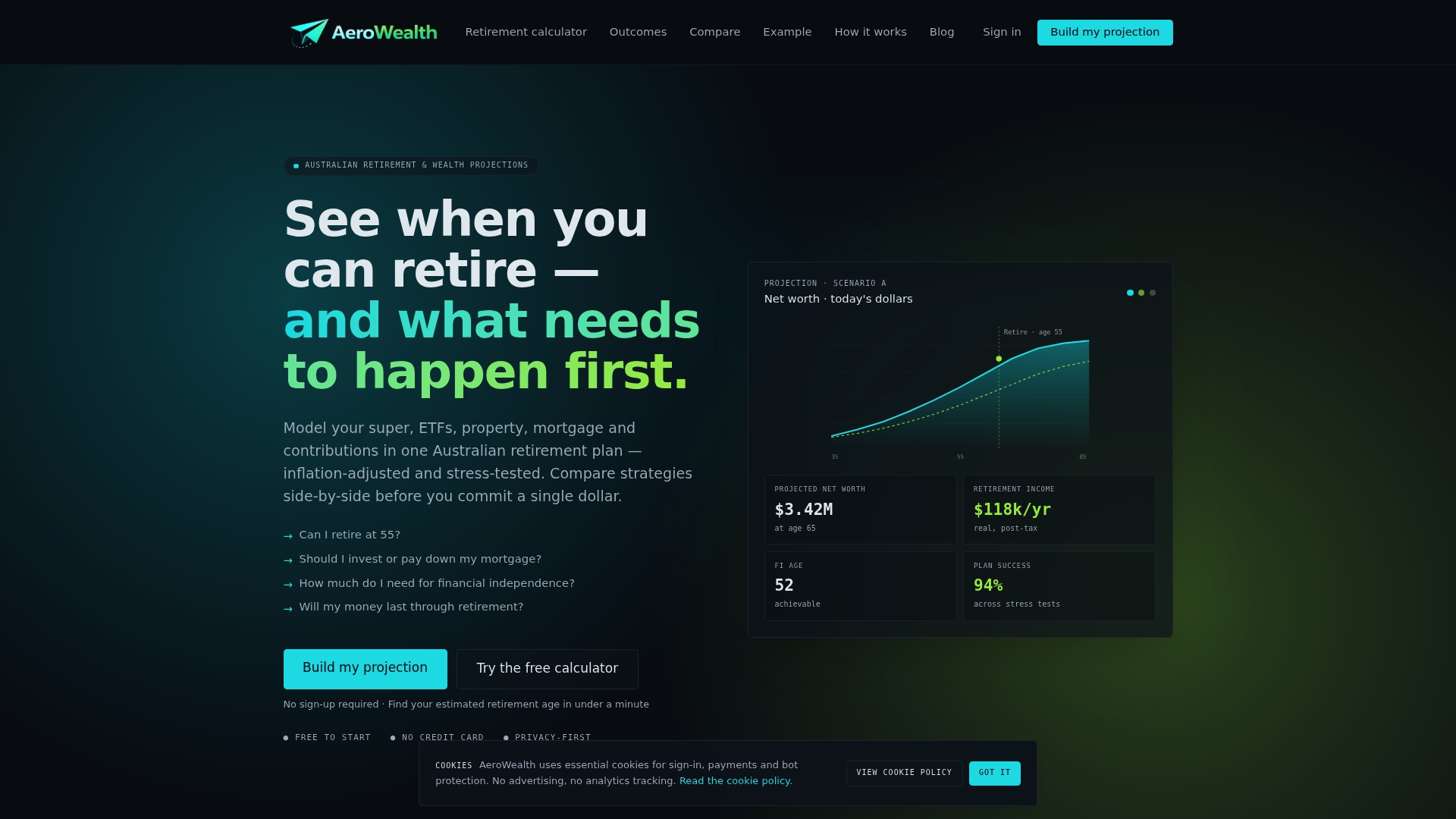
If you want to start with the basics first, take a look at AeroWealth’s planning tool and build your first scenario.
FAQ
What is the last day to make a super contribution for this financial year?
The fund must receive the money by 30 June for it to count in that year. Many funds set earlier cut-offs for personal contributions, often several days before, so check your fund’s end-of-year page and pay in early to mid June.
How often does my employer have to pay super?
From 1 July 2026, employers must pay super guarantee for each payday, and the fund must receive it within 7 business days. Before that date, employers paid quarterly, within 28 days of the quarter’s end.
Does timing matter for the government co-contribution?
The co-contribution is based on after-tax personal contributions and your income for the year, so the year the money lands still matters. Thresholds change each year, so check our co-contribution income thresholds guide for the current figures.
Can I make a large contribution if my balance is close to $500,000?
Possibly, but the order matters. Carry-forward eligibility is based on your balance at 30 June of the previous year, so using unused cap before your balance crosses $500,000 can keep that option open. Work through your own numbers, and speak to a licensed financial adviser if the amounts are large.
What if I go over my concessional cap by mistake?
The excess is added to your assessable income and taxed at your marginal rate with a 15% offset. You may be able to elect to release some of it from super. If you cannot or do not, the tax can reach up to 94%. Contact the ATO or a registered tax agent promptly.
Sources
- ATO: Non-concessional contributions cap
- ATO: Non-concessional contributions cap and bring-forward
- ATO: Concessional contributions cap
- ATO: Caps, limits and tax on super contributions
- ATO: Division 293 tax
- ATO: Restrictions on voluntary contributions
- ATO: Super from your employer
- ATO: Payday Super for employers
- ATO: Payday Super and SuperStream for super funds
- ATO: Revisiting Payday Super myths
- AustralianSuper: End of financial year cut-off dates
- MLC: Super deadlines 2025