Australians 67–75: No Work Test to Add Super. Deducting Still Requires It

Yes, most voluntary contributions can be made by Australians aged 67 to 74 without meeting the work test, but the work test still matters if you want to claim a tax deduction, and strict age deadlines apply once you turn 75. The ATO, contribution caps, the downsizer contribution and your total superannuation balance (TSB) all shape what you can actually do, and AeroWealth can help you model the trade-offs before you commit any money.
TL;DR:
- Australians aged 67 to 74 can make most voluntary super contributions without the work test, but claiming a tax deduction still requires meeting it.
- The work test involves working at least 40 hours in any 30 consecutive days, with one qualifying period allowing eligibility for the rest of the financial year.
- For those over 75, contributions must be made within 28 days after their birth month ends, regardless of work status, or they become ineligible.
- The 12-month work test exemption applies if you previously met the test, your super balance is below $300,000 at June 30, and you haven’t used the exemption before.
- Contribution caps for 2026-27 are $32,500 for concessional and $130,000 for non-concessional contributions, with the ability to bring forward multiple years of non-concessional caps based on your total super balance.
Table of Contents
- What counts as meeting the work test?
- What changed on 1 July 2022, and what still requires the work test?
- The 12-month work test exemption, explained
- Contribution caps, bring-forward rules and your total super balance
- Downsizer contributions: a separate path around the caps
- Claiming a deduction: notice of intent and recordkeeping
- A quick checklist before you contribute
- How scenario modeling clarifies these trade-offs
- Model your own contribution scenarios with AeroWealth
- Where to verify these rules yourself
- Sources
- FAQ
What counts as meeting the work test?
The work test is a straightforward employment check: you need to work at least 40 hours in any 30 consecutive days during a financial year. That period can fall anywhere in the year, and it does not need to be continuous work across the whole year, just one qualifying stretch of 30 days.
Once you have met the work test in a financial year, the effect carries through the rest of that year. You do not need to prequalify every time you want to make a contribution between July and June. This is what the ATO describes as the annual nature of the test: a single 30-day period unlocks eligibility, including for deductible contributions, for the remainder of that financial year.
Age changes the picture in two ways:
- Between 67 and 74, most voluntary contributions do not require the work test at all, though claiming a deduction still does.
- At 75 and older, voluntary contributions must reach your super fund no later than 28 days after the end of the month you turn 75, and missing that window makes the contribution ineligible, regardless of the work test.
Say you turn 68 in March and pick up casual consulting work from April 1 to April 25, totaling 42 hours. That satisfies the 40-hours-in-30-days rule, and it means you can make a personal deductible contribution any time before the end of that financial year, not just during the month you worked.
What changed on 1 July 2022, and what still requires the work test?
Before July 2022, anyone aged 67 to 74 needed to meet the work test before making almost any voluntary contribution. That requirement was removed for most contribution types. As the ATO now states, Australians aged 67 to 74 can make most voluntary contributions, including salary sacrifice and non-concessional contributions, without needing to satisfy any work test.
The catch sits with tax deductions. If you want to claim a deduction for a personal super contribution, you still need to meet the work test or qualify for the exemption, even though the contribution itself is allowed without it.
In practice, this splits contributions into two groups:
- Non-deductible personal contributions and salary sacrifice: generally open to those 67 to 74 with no work test required.
- Personal contributions you intend to claim as a tax deduction: still gated by the work test or the 12-month exemption, no matter your age within this bracket.
Salary sacrifice arrangements are unaffected by the work test change because they were never subject to it in the same way. Employers can continue directing pre-tax salary into super for eligible employees aged 67 to 74 without any employment-hours test attached. The distinction that trips people up is assuming that because the contribution went through, the deduction is automatic. It is not, and the ATO treats these as separate questions entirely.
The 12-month work test exemption, explained
If you stopped working partway through a year and did not requalify, you might still have one more year of flexibility through the work test exemption. This is a one-off allowance, and the ATO sets three conditions that all must be met:
- You met the work test in the financial year immediately before the one you want the exemption for.
- Your total superannuation balance was below $300,000 at the end of that previous financial year.
- You have not used this exemption in any earlier year.
The 12-month clock runs from the end of the financial year in which you last met the work test, giving you the following financial year to use the exemption. It is calculated against the financial year boundary, not your personal work anniversary, so the timing is fixed regardless of when in the year you stopped working.
Two quick scenarios show how this plays out. A 70-year-old who worked through most of 2025 but retired in March 2026, with a TSB of $250,000 at 30 June 2026, can use the exemption for the 2026 to 2027 financial year. A 73-year-old with a TSB of $310,000 at that same date cannot use it, even if everything else lines up, because the balance sits above the threshold.
Contribution caps still apply during an exemption year. The exemption changes who is eligible to contribute, not how much they can put in.
Pro Tip: Check your TSB as reported by your fund as close to 30 June as possible, since that single date determines whether the exemption is available to you the following year.

Contribution caps, bring-forward rules and your total super balance
Knowing you can contribute is only half the equation. The caps determine how much, and your TSB determines whether the bring-forward arrangement is even on the table. For the 2026–27 financial year, the concessional contributions cap is $32,500 and the non-concessional cap is $130,000.
If your TSB is low enough, you may be able to bring forward multiple years of the non-concessional cap into a single contribution:
- A TSB under $1.84 million allows a 3-year bring-forward, up to $390,000 in the first year.
- A TSB between $1.84 million and $1.97 million allows a 2-year bring-forward, up to $260,000.
Your TSB is fixed at 30 June of the previous financial year, so a large contribution or strong investment return late in one year can push you over a threshold and shrink your bring-forward room the next. This is worth modeling before you act rather than after, since you cannot undo a contribution once it lands.
Exceeding your caps triggers a formal ATO process. You will typically receive a determination for excess contributions, and you generally have around 60 days to elect how to handle it, which can mean releasing the excess from your super fund or paying excess non-concessional contributions tax. Timing matters here too: a contribution counts on the date your fund actually receives it, not the date you send it or the date your employer processes a salary sacrifice instruction. A payment sent on June 28 that lands in your fund’s account on July 2 counts toward next year’s cap, not this year’s, which has caught out plenty of people trying to maximize a cap before it resets.
For a deeper look at how the bring-forward arrangement interacts with your broader plan, A guide to modeling the $130,000 cap walks through the numbers, and another 2026 caps and planning guide covers carry-forward tactics in more detail.

Downsizer contributions: a separate path around the caps
The downsizer contribution is a distinct mechanism from everything above, and it comes with its own rules rather than sitting inside the work test or the non-concessional cap.
- You need to be 55 or older at the time you make the contribution.
- You or your spouse must have owned the home for at least 10 years.
- You must make your choice in the approved form and contribute within 90 days of settlement.
- The cap is $300,000 per person, meaning a couple could potentially contribute up to $600,000 combined from the same sale.
Downsizer contributions do not count toward the non-concessional cap and are not deductible, and critically, they bypass the work test entirely. This makes them one of the few ways someone aged 74 or older can still add a meaningful sum to super without any employment condition attached.
| Feature | Downsizer contribution |
|---|---|
| Minimum age | 55 |
| Home ownership requirement | 10+ years |
| Contribution window | 90 days after settlement |
| Cap | $300,000 per person |
| Counts toward non-concessional cap | No |
| Requires work test | No |
Couples selling a jointly owned home can split the proceeds between both super accounts, up to $300,000 each, even if only one spouse is named on the title, provided ownership conditions are satisfied. A guide to downsizer strategy covers the paperwork and timing traps in more depth, and another downsizing and Age Pension guide looks at how a $300,000 contribution can shift means-tested outcomes.
Claiming a deduction: notice of intent and recordkeeping
If you want a tax deduction for a personal contribution, there is a specific sequence to follow, and skipping a step can cost you the deduction entirely.
- Confirm you meet the work test or the 12-month exemption for that financial year.
- Make the personal contribution to your fund.
- Lodge a notice of intent to claim a deduction with your fund, using the approved form.
- Wait for written acknowledgement from your fund before you claim anything.
- Include the deduction in your tax return, within the relevant deadlines.
Keep records that back up each step:
- Evidence of the 40 hours worked, such as payslips, timesheets or an employment contract.
- Your fund’s written acknowledgement of the notice of intent.
- Settlement paperwork if any part of your contribution relates to a downsizer amount.
A few situations trip people up regularly. If you hold accounts across multiple funds, the notice of intent needs to go to the specific fund that received the contribution, not a different one you also hold. If your employer processes salary sacrifice, that portion is not something you separately claim as a deduction, since it is already made from pre-tax income. And if your notice of intent arrives after you have already lodged your tax return or withdrawn the funds, the deduction can be reduced or denied.
A quick checklist before you contribute
Run through this before moving money:
- Check your TSB as at the most recent 30 June.
- Confirm your age and, if you are near 75, the exact 28-day deadline that applies.
- Decide whether the contribution is deductible, non-deductible or a downsizer amount.
- Lodge a notice of intent with your fund if you plan to claim a deduction.
- Confirm timing with your fund or employer so the contribution lands in the year you intend.
Pro Tip: Ask your fund to confirm receipt in writing rather than relying on your bank’s transaction date, since the fund’s receipt date is what counts for cap purposes.
A 68-year-old who worked 42 hours across a 30-day stretch in April can make a deductible personal contribution any time before June 30 that year, once they lodge their notice of intent. A 72-year-old who last met the work test in the 2025 to 2026 year, with a TSB of $270,000 at 30 June 2026, can use the 12-month exemption to make deductible contributions through 2026 to 2027 without working again.
How scenario modeling clarifies these trade-offs
Deciding whether to contribute now or wait a year rarely comes down to eligibility alone. It usually hinges on how a contribution interacts with your TSB, your expected investment returns and, for many retirees, the Age Pension means tests.
- Model a scenario where you contribute the full non-concessional cap this year against one where you delay and use the bring-forward next year instead.
- Test how a $130,000 contribution shifts your assessable assets under the Age Pension asset test.
- Compare projected retirement income between claiming a deduction now versus banking the same contribution as non-deductible.
Running two or three versions side by side, rather than guessing, is where a tool with scenario comparisons earns its place in the decision.
— Aerowealth Team
Model your own contribution scenarios with AeroWealth
Working out whether to contribute now, wait for next year’s bring-forward, or use a downsizer amount instead is exactly the kind of decision that benefits from seeing the numbers side by side rather than guessing.
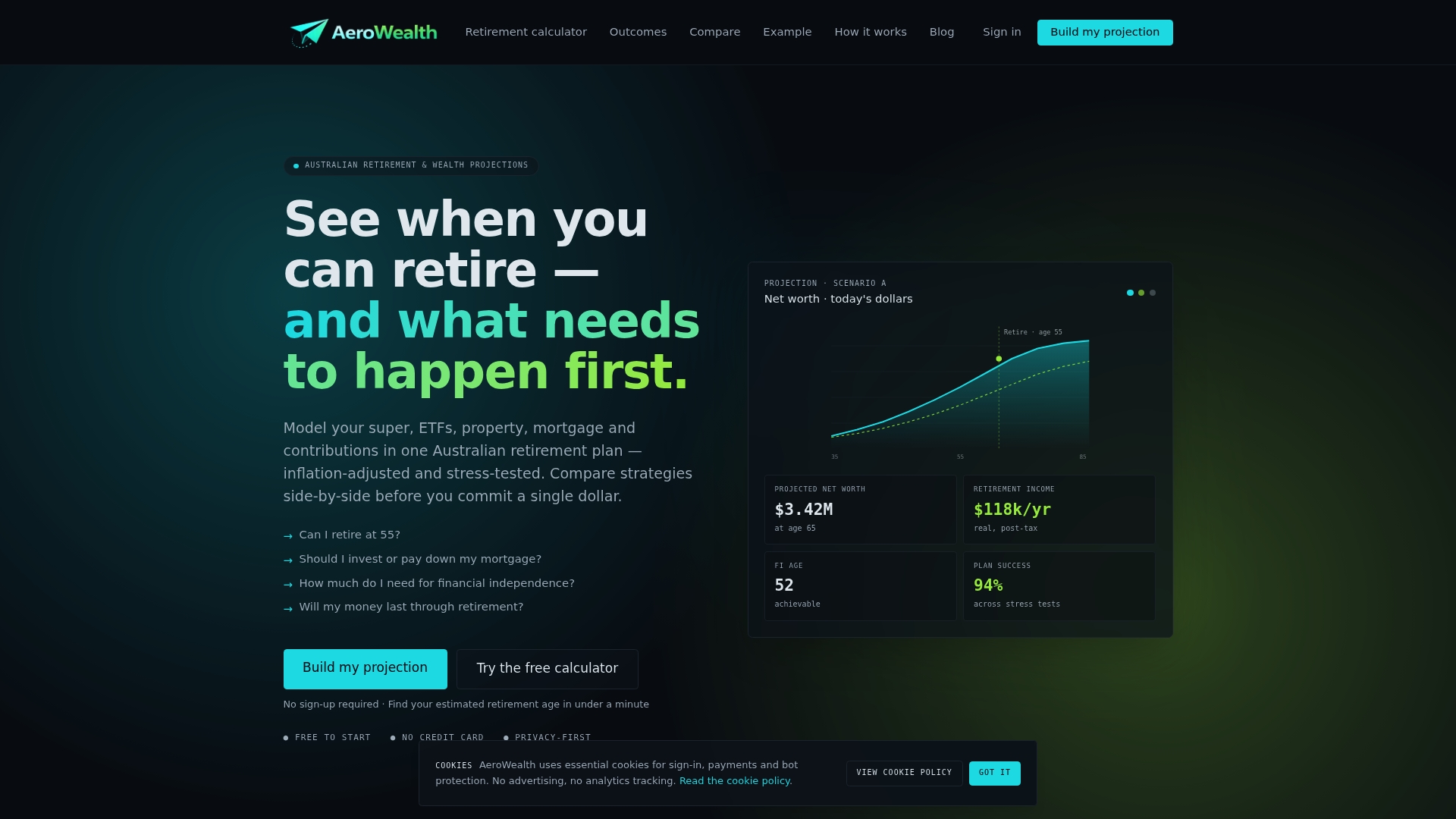
AeroWealth lets you build a contribute-now versus delay comparison, project how each choice affects your TSB and retirement income, and see the difference before you sign anything with your fund.
- Start on the Free plan to map out a basic contribution scenario.
- Upgrade to Pro for $7 AUD per month for expanded scenario planning and mortgage and property modeling alongside your super projections.
Head to AeroWealth to set up your first comparison.
Where to verify these rules yourself
These figures and rules come directly from ATO guidance, and it is worth checking your own numbers against the source pages, especially since caps and thresholds are reviewed periodically.
- Restrictions on voluntary contributions for work test and exemption detail.
- Non-concessional contributions cap for current caps and bring-forward thresholds.
- Downsizer super contributions for eligibility and timing rules.
- ATO online services, where you can view your own reported TSB and contribution history.
This article is general information, not a substitute for advice from a qualified financial advisor. Consult a qualified financial professional about your own circumstances before acting on anything here.
Sources
- Restrictions on voluntary contributions | Australian Taxation Office
- Non-concessional contributions cap | Australian Taxation Office
- Downsizer super contributions | Australian Taxation Office
FAQ
What happens if I contribute more than $130,000 to super?
Exceeding the non-concessional cap typically triggers an ATO determination for excess contributions, and you generally have around 60 days to choose how to handle it. Options include releasing the excess amount from your fund or paying excess contributions tax on it, as outlined in the ATO’s contributions caps guidance.
What are the superannuation contribution caps for 2026 to 2027?
For the 2026 to 2027 financial year, the concessional contributions cap is $32,500 and the non-concessional cap is $130,000, as set by the ATO. Eligible individuals with a lower TSB may be able to bring forward up to three years of the non-concessional cap.
Do voluntary super contributions reduce my taxable income?
Only personal contributions you formally claim as a tax deduction reduce your taxable income, and that requires meeting the work test or exemption plus lodging a valid notice of intent with your fund. Non-deductible personal contributions and salary sacrifice amounts are treated differently and do not work the same way on your tax return.
Can you still contribute to super after 65?
Yes, and the rules have become more flexible since 1 July 2022. Most Australians aged 67 to 74 can now make voluntary contributions without meeting the work test, and those 75 and older can still contribute up to 28 days after the end of the month they turn 75, provided the contribution isn’t one requiring a deduction claim tied to the work test.