Crypto CGT in Australia: Model Swap Tax for Retirement

Yes, in Australia crypto is generally a CGT asset: disposals usually trigger capital gains tax. The Australian Taxation Office sets the rules, and the Reserve Bank of Australia supplies the exchange rates most investors use to value transactions in AUD. Your next step is simple: pull together every transaction record now, convert values to AUD, and check which events actually count as disposals before you lodge.
TL;DR:
- Swapping, gifting, spending, or wrapping crypto can trigger a disposal even without converting it to cash, so record each event at its market value.
- Eligible individuals may qualify for the CGT discount after holding an asset for at least 12 months, while business profits are taxed as ordinary income.
- Report staking rewards and airdrops as income at their AUD value on receipt; a later sale or swap creates a separate CGT event.
- Keep transaction records for at least five years, including wallet transfers and DeFi activity that exchange reports may fail to capture.
- Crypto capital losses offset capital gains, and unused losses carry forward indefinitely, but they cannot reduce salary or other ordinary income.
Table of Contents
- How CGT Applies to Crypto Under ATO Rules
- Calculating Capital Gains on Crypto: Cost Base, Proceeds, and the 12-Month Discount
- Taxable Events for Staking, Airdrops, DeFi, and Wrapped Tokens
- Record Keeping, AUD Valuation, and Reporting Your Crypto CGT
- Managing Your Crypto CGT Exposure Lawfully
- Exemptions and Rollovers That Apply to Crypto
- How We Think About CGT Inside a Retirement Plan
- See Your Crypto Tax Decisions Play Out in Your Retirement Numbers
- FAQ
- Sources
How CGT Applies to Crypto Under ATO Rules
The ATO treats most cryptocurrency as a CGT asset, which means a capital gains tax event happens whenever you dispose of it, not just when you convert it back to cash. Disposal is a broader concept than most new investors expect.
Common CGT events include:
- Selling crypto for AUD or any other fiat currency
- Swapping one crypto asset for another
- Gifting crypto to another person
- Using crypto to pay for goods or services
- Converting a token through a wrapping or liquidity pool arrangement
Not every crypto holder is taxed the same way. If you buy and hold as an investment, gains and losses fall under the CGT regime. If your activity looks like a business, high transaction volume, short holding periods, a commercial setup, the ATO may instead treat profits as ordinary income, taxed in full at your marginal rate with no CGT discount available. The distinction matters for how much tax you pay and how losses can be used.
Compliance visibility is increasing as cross-border frameworks shape how digital asset reporting unfolds internationally, with key insights into digital asset cross-border legal considerations. Australia is implementing the OECD’s Crypto Asset Reporting Framework, with information exchanges between jurisdictions expected by 2027, and the ATO already runs data-matching programs against exchange data. Treasury and the ATO continue to consult on how digital assets fit existing tax law, but the practical effect for investors is the same either way: unreported activity is increasingly likely to surface.
Calculating Capital Gains on Crypto: Cost Base, Proceeds, and the 12-Month Discount
The core formula is straightforward: capital gain equals capital proceeds minus cost base. Capital proceeds are the market value of what you receive on disposal, in AUD, minus any selling fees. Cost base includes your original purchase price plus incidental costs like exchange fees, brokerage, and transfer costs.
Say you bought $5,000 of a token, paid $50 in fees, and later swapped it for another crypto asset worth $8,000 at the time of the swap. Your cost base is $5,050 and your capital proceeds are $8,000, giving a capital gain of $2,950 before any discount.
- Work out your cost base: purchase price plus fees and incidental costs.
- Work out your capital proceeds: market value received, in AUD, minus disposal costs.
- Subtract cost base from proceeds to get the raw capital gain or loss.
- Apply the 12-month discount if you’re an eligible individual who held the asset for at least 12 months before disposal.
Individuals who hold a crypto asset for at least 12 months before disposal may be eligible for the CGT discount, which can meaningfully reduce the assessable portion of a long-held gain.
Parcel allocation matters when you’ve bought the same token at different times and prices. Label each purchase as its own parcel, with its own date and cost base, so that when you dispose of part of a holding you can identify exactly which parcel you’re selling. This is especially important for swaps, where the ATO treats the old token as disposed of and the new one as acquired at its market value on that date.

Taxable Events for Staking, Airdrops, DeFi, and Wrapped Tokens
Staking rewards and airdrops are generally treated as assessable “other income” at the market value of the tokens when you receive them, separate from any later CGT event. That income gets reported at receipt, regardless of whether you ever sell the tokens.
DeFi activity adds another layer. Depositing crypto into a liquidity pool, lending it out, or wrapping and unwrapping a token can all count as CGT events because beneficial ownership of the original asset often ends, even if you still have exposure to its value through a derivative token. Capital proceeds in these cases equal the market value of whatever you receive in return, whether that’s a liquidity pool token, a wrapped asset, or interest paid in crypto.
Typical sequence:
- Receive a staking reward: report its AUD market value as other income on that date.
- Hold the reward token, then later sell or swap it: this triggers a separate CGT event, with cost base equal to the value already reported as income.
- Deposit a token into a liquidity pool or wrap it: treat this as a disposal of the original asset and acquisition of the new one.
Pro Tip: Record the exact AUD value and timestamp the moment you receive a reward or interact with a DeFi protocol, since that figure becomes both your income amount and your future cost base.
Record Keeping, AUD Valuation, and Reporting Your Crypto CGT
Every crypto transaction needs to be converted into AUD at the time it happened, and the ATO prefers Reserve Bank of Australia exchange rates where one is available for the currency pair involved. Where RBA doesn’t publish a rate for a particular pair, use a reasonable alternative source and note which one you used, consistently, across your records.
For each transaction, keep:
- The date and type of transaction (buy, sell, swap, gift, income event)
- The counterparty or wallet address involved
- The AUD value at the time, with your source for that value
- Receipts, exchange statements, and wallet exports
- Records of fees and any software or subscription costs used to manage your portfolio
Records must be kept for at least 5 years after the relevant transaction or event, and that clock resets if you’re disputing an assessment. Relying solely on exchange-generated reports is a common mistake: exchanges often miss transfers between your own wallets and rarely capture DeFi activity accurately, leaving gaps that surface only when the ATO cross-checks data.
Managing Your Crypto CGT Exposure Lawfully
Tax loss harvesting, selling an asset at a loss to offset gains elsewhere in your portfolio, is a standard, lawful strategy. Capital losses first offset capital gains in the same year; any unused loss carries forward indefinitely until you have gains to absorb it against, though it can never offset ordinary income.
- Realize losses on underperforming holdings before year end to offset gains already locked in.
- Hold appreciating assets past the 12-month mark where feasible to access the CGT discount.
- Avoid wash-sale-style repurchases that could draw ATO scrutiny over the substance of the disposal.
Pro Tip: Model a few different disposal timelines before you sell anything large. The difference between a disposal at month 11 and month 13 can be the entire CGT discount.
Beyond single-year tax planning, it’s worth running the numbers forward: how a realized gain this year changes your net worth trajectory, or how a stretch of harvested losses affects the capital you’ll have available at retirement. Our guide to tax loss harvesting in Australia walks through how to model those outcomes over time rather than just for the current return.
Exemptions and Rollovers That Apply to Crypto
Crypto assets have very few carve-outs from CGT. The personal use asset exemption is the one most investors ask about, and it’s narrower than it sounds. According to the ATO, a crypto asset only qualifies as a personal use asset if it was acquired and kept mainly to buy items for personal use or consumption, judged at the time of disposal. Holding a token with any investment intent, even if you occasionally spend some of it, generally disqualifies it from this exemption.
There’s no broad rollover relief designed specifically for crypto disposals the way there is for some business restructures or small business CGT concessions. Standard CGT rollover provisions that exist elsewhere in tax law can occasionally apply where a transaction meets their general requirements, but these aren’t crypto-specific and shouldn’t be assumed without checking the underlying provision against your exact situation.
The government’s current posture reinforces this. The Treasury response to the Board of Taxation’s digital asset review confirms there’s no dedicated new crypto tax regime in the pipeline. Existing capital gains and income tax law continues to apply to digital assets, with the ATO issuing expanded guidance rather than new legislation. For most individual investors, that means the standard CGT rules outlined above are the rules, with no special relief to plan around.

How We Think About CGT Inside a Retirement Plan
We built our modeling approach around the idea that a capital gain isn’t just a tax return line, it’s a number that reshapes a retirement timeline. Side-by-side scenario comparisons let you see a higher-CGT year next to a tax-managed alternative and watch how each path changes your projected balance and retirement age.
Two patterns show up often: a large unplanned disposal can quietly erode years of compounding, while spreading disposals across tax years or timing them past the 12-month discount threshold can preserve meaningfully more capital for the same underlying portfolio. Read more on our blog.
— Aerowealth Team
See Your Crypto Tax Decisions Play Out in Your Retirement Numbers
You can build scenarios where a crypto disposal happens this year versus holding past the 12-month mark, and compare how each affects your projected retirement income side by side.
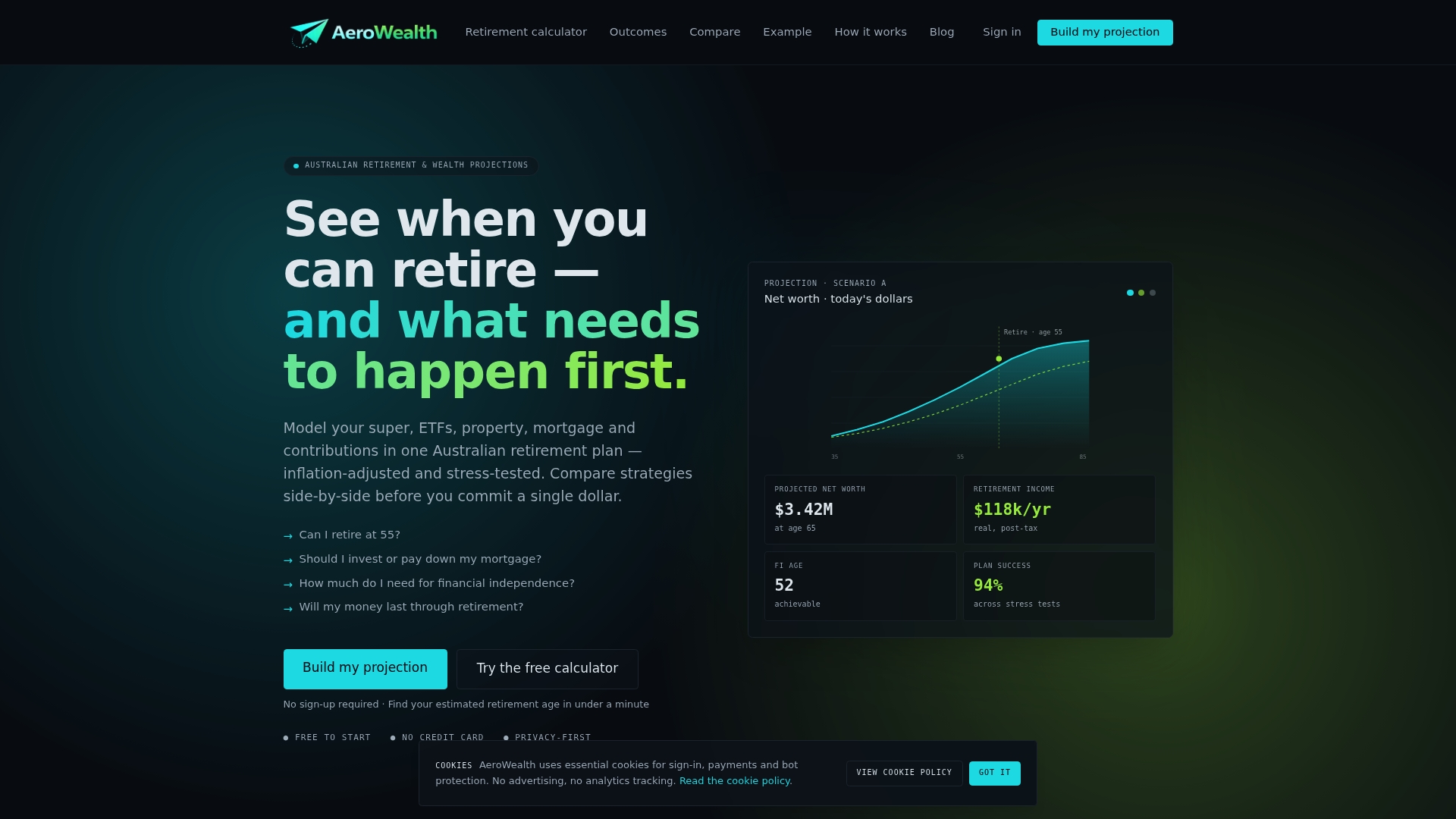
- Model different disposal timings against your actual super and investment plan.
- Stress-test how a bigger-than-expected gain changes your retirement age.
- Start free or check what’s included in Pro at $7 AUD per month.
See your own numbers at AeroWealth.
This article is general information, not a substitute for advice from a qualified financial advisor. Consult a qualified financial professional about your own circumstances before acting on anything here.
FAQ
How much capital gains tax do I pay on $100,000?
There’s no flat rate: crypto capital gains are added to your other taxable income and taxed at your marginal rate, after any eligible 12-month CGT discount is applied. Long-held gains may qualify for the 12-month CGT discount, reducing the assessable amount, with the exact tax payable depending entirely on your total income and applicable tax brackets that year.
Can I deduct crypto losses on my tax return?
Yes, capital losses from crypto disposals offset capital gains in the same income year, and any leftover loss carries forward to offset gains in future years. These losses can’t be used against your salary or other ordinary income, only against capital gains.
Where can I buy crypto in Australia?
Crypto can be purchased through exchanges operating in Australia, and the platform you choose doesn’t change your underlying CGT obligations. Whichever exchange you use, you’re still responsible for converting each transaction to AUD and keeping your own records rather than relying solely on the exchange’s reporting.
Do I need to pay capital gains tax on crypto?
In most cases, yes: the ATO treats crypto as a CGT asset, so selling, swapping, gifting, or spending it typically triggers a CGT event. The main exception is a narrow personal use asset carve-out, which generally doesn’t apply if you held the asset with any investment intent.