Australian Retirees: How 2027 CGT Reform Changes Investment Tax

Yes, most Australian retirees pay tax on their investment income, but there’s one major exception: account-based pension payments from a taxed super fund are generally tax-free once you turn 60. Outside super, interest, dividends, rental income, and capital gains are all assessable at your marginal rate. The rules around capital gains are also about to shift, with new reforms landing on July 1, 2027, and SAPTO or Age Pension status can change your final bill more than most retirees expect.
TL;DR:
- Retired Australians with taxed super funds can receive pension payments tax-free once they turn 60, but outside super, interest, dividends, rental income, and capital gains remain taxable at marginal rates.
- Capital gains reforms starting July 1, 2027, introduce a CPI indexation and a minimum 30% tax floor, which may increase taxes for retirees with low marginal rates, except Age Pension recipients.
- Allocating super withdrawals to pension phase preserves tax-free benefits, while drawing from outside accounts or after lump sum withdrawals incurs ongoing tax on earning investments.
- Offsets like SAPTO and super income stream offsets can significantly reduce tax obligations, but stacking these benefits requires careful management of income levels and timing.
- Accurate recordkeeping, valuations, and strategic timing of asset sales and drawdowns are crucial to minimizing tax impacts during retirement and ahead of the 2027 CGT reforms.
Table of Contents
- What Counts as Investment Income for Retirees
- How Different Retirement Vehicles Get Taxed
- Capital Gains Tax for Retirees Is Changing in 2027
- Offsets and Concessions That Reduce Your Tax Bill
- Declaring Investment Income and How Super Withholding Works
- State or Local Taxes on Investment Income
- How Minimum Pension Drawdowns Affect Your Taxable Income
- Super vs. Non-Super Accounts: Which Withdrawals Cost You More
- Tax-Smart Timing: When to Sell, Hold, or Harvest Losses
- Author Perspective: What Actually Matters Here
- Test Your Own Numbers Before You Decide
- Where to Verify These Rules Yourself
- Sources
- FAQ
What Counts as Investment Income for Retirees
Investment income covers a wider net than most people assume once they stop working. It’s not just bank interest. Rental profits, share dividends, and managed fund payouts all count, and each has its own reporting quirks.
Here’s the breakdown of what typically shows up on a retiree’s tax return:
- Interest from savings accounts and term deposits, reported in full.
- Dividends, which may carry franking credits that reduce your overall tax if the company has already paid tax on that profit.
- Rental income from investment properties, net of allowable deductions.
- Managed fund and trust distributions, which often bundle several income types (interest, capital gains, foreign income) into one statement.
- Capital gains from selling shares, property, or crypto assets held outside super.
- Super income stream payments, which follow a completely different set of rules depending on your age and fund type.
That last category is the one that trips people up. Money coming from your super pension is taxed under superannuation law, not the ordinary income tax rules that apply to a term deposit or a rental property. Keep your PAYG payment summaries, dividend statements, and property settlement records handy. You’ll need them all come tax time, and we’ll get to exactly which forms matter later.
How Different Retirement Vehicles Get Taxed
Where your money sits matters just as much as how much you’ve got. Two retirees with identical balances can face wildly different tax bills depending on whether their funds are in pension phase, accumulation phase, or sitting outside super entirely.
-
Account-based pensions (retirement phase). If you’re 60 or older and drawing from a taxed super fund, your pension payments are generally tax-free, and investment earnings inside that pension account escape tax entirely. This is the single biggest tax advantage available to Australian retirees, according to MoneySmart.
-
Accumulation accounts. If you haven’t converted your super to pension phase yet, investment earnings inside that account are still taxed at up to 15%, with a discounted rate of roughly 10% applying to certain capital gains on assets held longer than twelve months.
-
Transition-to-retirement (TTR) income streams. If you’re using a TTR strategy while still working, your account doesn’t get the full tax-free treatment. Earnings are taxed at up to 15%, the same as accumulation phase, until you meet a full condition of release.
-
Untaxed and defined benefit funds. Some public sector funds are untaxed, meaning your pension payments may attract marginal tax rates with an offset applied, rather than being tax-free outright. Defined benefit pensions also get assessed differently, often through a defined benefit income cap that limits how much of your payment stays concessionally taxed.
-
Annuities. Income from an annuity is partly assessable and partly a return of your own capital (the undeducted purchase price), and the taxable portion is reported through PAYG summaries just like a super pension.
-
Lump sum withdrawals invested outside super. Take your super out as a lump sum and put it into a term deposit or share portfolio, and every dollar of future earnings becomes taxable. Keeping money inside a retirement-phase account preserves that tax-free treatment; pulling it out cancels it. This is one of the most consequential, and most reversible, decisions a retiree makes, and it’s worth reading through the mechanics of tax on super withdrawals before you act.
Capital Gains Tax for Retirees Is Changing in 2027
Capital gains tax applies whenever you sell an asset, like shares, an investment property, or crypto, for more than you paid for it, and the gain gets added to your assessable income at tax time, according to the ATO. Right now, individuals who hold an asset for more than twelve months get a 50% discount on the taxable gain. That’s about to change.
Key reform: From July 1, 2027, the 50% CGT discount is replaced by CPI cost-base indexation, splitting gains into pre-reform and post-reform portions, alongside a 30% minimum effective tax rate on real capital gains for most non-exempt taxpayers, according to Treasury’s Budget summary.
That 30% floor is the detail retirees need to sit with. If your marginal tax rate is below 30%, which describes plenty of retirees living on modest investment income, the reform can actually push your effective CGT rate up rather than down. There’s a carve-out, though: Age Pension recipients are exempt from the 30% floor, though they’re still taxed on the indexed portion of their gain at their normal marginal rate.
A few things worth flagging as you plan around this:
- The reform only affects gains arising on or after July 1, 2027. Anything crystallized before that date follows the old 50% discount rules.
- Assets bought years ago will need a “deemed sale” split between pre- and post-reform periods, and that requires an accurate valuation dated exactly at the July 1, 2027 cutoff, according to tax reform analysis.
- Self-funded retirees on lower marginal rates are the group most likely to feel the 30% floor bite, since it can exceed what they’d otherwise pay.
- Getting your cost-base records and valuations sorted now, well before mid-2027, will save you a scramble later and protects your ability to prove the pre-reform portion of any gain.
The legislation behind all this, the Treasury Laws Amendment (Tax Reform No. 1) Act 2026, received royal assent in June 2026, so the framework is locked in even though the effective date is still ahead.
Offsets and Concessions That Reduce Your Tax Bill
Retirees have access to a handful of offsets that ordinary working-age taxpayers don’t, and stacking them correctly can meaningfully cut what you owe.
- Seniors and Pensioners Tax Offset (SAPTO) reduces or eliminates tax for eligible retirees. For 2025–26, a single person needs rebate income under $52,759 to qualify, while couples need combined rebate income under $87,620, with a maximum offset of up to a few thousand dollars each for couples living together, per the ATO’s SAPTO guidance.
- Super income stream tax offset applies a 15% offset on the taxed element and a 10% offset on the untaxed element of certain pension payments, softening the impact for people drawing from untaxed or defined benefit funds.
- Lump sum in arrears offsets can apply if you receive a backdated pension or super payment that would otherwise push you into a higher bracket for one year only.
- Partial Age Pension eligibility can remove the 30% CGT floor entirely for post-2027 gains, but qualifying for the pension purely to chase this tax benefit is a genuinely bad idea for most people, since strict means testing and anti-avoidance provisions tend to erase the expected advantage.
Pro Tip: Run your rebate income through the SAPTO thresholds before you sell any asset. A gain that tips you just over the $52,759 or $87,620 mark can cost you the entire offset, not just tax on the extra dollar.
Declaring Investment Income and How Super Withholding Works
Your tax return needs to capture every dollar of investment income, and the ATO is explicit about what belongs on it: interest, dividends, rental income, managed investment trust distributions, crypto proceeds, and net capital gains all count, according to the ATO’s investment income guidance.
Super income streams work differently. Funds paying a taxable super income stream typically issue a PAYG payment summary showing the assessable amount, and withholding is calculated using Schedule 13’s tax tables, which also set the defined benefit income cap used to limit how much of a defined benefit pension gets concessional treatment.
Before you sit down to lodge, gather:
- PAYG payment summaries for any super income stream.
- Dividend and distribution statements from shares and managed funds.
- Settlement statements for any property or asset sales.
- Cost-base records, including purchase dates and prices, for anything sold during the year.
Missing even one of these can mean an amended return later, which is far more hassle than pulling the paperwork together now.
State or Local Taxes on Investment Income
Australia doesn’t levy state income tax, so your investment earnings, whether from shares, super, or a rental property, are taxed only once at the federal level through the ATO. There’s no equivalent of the state-level tax layers that exist in some other countries.
That said, state and territory governments do tax property in ways that indirectly affect retirees holding investment real estate. Land tax applies annually in most states based on the unimproved value of land you own beyond your home, and thresholds and rates vary by state. Stamp duty applies when you buy an investment property, not when you earn income from it, so it’s a one-off cost rather than an ongoing tax on investment income itself.
Council rates are another local cost tied to property ownership rather than income, and while they’re not income tax, they do factor into the net return on a rental property once you’re calculating what you actually keep after expenses. If you’re weighing whether to hold a rental property into retirement or sell it before the 2027 CGT changes take effect, factor these local costs into your net yield calculation, not just the headline rental income figure.
How Minimum Pension Drawdowns Affect Your Taxable Income
Australia doesn’t use the same Required Minimum Distribution system as some other countries, but account-based pensions do have a comparable mechanism: minimum annual drawdown rates. Once you start a super pension, you’re required to withdraw a set percentage of your account balance each year, starting around 4% and rising as you age, and this isn’t optional.
The tax consequence depends entirely on your age and fund type. If you’re 60 or over and drawing from a taxed fund, that mandatory withdrawal is tax-free, so a higher minimum drawdown doesn’t inflate your tax bill at all. It just moves money from a tax-free environment into your bank account, where any subsequent earnings on it then become taxable.
This is where the drawdown mechanic quietly interacts with the lump sum decision covered earlier. A retiree forced to draw down more than they need to live on faces a choice: spend it, gift it, or reinvest it outside super where future earnings will be taxed. None of those options carry immediate tax on the drawdown itself, but the reinvestment path resets the tax treatment of everything that money earns from that point forward. Modelling how a rising minimum drawdown schedule interacts with your marginal rate over a 20 or 30 year retirement is exactly the kind of scenario testing that’s easy to get wrong doing manual spreadsheet math.

Super vs. Non-Super Accounts: Which Withdrawals Cost You More
Australia doesn’t have a Traditional IRA or Roth IRA structure, but the tax gap between super and ordinary investment accounts serves a similar function, and it’s arguably a bigger swing than the IRA distinction in the US system.
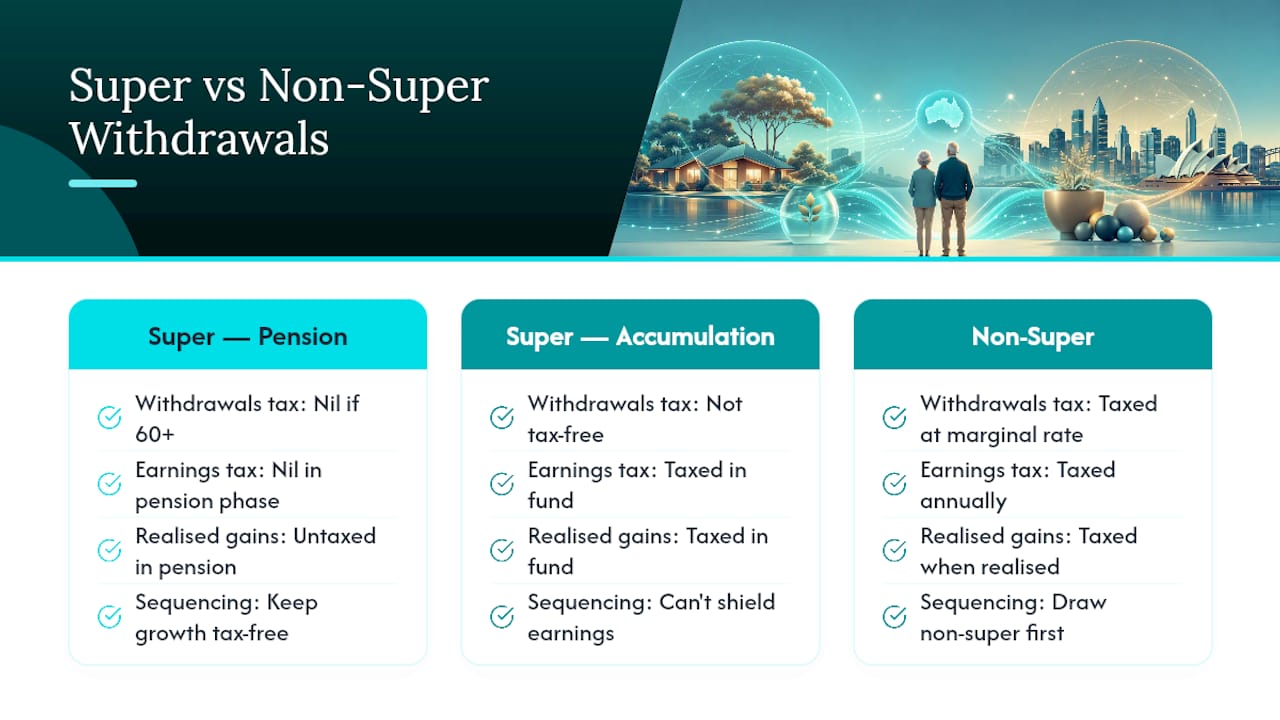
Withdrawing from an account-based pension in a taxed super fund, once you’re 60 or over, costs you nothing in tax. Compare that to a standard investment account or term deposit sitting outside super: every dollar of interest, dividend, or realized capital gain gets taxed at your marginal rate, year after year, for as long as you hold it.
The practical upshot is that the account you draw from first matters more than most retirees realize. Drawing down a non-super investment portfolio before touching your super pension can sometimes make sense if it lets more money keep growing tax-free inside the super environment for longer. But that only works if your super is actually in pension phase, since accumulation accounts still get taxed on earnings even though you can’t withdraw ordinary income tax on them yourself. Getting this sequencing wrong, spending down tax-free super early and leaving a taxable portfolio to keep compounding, can cost you tens of thousands of dollars in unnecessary tax over a retirement.
Tax-Smart Timing: When to Sell, Hold, or Harvest Losses
Timing is the one lever retirees control more than almost anyone else in the tax system, because you’re not tied to a wage cycle or a business’s cash flow needs.
Tax-loss harvesting means selling underperforming investments to realize a capital loss, which then offsets a capital gain elsewhere in the same financial year, or gets carried forward to offset future gains. If you’re planning to sell an investment property or a large parcel of shares before the July 2027 CGT reforms take effect, checking your portfolio for any losses worth crystallizing in the same year can meaningfully cut the tax on that bigger gain. Read through a fuller walkthrough of tax-loss harvesting in Australia if this is new territory.
Income timing matters just as much. Selling an asset in a year when your other taxable income is low, perhaps a year before you start drawing a defined benefit pension, or a year when rental income dipped, can keep you under the SAPTO thresholds or in a lower bracket entirely.
Staging disposals across multiple financial years, rather than selling everything at once, spreads the gain and can keep you out of higher brackets in any single year.
Author Perspective: What Actually Matters Here
Protect your super’s tax-free status where it genuinely suits your goals, don’t withdraw it “just in case.” Get your recordkeeping and valuations sorted well before July 2027, before you model any large disposal. And be wary of anyone suggesting you restructure your finances purely to qualify for a pension for CGT purposes. It rarely survives contact with the means test.
— Aerowealth Team
Test Your Own Numbers Before You Decide
Seeing exactly how they hit your own balance, your own property, and your own drawdown schedule is another. This tool is built for modelling super, property, and investment scenarios side by side so you can see the actual dollar difference between selling before or after July 2027, rather than guessing from a general rule.

You can build out a scenario comparing a single large asset sale against staged disposals over three or four years, stress-test what happens if you draw down super faster than planned, or check how an Age Pension eligibility shift changes your post-2027 CGT exposure. It’s the same kind of modelling covered in this article, applied to your actual account balances instead of hypothetical numbers. Start with the Free plan to build your first scenario, or move to Pro at $7 AUD per month if you want to run side-by-side comparisons across multiple retirement pathways.
Where to Verify These Rules Yourself
For the official word on any of this, go straight to the source. The ATO’s investment income guidance and Schedule 13 tax tables cover declaration and withholding. MoneySmart’s tax and super page explains pension-phase tax in plain language, and Treasury’s Budget CGT summary details the 2027 reform.
This article is general information, not a substitute for advice from a qualified financial advisor. Consult a qualified financial professional about your own circumstances before acting on anything here.
Sources
- How super works: tax and super — MoneySmart
- Treasury / Budget — tax reform summary (CGT changes)
- Investment income you must declare — ATO
FAQ
How Much Can a Retiree Earn Tax-Free in Australia?
There’s no single tax-free threshold unique to retirees, but the combination of the standard tax-free threshold and SAPTO can significantly reduce or eliminate tax for eligible singles, depending on their exact circumstances. On top of that, super pension payments from a taxed fund are entirely tax-free once you’re 60 or over, regardless of the amount.
What Are Some Tax-Free Investments for Retirees?
The main tax-free investment vehicle for Australian retirees is an account-based pension in a taxed super fund, where both the income payments and the underlying investment earnings are tax-free once you’re 60 or older. Outside super, there’s no fully tax-free investment category, though franking credits on dividends can offset tax already paid at the company level.
Do Pensioners in Australia Have to Pay Capital Gains Tax?
Yes, pensioners generally still pay capital gains tax on assets sold outside super, and being on the Age Pension doesn’t exempt you from CGT altogether. It does, however, mean you’re exempt from the new 30% minimum tax floor taking effect on July 1, 2027, though the indexed portion of any gain is still taxed at your marginal rate.
What Are the ATO Retirement Rules for Retirees?
The core rules cover when super becomes tax-free (generally age 60 in a taxed fund), what counts as declarable investment income, and which offsets like SAPTO apply. The ATO publishes updated guidance and forms each financial year, and checking the current page before lodging is worth the five minutes it takes.