Model Debt Recycling for 7 Years: Australian Tax Tracing and Cash Flow

Debt recycling is a way for Australian homeowners to convert non-deductible mortgage debt into investment borrowing by using redraws or loan splits to fund income-producing investments, provided the Australian Taxation Office’s tracing rules are satisfied. Deductibility hinges on exactly how borrowed funds are used, not on what the loan account is called, and the strategy tends to suit people with high marginal tax rates, stable income and a long investment horizon.
TL;DR:
- The deductibility of interest depends on the actual use of borrowed funds, not the loan account’s name or structure.
- Redraws are considered separate borrowings for tax purposes, making each drawdown’s deductibility dependent on its specific use.
- Mixing private expenses with investment loans can trigger anti-avoidance rules and jeopardize deductibility, requiring careful record-keeping and apportionment.
- The success of debt recycling relies heavily on a high marginal tax rate, stable income, and a long investment horizon, with risks magnified by market downturns and rate rises.
- Effective implementation requires clear loan structures, diligent monitoring, and professional advice, as well as a prepared exit plan to unwind or stop the strategy when needed.
Table of Contents
- What debt recycling is and the typical cycle
- How Australian tax rules treat debt recycling
- Risks, costs and who debt recycling suits
- Loan structures, lender mechanics and practical controls
- Step-by-step checklist to start debt recycling
- Record-keeping, tax reporting and the role of professional advice
- How debt recycling changes your cash flow and budgeting
- Long-term outcomes and scenario analysis
- Comparing debt recycling with other debt and investment strategies
- Exit strategies: how to unwind or stop debt recycling
- Common mistakes and pitfalls in debt recycling
- Aerowealth team perspective: modeling debt recycling
- AeroWealth: model debt-recycling outcomes before you commit
- FAQ
- Sources
What debt recycling is and the typical cycle
Debt recycling is a strategy with two goals running side by side: paying down a non-deductible home loan faster while building a separate pool of tax-deductible investment debt. It works by repeating a cycle rather than a single transaction.
- Use surplus cash or equity to repay a chunk of your non-deductible home loan principal.
- Redraw or borrow that same amount through a separate loan split or line of credit.
- Direct the redrawn funds into an income-producing investment, never into everyday spending.
- Use the investment’s income and any tax benefit to accelerate further principal repayments, then repeat.
Australian borrowers typically invest the redrawn funds into shares, managed funds or an investment property, as described in bank guidance on debt recycling. Shares and managed funds suit smaller, staged redraws because you can top up the investment split gradually. Property usually requires a larger lump sum and a longer commitment, which changes the risk and timing calculations considerably.
How Australian tax rules treat debt recycling
Whether the interest on a recycled loan is deductible comes down to one question: what was the money actually used for? Section 8-1 of the Income Tax Assessment Act 1997 allows a deduction for interest only when the borrowing has a sufficient connection with producing assessable income. Interest on funds used for private purposes, including most owner-occupied home loan debt, is not deductible.
The ATO’s TR 2000/2 ruling sets out how tracing works for redraws and line-of-credit facilities: each drawdown is treated as a separate borrowing, and deductibility follows the use of that specific amount, not the loan account’s label. Calling a sub-account an “investment split” does not make the interest deductible if the money ends up funding private expenses.
- Section 8-1 requires a direct connection between the borrowed funds and assessable income.
- TR 2000/2 treats each redraw as its own traceable borrowing for tax purposes.
- TR 98/22 flags that linked or split loan structures designed mainly to manufacture deductions can trigger Part IVA anti-avoidance provisions.
- Mixed-use loans require apportionment between deductible and non-deductible interest.
One rule carries more weight than any other in this strategy: interest is deductible only to the extent borrowings have a sufficient connection with producing assessable income, under section 8-1 and the ATO’s interest expenses guidance. That single test decides whether years of careful structuring pay off at tax time.
TR 98/22 is the ruling that keeps aggressive debt-recycling schemes in check. Arrangements built primarily to create extra deductions, rather than for a genuine investment purpose, can be challenged under Part IVA. Keeping a clear commercial rationale and solid documentation is the practical defense. When a loan serves both private and investment purposes, the ATO’s interest expenses guidance requires you to apportion interest between the two uses and keep records that support the split, a point we cover in more detail in our guide to tax write-offs for investment property.
Risks, costs and who debt recycling suits
Borrowing to invest magnifies outcomes in both directions. Moneysmart warns that gains are amplified when markets rise, but losses are amplified too, and loan repayments are still due even if your investments fall in value or your income drops.
- Leverage increases both potential returns and potential losses on the same capital base.
- A job loss or income cut does not pause your loan repayments.
- Rising variable rates increase the cost of carrying the investment loan.
- Market downturns can leave you with a capital loss and an ongoing debt.
Debt recycling asks for patience as much as capital. Markets move in cycles, and unwinding a position early to cover a cashflow gap often locks in a loss. It tends to suit people with secure income, an income tax bracket high enough to make the deduction meaningful, a time horizon of several years or more, and existing insurance and cash buffers already in place.
Pro Tip: Before committing, calculate your hurdle rate: your after-tax investment return needs to exceed your after-tax borrowing cost, or the strategy is working against you regardless of the tax deduction.
Loan structures, lender mechanics and practical controls
Most debt recycling in Australia runs through one of three structures: a split loan with a separate investment sub-account, a redraw facility on the existing mortgage, or a standalone line of credit. Each has different fee and flexibility trade-offs, and our breakdown of split-loan strategies walks through how staged redirection works in practice.
- Split loans separate your home loan into distinct accounts, one for private debt and one for investment borrowing, which simplifies tracing from day one.
- Redraw facilities let you draw back extra repayments you have made, but every redraw needs to be tracked individually since each one is a separate borrowing for tax purposes.
- Lines of credit offer flexible access to a set credit limit, often with a higher interest rate than a standard home loan split.
Before implementing any of these, confirm with your lender whether redraws require separate consent, what fees apply to creating or maintaining splits, whether interest capitalizes on the investment account, and how the lender’s systems report each sub-account for tax purposes. Our comparison of offset accounts versus redraw facilities covers a related mechanic worth understanding before you choose a structure.
Practical controls matter as much as the structure itself. Transfer redrawn funds directly into the investment account rather than through a transaction account, keep a dedicated account for all recycling activity, review the arrangement periodically against your original plan, and never let private spending touch the investment split.

Step-by-step checklist to start debt recycling
Preparation reduces most of the risk in debt recycling. Work through these steps before you redraw a single dollar.
- Assess your borrowing capacity and run hurdle-rate scenarios against realistic interest rate and return assumptions.
- Confirm redraw and split mechanics with your lender, and get fee and consent terms in writing.
- Build cash and insurance buffers large enough to cover repayments during an income gap.
- Set aside funds to cover the tax owed on investment income and any capital gains.
- Choose your investment type and confirm it suits a genuine multi-year horizon, ideally 7 years or longer.
- Engage a tax adviser and mortgage professional, and set up a record-keeping system before the first transaction.
Record-keeping, tax reporting and the role of professional advice
Deductibility depends on evidence, not intention. The ATO expects a documented trail showing exactly where every redrawn dollar went.
- Keep loan statements showing each redraw, split and balance change over time.
- Retain transfer records linking redrawn funds directly to the investment account.
- Save trade confirmations and distribution or dividend statements for every investment purchase.
- Keep your own apportionment calculations where a loan has mixed private and investment use.
A tax adviser plays a central role here, since apportionment calculations and tracing documentation are exactly the kind of detail the ATO scrutinizes under TR 2000/2. Mortgage brokers help structure the loan splits correctly from the outset, and a financial planner can assess whether the investment choice and risk level fit your broader goals, a combination that is hard to replace with guesswork.
How debt recycling changes your cash flow and budgeting
Debt recycling adds a second, variable expense to your household budget: interest on the investment loan, alongside whatever income or distributions the investment produces. In the early cycles, investment income is often modest relative to the new interest cost, so your monthly outgoings can rise even as your long-term net worth strategy improves. Budgeting for this gap matters more than most people expect.
A practical approach is to treat the investment loan’s interest as a fixed cost from day one, separate from your home loan budget, and size your buffer to cover it independently. Because each redraw is a new borrowing, the interest bill grows in steps rather than smoothly, so your cashflow plan needs to account for each increase rather than averaging it out.
Tax refunds or reduced withholding from the deduction arrive later than the interest cost does, often at the end of the financial year, which creates a timing mismatch. Households that rely on the eventual tax benefit to cover current repayments tend to run into trouble during the months before that benefit lands. Building the buffer discussed earlier into your monthly budget, rather than treating it as a one-off reserve, keeps the strategy from straining day-to-day finances when rates move or distributions come in lower than expected.
Long-term outcomes and scenario analysis
Debt recycling is a multi-year project, and its payoff depends heavily on the sequence of returns and rates you experience along the way, not just the averages. Industry commentary on debt recycling frames it as a long-horizon strategy and recommends testing outcomes under more than one scenario before committing.
Three broad scenarios are worth modeling. In a favorable case, investment returns consistently exceed the after-tax cost of borrowing, your home loan shrinks faster than it would have otherwise, and the investment portfolio compounds alongside it. In a flat case, returns roughly match the hurdle rate, and the main benefit becomes the tax deduction itself rather than net investment growth, which still has value but changes the calculus. In an adverse case, a rate rise or a market downturn coincides with reduced income, and the investment loan becomes a drag rather than an accelerant.

Running these scenarios before you start, rather than after a downturn forces the question, is the difference between a planned strategy and a reactive one. The variables that matter most are the interest rate on the investment loan, the expected return and volatility of the chosen investment, your marginal tax rate, and how long you can sustain the arrangement without needing to unwind it early.
Comparing debt recycling with other debt and investment strategies
Debt recycling is not the only way to reduce debt or build wealth, and it is worth weighing against the alternatives before committing capital.
Extra repayments directly onto your home loan reduce interest cost immediately and carry no investment risk, but they do not build any deductible debt or separate asset base. An offset account achieves a similar interest-reduction effect while keeping your cash accessible, without the leverage or tax complexity of recycling. Standard debt consolidation, rolling multiple debts into one lower-rate loan, reduces interest cost and simplifies repayments but does nothing to convert non-deductible debt into deductible debt. Investing surplus cash directly, without borrowing against the home loan, avoids leverage risk entirely but grows your investment base more slowly since you are not accelerating it with borrowed funds.
Debt recycling sits at the more aggressive end of this spectrum: it offers the potential for faster wealth accumulation and a tax deduction, in exchange for leverage risk, cashflow sensitivity and a tracing burden the other options do not carry. The right choice depends on how much risk and administrative discipline you are prepared to take on in exchange for that potential upside.
Exit strategies: how to unwind or stop debt recycling
Debt recycling is not meant to run forever, and having an exit plan from the start avoids forced decisions later. The most straightforward exit is to simply stop redrawing further, let the investment loan sit at its current balance, and continue paying it down with investment income or surplus cash like any other debt.
A faster exit involves selling part or all of the investment portfolio to repay the investment loan outright, which crystallizes any capital gain or loss at that point and ends the tracing requirement for that loan split. This works best when the investment has had time to grow and when selling does not trigger an unfavorable tax outcome. A partial unwind, selling enough to cover a cashflow shortfall while keeping the rest of the strategy running, is a middle option worth planning for in advance rather than improvising during a downturn.
Retirement, a major income change, or simply reaching your original target are the three most common triggers for winding down. Whichever trigger applies, closing out the strategy cleanly means reconciling your records one final time: confirming the investment loan balance, the sale proceeds, and the capital gains tax position, so your final tax return reflects the arrangement accurately.
Common mistakes and pitfalls in debt recycling
Most debt-recycling problems come from a handful of repeated errors rather than from the strategy itself failing.
Mixing private spending with the investment loan is the single most damaging mistake, since it contaminates the tracing trail and can turn previously deductible interest into a mixed-use loan requiring apportionment, as outlined in the ATO’s interest expenses guidance. Treating the tax deduction as the primary goal, rather than a secondary benefit of a genuine investment, raises the risk of Part IVA scrutiny under TR 98/22. Underestimating cashflow needs, particularly the gap between when interest is charged and when any tax benefit or investment income arrives, catches out borrowers who assume the numbers will balance month to month from the start.
Poor record-keeping is a slower but equally costly mistake: without clear transfer records and trade confirmations, demonstrating the connection between borrowed funds and assessable income becomes difficult at tax time. Starting with too short a time horizon, or committing the full strategy at once rather than staging it, leaves little room to recover from an early downturn. Our guide to offset accounts for investment property covers how mixed-purpose loans commonly go wrong in more detail.
Aerowealth team perspective: modeling debt recycling
The hurdle rate is the number that decides whether debt recycling works, yet most people never calculate it before committing. Stress-testing that rate against a rate rise or a weaker return year often changes the answer entirely. We built AeroWealth’s scenario comparisons and stress-testing tools around exactly this kind of sensitivity check, so you can see how your numbers hold up before locking in a loan split. Modeling clarifies the decision, but it does not replace advice from a qualified tax or mortgage professional.
— Aerowealth Team
AeroWealth: model debt-recycling outcomes before you commit
We built this tool so you can test a debt-recycling plan against your own numbers before you ever speak to a lender. Running side-by-side scenario comparisons shows you what happens to your mortgage, your investment debt and your retirement projections under different assumptions, rather than relying on a single best-case estimate.
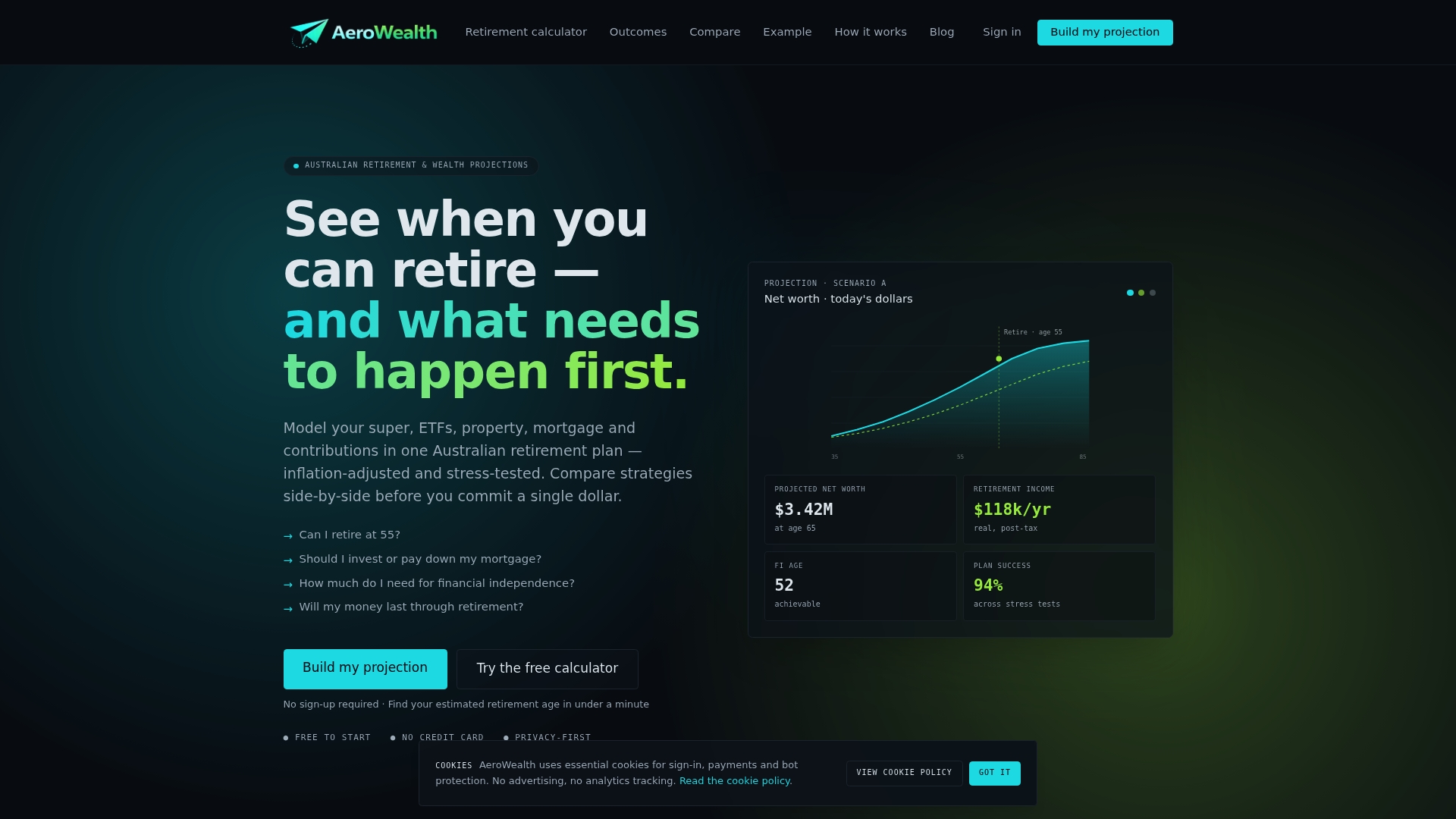
- Compare a debt-recycling scenario against staying the course on extra repayments, side by side.
- Stress-test your hurdle rate against higher interest rates or a weaker investment return.
- See how the strategy shifts your projected retirement age, income and net worth over time.
Our Free plan lets you build your first scenario and see where the numbers land, and our Pro plan at $7 AUD per month adds deeper scenario modeling and expanded stress-testing for borrowers running more complex plans. Explore your options at AeroWealth and see your projections before you redraw a single dollar.
This article is general information, not a substitute for advice from a qualified financial advisor. Consult a qualified financial professional about your own circumstances before acting on anything here.
FAQ
Is debt recycling actually worth it?
It depends on whether your after-tax investment return exceeds your after-tax borrowing cost over a sustained period, which is the hurdle-rate test described by Moneysmart. For borrowers with stable income, a long horizon and a high marginal tax rate, it can accelerate wealth building, but it adds real leverage risk that is not worth taking on for everyone.
Is debt recycling legal in ATO?
Yes, debt recycling itself is a legitimate strategy, and interest on the investment portion is deductible when it satisfies the tracing rules in TR 2000/2. Arrangements designed primarily to manufacture tax deductions, rather than for genuine investment, risk challenge under Part IVA as described in TR 98/22.
Can you debt recycle in Australia?
Yes, debt recycling is a recognized strategy among Australian homeowners and is commonly implemented through split loans, redraw facilities or a separate investment loan, as described in bank guidance on debt recycling. It requires a lender willing to set up the right loan structure and a borrower with reliable surplus cashflow to fund the cycle.
Who is eligible for $10,000 debt relief in Australia?
This question refers to a general debt relief program unrelated to debt recycling, which is a tax and investment strategy rather than a relief scheme. For current debt relief or hardship assistance eligibility, check directly with your lender or a government financial counseling service, since this falls outside the scope of debt recycling itself.
Sources
- TR 2000/2 | Australian Taxation Office
- Borrowing to invest | Moneysmart (ASIC)
- Debt recycling explained | NAB