2026 Defined Benefit Pension Tax Australia: Stay Under $131,250 Cap

For most Australians aged 60 or over, the taxed element of a defined benefit pension is tax-free, but any untaxed element counts as assessable income and attracts tax at marginal rates, softened by a 10% offset. The critical step for 2026 is running the ATO defined benefit income cap tool to confirm where you sit against the $131,250 defined benefit income cap and to check your provider’s PAYG withholding.
TL;DR:
- The defined benefit income cap for 2026-27 is $131,250, and exceeding it can cause half of the excess to become assessable income without offset.
- The untaxed element remains assessable at any age, but a 10% offset generally applies for recipients aged 60 and over, if their income stays below the cap.
- Reaching or surpassing the cap is common for retirees with large pensions, especially if they start or turn 60 partway through the year, making it essential to recheck yearly.
- Most retirees should use the ATO cap tool and verify PAYG withholding and offset eligibility to avoid overpaying tax or missing out on offsets.
- Using financial software or modeling tools helps compare scenarios like early retirement, part-year pensions, or combining pensions to optimize tax outcomes.
Table of Contents
- Tax components of a defined benefit pension explained
- Defined benefit income cap and the 2026 to 2027 threshold
- How the 10% offset and PAYG withholding actually work
- Transfer balance cap effects when you hold multiple pensions
- Using the ATO cap tool: a step-by-step worked example
- Practical checklist before you lodge this year
- Modelling your defined benefit tax outcomes with AeroWealth
- What happens if you go back to work or have other income
- Death benefits and estate planning for defined benefit pensions
- How defined benefit income appears on your tax return
- Lump sums and commutations: what changes for your tax bill
- Where retirees get tripped up on defined benefit tax
- A modelling option if you want to see your own numbers
- Sources
- FAQ
Tax components of a defined benefit pension explained
Every defined benefit pension is made up of building blocks that the Australian Taxation Office treats quite differently. Getting these labels straight is the first step to understanding your own payment summary.
The tax-free component reflects contributions already taxed on the way in and is never assessable, regardless of your age. The taxed element comes from a fund that has already paid tax on the underlying benefit, and for members aged 60 and over it is generally non-assessable, non-exempt income under ATO guidance. The untaxed element is different again: it exists because many older public sector schemes, including some legacy state and Commonwealth arrangements, were never taxed inside the fund. That element remains in your assessable income no matter your age, though a 10% tax offset is usually available once you turn 60.
Age and preservation status change the picture in a few concrete ways.
- Members aged 60 or over generally have the taxed element treated as non-assessable, non-exempt income.
- Members under 60 but over preservation age typically have both elements taxed, with a 15% offset applying to the taxed element in many cases.
- The untaxed element is assessable at any age, with the 10% offset available to eligible recipients aged 60 or over.
Services Australia also assesses defined benefit income streams differently for the income and assets tests, since the fund calculates a deductible amount that reduces the assessable portion for means-testing purposes. This is a separate calculation from the tax treatment described above, and it is worth checking both if you also receive an Age Pension.
Defined benefit income cap and the 2026 to 2027 threshold
The defined benefit income cap is not an arbitrary number. It is derived from the general transfer balance cap divided by 16, a formula the ATO uses to set an annual ceiling on how much of your non-assessable defined benefit income can stay tax-free. For the 2026-27 income year, that cap sits at $131,250, and because the underlying transfer balance cap is indexed periodically, this figure can shift from year to year, which is why re-checking it annually matters. For a fuller picture of how the transfer balance cap itself is set, see our explainer on the transfer balance cap.
The cap is not always a flat annual figure for every retiree. It gets pro-rated in several common situations.
- Turning 60 partway through the financial year reduces your cap proportionally for the months before your birthday.
- Starting a defined benefit income stream mid-year means the cap applies only from the commencement date.
- Receiving a reversionary death benefit income stream can trigger a fresh, pro-rated cap calculation from the date you become entitled to it, reducing the cap proportionally.
Breaching the cap has a specific consequence spelled out in ATO legal ruling LCR 2016/10: when the combined tax-free component and taxed element that would otherwise be non-assessable exceed the cap, 50% of that excess becomes assessable income, and no tax offset applies to that portion. This is one of the more overlooked mechanics of defined benefit taxation, and it catches out retirees with larger pensions or those who assume everything under the cap is automatically fine.
How the 10% offset and PAYG withholding actually work
The 10% tax offset on the untaxed element is not automatic in every payslip, and understanding how it is calculated helps you spot errors before tax time.
- Your fund or provider annualizes the untaxed element of your pension payments for the financial year.
- If you are 60 or over and eligible, a 10% offset is applied against the tax payable on that untaxed element.
- The offset is generally built into regular PAYG withholding, spread across each payment rather than applied as one lump adjustment.
- Where the defined benefit income cap is exceeded, the offset is reduced or lost entirely on the portion pushed into assessable income above the cap.
One sourced figure worth remembering: the 10% tax offset applies specifically to the untaxed element for eligible recipients aged 60 and over, and it does not extend to the excess amount created once you breach the defined benefit income cap.
PAYG withholding for capped defined benefit income streams follows the ATO’s Schedule 13 tax table, with separate parts covering different scenarios and rates applying from 1 July 2026. Providers use these tables to withhold tax throughout the year, but they do not always automatically account for individual circumstances like the Seniors and Pensioners Tax Offset (SAPTO). If SAPTO applies to you, you may need to lodge a withholding declaration with your provider so the correct amount is withheld from each payment rather than settled as a large refund or bill at tax time.
Transfer balance cap effects when you hold multiple pensions
A defined benefit income stream carries what the ATO calls a “special value” for transfer balance cap purposes, calculated as your annual entitlement multiplied by 16. Say your annual defined benefit pension pays $40,000: the special value credited to your transfer balance account would be $640,000, regardless of the pension’s actual lump sum equivalent. That credit counts toward your personal transfer balance cap alongside any account-based pension you hold. Our guide to the transfer balance cap walks through how that overall limit is set and indexed.

The complication arises because capped defined benefit income streams generally cannot be commuted, meaning you cannot withdraw or convert them the way you can an account-based pension. LCR 2016/10 explains that if your combined pensions push you over your transfer balance cap, you may need to commute the other income stream instead, since the defined benefit pension itself is off-limits. If the capped stream alone is what causes the excess, the Commissioner of Taxation issues a determination and a debit is recorded against your transfer balance account rather than requiring commutation of the defined benefit pension.
A few situations are worth flagging if this applies to you.
- Holding both a capped defined benefit stream and an account-based pension means the account-based pension is usually the one adjusted if you exceed your cap.
- A large defined benefit entitlement can consume most or all of your personal transfer balance cap on its own, limiting room for other pensions.
- Reversionary defined benefit pensions inherited from a spouse can unexpectedly push a survivor over their own cap, so checking this early avoids a surprise notice.
Using the ATO cap tool: a step-by-step worked example
Before you sit down with the calculator, gather a few documents: your PAYG payment summary from the fund, a breakdown of taxed versus untaxed elements (usually shown on your annual statement), and confirmation of when your pension started or when you turned 60 if either happened partway through the year.
- Identify each component of your annual pension: tax-free component, taxed element, and untaxed element, then annualize any that started partway through the year.
- Enter your figures into the ATO Defined benefit income cap tool, which calculates your personal cap and the amount you need to report as assessable income.
- Use the tool’s output to work out your tax offset entitlement, cross-checking it against what your provider has withheld under PAYG schedules.
- Transfer the resulting figures into the relevant labels on your tax return, keeping the tool’s summary as a record in case the ATO asks for it later.
Here is a simplified, illustrative example using round numbers rather than real fund data. Say a retiree aged 62 receives an annual defined benefit pension of $150,000, made up of a $40,000 tax-free component, an $80,000 taxed element, and a $30,000 untaxed element.
| Component | Annual amount | Tax treatment |
|---|---|---|
| Tax-free component | $40,000 | Never assessable |
| Taxed element | $80,000 | Non-assessable, non-exempt (aged 60+) |
| Untaxed element | $30,000 | Assessable, with 10% offset if eligible |
In this illustration, the non-assessable amount ($40,000 plus $80,000, totaling $120,000) sits under the 2026-27 cap of $131,250, so none of it spills into assessable income. If the non-assessable total had instead exceeded the cap, half of the excess would have become assessable with no offset attached, which is exactly the scenario the ATO tool is built to flag.
Practical checklist before you lodge this year
A few short tasks now can prevent a much larger headache at tax time.
- Run the ATO defined benefit income cap tool as soon as your annual payment summary arrives.
- Check with your fund that PAYG withholding reflects your correct age, offset eligibility, and any part-year adjustments.
- Confirm your SAPTO eligibility separately, since providers do not always factor it into withholding automatically.
- Request a formal payment summary or income statement each year and keep at least five years of records.
- Contact your super fund’s member services line first for calculation questions, then a registered tax agent if your situation involves multiple income streams or a part-year cap.
Pro Tip: Set a calendar reminder for July each year to re-run the ATO cap tool, since both the cap and your personal circumstances can shift from one financial year to the next.
Modelling your defined benefit tax outcomes with AeroWealth
Working through caps, offsets, and part-year adjustments by hand is manageable once, but it gets harder when you are weighing multiple scenarios: retiring mid-year, combining a capped defined benefit stream with an account-based pension, or checking how a change affects SAPTO and total taxable income. Financial planning software lets you build these scenarios side by side rather than recalculating each one from scratch. You can model turning 60 partway through a financial year, compare a defined benefit pension against an account-based alternative, and stress-test how each choice shifts your overall tax position and retirement cashflow. It will not replace the ATO’s own cap tool for your official figures, but it gives you a faster way to see how different timing or structuring decisions play out before you commit to one.
What happens if you go back to work or have other income
Returning to paid work after starting a defined benefit pension does not change how the pension itself is taxed. The tax-free component and taxed element remain governed by the same age-based rules described earlier, and the untaxed element still attracts the 10% offset if you are 60 or over. What changes is your total taxable income for the year, since employment income, investment income, or other pension payments are all added together on your tax return.
This combined total matters for a few practical reasons. It can push you into a higher marginal tax bracket, which increases the tax payable on your untaxed element even though the offset itself does not shrink. It can also affect eligibility for income-tested offsets such as SAPTO, since that offset phases out above certain income thresholds. If you are receiving an Age Pension alongside your defined benefit pension, additional employment income is assessed separately under Services Australia’s income test, which can reduce your pension payments even though it has no direct bearing on how your defined benefit pension is taxed. Keeping these two systems, tax and social security, mentally separate helps avoid confusion when your circumstances shift mid-year.
Death benefits and estate planning for defined benefit pensions
When a defined benefit pension holder dies, the tax outcome depends heavily on who receives the ongoing income and how old both the deceased and the beneficiary are. A reversionary pension paid to a spouse generally follows similar component rules: the taxed element is non-assessable if the recipient is 60 or over, or if the deceased was 60 or over at the time of death, while the untaxed element remains assessable with the offset available under the same conditions.
A death benefit paid as a reversionary income stream also creates a fresh transfer balance credit for the survivor, calculated using the same special value method described earlier, which can affect their own transfer balance cap position. This is particularly relevant for a surviving spouse who already holds their own super pensions, since the combined value could approach or exceed their personal cap. Because a capped defined benefit income stream generally cannot be commuted, estate planning conversations should consider this inflexibility well before it becomes relevant, particularly for couples where one partner holds a substantial legacy defined benefit entitlement. A tax adviser or estate planning specialist can help map out how a reversionary pension interacts with other assets in a will or superannuation death benefit nomination.
How defined benefit income appears on your tax return
Reporting a defined benefit pension is generally simpler than it sounds, because your fund does most of the categorization for you on your annual payment summary. The non-assessable components, the tax-free component and, for those 60 and over, the taxed element, do not need to be declared as income at all. The untaxed element is reported as assessable income in the superannuation income stream section of your tax return, alongside the tax offset amount your provider has calculated.
Cross-checking your payment summary against the figures produced by the ATO Defined benefit income cap tool before you lodge is worth the ten minutes it takes, since it catches discrepancies between what your fund withheld and what you actually owe. If you use a tax agent or lodge through myTax, these figures typically pre-fill from data your fund has already reported to the ATO, but pre-filled data is not infallible, especially in a year where your cap was pro-rated or you started receiving payments partway through the year. Keeping your own annual note of the taxed and untaxed elements gives you a quick reference if anything looks off on your notice of assessment.
Lump sums and commutations: what changes for your tax bill
Most capped defined benefit income streams are structured precisely so they cannot be commuted into a lump sum, which is part of why the ATO treats them with the specific cap and offset rules covered earlier. Where a lump sum option does exist, typically in older scheme designs or under specific plan rules, the tax treatment differs from the ongoing pension. A lump sum withdrawal is generally taxed based on the same component split, tax-free, taxed, and untaxed, but the rates and thresholds that apply to a lump sum are not identical to those applied to pension payments, and age-based low-rate caps can come into play.
If your scheme does allow a partial commutation, taking a lump sum reduces your ongoing pension amount and, correspondingly, the annual figures used in the defined benefit income cap calculation going forward. This can shift you further under the cap in future years, which is worth modelling if you are considering the option. Because the rules around commutation eligibility vary significantly between schemes such as the Public Sector Superannuation Scheme (PSS) and the Commonwealth Superannuation Scheme (CSS), checking your specific scheme’s rules with your fund is the necessary first step before assuming a lump sum is even available to you.
Where retirees get tripped up on defined benefit tax
The most common mistake is assuming a defined benefit pension becomes entirely tax-free once you hit 60. In reality, the untaxed element keeps showing up on assessable income for many public sector retirees, and the offset does not always cover the full tax impact once other income is added in.
The second mistake is ignoring part-year cap effects, particularly for anyone turning 60 or starting a pension mid-year, and the third is leaving PAYG withholding on autopilot without confirming SAPTO has actually been applied. None of these are complicated to fix, but they require checking your own numbers each year rather than assuming last year’s setup still holds.
— Aerowealth Team
A modelling option if you want to see your own numbers
If you would rather see how these rules play out for your own pension and other assets before you lodge, that is exactly the gap AeroWealth is built to fill. Rather than working through the ATO’s cap tool and your fund’s payment summary in isolation, AeroWealth lets you build a full retirement scenario around your defined benefit pension, layering in an account-based pension, investment property, or part-time work income to see the combined tax and cashflow effect.
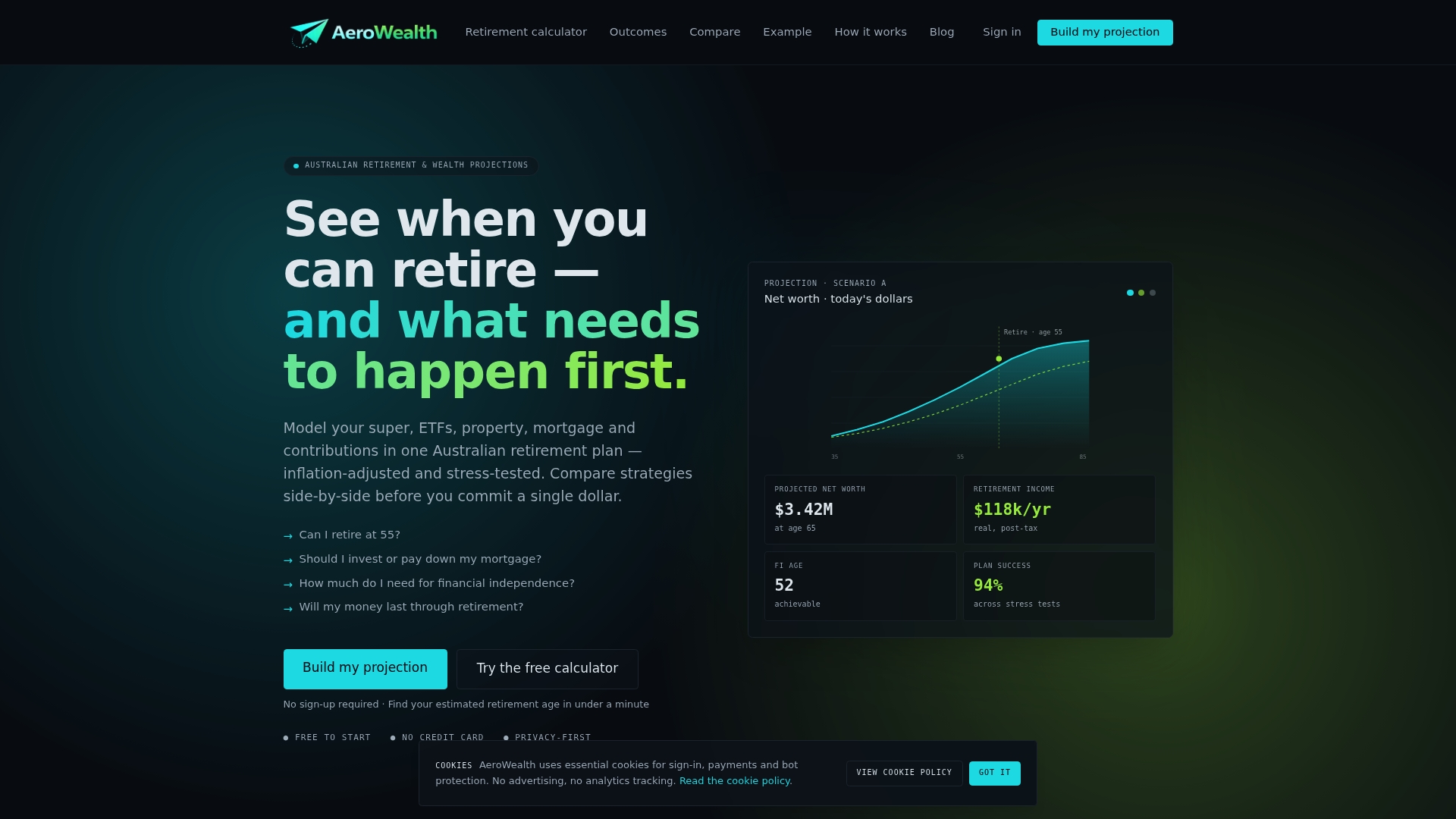
The Free plan lets you start building a scenario at no cost, while the Pro plan, at $7 AUD per month, unlocks side-by-side scenario comparisons and stress testing for more complex situations like mixed income streams or early retirement bridging.
| Plan | Price | Best suited to |
|---|---|---|
| Free | Available at no cost | A first look at how your defined benefit pension fits your retirement plan |
| Pro | $7 AUD per month | Comparing multiple scenarios, such as part-year caps or mixed pension types |
If you want a second, independent view on after-tax growth projections, Fieldvest’s wealth projection tool is another option worth a look. To start mapping your own defined benefit pension against the rest of your retirement plan, visit AeroWealth’s pricing page and choose the plan that fits how deep you want to go.
This article is general information, not a substitute for advice from a qualified financial advisor. Consult a qualified financial professional about your own circumstances before acting on anything here.
FAQ
Do I pay tax on my defined benefit pension?
It depends on the component: the tax-free component is never taxed, and the taxed element is generally non-assessable once you are 60 or over, but the untaxed element is included in your assessable income and taxed at marginal rates. A 10% offset usually applies to that untaxed portion for eligible recipients aged 60 and over.
What are the disadvantages of a defined benefit pension?
A capped defined benefit income stream generally cannot be commuted into a lump sum, which limits flexibility compared with an account-based pension. It also has a fixed special value for transfer balance cap purposes calculated at 16 times the annual entitlement, which can consume a large share of your personal transfer balance cap regardless of the pension’s actual lump sum value.
Is PSS tax-free after 60?
Not entirely.
What happens to my defined benefit when I retire?
Your fund calculates the tax-free, taxed, and untaxed components of your pension and applies PAYG withholding accordingly, with the taxed element becoming non-assessable once you turn 60. You should run the ATO defined benefit income cap tool to confirm your personal cap and check that withholding reflects your correct age and offset entitlement.